Saint Margaret of Cortona: Her Life, Faith, and Legacy
Saint Margaret of Cortona: Her Life, Faith, and Legacy
When you hear the name Saint Margaret of Cortona, you may wonder why a woman who spent years outside marriage is honored as a saint. The answer is found in the direction of her life after a profound conversion: Margaret became a Franciscan penitent, served the poor, cared for the sick, and devoted herself to prayer and reconciliation. Her story is not presented as a record of a flawless past, but as an example of how a person can turn toward God with honesty, perseverance, and practical love.
Margaret lived in thirteenth-century Tuscany, in central Italy. She was born around 1247 in Laviano and died in Cortona in 1297. Her life included poverty, grief, social shame, spiritual struggle, and years of service. Those details make her especially meaningful to people who are seeking forgiveness, beginning again, or trying to understand how faith can take shape through ordinary acts of care.
Who Saint Margaret of Cortona was and why she is remembered
Margaret was born to a farming family in Laviano, a small community in the Val di Chiana. Her mother died when Margaret was still young. Margaret later described her relationship with her stepmother as difficult, and as a young woman she left home. She entered a relationship with a nobleman from Montepulciano, commonly identified as Arsenio, and lived with him for several years.
They had a son, although they were not married. Margaret’s circumstances placed her outside the social and religious expectations of her community. Medieval accounts describe her as having enjoyed comfort and status during part of this period, but they also emphasize the insecurity of her position. She depended on a relationship that did not provide the stability or protection of marriage, and she would later look back on those years with deep regret.
The turning point came after Arsenio was killed. Accounts say that his body was discovered by a dog, which led Margaret to confront the suddenness of death and the direction of her own life. The event affected her so strongly that she returned to Laviano with her son and sought a new beginning. When her family would not receive her, she went to Cortona, where she asked for help from members of the Franciscan community.
Her conversion was not a single emotional moment followed by an easy life. Margaret spent years working through penance, prayer, and public humiliation. She asked forgiveness for her past and gradually built a life centered on God and service. Some early accounts describe severe acts of penance and intense spiritual experiences, but her enduring importance rests not only on those practices. It also rests on the concrete mercy she offered to people who were poor, sick, abandoned, or in need of protection.
Margaret became associated with the Third Order of Saint Francis, now generally called the Secular Franciscan Order. She did not become a cloistered nun. Instead, she lived among people while following a disciplined religious vocation marked by simplicity, prayer, repentance, and works of mercy. This path allowed her to remain connected to the city and to serve people directly.
A useful way to understand her story: Margaret’s sainthood is not based on having an uncomplicated past. It is associated with the sustained transformation of her life and the mercy she extended after that transformation began.
How Margaret’s conversion changed her daily life
Margaret’s decision to change was expressed through ordinary and demanding choices. She adopted a simpler way of living, gave attention to prayer, and sought spiritual guidance. Her life became less focused on personal comfort and more focused on repentance joined to responsibility. She did not treat sorrow as an end in itself; she allowed it to shape a new pattern of conduct.
She also faced the consequences of her reputation. People in Cortona knew about her earlier life, and not everyone treated her with sympathy. Medieval biographies describe moments in which she was mocked or judged. That experience is part of the reason her story continues to speak to people who feel defined by past mistakes. Margaret’s example suggests that conversion may involve accepting the truth about the past while refusing to let other people’s contempt determine the future.
Margaret’s son was part of this new life. She had to care for him while also living with limited resources. Her choice to return to a religiously serious life was therefore not an escape from practical obligations. She had to make decisions about housing, work, food, and the education and care of her child. Her spiritual growth unfolded alongside the responsibilities of parenthood and poverty.
Her prayer life became central. Sources associated with her biography describe visions, interior conversations, and mystical experiences. These accounts were recorded by her confessor, the Franciscan friar Giunta Bevegnati, who wrote a major early biography of her. Such descriptions should be read within the spiritual language of medieval Christianity. They are part of the tradition’s account of her holiness, but they do not need to be separated from the practical evidence of her faith: her care for suffering people and her commitment to the Church.
Margaret was also known for a strong devotion to Christ’s suffering and to the Eucharist. In the spirituality of her time, contemplation of the Passion encouraged humility, compassion, and a willingness to share in the burdens of others. Her prayer was not merely private comfort. It led her toward people whose pain could be seen in the streets, homes, and hospitals of Cortona.
Her life offers several recognizable signs of a serious conversion:
Honest acknowledgment: Margaret did not present her earlier decisions as harmless or pretend that regret was unnecessary.
Changed habits: She adopted a simpler lifestyle and gave greater priority to prayer and service.
Repaired relationships: She sought reconciliation with God and tried to live responsibly toward her son and neighbors.
Practical mercy: She served people who were sick, poor, or socially vulnerable.
Perseverance: She continued her vocation despite criticism, temptation, and spiritual difficulty.
These elements help explain why Margaret is often presented as a patron for people seeking repentance. Repentance in her example is more than feeling guilty. It involves truth, changed direction, and patient fidelity. Her life does not suggest that the past can be erased. It shows that the past can be placed within a larger story of healing and service.
Margaret’s work with the poor and the sick in Cortona
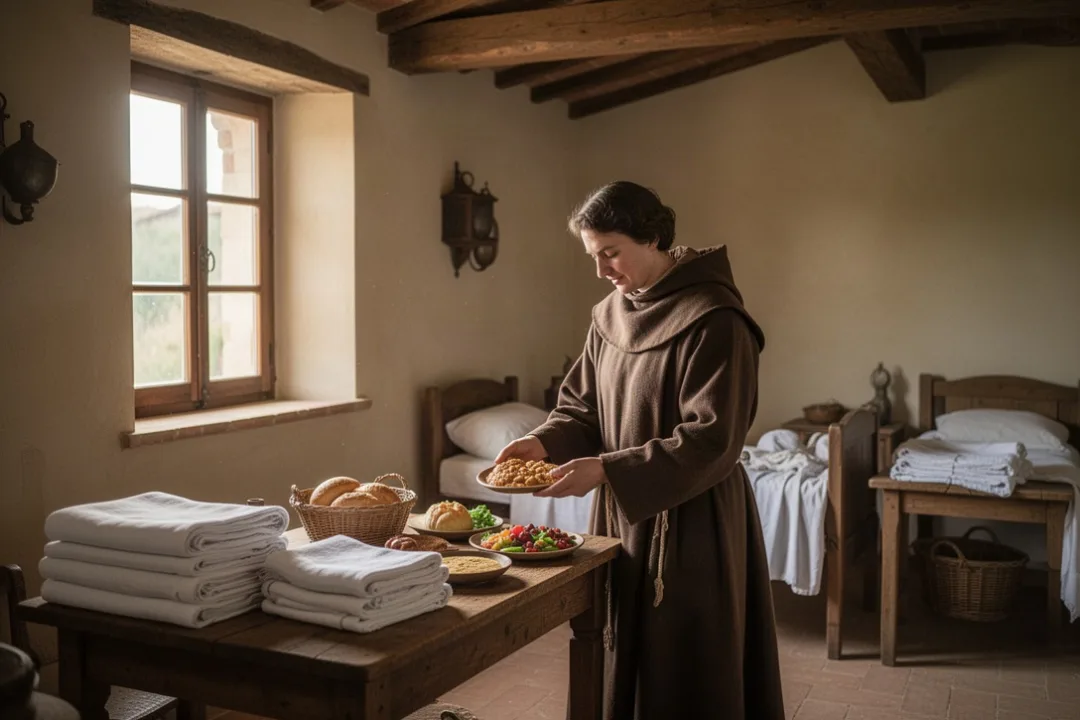
Margaret’s religious vocation became visible through her work for people who were suffering. She helped the poor and visited the sick, especially those who had few advocates. Her concern was not limited to people who were admired or respectable. She was drawn toward people whose needs made them easy to ignore.
She became closely connected with a charitable organization known as the Casa di Santa Maria della Misericordia, or House of Saint Mary of Mercy. The institution cared for sick people and supported charitable work in Cortona. Margaret’s involvement reflects the practical side of medieval lay religious life: prayer, fundraising, nursing, advocacy, and personal attention often worked together.
Care for the sick in the thirteenth century was physically demanding and medically limited by modern standards. There were no antibiotics, modern emergency departments, or reliable treatments for many infections. A person who visited the sick might provide food, clean clothing, companionship, and basic care while also helping the person prepare spiritually for death. Margaret’s ministry required patience and courage, not just charitable feelings.
She also spoke on behalf of people who were being treated unfairly. Accounts of her life portray her as concerned about the poor and critical of corruption or abuse of power. She urged people with influence to act justly. Her holiness, as remembered by the tradition, included both personal humility and a willingness to challenge behavior that harmed vulnerable people.
That combination matters. Christian charity is sometimes reduced to private generosity, but Margaret’s example includes attention to the conditions that leave people exposed. She cared for individuals while also urging authorities and wealthy people to take responsibility. Her work points toward mercy with moral clarity: compassion does not require ignoring injustice.
Margaret’s service also extended to women and children who lacked support. Because she knew poverty and social vulnerability personally, she could understand the fear of being without a secure home or respected place in the community. Her own experience did not make her withdraw from people in difficult circumstances. It helped direct her toward them.
For readers today, her charitable example can be translated into many forms of service:
Visiting or calling someone who is isolated or ill.
Supporting a food pantry, shelter, hospital ministry, or parish outreach program.
Offering practical help to a single parent or family facing financial stress.
Advocating for people who are treated unfairly because they are poor or socially excluded.
Combining material assistance with respectful listening and human companionship.
Margaret’s work also corrects a common misunderstanding about penitential saints. Her repentance did not lead her away from human need. It led her more deeply into it. The person who has received mercy is called to become merciful toward others, not self-absorbed in personal shame.
What Saint Margaret of Cortona teaches about repentance
Margaret is especially associated with people who are trying to return to faith after a serious mistake. Her story can be difficult because medieval accounts sometimes emphasize dramatic penances and intense remorse. Those details should not be used to encourage self-hatred or reckless punishment. The central point is that genuine repentance seeks healing, accountability, and a different way of living.
Her example separates healthy remorse from hopeless shame. Remorse recognizes that harm has been done and asks what must change. Shame says that a person is nothing more than the worst thing they have done. Margaret’s life, as understood by the Church, rejects that second message. She acknowledged sin while trusting that grace could create a new future.
For Catholics, her story connects naturally with the Sacrament of Reconciliation. A person who wants to return to the Church can speak with a priest, confess honestly, receive absolution, and accept guidance for making amends. Margaret’s life should not be used to replace the Church’s sacramental practice with private guilt. It points toward a fuller process of confession, forgiveness, repair, and perseverance.
Repentance may also involve practical safeguards. Someone leaving an unhealthy relationship may need housing, legal advice, counseling, or protection from violence. Someone recovering from addiction may need medical treatment and a support network. Someone who has harmed another person may need to respect boundaries and accept consequences. Spiritual language is strongest when it does not hide these real responsibilities.
For anyone carrying regret: Asking forgiveness does not require you to remain in danger or accept abuse. A responsible new beginning can include prayer, professional support, legal protection, therapy, and concrete steps to repair harm.
Margaret’s life also offers encouragement to people who feel spiritually disqualified. She was not accepted because her history was impressive. She became known for holiness through the direction she chose afterward. That does not make harmful choices insignificant, and it does not remove the effects they may have had on others. It does mean that failure does not have the final word when a person responds with truth and lasting change.
Her story can guide a personal examination of conscience:
What part of my past am I avoiding or minimizing?
Whom may my actions have affected?
What apology, restitution, or boundary is appropriate?
What support will help me avoid repeating the same pattern?
How can I turn gratitude for forgiveness into service for someone else?
These questions are not a substitute for pastoral or professional help when that help is needed. They are a way of connecting prayer with action. Margaret’s example is most useful when it moves beyond admiration and becomes a disciplined response to grace.
Saint Margaret of Cortona’s feast day, symbols, and patronage
Saint Margaret of Cortona’s feast day is observed on February 22 in the Roman Catholic tradition. Her liturgical remembrance invites the faithful to consider repentance, compassion for the poor, and the possibility of renewal. Local communities may observe her with Mass, prayer, charitable activities, or devotional gatherings connected to Cortona and Franciscan spirituality.
She is often shown wearing the clothing of a Franciscan tertiary, with a cross, a skull, or a small dog among her identifying symbols. The dog recalls the discovery of Arsenio’s body and the event that prompted her conversion. A skull represents mortality and the medieval Christian practice of remembering death. A cross points to her contemplation of Christ’s Passion and to the center of her prayer.
Artistic symbols are not meant to reduce her life to one dramatic scene. The dog may be the detail many people remember first, but Margaret’s lasting significance is broader. She was a mother, penitent, lay religious, caregiver, advocate for the poor, and mystic. Together, these dimensions show how a vocation can develop through both extraordinary experiences and repeated acts of service.
Margaret is commonly invoked as a patron of penitents and people seeking conversion. She is also associated with single mothers, the homeless, and people who are socially marginalized. Different communities may emphasize different aspects of her life, and devotional customs can vary. Her patronage is best understood through the circumstances she knew firsthand: instability, public judgment, motherhood, poverty, and the need for mercy.
She was canonized in 1728 by Pope Benedict XIII. Canonization formally recognizes a person’s holiness and permits public veneration in the Church. Long before that declaration, Margaret had been honored locally in Cortona, where her memory remained connected to churches, charitable institutions, and the Franciscan tradition.
Her body is associated with the Basilica of Saint Margaret in Cortona, a church dedicated to her memory. Pilgrims and visitors have long been drawn to places connected with her life because those places preserve more than historical information. They provide a setting for prayer about forgiveness, mercy, and a renewed vocation.
How to pray with Saint Margaret of Cortona today
You do not need to recreate Margaret’s medieval practices to learn from her. A simple prayer can begin with an honest statement: “God, help me face the truth, receive mercy, and make the changes love requires.” You might then name one person who needs care and one action you can take without seeking recognition.
People often ask Saint Margaret’s intercession when they are burdened by past choices, estranged from family, uncertain how to return to church, or concerned about someone living in poverty. Prayer can be directed to God through her intercession, asking for courage, humility, wisdom, and perseverance. In Catholic practice, saints are not worshiped; they are honored as friends of God who can pray with and for the faithful.
A parish or household could remember her feast day through a modest act of mercy. For example, you might bring supplies to a shelter, check on a homebound neighbor, arrange a meal for a struggling family, or support a medical charity. The action should be respectful and useful rather than performative. Margaret’s legacy points toward assistance that protects a person’s dignity.
Prayer with her story can also be appropriate when you are trying to forgive yourself. Self-forgiveness does not mean denying responsibility. It means accepting God’s mercy, making reasonable amends, learning from the past, and refusing to define your entire identity by an old failure. If guilt is overwhelming or connected to trauma, depression, or self-harm, a priest, therapist, doctor, or crisis service can provide support beyond private prayer.
A short devotional practice might include these steps:
Read a reliable account of Margaret’s life slowly.
Spend a few minutes naming one regret and one hope.
Ask God for the grace to make a specific, responsible change.
Pray for someone who is poor, sick, isolated, or judged by others.
Complete one concrete act of service and return to prayer without seeking praise.
Saint Margaret of Cortona remains compelling because her holiness grew through a life that was complicated and publicly known. She did not become a saint by pretending that her past had never happened. She became a model of conversion expressed through mercy: a person who faced death, returned to God, accepted a demanding new path, and used her life to care for people in need.
Frequently asked questions
When is Saint Margaret of Cortona’s feast day?
Saint Margaret of Cortona’s feast day is February 22 in the Roman Catholic tradition. Parishes and Franciscan communities may mark the day with Mass, prayer, or charitable service. The observance recalls her conversion, life as a Franciscan penitent, care for the sick and poor, and continuing witness to God’s mercy.
What is Saint Margaret of Cortona the patron saint of?
She is especially associated with penitents and people seeking conversion. Devotion to her also extends to single mothers, people experiencing homelessness, and those who feel socially rejected. These associations reflect significant parts of her life, including motherhood, poverty, public judgment, and her work among people who needed practical care.
Was Saint Margaret of Cortona a nun?
No. Margaret was not a cloistered nun. She became connected with the Franciscan Third Order, now called the Secular Franciscan Order, and lived as a lay religious woman. This vocation combined prayer, penance, simplicity, and service while allowing her to remain active in the community and care for people who were sick or poor.
How can someone pray to Saint Margaret of Cortona?
You can ask Saint Margaret to pray for you, particularly when you are seeking forgiveness, courage to change, or help for someone vulnerable. Catholics may also remember her through Scripture, confession, Mass, and an act of mercy. Prayer should be joined to responsible action, including professional or pastoral support when serious problems are involved.














Leave a Reply