Saint Rose usually refers to Saint Rose of Lima, a Peruvian Dominican laywoman and the first person born in the Americas to be canonized by the Catholic Church. She lived from 1586 to 1617 and is remembered for prayer, severe self-discipline, service to poor and sick people, and a deep devotion to Christ.
Her liturgical feast is celebrated on August 23 in the Roman Catholic calendar, while Peru traditionally honors her on August 30. Saint Rose is the patron saint of Peru and is widely honored as a patroness of the Americas, gardeners, florists, and people who work with needles and embroidery.
Saint Rose of Lima was born Isabel Flores de Oliva in Lima, Peru, in 1586. Her parents were Spanish colonists, and her family lived during a period when Lima was an important religious and political center in the Spanish colonies of South America.
According to the traditional account, a servant called her “Rose” after seeing what appeared to be a rose on the infant’s face. The name stayed with her, and she later received Rose as her confirmation name. Her life became closely associated with the flower: beauty, suffering, devotion, and a life offered to God.
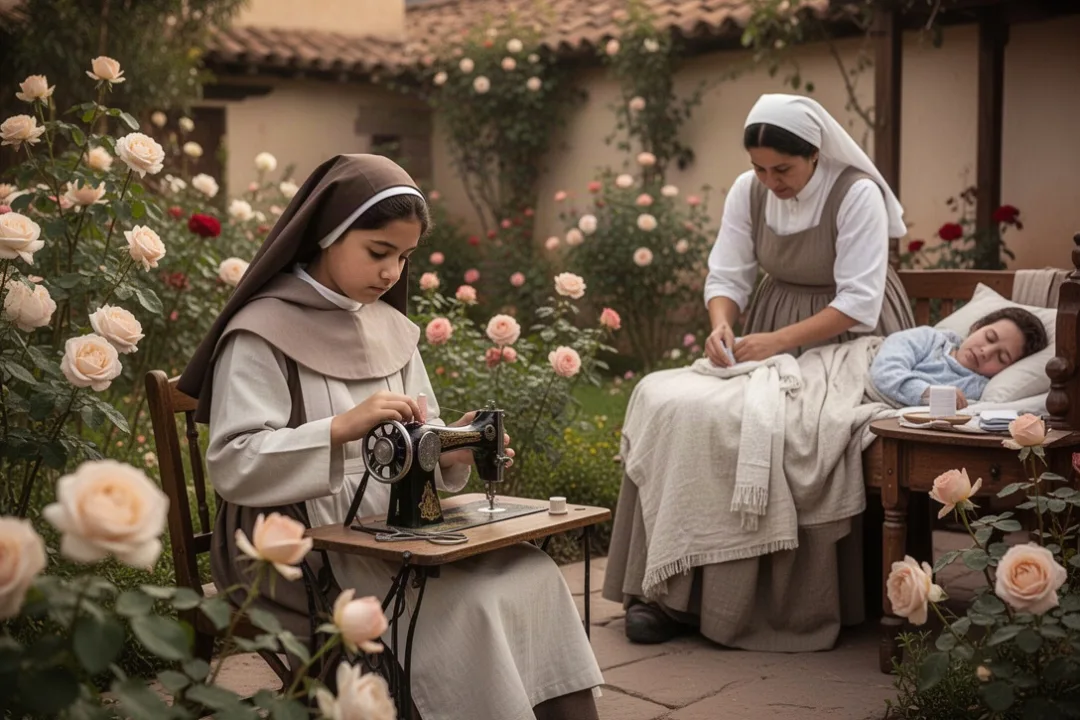
Rose did not enter a convent. Instead, she became a lay member of the Dominican Third Order, a community for people who sought to live according to Dominican spirituality while remaining in the world. She lived in a small room in her family’s garden and spent much of her time praying, working, and helping people in need.
The central answer: Saint Rose is remembered not because she withdrew from every human concern, but because she combined intense prayer with practical care for poor, sick, and vulnerable people in her community.
Saint Rose’s life in Lima, Peru
Rose grew up in a large family with limited financial resources. She learned domestic skills and used her work to contribute to the household. Accounts of her life describe her as a gifted seamstress and embroiderer, and she also sold flowers and other handmade goods to help support her family.
From childhood, Rose showed a strong desire to dedicate herself to God. Her family expected that she might marry, but she resisted marriage because she believed she had a different vocation. She chose a life of virginity, prayer, and service, even though that decision created tension at home.
She did not consider ordinary work separate from religious devotion. Sewing, gardening, caring for the sick, and earning money could all become acts of love when done for God and for other people. This combination makes her example more practical than the severe stories about her penances might first suggest.
Why Rose lived a life of penance
Saint Rose practiced forms of physical penance that reflected the spirituality of her time. Traditional biographies describe fasting, limited sleep, physical discomfort, and other acts of self-denial. She understood these practices as a way to discipline herself, pray for others, and share spiritually in Christ’s suffering.
Modern readers should approach these practices with care. Extreme self-denial is not a general instruction for Christian life, and physical harm should never be treated as a requirement for holiness. Saint Rose’s historical setting, personal vocation, and religious culture shaped her choices.
The lasting lesson is better found in her motives: she wanted to grow in compassion, resist selfishness, and remain faithful to God. Her story should not encourage unsafe imitation. A person seeking spiritual guidance should choose practices that are healthy, appropriate, and discussed with a trusted religious or medical professional when necessary.
Saint Rose’s work with poor and sick people
One of the clearest parts of Rose’s example was her care for people who had few resources. She reportedly opened a room in her family’s home to people who were ill and needed help. She cared for them directly, using the skills available to her rather than waiting for someone else to act.
Her service extended beyond people who could repay her. She assisted Indigenous people, enslaved people, and others living on the margins of colonial society, according to traditional accounts. The social world around her was marked by sharp inequality, and her ministry brought her into contact with people whom many members of her class ignored.
Rose’s compassion was connected to her prayer. She did not treat prayer as an escape from suffering. Instead, prayer led her toward hospitality, personal sacrifice, and attention to neglected neighbors. That connection remains one of the strongest reasons Catholics continue to remember her.
Rose became associated with the Dominican Third Order, also called the Third Order of Saint Dominic. This vocation allowed her to remain a laywoman while following a disciplined pattern of prayer and service. She wore a simple religious habit associated with the Dominicans and lived chastely without joining a cloistered convent.
Dominican spirituality emphasizes the search for truth, prayer, study, preaching, and works of mercy. Rose’s life expressed these ideals in a form suited to her circumstances. She did not preach from a pulpit, but her patience, care for the sick, and willingness to live simply communicated her beliefs.
Her vocation also shows that Catholic holiness can take different forms. Some saints served as priests, missionaries, or members of religious orders. Rose remained a laywoman living with her family, showing that a demanding spiritual life can exist within ordinary household responsibilities.
How to understand Saint Rose’s example step by step
Rose’s story can seem distant because of its mystical language and severe practices. These points make her example easier to understand without reducing it to a single trait:
She identified a personal vocation. Rose believed she was called to give her life to God rather than marry, and she shaped her decisions around that conviction.
She accepted ordinary responsibilities. She worked with her hands, helped her family, and used practical skills instead of treating holiness as an excuse to avoid duty.
She made prayer central. Prayer gave structure and meaning to her sacrifices, work, and concern for other people.
She served people in immediate need. Her care included the sick, the poor, and people who were socially vulnerable.
She practiced simplicity. She rejected luxury and tried to direct her time, money, and attention toward God and others.
She endured misunderstanding. Her choices were not always easy for her family or neighbors to understand, yet she continued to follow the vocation she believed she had received.
This pattern is more useful than copying individual details. A person inspired by Saint Rose might begin with regular prayer, generous service, responsible work, and a simpler approach to possessions. Those practices preserve the spirit of her example while respecting different health, family, and life circumstances.
What Saint Rose’s mystical experiences mean
Traditional accounts describe Rose as having mystical experiences, intense prayer, visions, and spiritual trials. Catholic tradition does not require every believer to have such experiences. They are understood as unusual gifts, not as proof that one person is more valuable than another.
Her experiences should also be read within the devotional language of the seventeenth century. Biographers often used symbolic descriptions to communicate a saint’s love of God, suffering, and inner struggle. The safest focus is on the virtues associated with Rose’s life: humility, perseverance, compassion, and trust.
Rose’s spirituality centered on Christ’s Passion, the Eucharist, and prayer. She saw suffering through a Christian framework and tried to respond to it with love rather than bitterness. That does not mean suffering is good in itself or that people should remain in abusive or dangerous situations.
A necessary distinction: Saint Rose’s endurance of religious penance should not be used to justify neglect, abuse, starvation, or self-harm. Christian service includes caring responsibly for your own body and seeking help when suffering becomes unsafe.
When is Saint Rose’s feast day?
August 23 is the feast day of Saint Rose of Lima in the current Roman Catholic calendar. Peru has traditionally observed her major celebration on August 30, a date that remains deeply significant in Peruvian religious and civic life.
Feast-day customs vary by place. Churches and communities may celebrate Mass, organize processions, pray a novena, decorate an image of Rose with flowers, or gather for charitable activities. In Lima, devotion to Saint Rose is especially visible, and pilgrims may visit places connected with her life.
When the feast is observed, the purpose is not simply to remember a historical figure. A feast day invites believers to honor God through the life of a saint and to consider how that person’s virtues can shape Christian practice now.
Simple ways to observe her feast day
Attend Mass or spend quiet time in prayer on August 23 or August 30.
Read a reliable biography of Saint Rose and reflect on one aspect of her service.
Place fresh flowers in a home prayer space as a reminder of her name and vocation.
Visit or call someone who is sick, isolated, or in need of practical support.
Donate food, medical supplies, or money to a trustworthy organization serving vulnerable people.
Pray for Peru, the Americas, healthcare workers, caregivers, and people living in poverty.
These observances do not need to be elaborate. A quiet act of mercy can reflect Saint Rose’s spirit more directly than an impressive display with no concern for people in need.
What Saint Rose is the patron saint of
Saint Rose of Lima is most closely associated with Peru. She is also widely honored as a patroness of the Americas and the Philippines. Different Catholic communities may name additional patronages based on local devotion and stories connected with her work.
She is commonly associated with gardeners, florists, embroiderers, and needleworkers because of the flowers, gardening, sewing, and handmade work linked with her life. She is also invoked by people who care for the sick and by those facing difficult circumstances.
Patronage does not mean that a saint replaces God or guarantees a particular result. Catholics ask saints to pray with them and for them, trusting that all grace comes from God. A prayer to Saint Rose can therefore include a request for her intercession as well as a direct request to God.
Saint Rose’s symbols and what they represent
Religious art often shows Saint Rose wearing the habit of a Dominican tertiary and holding a rose, a crucifix, or a small image of the Child Jesus. Artists may also place flowers, a crown of thorns, or a garden near her.
Roses and flowers: These recall her name, beauty, humility, and the transformation of ordinary work into an offering.
The crown of thorns: This represents her devotion to Christ’s Passion and her willingness to accept hardship for spiritual reasons.
The Dominican habit: It identifies her connection with the Dominican Third Order.
The garden: It recalls the place where she prayed, worked, and lived apart from worldly comfort.
The sick person or child: This points to her care for people who needed shelter, treatment, and compassion.
Images of Rose are often highly symbolic rather than literal portraits. Their purpose is to help worshipers remember her virtues and direct their attention toward prayer.
Saint Rose’s canonization and historical legacy
Rose died in Lima in 1617 at the age of 31. Devotion to her spread quickly after her death, especially in Peru. People remembered her holiness, service, prayer, and the suffering she had accepted during her life.
She was beatified and later canonized by Pope Clement X in 1671. Her canonization made her the first person born in the Americas to be formally recognized as a saint by the Catholic Church. This distinction gave her special importance in the religious history of Latin America.
Her legacy is both spiritual and cultural. She became a symbol of Peruvian Catholic identity and an important figure in the history of the Church in the Americas. Churches, schools, parishes, charities, and towns have been named for her in many countries.
At the same time, her story should be read with historical awareness. She lived in a colonial society marked by racial hierarchy, forced labor, poverty, and unequal access to power. Remembering her service to marginalized people can encourage honest reflection about the conditions she encountered rather than treating the past as a simple religious ideal.
Saint Rose of Lima compared with other saints named Rose
The name “Saint Rose” can refer to more than one Catholic saint. Saint Rose of Lima is the best-known answer in many Latin American and American contexts, but other saints named Rose appear in Catholic calendars and local traditions.
Saint Rose of Viterbo was an Italian Franciscan-associated mystic and preacher from the thirteenth century. She is not the same person as Saint Rose of Lima. Their countries, historical periods, religious settings, and biographies are different.
Saint Rose Philippine Duchesne was a French religious sister who served as a missionary in the United States during the nineteenth century. She belonged to the Society of the Sacred Heart and worked in education and mission communities, making her another distinct saint from Rose of Lima.
When searching for prayers, feast-day information, artwork, or a parish dedication, check the full name. “Saint Rose of Lima” identifies the Peruvian saint and avoids confusion with Rose of Viterbo, Rose Philippine Duchesne, or other local figures.
How to pray with Saint Rose of Lima
You do not need a long formula to ask for Saint Rose’s intercession. Begin by addressing God, mention the need you are carrying, and ask Saint Rose to pray with you. You can also reflect on one part of her life, such as care for the sick or courage in following a vocation.
A short prayer might ask God to help you serve people with humility, remain faithful during hardship, and use your work for the good of others through the intercession of Saint Rose. You could include a specific person who is ill, a family facing poverty, or a community affected by injustice.
For a longer devotion, some people pray a novena over nine days before her feast. A novena may include a passage from Scripture by reference, a reflection on Rose’s life, prayers for a specific need, and an act of charity. The form can be simple and adapted to your tradition.
“Where there is no love, put love, and you will draw out love.”
This saying is often associated with Saint John of the Cross rather than Saint Rose, so it should not be presented as a verified quotation from her. The principle, however, fits a useful way of remembering Rose: respond to coldness and neglect by practicing concrete love, while still maintaining healthy boundaries and seeking justice.
What Saint Rose can mean for people today
Saint Rose’s life speaks most clearly to people who want faith to become visible in daily choices. Her example connects private prayer with public compassion. She worked, cared for people, accepted responsibility, and tried to live consistently with her beliefs.
Her story can also raise difficult questions. How do you respond when family members do not understand your vocation? Can you serve without seeking recognition? Do your religious practices make you more patient and generous, or only more focused on yourself?
These questions apply beyond Catholic devotion. Someone may admire Rose’s commitment to the poor, her care for the sick, or her disciplined life without sharing every element of her theology. Her historical example invites serious reflection on how conviction, work, and concern for others can belong together.
The most responsible way to honor Saint Rose is not to romanticize pain. It is to follow the values at the heart of her life: compassion without discrimination, prayer joined to action, simplicity without neglect, and courage guided by love.
Questions to ask when choosing a Saint Rose prayer or medal
If you are choosing a devotional item, learn which Saint Rose it represents. A medal or image should identify her as Rose of Lima if that is the saint you intend to honor. Look for the Dominican habit, roses, or a Peruvian connection, while remembering that artistic details can vary.
Choose a prayer that matches your purpose. You might seek intercession for illness, poverty, family concerns, a vocation, or strength to serve others. The object itself is not a magical protection; its value lies in helping you remember God, the saint’s example, and your responsibility toward other people.
A parish, Catholic bookstore, or reputable religious publisher can usually help identify the saint and provide an established prayer. If a prayer makes promises of guaranteed wealth, instant healing, or supernatural results, treat it cautiously and ask a priest or another trusted Catholic leader for guidance.
Frequently asked questions
Is Saint Rose the same person as Saint Rose of Lima?
Usually, yes. In Catholic contexts, “Saint Rose” most often means Saint Rose of Lima, the Peruvian Dominican tertiary who lived from 1586 to 1617. However, the name can also refer to Saint Rose of Viterbo or Saint Rose Philippine Duchesne. Use the full name when you need to identify the correct saint for a feast day, prayer, medal, or church dedication.
Why did Saint Rose of Lima live such a strict life?
Rose believed that prayer, self-denial, and sacrifice helped her grow in love for God and solidarity with suffering people. Her practices reflected the religious culture of her era and her personal vocation. They should not be copied in harmful ways. Modern devotion focuses more safely on her compassion, service, perseverance, and disciplined prayer.
What do people pray to Saint Rose for?
People commonly ask Saint Rose’s intercession for Peru, the Americas, people who are sick or poor, caregivers, family needs, and strength during hardship. She is also associated with gardeners, florists, embroiderers, and needleworkers. Catholics understand such prayer as asking the saint to pray with them, not as treating her as a replacement for God.
What is Saint Rose of Lima’s feast day?
Her feast day is August 23 in the Roman Catholic calendar. Peru traditionally celebrates her major observance on August 30, a date that remains especially important there. Churches may mark the occasion with Mass, flowers, processions, charitable service, or prayers asking for her intercession.















Leave a Reply