Martin de Porres was a Peruvian Dominican brother remembered for serving the poor, sick, and abandoned with extraordinary humility.
Born in Lima in 1579, he lived during a period when colonial Peru was deeply divided by race, class, and legal status. Martin faced those divisions personally as the son of a Spanish nobleman and a formerly enslaved woman of African descent. Instead of allowing prejudice to define his life, he made charity, prayer, medical care, and practical service the center of his vocation.
Martin de Porres is honored by the Catholic Church as a saint of service and compassion. He spent most of his life at the Dominican Convent of the Holy Rosary in Lima, where he worked as a barber, nurse, pharmacist, administrator, and caretaker. His responsibilities reached far beyond the convent. He regularly helped people who had nowhere else to turn.
His story matters for several reasons. Martin challenged racial prejudice through the dignity of his work, demonstrated that ordinary duties could become a serious spiritual vocation, and used his position to seek food, medicine, shelter, and education for vulnerable people. He is also remembered for his care of animals, which reflected his broad understanding of responsibility toward every living creature.
Many Catholics ask for his intercession when facing illness, poverty, discrimination, or difficult work in service of others. He is especially associated with racial harmony, social justice, public health, barbers, and animal welfare. His life speaks to people who want faith to produce visible acts of mercy rather than remain only a private belief.
The central idea: Martin de Porres did not separate prayer from service. For him, caring for a sick person, feeding a hungry family, treating an animal gently, and praying were connected expressions of love.
Martin de Porres’s early life in colonial Peru
Martin was born in Lima, Peru, on December 9, 1579. His mother, Ana Velázquez, was a woman of African descent who had been born in Panama. His father, Juan de Porres, was a Spanish nobleman who held a government position connected with the colonial administration.
Martin’s parents were not married. His father initially acknowledged him, but the family’s circumstances were unstable, and Juan later spent long periods away from Lima. Martin grew up with his younger sister, Juana, under financial strain. His mother worked to support the children, and Martin experienced the insecurity and discrimination common to people of mixed African and European ancestry in colonial society.
Historical records describe Martin as a child who showed an early concern for people in need. His family lived in a neighborhood where poverty was visible, and he became familiar with illness, hunger, and unequal treatment. Those experiences likely shaped the compassion that later became a defining part of his religious life.
As a young boy, Martin was placed in training with a local barber. In the colonial world, a barber often performed much more than hair cutting. Barber-surgeons commonly provided basic medical treatment, wound care, tooth extraction, and other practical services. Martin learned skills that later made him valuable to the Dominican community and to the wider population of Lima.
How Martin entered Dominican religious life
Martin’s path into the Dominican Order developed gradually. He first served at the Dominican priory as a donado, a person who offered labor and service to the community without immediately becoming a full religious brother. His mixed ancestry and birth outside marriage affected the status available to him within colonial society.
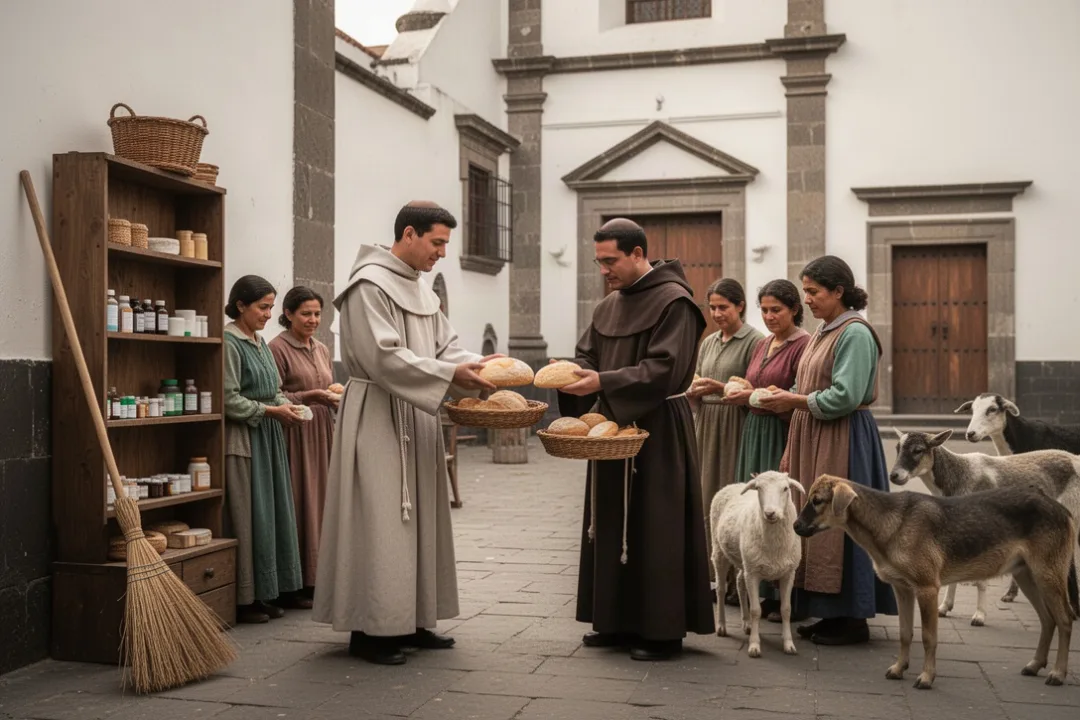
He began with humble tasks, including cleaning, carrying supplies, and assisting with household work. Rather than treating these duties as beneath him, Martin approached them as a way to serve God and his neighbors. His skill with medicine soon became clear, and he began caring for members of the community and people who came to the convent seeking help.
Over time, the Dominican community recognized his character and abilities. Martin eventually made religious profession as a lay brother. He did not become a priest, and his vocation was not built around preaching from a pulpit. His ministry took place through hands-on care, disciplined prayer, and personal attention.
His life illustrates an important distinction within Catholic religious service. A person does not need an official teaching role to have a substantial spiritual influence. Martin’s authority came from consistency: he performed difficult work, treated people with respect, and gave his time to those who were easy for society to overlook.
Martin became known for taking responsibility wherever the need was greatest. His duties expanded well beyond the work he had originally been assigned. Accounts of his life describe a daily routine that combined physical labor, medical knowledge, administration, prayer, and direct aid.
His main areas of service included:
Medical care: He treated injuries and illness using the knowledge available to him as a barber-surgeon and pharmacist.
Care for the sick: He helped friars, workers, neighbors, and people who came to the convent without money for treatment.
Food and clothing: He collected and distributed necessities to poor families.
Household management: He organized supplies and helped maintain the Dominican community.
Support for children: He was associated with efforts to provide children with food, care, and a safer place to live.
Care for animals: He fed and sheltered animals, including those that had been abandoned or mistreated.
Martin’s medical work was particularly significant because professional care was inaccessible to many poor people. He did not limit help to members of his own religious community. His concern crossed boundaries of race, social position, religion, and income.
Tradition says that he was able to find food and medicine even when resources were scarce. Some stories describe him quietly persuading wealthy people to donate or organizing supplies in ways that kept the poor from being publicly humiliated. These accounts should be understood within the devotional tradition surrounding him, while his documented pattern of service remains the foundation of his reputation.
A practical breakdown of Martin de Porres’s spirituality
Martin’s spirituality can be understood through several recurring principles. They help explain why his example continues to appeal to people working in hospitals, shelters, schools, parishes, and community organizations.
Begin with the person in front of you. Martin responded to concrete needs rather than waiting for ideal conditions. A hungry child, injured worker, or sick neighbor required immediate attention.
Use the skills you already have. His knowledge of barbering, medicine, and household management became part of his religious vocation. He did not dismiss practical abilities as separate from spiritual life.
Serve without ranking people by status. Martin assisted people who were poor, sick, socially excluded, or otherwise ignored. He treated service as a matter of human dignity.
Join action with prayer. His work was not presented as mere charity driven by personal preference. Prayer gave his service direction, endurance, and a concern for the whole person.
Protect the vulnerable. His attention to children, animals, and the ill shows a consistent concern for those unable to defend their own interests.
Remain humble about recognition. Martin accepted demanding work without making public attention the measure of its value.
This pattern does not require you to copy the exact circumstances of a religious brother in seventeenth-century Lima. It offers a way to examine your own responsibilities. A nurse, teacher, caregiver, volunteer, tradesperson, or family member can apply the same principle by pairing competence with compassion.
Martin de Porres and racial prejudice
Martin lived in a society organized by racial categories and colonial privilege. People of African descent and people of mixed ancestry faced restrictions and prejudice in many areas of life. His own birth, family background, and position within the Dominican community were affected by those attitudes.
His response was not passive acceptance of injustice. He insisted through his conduct that a person’s value could not be measured by ancestry or social rank. The people he served were not treated as anonymous recipients of aid. His work expressed the conviction that every person deserves care and respect.
Martin’s example should not be used to suggest that individual kindness solved the larger injustices of colonial society. Personal charity and structural justice are related but not identical. His life shows the importance of immediate mercy, while the conditions around him also remind modern readers to question systems that create poverty, exclusion, and unequal access to care.
For this reason, Martin is often invoked as a patron of racial harmony and interracial understanding. His legacy can encourage people to reject prejudice, examine inherited assumptions, and build communities where service is not limited by race or social class.
A useful caution: Martin’s humility should not be interpreted as approval of discrimination. His life can inspire personal service while also challenging the social attitudes that make some people invisible or leave them without basic care.
Why animals are part of Martin de Porres’s legacy
Stories about Martin often include dogs, cats, birds, and other animals. He is traditionally portrayed feeding animals, caring for those that were injured, and finding ways for animals to live safely together. The familiar image of Martin with a broom and animals reflects both his humble work and his compassion.
These stories have helped make him a beloved figure for animal lovers and people who work in shelters or veterinary care. They also express a broader principle: kindness does not become less valuable when its recipient cannot repay you or explain what is wrong.
Some stories about Martin’s relationship with animals include extraordinary elements, such as animals responding to his commands in unusual ways. These accounts belong to devotional tradition and should be distinguished from the historical record. Their purpose is generally to illustrate peace, care, and harmony in creation, rather than provide a scientific description.
People who honor Martin today may express that concern through practical action: adopting responsibly, supporting shelters, providing veterinary care, avoiding cruelty, or treating working animals humanely. Such actions reflect the spirit of his example more meaningfully than simply repeating a charming story about him.
Miracles and stories associated with Martin de Porres
Martin’s biography includes reports of healing, extraordinary knowledge, appearances in distant places, and other supernatural events. Some accounts say he was seen in more than one location, helped people despite severe shortages, or had unusual insight into another person’s condition.
These stories became part of the devotion surrounding him, especially after his death. Catholic tradition recognizes that saints’ lives often include accounts passed down by witnesses, communities, and later biographers. Not every popular story has the same historical certainty, and a careful account distinguishes between documented service and devotional tradition.
The Church’s recognition of Martin’s holiness does not depend on treating every story in exactly the same way. His canonization followed an investigation of his life, reputation for holiness, and miracles attributed to his intercession. For many believers, the stories are meaningful because they point toward his trust in God and his concern for people in distress.
A balanced view allows both faith and historical care. You can appreciate the spiritual meaning of a healing story while acknowledging that records from earlier centuries may be incomplete. Martin’s daily work with the sick and poor is firmly central to his legacy regardless of how one evaluates individual supernatural accounts.
Martin de Porres’s death and recognition as a saint
Martin died in Lima on November 3, 1639. He was widely respected by the Dominican community and by people throughout the city. His death was followed by strong public devotion, and many people regarded him as a holy person long before the Church formally canonized him.
He was beatified by Pope Gregory XVI in 1837. More than a century later, Pope John XXIII canonized him in 1962. His feast day is observed on November 3, the anniversary traditionally associated with his death.
Martin is widely described as the first Black saint of the Americas to be canonized by the Catholic Church. His recognition has particular meaning for Catholics of African descent and for communities that have seen themselves underrepresented in religious institutions. It also highlights the importance of recognizing holiness expressed through labor, caregiving, and service rather than only through formal leadership.
His canonization took place during a period when questions of civil rights, racial equality, and the dignity of marginalized communities were receiving renewed attention in many parts of the world. His life therefore became a source of encouragement for people seeking a faith that directly confronts prejudice and social exclusion.
Symbols commonly associated with Martin de Porres
Art and devotional images often show Martin in the habit of a Dominican lay brother. Several objects and animals are connected with his story because they represent the work he performed and the values he embodied.
A broom: This represents humble household work and the dignity of serving without seeking status.
A cross or rosary: These symbolize his prayerful life and his reliance on Christian devotion.
Medical tools or a bowl: These refer to his work caring for the sick and preparing remedies.
Animals: Dogs, cats, mice, and birds recall his concern for creatures in need.
Food or bread: These images represent his efforts to feed poor people and organize practical assistance.
The Dominican habit: This identifies his connection with the Order of Preachers and his life within the convent.
Symbols are useful when they lead to a deeper understanding of a person’s actions. The broom, for example, is not merely a decorative object. It recalls the way Martin transformed an ordinary task into an expression of humility and care.
How people honor Martin de Porres today
Parishes, schools, hospitals, nursing facilities, and charitable organizations around the world bear Martin’s name. Communities may celebrate his feast day with prayer services, food drives, health clinics, animal blessings, or programs supporting people experiencing poverty.
Devotion to Martin can include asking for his intercession, reading accounts of his life, or displaying an image of him. For others, the most appropriate way to honor him is through a practical act of service. Donating medicine, helping a neighbor reach a clinic, volunteering at a shelter, or supporting educational opportunities can connect remembrance with action.
A personal observance might follow a simple pattern:
Identify a real need in your family, workplace, parish, or neighborhood.
Offer a short prayer asking for compassion, wisdom, and courage.
Use a specific skill to help rather than offering only general concern.
Protect the dignity of the person receiving help by avoiding unnecessary publicity or judgment.
Continue the relationship when possible instead of treating service as a one-time gesture.
Those steps reflect Martin’s approach more closely than grand gestures do. His contribution was built from repeated acts of attention, competence, and mercy.
What Martin de Porres can teach caregivers and service workers
Martin’s example has particular relevance for people who provide care. Nurses, home health aides, social workers, teachers, shelter staff, barbers, sanitation workers, and family caregivers often perform necessary labor that receives little public recognition. Martin’s life affirms that this work has moral and spiritual importance.
He also offers a realistic lesson about service: compassion works best when paired with skill. Good intentions do not replace training, safe procedures, medical expertise, or respect for professional boundaries. Martin used the knowledge available to him, while modern caregivers should use current standards and seek qualified help when a situation exceeds their ability.
His example also encourages caregivers to notice the person behind the problem. A patient is not only a diagnosis, a hungry neighbor is not only a case, and an abandoned animal is not only an inconvenience. Care begins when practical assistance is joined to attention, patience, and respect.
At the same time, Martin’s life should not be used to pressure people into exhausting themselves. Sustainable service includes rest, cooperation, training, and asking for help. The goal is not to imitate every hardship he endured but to practice generous responsibility in ways that are wise and possible.
Why Martin de Porres remains relevant
Martin’s historical setting was different from modern life, but the needs he addressed remain familiar. Communities still face poverty, unequal health care, racial prejudice, homelessness, food insecurity, loneliness, and neglect of animals. His example gives these concerns a human face and shows how faith can respond through organized, hands-on care.
He also offers a corrective to narrow ideas about importance. Martin was not known for political office, wealth, public power, or academic fame. His influence grew from work that many people might consider ordinary: cleaning, treating wounds, preparing food, organizing supplies, and accompanying people who were suffering.
Remembering him can therefore change how you view both service and status. A community depends on many forms of labor, including work that happens quietly and is rarely celebrated. Martin de Porres is remembered because he showed that humility can be active, skilled, and socially meaningful.
His legacy ultimately joins three concerns: closeness to God, care for human beings, and respect for creation. Whether someone approaches him as a Catholic saint, a historical figure, or an example of compassionate leadership, the central lesson remains clear: a life devoted to the vulnerable can cross racial and social boundaries and continue influencing people centuries later.
Frequently asked questions
What is Martin de Porres best known for?
Martin de Porres is best known for caring for poor and sick people in Lima, Peru, while serving as a Dominican lay brother. He used his training as a barber-surgeon and pharmacist to provide practical medical assistance. He is also remembered for supporting children, helping families in need, caring for animals, and promoting a vision of human dignity that crossed racial and social divisions.
When is the feast day of Martin de Porres?
The Catholic Church celebrates Martin de Porres’s feast day on November 3. That date is associated with the anniversary of his death in Lima in 1639. Parishes and organizations honoring him may mark the day with prayer, community service, food distribution, health outreach, educational programs, or activities supporting animal welfare.
What is Martin de Porres the patron saint of?
Martin de Porres is commonly associated with racial harmony, interracial understanding, public health, barbers, and people who serve the poor. He is also honored by many people involved in animal welfare. Patronage lists can vary by community, but these connections all reflect major parts of his life: medical care, humble labor, compassion, and opposition to prejudice.
How can someone honor Martin de Porres?
You can honor Martin by helping someone with a practical need, supporting a food pantry or clinic, volunteering with an animal shelter, or assisting a person who faces discrimination or poverty. A prayer asking for his intercession can accompany the action, but service should preserve the other person’s dignity and avoid treating charity as a way to gain attention.














Leave a Reply