When you hear the name Peter Claver, you may be wondering why a seventeenth-century priest is still remembered today. The short answer is that Claver devoted most of his adult life to enslaved Africans arriving in Cartagena, a major port in Spanish America, and treated people whom society reduced to property as human beings deserving care, dignity, and Christian fellowship.
His work did not end slavery, and it took place within a deeply unjust system. That fact matters when evaluating his legacy. Peter Claver offered direct service to people suffering under slavery, challenged some forms of cruelty through his ministry, and organized practical assistance. At the same time, his approach belonged to his historical period and did not amount to a complete political program for abolishing the institution.
Remembered by the Catholic Church as Saint Peter Claver, he was a Spanish Jesuit who lived from 1580 to 1654. He spent nearly four decades in Cartagena, where he welcomed newly arrived Africans, visited enslaved people, cared for the sick, taught Christian faith, and defended their basic humanity as far as his position allowed.
The central point: Peter Claver’s significance lies in sustained, personal service to enslaved people, not in a claim that he solved the injustice of slavery. His life is best understood alongside the suffering of the people he served and the limits of the colonial world around him.
Peter Claver was born in Verdú, Spain, in 1580. He studied before entering the Society of Jesus, commonly called the Jesuits, and eventually traveled to the Spanish colony of New Granada. Cartagena, now Cartagena de Indias in Colombia, became the setting for his ministry.
During Claver’s lifetime, Cartagena was an important Atlantic port. Ships carrying captive Africans arrived there as part of the transatlantic slave trade. Many people had endured capture, forced removal, confinement, hunger, disease, and brutal treatment before reaching the port. Some died during the voyage; others arrived weak and traumatized.
Claver served in this environment from the early seventeenth century until his death. He was ordained a priest in Cartagena in 1616. Rather than limiting his work to church services for colonial residents, he made the people arriving in slave ships a central focus of his ministry.
He is often associated with the statement that he wanted to be “a slave of the slaves.” That phrase expresses his desire to place himself at the service of people held in bondage. It should not be confused with a claim that slavery was acceptable. His ministry was directed toward those who were enslaved, not toward preserving the institution as a moral good.
What Peter Claver did in Cartagena
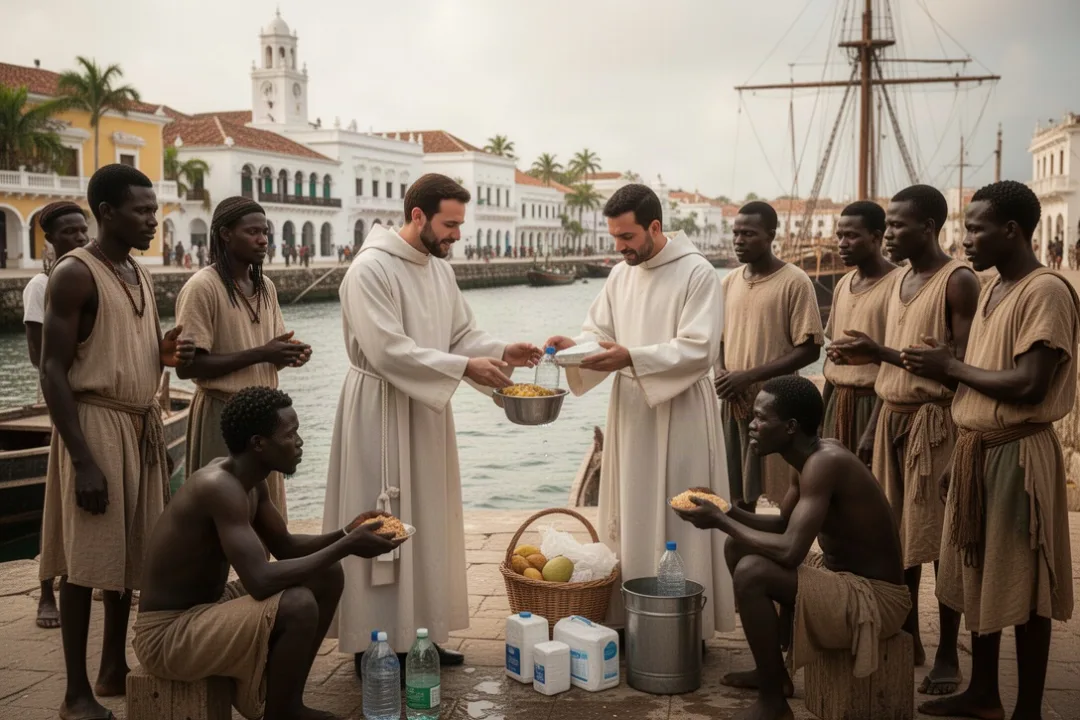
Claver’s ministry combined immediate relief, religious instruction, advocacy, and long-term pastoral care. He worked with interpreters because the people brought to Cartagena spoke many different languages. He also relied on practical cooperation from others who could help him reach people in crowded and dangerous conditions.
His work commonly included the following activities:
Meeting arriving ships: He went to the places where enslaved Africans were held after arrival, bringing food, water, medicine, clothing, and other necessities when possible.
Caring for the sick: He visited people suffering from disease, injuries, malnutrition, and the effects of the voyage.
Offering religious instruction: He taught Christian beliefs through interpreters and prepared people for baptism and other sacraments according to the practices of his Church.
Visiting plantations and households: He continued to seek out enslaved people after they had been sold or assigned to labor.
Pressing for humane treatment: He confronted owners and officials when he believed enslaved people were being neglected or abused.
Maintaining relationships: He returned to people he had met instead of treating a single encounter as the end of his responsibility.
These tasks required more than public preaching. Claver had to enter places many respectable colonists avoided, confront the physical consequences of exploitation, and communicate across language and cultural barriers. His ministry was often exhausting and involved exposure to serious illness.
How Peter Claver responded to newly arrived Africans
The first hours and days after arrival were especially dangerous. People had been separated from families and communities, deprived of freedom, and transported under inhuman conditions. They might be confined in holding areas while buyers, officials, and ship personnel handled them as commercial cargo.
Claver responded by trying to meet concrete needs first. Accounts of his ministry describe him bringing food and drink, using interpreters, and tending to people who were ill. This approach communicated a claim that the slave trade denied: each person had a body that mattered, a name and identity, and a need for compassionate treatment.
He also tried to establish trust. A person who had just survived forced transportation might reasonably distrust representatives of European institutions, especially Christian institutions connected to colonial power. Claver’s repeated visits and willingness to remain among the sick were part of how he expressed solidarity.
His service should not be romanticized. Food or medicine could ease immediate suffering, but it could not restore freedom or undo family separation. Baptism and religious teaching, when offered within a coercive colonial setting, also raise serious questions about how freely people could respond. A careful account recognizes both the compassion in his actions and the unequal conditions surrounding them.
How his religious mission shaped his daily work
Peter Claver was a Jesuit priest, so his service was grounded in Catholic beliefs about the human person, sin, salvation, and the duties of Christian charity. He believed that enslaved Africans were fully capable of receiving the sacraments and belonging to the Christian community. That position challenged racist assumptions common in the colonial world.
Claver’s religious teaching was not separate from his practical care. He linked spiritual ministry with bodily assistance, visiting people in distress rather than treating them as an audience for sermons alone. He taught through interpreters and used images or other accessible methods because communication across languages was essential.
For the people he served, religious instruction could carry different meanings from those intended by European clergy. Some may have embraced Christianity, while others may have responded under pressure or adapted Christian practices alongside existing beliefs. Historical evidence cannot reduce the experiences of all enslaved people to one pattern.
Claver’s commitment to baptism and sacramental ministry also reveals a tension in his legacy. He affirmed the spiritual equality of people whom colonial society treated as inferior, but he did not dismantle the legal and economic structures that kept them enslaved. His work was therefore both a meaningful challenge to dehumanization and an incomplete response to systemic injustice.
What his ministry reveals about slavery in Cartagena
Understanding Peter Claver requires understanding the institution around him. Slavery in Spanish America was not a series of isolated personal abuses. It was supported by laws, commercial networks, colonial officials, landowners, ship operators, and buyers. Enslaved people were forced to labor in households, workshops, farms, mines, and other settings.
Cartagena’s role in the Atlantic slave trade placed Claver close to the point where violence became visible. He saw people immediately after the ocean crossing, before colonial society could hide the human cost behind contracts, marketplaces, and routine labor. His actions confronted that hidden distance by bringing attention to the individuals affected.
Some accounts describe him criticizing owners who failed to provide sufficient food, clothing, shelter, or medical attention. Such interventions could improve a person’s treatment, but they usually worked within assumptions that slavery itself would continue. Advocating for better conditions is not the same as calling for emancipation.
That distinction helps prevent two common errors. One error portrays Claver as irrelevant because he did not lead a modern abolitionist movement. The other treats him as a complete opponent of slavery in the later political sense. The historical record supports a more precise view: he served enslaved people directly and defended their human and spiritual dignity, while operating within and sometimes accepting the limits of his society.
Read the legacy in context: Compassionate service can be morally significant without being sufficient. Peter Claver’s example invites admiration for his care and honest criticism of the colonial system that made such care necessary.
Peter Claver’s relationship with enslaved people
One of the strongest features of Claver’s work was its sustained character. He did not only meet newly arrived people and then return to a comfortable religious routine. He sought out enslaved communities after their arrival, including people working in homes and rural settings.
His ministry involved repeated contact with individuals and groups. He tried to teach, visit, hear concerns, provide assistance, and prepare people for religious rites. These efforts depended on interpreters and on networks of people who could identify where enslaved communities were located.
Claver also recognized that enslaved people formed communities with their own relationships, memories, and cultural identities. They were not simply anonymous recipients of charity. His contact with them gave him opportunities to learn about their conditions and to respond to particular needs.
Still, the surviving accounts were often written by European religious observers rather than by the enslaved people themselves. That creates a source problem. We know a great deal about how Claver’s admirers described his actions, but much less about how every person he met understood him. Responsible history leaves room for those missing voices.
Why Peter Claver is called the patron of enslaved people
The title associated with Claver reflects the central focus of his ministry. In Catholic tradition, a patron saint is a saint connected with a particular place, group, occupation, or need and invoked as an example or intercessor. Claver’s association with enslaved people comes from his decades of service to Africans held in bondage in Cartagena.
He is also associated with Colombia, race relations, and people working to oppose racism. These connections developed because his life placed him in direct contact with a racialized system of exploitation and because he insisted that Black people belonged within the Church’s pastoral concern.
The title does not mean he represented enslaved people in every modern sense. It does not erase the fact that he was a European priest working within colonial institutions. Instead, it identifies the people toward whom his ministry was directed and the moral issue his life continues to raise.
How Peter Claver became a saint
Claver died in Cartagena in 1654 after years of service. Reports of his ministry circulated among people who had known him, and his reputation for holiness developed within the Catholic community. The Church later formally recognized him as a saint.
He was canonized in 1888 by Pope Leo XIII. His feast day is observed on September 9, the day after the anniversary of his death. Catholic communities may remember him through liturgy, prayer, education, service projects, and work related to racial justice.
Canonization is not a historical claim that every action or assumption associated with a person should be copied without examination. It is a religious recognition of holiness according to Catholic standards. For many Catholics, Claver’s canonization highlights his charity, perseverance, humility, and attention to people society treated as disposable.
For readers outside the Catholic tradition, his canonization can still be understood as evidence of how the Church interpreted his life. It also creates an opportunity to ask how religious institutions respond when they are embedded in unjust political and economic systems.
Questions his legacy raises today
Peter Claver’s life is often presented as an example of individual compassion. That lesson has value, but it becomes incomplete if it focuses only on personal kindness. The people he served were harmed by a system, so moral response must include both care for individuals and attention to structures.
His legacy can prompt several questions:
How do you treat people whom a society has labeled inferior, foreign, disposable, or dangerous?
Do you respond to immediate suffering while also examining the policies and institutions causing it?
Can charitable work preserve dignity if the people receiving help have no voice in decisions affecting them?
How should religious communities confront injustice when their own institutions are connected to the surrounding society?
What sources are missing when history is told mainly through the records of people with authority?
These questions apply to modern work involving migrants, prisoners, victims of trafficking, people experiencing homelessness, and communities facing racial discrimination. The comparison should be made carefully; present-day situations are not identical to colonial slavery. The broader principle, however, remains relevant: service is stronger when it listens to affected people and addresses the conditions that produce harm.
What people can learn from Peter Claver without idealizing him
A balanced reading of Claver includes several lessons. First, meaningful service may require going where suffering is concentrated rather than waiting for people to come to a safe or respectable setting. Claver’s willingness to visit ships, holding areas, sickrooms, plantations, and households made his ministry physically present.
Second, effective care often depends on practical details. Food, clean clothing, medicine, translation, transportation, and repeated visits may appear ordinary, but they can determine whether help is real. Claver’s example is not only about religious conviction; it is also about organizing assistance around actual needs.
Third, language and trust matter. Working through interpreters was necessary, but interpretation is not the same as full understanding. Modern service providers can learn from this by using qualified interpreters, respecting cultural differences, and allowing people receiving assistance to explain their own priorities.
Fourth, individuals cannot substitute for structural change. Claver could comfort, teach, nurse, and protest, but his ministry did not abolish the slave trade or colonial slavery. His example therefore works best when paired with support for laws, institutions, and movements that protect freedom and equal rights.
Finally, historical admiration should include moral clarity. It is possible to honor Claver’s courage and dedication while naming the limits of his response. Doing so does not diminish the suffering of those he served; it keeps their experience at the center.
Ways to study Peter Claver responsibly
If you are researching Peter Claver for school, church, or personal study, begin with a basic timeline and then read beyond devotional biographies. Look for historical works on Cartagena, the transatlantic slave trade, Jesuit missions, African diaspora communities, and the experiences of enslaved people in Spanish America.
Separate fact from devotional language. Religious biographies may use symbolic descriptions of holiness that are meaningful to believers but require careful historical interpretation.
Identify who wrote each source. Ask whether the account came from Claver, another priest, a colonial official, an enslaved person, or a later biographer.
Place every action in its system. A visit to a sick person matters, but so does the legal and commercial structure that caused the person’s suffering.
Look for African voices and perspectives. Do not allow the story of a European minister to replace the histories of the people he served.
Compare religious and secular interpretations. Catholic accounts may emphasize sanctity, while historians may focus on colonial power, race, labor, and institutional limits.
Ask what changed and what did not. Individual acts of care can affect lives even when they leave larger systems intact.
Studying Claver this way produces a fuller picture than either praise or dismissal alone. It shows a man who chose demanding service, a community subjected to extreme violence, and a colonial order that continued despite his efforts.
Peter Claver’s place in the history of Christian service
Claver belongs to a long Christian tradition of caring for the sick, feeding the hungry, visiting prisoners, and serving marginalized people. His distinctive setting was the Atlantic slave trade and the Spanish colonial world. He brought that tradition into direct contact with people whom many colonists treated as commodities.
His life also shows how service can be both courageous and constrained. He crossed boundaries of race and social status that many people around him accepted. Yet he remained a priest within the institutions of colonial society and did not fully challenge every structure that sustained enslavement.
That complexity makes his story useful rather than useless. Historical figures do not need to fit a simple pattern of hero or villain before their choices can be examined. Peter Claver’s ministry can be honored for its persistence, personal risk, and recognition of human dignity, while the voices and agency of enslaved Africans remain central to the story.
His name ultimately points beyond one priest. It points to the people who survived forced migration, captivity, illness, separation, and exploitation. Any account that remembers Peter Claver well must remember them first—not as background to his holiness, but as human beings whose suffering demanded a response.
Frequently asked questions
Was Peter Claver an abolitionist?
Not in the modern political sense. Peter Claver served enslaved people, protested mistreatment, and affirmed their spiritual and human dignity, but he did not lead a movement to abolish slavery or develop a complete political program against the institution. His work was compassionate and significant, yet it operated within the colonial system that continued to enslave Africans.
Where did Peter Claver do most of his work?
He spent most of his ministry in Cartagena de Indias, a major port in present-day Colombia. He worked among newly arrived Africans, visited enslaved people in colonial households and labor settings, cared for the sick, taught through interpreters, and provided pastoral support over many years.
When is Saint Peter Claver’s feast day?
The Catholic Church observes Saint Peter Claver’s feast day on September 9. The date follows the anniversary of his death in Cartagena in 1654. Churches and organizations may mark the day with worship, educational programs, charitable service, and reflection on racism, human trafficking, slavery, and human dignity.
Why is Peter Claver controversial today?
His legacy is complicated because he offered sustained care to enslaved Africans while remaining a European priest within colonial society. Some accounts praise his dedication, while critics point out that his ministry did not end slavery and that historical records often center his actions more than the voices of the people he served. Both points belong in an honest assessment.















Leave a Reply