St. Peter Chrysologus: life, teachings, and legacy
St. Peter Chrysologus: life, teachings, and legacy
St. Peter Chrysologus was a fifth-century bishop of Ravenna whose clear, concise sermons earned him the title “Doctor of the Church.” He preached the Christian faith during a period of major political and religious change, explaining the mysteries of Christ in language ordinary people could understand.
His name combines the Greek words for “gold” and “word”, so Chrysologus is commonly translated as “Golden-Worded.” The title reflects his reputation as a gifted preacher, but his surviving sermons show more than polished language. They reveal a pastor concerned with repentance, mercy, prayer, fasting, the poor, the Virgin Mary, and the mystery that God became human in Jesus Christ.
Peter Chrysologus was born around 380, probably in Imola, a city in northern Italy. The details of his early life are limited, and later accounts contain traditional elements that cannot always be confirmed independently. He received a Christian education and entered the clergy, eventually serving as a deacon and then as a priest.
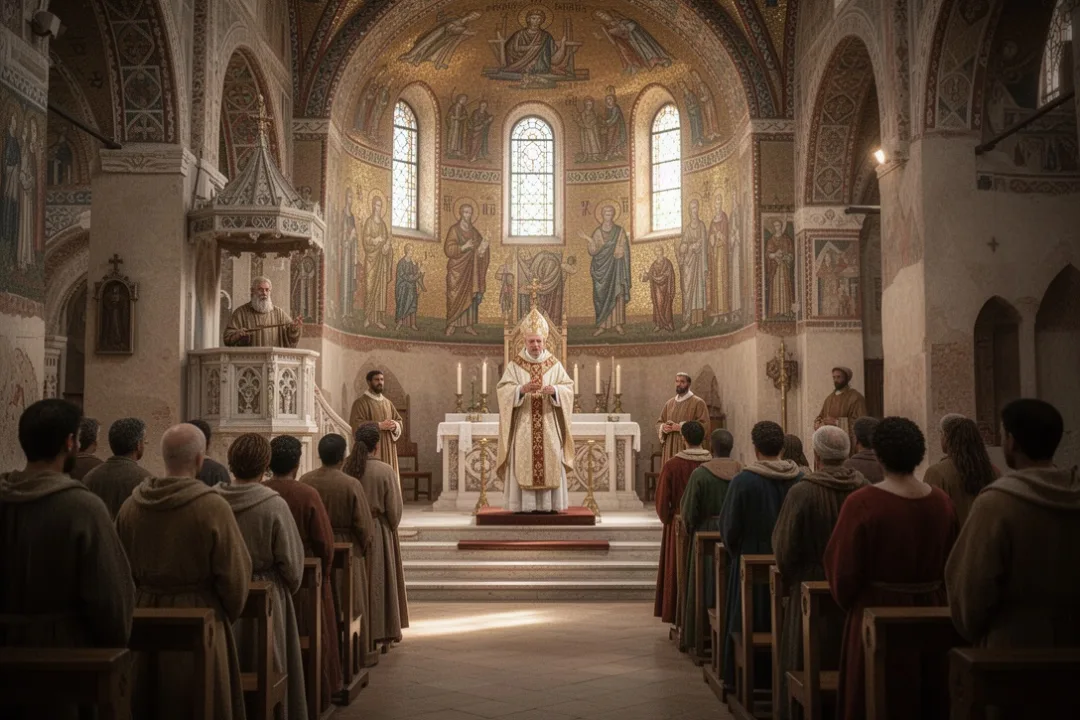
His path changed when he was chosen to become bishop of Ravenna, likely around 433. Ravenna was one of the most important cities in the western Roman world. It served as an imperial residence and later became a major center of political power in Italy, bringing Peter into contact with officials, wealthy families, clergy, and people living with poverty and instability.
According to a longstanding account, Peter was selected for Ravenna after a vision associated with Pope Sixtus III. The story says that the pope received a divine sign identifying Peter as the right bishop, even though the people of Ravenna had favored another candidate. Historians treat this account as part of the saint’s traditional biography rather than as a firmly documented event.
As bishop, Peter had responsibilities beyond preaching. He oversaw the liturgy, instructed converts, encouraged Christian discipline, cared for the poor, and worked with other bishops to preserve orthodox teaching. His ministry took place while the western Roman Empire was under severe pressure, yet his sermons focus less on political events than on the daily spiritual choices of Christian life.
Peter remained connected to his birthplace. He died at Imola around 450 and was buried there. The Church celebrates his feast on July 30, remembering him especially as a preacher and teacher whose words directed listeners toward Christ rather than toward himself.
Core fact: Peter Chrysologus is remembered not because he wrote a large theological system, but because his homilies made central Christian beliefs understandable, personal, and practical.
Why Peter Chrysologus is called the Doctor of the Church
The title Doctor of the Church is given to saints whose teaching has lasting importance for Christian faith and practice. It does not mean that every sentence attributed to a saint is treated as infallible. Rather, it recognizes a broad and enduring contribution to the Church’s understanding of Christian truth.
Peter Chrysologus was proclaimed a Doctor of the Church by Pope Benedict XIII in 1729. His importance rests chiefly on his sermons, which preserve the voice of a bishop speaking directly to a congregation. He did not usually present theology as an abstract academic argument. Instead, he connected doctrine to worship, moral conduct, Scripture, and the needs of people in front of him.
Many of his sermons are short compared with the extended theological works of other Church Fathers. That brevity appears to have been part of his pastoral method. A congregation could remember a focused image or a carefully formed sentence, then carry it into prayer and daily life.
His preaching often follows a recognizable movement:
He begins with Scripture, a feast, or a point in the Church’s liturgical celebration.
He explains what the passage reveals about Christ, especially Christ’s incarnation, death, resurrection, or mercy.
He applies the teaching to conduct, calling listeners to repentance, generosity, self-control, or faith.
He returns the congregation to worship, showing how Christian belief should shape prayer and participation in the sacraments.
This approach helps explain why his sermons have remained useful. Peter did not separate doctrine from discipleship. The truth about Christ was not merely something to defend in debate; it was something that should change how people treated God, their neighbors, their possessions, and their own weaknesses.
His preaching also reflects the communication challenges of a large urban church. Listeners would have had different levels of education and different familiarity with Scripture. Peter used images drawn from ordinary experience—food, clothing, debt, healing, family relationships, and labor—to make theological ideas easier to grasp without reducing their seriousness.
What Peter Chrysologus taught about Jesus Christ
The incarnation stands at the center of Peter Chrysologus’s preaching. He repeatedly presents Jesus Christ as truly God and truly human. For Peter, this belief is not a technical formula detached from life. It explains how human beings can encounter God’s mercy in a real and personal way.
Peter emphasizes that the Son of God did not merely appear to be human. Christ took on genuine human nature, entered human history, experienced human vulnerability, and accepted suffering. At the same time, Christ remained fully divine. This union is essential to Peter’s understanding of salvation: the one who heals humanity is both truly God and truly one of us.
His sermons often move between the manger, the cross, and the empty tomb. The humility of Christ’s birth reveals divine love; the cross shows the depth of Christ’s self-giving; and the resurrection proclaims that sin and death do not have the final word. Peter invites listeners to see these events as one saving work rather than as isolated scenes.
He also presents Christ as a physician who heals wounded humanity. This medical language was common among early Christian writers, but Peter gives it a strongly pastoral meaning. Human beings need more than instruction. They need mercy, restoration, and the courage to return to God after failure.
Peter’s view of repentance is therefore serious but not despairing. Sin damages the relationship between people and God, yet God’s mercy remains open to those who turn back. The preacher’s role is not to flatter the congregation or to condemn sinners as beyond hope. It is to tell the truth about sin while directing people toward conversion and forgiveness.
Peter Chrysologus consistently directs attention away from human pride and toward the humility of Christ.
His Christ-centered preaching also shapes his understanding of human dignity. Because God has entered human existence, the human person cannot be treated as disposable. This conviction supports his calls to charity and compassion. Service to people in need is not an optional display of generosity; it is a response to the God who came near in human flesh.
Peter’s teaching on Mary and the birth of Christ
Peter speaks of the Virgin Mary as the mother of Jesus and as a central witness to the mystery of the incarnation. His Marian preaching is always connected to Christ. Mary matters because of the Son she bears, and her faith shows how human beings can receive God’s work with humility and trust.
When Peter reflects on Christ’s birth, he often highlights the surprising way divine power appears through weakness. The eternal Son is revealed as an infant; the one who sustains creation accepts dependence; the Lord enters the world without worldly display. These contrasts allow Peter to challenge pride and redefine greatness according to Christian standards.
His Christmas preaching also has a moral purpose. If God has drawn near to humanity, Christians should not remain distant from one another. The celebration of Christ’s birth should lead to reconciliation, generosity, and renewed faith, not merely an annual observance without practical change.
How Peter Chrysologus connected prayer, fasting, and charity
Peter Chrysologus presents Christian practice as a unified life. Prayer, fasting, and almsgiving belong together because each addresses a different part of the human person. Prayer turns the heart toward God, fasting disciplines desire, and charity turns attention toward the needs of others.
Fasting, in Peter’s preaching, is not valuable simply because someone eats less. Its purpose is to free a person from domination by appetite and to create greater readiness for God. A fast that leaves a person harsh, proud, or indifferent to suffering has missed its spiritual purpose.
He repeatedly links fasting with generosity. If someone gives up food but refuses to share resources with the hungry, the practice becomes incomplete. Peter’s point is not that bodily discipline has no value. Rather, physical discipline should produce greater compassion and self-control, not spiritual vanity.
His practical vision can be expressed in several questions:
Does your prayer make you more attentive to God and less controlled by resentment?
Does your fasting help you recognize the needs of people who lack necessities?
Does your charity protect another person’s dignity rather than advertise your own goodness?
Does your religious practice lead to forgiveness, patience, and honest repentance?
Peter also warns against separating worship from ethics. A person cannot honor God publicly while deliberately exploiting or humiliating others. The liturgy should form people who recognize Christ in those who are poor, vulnerable, sick, or excluded.
This concern reflects the social realities of his ministry in Ravenna. The city included great wealth and significant poverty, and Christian communities had to decide how to use their resources. Peter’s sermons speak directly to those who possessed more than they needed, urging them to regard possessions as an opportunity for mercy and responsibility.
His teaching does not reduce charity to a transaction. Giving to the poor is not merely a way to purchase forgiveness or improve one’s reputation. It is an act of love rooted in the recognition that all people stand before God as creatures with equal dignity.
Peter’s advice remains concrete. He urges listeners to begin with the opportunities already in front of them: forgive a debt, feed someone who is hungry, visit the sick, release resentment, share possessions, or refuse to profit from another person’s weakness. Christian holiness, in his presentation, is built through repeated acts of faithfulness rather than dramatic public displays.
What Peter Chrysologus’s sermons reveal about his preaching style
The surviving sermons attributed to Peter Chrysologus are the main source for understanding his thought. A substantial collection has come down to modern readers, although questions about authorship and the exact transmission of some sermons require care. Not every text associated with his name can be treated in precisely the same way.
His sermons show a preacher who valued clarity, structure, and memorable imagery. He often develops one main idea instead of pursuing many unrelated points. Biblical scenes become windows into the life of the congregation: a healing story can teach trust, a parable can expose greed, and a feast can reveal the meaning of Christ’s saving work.
Peter makes frequent use of contrasts. He places divine greatness beside human weakness, abundance beside poverty, pride beside humility, and death beside resurrection. These contrasts are not merely literary decoration. They help listeners see how the gospel reverses ordinary assumptions about power and success.
He also uses vivid personification. Sin, death, the devil, the human soul, and the Church may appear in his sermons as active participants in a dramatic story. This style reflects the preaching conventions of late antiquity and helped congregations imagine invisible spiritual realities.
His language can be highly rhetorical, but the central purpose is practical. Peter wants listeners to move from hearing to doing. The congregation should not admire a beautiful sermon and then return unchanged to injustice, bitterness, or indifference.
Reading tip: When approaching one of Peter’s sermons, look for the movement from biblical image to Christian action. His main question is often not only “What does this passage mean?” but also “How should this truth change the way you live?”
Peter’s sermons are also valuable historical evidence. They show how a bishop addressed a Christian population in late Roman Italy, what themes were emphasized in public worship, and how biblical interpretation was connected to moral instruction. They offer a glimpse of a Church that was both doctrinally engaged and deeply concerned with ordinary habits of mercy.
Peter served during controversies about the person of Christ, including disputes surrounding Eutyches, a prominent monk in Constantinople. The controversy involved how to speak accurately about Christ’s divinity and humanity after the incarnation. Peter’s response illustrates his commitment to orthodox teaching and to the authority of the wider Church.
In a letter traditionally associated with this controversy, Peter urged Eutyches to listen to Pope Leo the Great and to seek agreement with the apostolic teaching received by the Church. Peter did not treat a private interpretation as more reliable than the settled faith of the Church’s bishops. His position reflects a concern that theological language remain faithful to the full mystery of Christ.
The controversy was eventually addressed at the Council of Chalcedon in 451, after Peter’s death. The council taught that Christ is one person in two natures, truly divine and truly human. Peter’s preaching belongs to the same broad effort to confess Christ without diminishing either his divinity or his humanity.
His ministry in Ravenna also placed him within the cultural and political world of the late Roman Empire. Ravenna became famous for its churches and mosaics, and the city’s Christian community was connected to important developments in western Christianity. Peter’s sermons help show that this setting was not only a place of monumental architecture and political power. It was also a community where people struggled with wealth, poverty, sin, fear, and the demands of discipleship.
Peter’s relationship with Rome is part of his historical significance. He recognized the importance of communion among bishops and the need for theological teaching to remain connected to the Church’s received faith. At the same time, his surviving work is primarily pastoral rather than administrative. His enduring reputation rests on how he explained Christian belief to people gathered for worship.
The Church remembers him as a model of responsible preaching: teach the truth clearly, keep Christ at the center, address the moral life honestly, and speak in a way that leads people toward mercy. His sermons do not present Christian faith as an escape from human suffering. They present it as the way God meets humanity within weakness and transforms it through grace.
For readers today, Peter Chrysologus offers several lasting lessons:
Good preaching serves understanding. Beautiful language matters, but it should illuminate truth rather than conceal it.
Doctrine should shape conduct. Belief in the incarnation should produce humility, compassion, and respect for human dignity.
Religious practices belong together. Prayer, fasting, and charity are strongest when they form one integrated life.
Repentance includes hope. Honest recognition of sin should lead people back to God rather than toward despair.
Christian leadership is pastoral. A bishop or teacher serves by guiding people toward Christ, not by drawing attention only to personal authority.
That combination of theological precision and practical concern explains why Peter Chrysologus remains a significant figure in Christian history. His sermons were shaped by the fifth century, but his central questions continue to matter: How should faith change the way people use power? What does mercy require? How can worship become a pattern of life? And how does the humility of Christ challenge human pride?
Frequently asked questions
What is St. Peter Chrysologus the patron saint of?
Peter Chrysologus is especially associated with preaching and the ministry of proclaiming the gospel. He is not commonly known for a single specialized patronage in the way some saints are linked to particular occupations or illnesses. His principal legacy is as a bishop, homilist, and Doctor of the Church whose sermons explain Christian faith with clarity and pastoral concern.
When is the feast day of St. Peter Chrysologus?
The Roman Catholic Church celebrates St. Peter Chrysologus on July 30. The date honors the bishop and preacher who served Ravenna and later died at Imola around 450. Feast-day calendars can differ among Christian traditions, so local communities may remember him on another date or according to a different liturgical calendar.
What does the name Chrysologus mean?
“Chrysologus” comes from Greek roots commonly understood as “golden word” or “golden-worded.” The title refers to Peter’s skill as a preacher. It does not mean that every sermon was ornate; his reputation also came from presenting important Christian teachings in a focused, memorable, and accessible way.
Where can people read the sermons of Peter Chrysologus?
His sermons are available in scholarly collections of the writings of the Church Fathers, as well as in selected English translations published by Christian and academic presses. When choosing a collection, check whether it identifies the translator, explains the historical setting, and distinguishes sermons securely attributed to Peter from texts whose authorship is uncertain.











Leave a Reply