Peter Damian was an 11th-century Italian Benedictine monk, cardinal, bishop, writer, and reformer who pressed the Catholic Church to confront corruption and restore stricter standards for clergy. He is remembered especially for his defense of clerical discipline, his promotion of monastic renewal, and his service as a papal adviser and envoy.
Born in Ravenna around 1007, he rose from a difficult childhood to become one of the most influential churchmen of his generation. The Catholic Church recognizes him as a Doctor of the Church, and his liturgical memorial is celebrated on February 21.
Peter Damian was born in Ravenna, a city with a long Christian and imperial history in northern Italy. His birth name was Pietro Damiani, although later sources and tradition commonly use the Latin form Peter Damian. The details of his early childhood come mainly from medieval accounts, including biographical material written by people connected with his religious community.
His childhood appears to have been marked by poverty and family loss. After becoming an orphan, he was reportedly taken in by one of his older brothers, Damian, who helped him obtain an education. Peter later adopted the name Damian in gratitude for this brother’s care, a choice that explains the unusual form of his familiar name.
Peter’s education was significant because formal learning was not equally available to everyone in medieval society. He studied grammar, rhetoric, and the liberal arts, eventually becoming a teacher. His training gave him the tools to write persuasive letters, interpret Christian texts, and participate in serious debates about the responsibilities of church leaders.
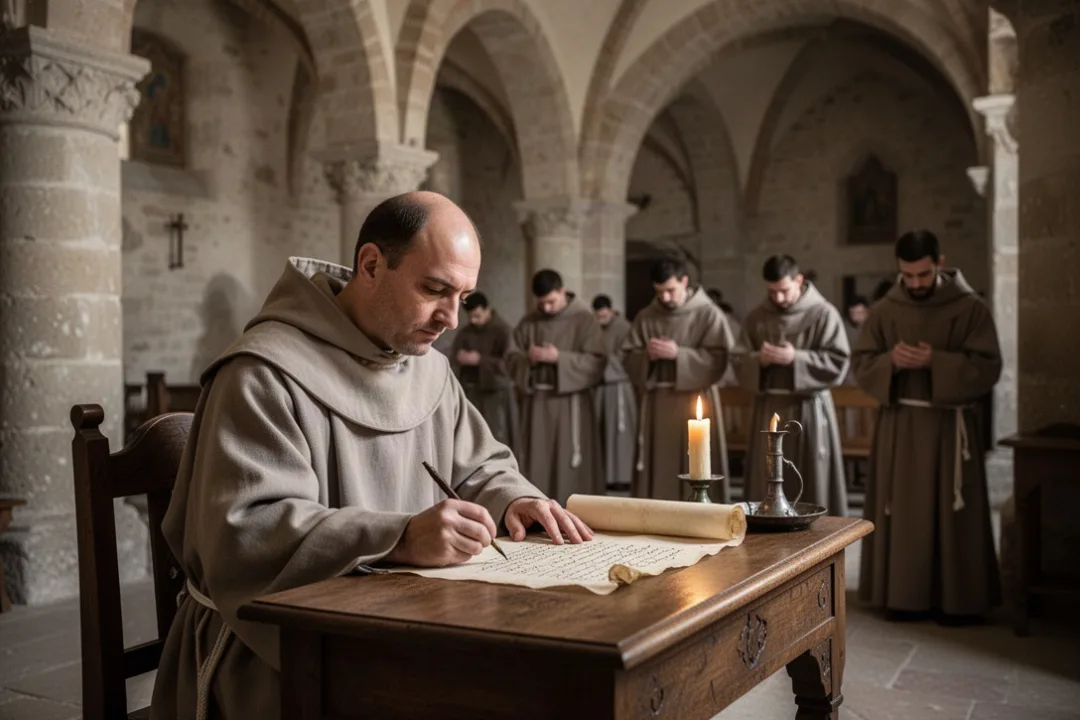
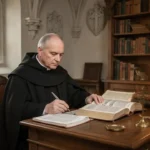
Although he had a successful teaching career, Peter was drawn toward a more demanding form of religious life. He entered the Benedictine community at Fonte Avellana, a monastery in the Apennines associated with an austere style of prayer, fasting, study, and solitude. The community combined communal worship with practices influenced by the older tradition of Christian hermits.
Why his background matters: Peter Damian’s authority came from more than his later church offices. He had experienced poverty, pursued an education, practiced monastic austerity, and developed a reputation for personal seriousness before becoming a cardinal.
At Fonte Avellana, Peter became a monk, teacher, and eventually a leader. He supported a form of monastic life that valued prayer, penance, silence, and disciplined study. He also helped strengthen the monastery’s influence by training monks and encouraging the foundation or reform of related religious communities.
Peter did not regard monastic withdrawal as an excuse to ignore the wider church. He believed that monks could serve the church through prayer, moral example, theological instruction, and counsel to bishops and popes. That conviction shaped the tension that marked much of his career: he wanted churchmen to live apart from worldly corruption, yet he repeatedly entered public disputes to defend reform.
How Peter Damian became a church reformer
Peter Damian lived during a period when church offices, clerical behavior, and relations between religious leaders and secular rulers were subjects of intense controversy. Reformers criticized the purchase or sale of ecclesiastical offices, commonly called simony, and objected to clergy who did not meet accepted standards of celibacy and moral conduct.
He considered these problems more than administrative failures. In his view, the church’s ministers handled sacred responsibilities, so corruption among them damaged the credibility of Christian worship and weakened the spiritual life of ordinary believers. His reform program therefore joined institutional change with a call to personal conversion.
Peter expressed his ideas through a large collection of letters, sermons, theological works, and moral treatises. His letters were addressed to popes, bishops, abbots, monks, rulers, and fellow reformers. They show a writer who could be respectful toward authority while also using direct, sometimes severe language when he believed a serious offense had been overlooked.
One of his best-known works is the Liber Gomorrhianus, or “Book of Gomorrah,” written in the mid-11th century and addressed to Pope Leo IX. The work condemned sexual misconduct among members of the clergy and called for firm disciplinary action. Its language is severe, and modern readers should understand it within the assumptions and controversies of medieval church reform rather than treating it as a simple description of all clergy at the time.
The book has attracted particular attention because it discusses sexual acts and clerical misconduct in unusually direct terms for its period. Historians continue to examine its purpose, intended audience, and relationship to actual disciplinary practice. Peter’s aim was to force church authorities to acknowledge misconduct and to insist that clerical office required moral accountability.
Peter also addressed the problem of clerical marriage and concubinage, which reformers associated with the wider effort to establish clerical celibacy. Rules concerning clergy and marriage had developed over many centuries, and enforcement varied widely by region. Peter supported a stricter standard, arguing that priests should be visibly dedicated to their religious calling and free from family interests that could influence church property or office.
His reform work included criticism of simony. He rejected the idea that spiritual authority could properly be obtained through payment or political exchange. For him, buying a church office confused sacred service with commerce and allowed wealth or family connections to displace learning, integrity, and pastoral ability.
Simony: the buying or selling of ecclesiastical offices or spiritual benefits.
Clerical discipline: standards governing the conduct and responsibilities of priests, bishops, and other church ministers.
Monastic reform: efforts to restore religious communities to stricter prayer, communal order, study, and moral practice.
Papal reform: attempts to strengthen church leadership and reduce improper control by secular authorities.
Peter’s position was not merely punitive. He believed that discipline should protect the church’s spiritual purpose. A priest or monk who followed a demanding rule could become a visible example of Christian seriousness, while a corrupt official could mislead an entire community.
Peter Damian’s role as cardinal and papal adviser
Peter’s reputation brought him into the center of church leadership. In 1057, Pope Stephen IX appointed him cardinal-bishop of Ostia, one of the most important episcopal offices near Rome. The appointment placed a deeply ascetic monk in a position that required him to manage church affairs, advise the papacy, and represent reforming interests in difficult political circumstances.
Peter did not abandon his monastic identity when he received high office. He continued to value solitude and the practices of the hermit tradition. At the same time, he accepted responsibilities that required travel, negotiations, legal judgment, and communication with powerful people.
His service coincided with the wider reform movement associated with figures such as Leo IX, Hildebrand—the future Pope Gregory VII—and other church leaders who sought to improve clerical standards and strengthen the independence of ecclesiastical institutions. Peter was an important participant in this movement, although he was not identical in outlook to every later Gregorian reformer.
As a papal representative, Peter traveled on missions designed to settle disputes and encourage compliance with reforming policies. He dealt with bishops, rulers, monasteries, and local church communities. These assignments required more than doctrinal confidence; they demanded diplomacy and an ability to persuade people with different interests.
One of the issues surrounding church reform was the relationship between spiritual authority and secular power. Medieval kings, emperors, nobles, and local rulers often influenced appointments and controlled land or privileges connected with the church. Reformers feared that such influence could turn bishops and abbots into political clients rather than pastors and spiritual leaders.
Peter wanted church officials to exercise legitimate authority without becoming dependent on worldly wealth. Yet he also understood that reform could not be achieved through private devotion alone. His letters show him working within the institutions he criticized, seeking decisions from popes and bishops while reminding them that their authority carried moral obligations.
He sometimes became frustrated with the demands of public office. The responsibilities of a cardinal and papal envoy conflicted with his preference for monastic withdrawal. This tension is one of the most revealing features of his life: the hermit became an administrator, and the writer of severe spiritual advice had to negotiate with the same human institutions he wanted purified.
Peter’s career also demonstrates that medieval reform was not a single event directed by one person. It was a long process involving monasteries, bishops, papal officials, scholars, local clergy, rulers, and lay communities. Peter contributed through argument, correspondence, preaching, and personal example.
Peter Damian’s writings and theological ideas
Peter Damian was a prolific writer, and his works cover more than church administration. He wrote about sin, penance, prayer, monastic discipline, the sacraments, moral responsibility, and the value of religious solitude. His approach was practical as well as theological: he wanted Christian teaching to shape conduct.
His letters are especially valuable for understanding his thought. They reveal how reform ideas were applied to particular people and situations. A letter to a pope might address the danger of weak leadership, while a letter to a monk might focus on obedience, humility, temptation, or perseverance.
Peter’s writing frequently presents the church as a community that must be renewed from within. He did not separate the holiness of individuals from the health of institutions. A monastery needed rules and capable leadership, while a bishop needed both authority and a life consistent with the faith he preached.
He placed strong emphasis on penance and conversion. Wrongdoing, in his view, could not be treated as a minor personal matter when it involved a person entrusted with religious office. Repentance had to include an honest recognition of sin and a willingness to accept appropriate correction.
His work also reflects medieval Christianity’s deep interest in the spiritual value of asceticism. Fasting, vigils, manual labor, and restraint were not ends in themselves. Peter saw them as practices that could train the will, reduce attachment to status and comfort, and direct attention toward God.
That emphasis can make his writings sound demanding to modern readers. He often used strong contrasts between worldly ambition and spiritual devotion. His ideal monk was not simply someone who lived in a monastery, but someone who practiced obedience, humility, self-control, and sustained prayer.
Peter also wrote about the meaning of church authority. He believed that bishops and popes had real responsibilities, but he did not present office as a license for personal privilege. Authority existed to serve the church and guide believers, which meant that leaders could be judged by their conduct as well as by their formal position.
Some of his works address questions of logic, philosophy, and theological method. He belonged to a learned culture in which Christian writers used the tools of grammar and reasoning to clarify doctrine. His education allowed him to move between spiritual exhortation and technical argument, depending on the problem he was addressing.
His style was shaped by the traditions of Latin Christian writing. He used biblical allusions, examples from saints’ lives, moral warnings, and carefully constructed arguments. Bible references appear throughout his works, but his purpose was not merely to display learning; he used Scripture as a standard against which personal behavior and institutional decisions should be measured.
Reading his works today: Peter Damian’s writings should be read with attention to their historical setting, genre, and intended audience. His forceful language reflects medieval debates about sin and discipline, while his central concerns include accountability, integrity, prayer, and responsible leadership.
Peter Damian’s later years, death, and sainthood
Peter eventually sought release from some of his public responsibilities, but his reputation continued to draw him into church affairs. He remained available for important missions and disputes, showing that his reforming influence did not depend entirely on holding office.
In his later years, he continued to write and advise church leaders. His life illustrates the mixed character of medieval religious reform: it required both withdrawal from the world and engagement with rulers, courts, bishops, and papal institutions. The reformer had to challenge political interference while still working through political realities.
Peter died in 1072, traditionally associated with Faenza in northern Italy, while returning from a church mission. His body was buried in the cathedral at Faenza. The location of his death reflects the pattern of his final years: even after serving as a cardinal and leading monastic communities, he was still traveling on behalf of church responsibilities.
His reputation for holiness developed after his death, supported by the memory of his austere life, reforming work, and written legacy. He became known as Saint Peter Damian, and the church honors him as a bishop, cardinal, monk, and Doctor of the Church.
Pope Leo XII formally declared him a Doctor of the Church in 1828. That title recognizes theologians whose teaching has had lasting importance for Catholic doctrine and spiritual life. Peter’s designation reflects the breadth of his contribution, not only his role in 11th-century disputes.
His feast day is February 21. In Catholic calendars and devotional practice, he is associated with monastic renewal, church reform, episcopal responsibility, and the pursuit of holiness through disciplined Christian life.
Why Peter Damian still matters
Peter Damian remains significant because he connected personal integrity with institutional reform. He argued that church structures could not be renewed if the people responsible for them ignored prayer, moral discipline, and accountability. At the same time, he recognized that private virtue alone would not resolve problems embedded in offices, property, appointments, and political relationships.
His life also raises questions about how religious communities respond to misconduct. Peter’s approach was shaped by medieval assumptions and can be severe, but he insisted that abuse of spiritual office should not be hidden to preserve appearances. That insistence continues to make his writings relevant to discussions of transparency and leadership, even when his proposed penalties or explanations belong to another period.
His career offers a useful example of the tension between contemplation and public service. Peter preferred the quiet discipline of a monastery, yet he accepted demanding responsibilities because he believed reform required action. His experience suggests that religious vocation can include both withdrawal for prayer and difficult engagement with institutions.
Peter’s writings also show why historical figures should not be reduced to one famous text or controversy. The “Book of Gomorrah” is important, but it represents only part of his work. His larger legacy includes letters on leadership, reflections on monastic practice, arguments about church authority, and a sustained call to conversion.
For readers studying medieval Christianity, Peter Damian helps explain how the reform movement gained intellectual and spiritual force. He was not simply a critic of clerical misconduct, nor merely an austere monk. He was a teacher, organizer, writer, bishop, papal envoy, and reformer who believed that the church’s credibility depended on the lives of its leaders.
His example is therefore best understood through several connected themes:
Monastic seriousness: prayer and discipline could form people capable of serving the wider church.
Moral accountability: religious office demanded conduct consistent with its spiritual purpose.
Institutional independence: church offices should not be treated as possessions controlled by wealth or political influence.
Learned leadership: education, writing, and careful argument could support practical reform.
Service despite tension: a person committed to solitude might still accept public responsibilities for the good of the church.
Peter Damian’s historical importance rests on that combination. He pursued an intense spiritual life, used education to challenge corruption, and accepted authority without treating it as personal privilege. His legacy belongs both to the history of medieval reform and to the continuing question of how religious leaders should be held accountable.
Frequently asked questions
Was Peter Damian a pope?
No. Peter Damian was a Benedictine monk, cardinal, bishop of Ostia, papal adviser, and envoy, but he never became pope. He worked closely with several popes during the 11th-century reform movement. His influence came from his writing, monastic leadership, public missions, and strong advocacy for higher standards among clergy and church officials.
What is Peter Damian the patron saint of?
Peter Damian is chiefly associated with monastic reform, clergy, bishops, and the renewal of church discipline. He is not generally known for one narrowly defined patronage comparable to saints linked with a particular occupation or illness. His life is especially remembered for combining contemplative devotion with public service and reforming leadership.
Why is the Book of Gomorrah controversial?
The Book of Gomorrah is controversial because it describes sexual misconduct among clergy in unusually direct language and calls for strict disciplinary responses. Modern readers also debate how broadly its claims should be applied and how closely they reflected actual conditions. It should be read as a polemical medieval reform text, not as a neutral statistical account.
When is Saint Peter Damian’s feast day?
Saint Peter Damian’s feast day is February 21. Catholic calendars remember him as a bishop, cardinal, monk, writer, and Doctor of the Church. The date commemorates his death and provides an occasion to reflect on his contributions to monastic life, clerical discipline, theological writing, and the medieval reform movement.












Leave a Reply