Pius V: the Dominican pope who shaped Catholic reform
Pius V: the Dominican pope who shaped Catholic reform
When you hear “Pius V,” you may be wondering whether the name refers to a pope, a prayer, or the older form of the Catholic Mass. Pius V was Pope from 1566 to 1572, a Dominican friar who became one of the most influential leaders of the Catholic Reformation. His papacy was brief, but it helped turn the decisions of the Council of Trent into daily practice across the Catholic Church.
Born Antonio Ghislieri, he was known for his austere personal life, firm discipline, and determination to correct abuses among clergy and church institutions. He also commissioned important liturgical and catechetical reforms, supported Catholic resistance to the Ottoman Empire, and became closely associated with the victory at Lepanto. The Mass he promulgated in 1570 is commonly called the Tridentine Mass or traditional Latin Mass, although its history is more complicated than the simple claim that he invented it.
Antonio Ghislieri was born in 1504 in Bosco, a town in the Duchy of Milan, in what is now northern Italy. He came from a modest background and entered the Dominican Order as a young man. After his religious formation, he was ordained a priest and gained a reputation for learning, personal austerity, and a strong commitment to the ideals of Dominican preaching.
His early career developed during a period of severe religious and political tension. The Protestant Reformation had challenged Catholic teaching and church authority across large parts of Europe, while many Catholics were also demanding reform within their own Church. Ghislieri’s response emphasized doctrinal clarity, disciplined clergy, and the correction of practices he regarded as abuses.
Ghislieri served as a teacher and held several responsibilities within the Dominican community. He later worked as an inquisitor in northern Italy, where his role involved investigating suspected heresy and defending Catholic doctrine. The Roman Inquisition, established in 1542, was one of the institutions created to address doctrinal conflict and religious dissent. Ghislieri’s methods were strict, and his reputation for severity followed him throughout his career.
In 1556, Pope Paul IV appointed him bishop of Nepi and Sutri and made him a cardinal. Ghislieri became closely associated with Paul IV’s efforts to enforce moral and doctrinal discipline. When Paul IV died, Ghislieri briefly lost influence under the next pope, Pius IV, but the Council of Trent soon became the central concern of Catholic leadership.
The Council of Trent had opened in 1545 and met during several periods before finally concluding in 1563. It clarified Catholic teaching on subjects such as justification, the sacraments, Scripture and tradition, clerical discipline, and the training of priests. The council did not itself carry out every reform it approved, so later popes had to translate its decisions into liturgical books, catechetical materials, seminaries, and administrative policies.
Ghislieri was elected pope on January 7, 1566, and chose the name Pius V. His election reflected a desire for a pope who would implement Trent seriously rather than treat its decrees as merely theoretical. He brought the habits of a religious reformer to the papal office, maintaining a simple lifestyle and insisting that the papal court should avoid unnecessary luxury.
At a glance: Pius V was born Antonio Ghislieri in 1504, became a Dominican, served as a cardinal and inquisitor, was elected pope in 1566, died in 1572, and was canonized in 1712.
How Pius V implemented the Council of Trent
Pius V’s main historical importance lies in his effort to make the Council of Trent visible in the everyday life of the Church. He supported stronger episcopal oversight, expected bishops to reside in their dioceses, and promoted more consistent standards for priests and religious communities. These measures addressed longstanding problems such as absentee bishops, inadequate clerical education, and the holding of church offices for financial benefit.
His papacy formed part of a wider movement often called the Catholic Reformation or Counter-Reformation. The terms overlap but emphasize different aspects. “Catholic Reformation” highlights renewal within the Church, while “Counter-Reformation” emphasizes Catholic opposition to Protestant movements. Pius V participated in both: he promoted internal reform while defending Catholic doctrine against Protestant challenges.
One major task was giving clergy and laity a dependable explanation of Catholic teaching. Pius V oversaw the publication of the Roman Catechism in 1566, also known as the Catechism of the Council of Trent. It was written primarily for priests and clergy who needed a reliable guide for preaching and instruction. The work explained the Creed, sacraments, Ten Commandments, and Lord’s Prayer from a Catholic perspective.
The Roman Catechism was not a question-and-answer manual aimed mainly at children. It was a substantial pastoral resource intended to help priests teach consistently. Its publication reflected Pius V’s belief that reform required more than condemning errors; the Church also had to provide pastors with clear, organized material for forming the faithful.
Pius V also supported the development of seminaries and the improvement of clerical education. The Council of Trent had required dioceses to establish institutions for training future priests, but implementation varied considerably. The pope’s policies reinforced the principle that priests should be educated in theology, Scripture, pastoral care, and moral discipline before receiving broad responsibilities.
He took a similarly firm approach to religious life. Pius V expected religious orders to observe their rules more carefully and opposed practices that allowed wealth, personal privilege, or laxity to undermine their original purposes. His reforms could be unpopular, especially among people who benefited from older arrangements, but they helped strengthen the institutional changes associated with Trent.
His approach was not limited to church officials. Pius V supported charitable activity and personally maintained a reputation for helping the poor. He also tried to make the papal household less extravagant. Accounts of his life often stress his austere clothing, simple food, and concern for the needy, though later devotional biographies sometimes present these traits in idealized form.
Religious discipline during the sixteenth century could be severe by modern standards. Pius V supported the use of ecclesiastical courts and censorship against teachings considered heretical. A balanced understanding of his papacy therefore includes both his genuine efforts to improve pastoral standards and the coercive environment in which Catholic and Protestant authorities operated.
Why Pius V is connected with the Tridentine Mass
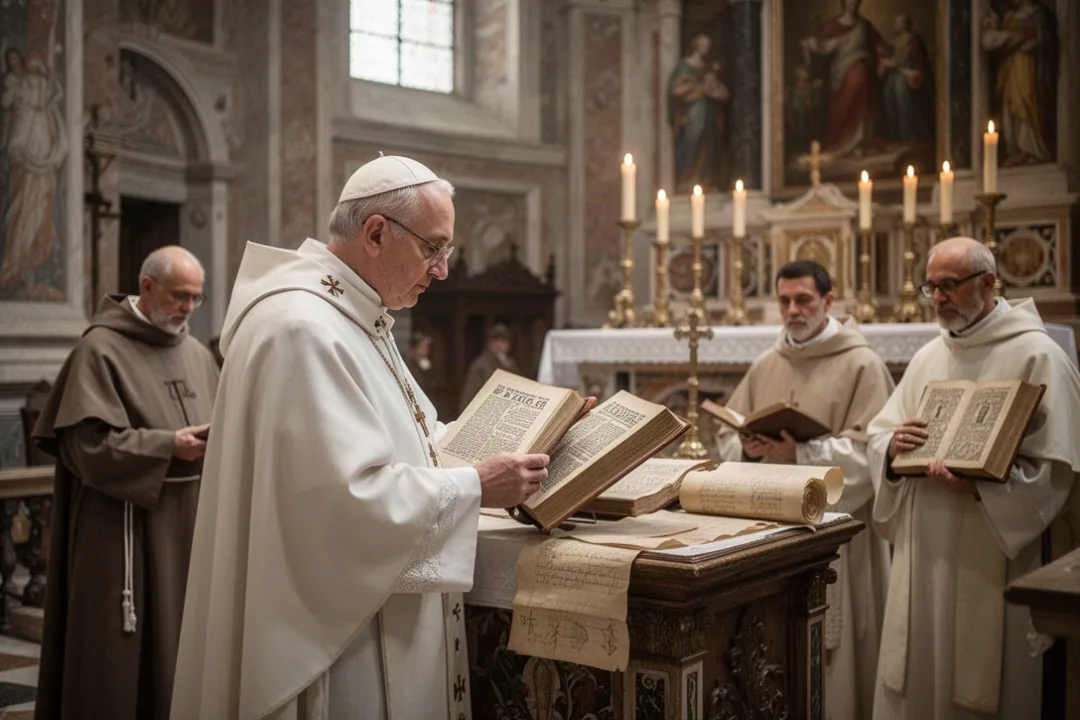
The phrase Tridentine Mass refers to the Roman Missal associated with the reforms after the Council of Trent and especially with the missal promulgated by Pius V in 1570. The name can be misleading if it suggests that Pius V created the Roman Mass from nothing. The liturgy he published drew on centuries of development and earlier Roman missals.
Before the sixteenth century, the Roman rite existed in a variety of local forms. Some dioceses and religious communities used distinct customs, calendars, prayers, and liturgical books. The spread of printing made it easier to establish an official and consistent text, while the disruptions of the Reformation increased the desire for greater uniformity in Catholic worship.
In 1570, Pius V promulgated a revised Roman Missal through the papal document commonly known as Quo primum. The missal standardized the texts and order of the Mass for the Roman rite. It became the principal liturgical book used in many Latin-rite Catholic settings for centuries, although it was not the only Catholic liturgy in use.
The missal preserved the basic structure of the Roman Mass: introductory prayers, readings, the offertory, the Eucharistic Prayer, Communion, and the dismissal. Its publication also established a more consistent calendar and set of liturgical texts. The goal was to prevent unauthorized alterations and to ensure that priests in different regions could celebrate the Roman rite from a common book.
Several qualifications matter when describing this reform:
Pius V standardized the Roman Missal; he did not create every prayer or ceremonial feature contained in it.
The missal applied primarily to the Roman rite, not to every Catholic liturgical tradition.
Some local rites with an established history of at least two centuries were permitted to continue.
The missal was revised by later popes, so the form used before the Second Vatican Council was not identical in every detail to the edition of 1570.
The term “Tridentine” reflects the missal’s connection with the Council of Trent, but the council did not personally draft the book. Rather, it asked the papacy to oversee the correction and standardization of liturgical texts. Pius V carried out that responsibility with the assistance of scholars and church officials.
Pius V also promulgated a revised Roman Breviary in 1568. The breviary contained the official prayers and readings for the Divine Office, the daily prayer of the clergy and religious communities. Revising the breviary alongside the missal helped create greater consistency between the Church’s public celebration of the Eucharist and its daily cycle of prayer.
A useful distinction: “Tridentine Mass” usually means the Roman Missal associated with Pius V, while “Latin Mass” can refer broadly to any Mass celebrated in Latin, including forms that developed later.
The missal of Pius V remained an important reference point long after his death. Later editions introduced changes under popes including Clement VIII, Urban VIII, Pius X, Pius XII, and John XXIII. In the twentieth and twenty-first centuries, debates about older and newer forms of the Roman rite have often used “Pius V” as shorthand for questions about liturgical continuity, language, ritual, and authority.
That shorthand should be used carefully. The liturgical tradition associated with Pius V was itself a reform of earlier materials, and the Roman rite continued to develop afterward. Calling it “the Mass of Pius V” identifies a major historical stage, but it does not mean that the form remained completely unchanged from 1570 onward.
How Pius V responded to Protestantism and England
Pius V defended Catholic doctrine with the same firmness that characterized his internal reforms. He opposed Protestant teaching on the sacraments, justification, church authority, and worship. His papacy therefore cannot be separated from the religious conflicts that divided Europe during the sixteenth century.
One of the most consequential decisions of his pontificate concerned England. Queen Elizabeth I had restored the Protestant settlement after becoming queen in 1558. Catholic worship faced legal restrictions, and tensions between the English crown and the papacy intensified as England became involved in wider conflicts with Catholic powers.
In 1570, Pius V issued the bull Regnans in Excelsis, which declared Elizabeth excommunicated and released her Catholic subjects from obedience to her. The document was a serious escalation. It treated the conflict not only as a dispute over religious practice but also as a matter involving the legitimacy of political authority.
The decision had complicated consequences for English Catholics. It placed many Catholics in a difficult position, particularly those who wanted to remain loyal to their country while practicing their faith. The English government responded with stronger suspicion toward Catholics, especially after later plots and foreign interventions. Although the bull did not by itself create all subsequent persecution, it contributed to a more dangerous political environment.
Historians assess this episode in different ways, but several facts remain clear. Pius V believed the pope possessed authority to judge the spiritual standing of rulers, and he saw Elizabeth’s religious policies as a grave threat to Catholicism. The English government, meanwhile, increasingly associated Catholic allegiance with possible foreign conspiracy. Ordinary Catholics often bore the consequences of decisions made by both church and state authorities.
Pius V also took a strong position against religious dissent within Catholic territories. His papacy reflects the sixteenth-century assumption that religious unity and political stability were closely connected. That assumption helps explain both the energy of his reforms and the severity of his opposition to Protestant rulers and communities.
His policies were not simply defensive. Catholic renewal produced new schools, improved preaching, stronger pastoral systems, and renewed religious orders. Yet the same age also saw censorship, trials, expulsions, and political coercion. A responsible account of Pius V must hold these realities together rather than presenting him only as a reformer or only as an authoritarian.
What happened at Lepanto during Pius V’s papacy
Pius V is also remembered for organizing Catholic support against the Ottoman Empire. In the Mediterranean, Ottoman naval power threatened several Christian territories and commercial routes. The pope worked diplomatically to unite Spain, Venice, the Papal States, and other Catholic participants in a military alliance known as the Holy League.
The alliance met the Ottoman fleet at the Battle of Lepanto on October 7, 1571, in the Gulf of Patras near western Greece. The Holy League achieved a major naval victory. The battle did not permanently end Ottoman power in the Mediterranean, but it stopped a major Ottoman advance and became a powerful symbol of Catholic resistance.
According to Catholic tradition, Pius V asked Christians to pray the Rosary for the fleet and later connected the victory with the intercession of the Virgin Mary. The pope established the feast associated with Our Lady of Victory, which was later given the title Our Lady of the Rosary. The feast is observed on October 7.
The connection between Lepanto and the Rosary became central to Catholic memory of the battle. Pius V’s support for the Rosary was part of a broader devotional culture that valued repetitive prayer, meditation on the life of Christ, and the intercession of Mary. The event helped spread the association of the Rosary with protection and victory.
The historical picture is more complex than a purely religious account suggests. Lepanto resulted from naval strategy, military resources, political negotiations, and the participation of different states with their own interests. The victory had symbolic and spiritual meaning for Catholics, but it should also be understood as a major event in Mediterranean geopolitics.
Pius V did not live long after Lepanto. He died in Rome on May 1, 1572, after a papacy of just over six years. He was buried in the Basilica of Santa Maria Maggiore, where his tomb remains associated with the church’s memory of him.
How the Catholic Church remembers Pius V today
Pius V was beatified in 1672 by Pope Clement X and canonized in 1712 by Pope Clement XI. His liturgical memorial is observed on April 30. He is remembered as a reformer pope, a Dominican, a defender of Catholic doctrine, and a promoter of the Rosary.
Supporters of his legacy often point to his personal discipline and his refusal to separate reform from the life of the clergy. They credit him with giving practical force to the Council of Trent, standardizing major liturgical books, improving catechetical instruction, and encouraging a more serious model of pastoral leadership.
Other readers approach his legacy more critically. They may focus on his support for religious coercion, his role in the Roman Inquisition, the excommunication of Elizabeth I, and the effects of his policies on religious minorities. These concerns do not erase his contribution to Catholic reform, but they show why his life cannot be reduced to a simple heroic portrait.
His name also appears in modern discussions of Catholic worship. Some Catholics value the missal associated with Pius V because they see it as preserving a stable inherited form of prayer. Others emphasize that the Roman rite has always developed and that later liturgical reforms belong to the Church’s continuing authority. The debate is theological as well as historical, and the phrase “Pius V” often carries meanings beyond the pope himself.
When identifying Pius V, the most useful points are these:
He was a Dominican pope who served from 1566 to 1572.
He helped implement the reforms of the Council of Trent.
He promulgated the Roman Missal of 1570 and a revised Roman Breviary.
He supported the Roman Catechism as a tool for clergy instruction.
He excommunicated Elizabeth I of England in 1570.
He helped organize the Holy League before the Battle of Lepanto in 1571.
He was canonized in 1712 and is commemorated on April 30.
Pius V’s historical importance comes from the way his short pontificate linked doctrine, worship, clerical discipline, politics, and popular devotion. He did not single-handedly create the Catholic Reformation, and he did not invent the Roman Mass. He did, however, give its reforms a determined papal champion whose decisions shaped Catholic life for centuries.
Frequently asked questions
Was Pius V the pope who created the Latin Mass?
No. Pius V promulgated a standardized Roman Missal in 1570, but he did not invent the Mass or create the Latin language of Catholic worship. His missal drew on older Roman traditions and standardized them for wider use. Later popes revised that missal, so the form associated with Pius V developed over time.
Why is Pius V connected with the Rosary?
Catholic tradition links Pius V with the Rosary because he encouraged prayer for the Christian fleet before the Battle of Lepanto in 1571. After the victory, he established a feast connected with Our Lady of Victory. The feast was later associated with Our Lady of the Rosary and is celebrated on October 7.
What did Pius V do during the Protestant Reformation?
He defended Catholic doctrine, enforced disciplinary reforms, supported the Roman Inquisition, and promoted consistent teaching after the Council of Trent. His most controversial action was the 1570 excommunication of Elizabeth I of England, which intensified the political and religious difficulties faced by English Catholics.
Is Pius V a saint in the Catholic Church?
Yes. Pius V was beatified in 1672 and canonized in 1712 by Pope Clement XI. Catholics remember him for his austere life, Dominican spirituality, implementation of Tridentine reforms, support for the Rosary, and role in organizing the Holy League before Lepanto.









Leave a Reply