Katherine of Siena was a 14th-century Italian mystic, Dominican laywoman, author, and adviser to popes and civic leaders. Born in Siena in 1347, she became known for her intense prayer, care for the sick and poor, and direct appeals for reform in the Church.
She died in 1380 at age 33 and was later recognized as a Doctor of the Church, a title given to saints whose teaching has particular importance. Her major work, The Dialogue, and hundreds of letters preserve her spiritual vision, including her emphasis on love of God, humility, courage, and practical service.
Katherine was born Caterina Benincasa in Siena, a prosperous city-state in central Italy. She grew up in a large family; her father, Jacopo, worked as a cloth dyer. Her religious formation took place in a society where family expectations, trade, political rivalries, disease, and Church affairs were closely connected.
From childhood, Katherine showed a strong attraction to prayer and solitude. According to accounts written by people who knew her, she experienced a vision of Christ at a young age and made a private commitment to dedicate herself to God. These early stories were recorded after her death, so they should be read as devotional testimony rather than as modern biography.
Her family expected her to marry, but Katherine resisted that plan. After a period of conflict, she began living as a Dominican tertiary, also called a member of the Third Order of Saint Dominic. This allowed her to remain a layperson while following Dominican spirituality through prayer, fasting, study, and works of mercy.
Katherine did not enter a cloistered convent. Instead, she lived in her family home for much of her early life and later traveled to meet religious, political, and Church leaders. Her spiritual life was deeply contemplative, yet her vocation led her into public action.
A useful distinction: Katherine was not a nun in the usual sense. She was a lay Dominican who combined an intense interior life with service among people affected by illness, poverty, conflict, and political uncertainty.
Her importance comes partly from this unusual combination. She was not trained through a university career or ordained ministry, but her letters reached cardinals, princes, city officials, and the pope. Her influence rested on a reputation for holiness, a strong knowledge of Christian teaching, and a willingness to speak plainly when she believed that leaders were acting unjustly.
Katherine’s prayer, visions, and Dominican vocation
Katherine’s spirituality centered on a personal relationship with Jesus Christ. She used vivid images to describe that relationship, including Christ as a bridegroom and the Church as a living body. Her writings are emotionally intense, but they are also practical: prayer should reshape a person’s conduct, relationships, and treatment of vulnerable people.
Her spiritual development included long periods of solitude, fasting, meditation, and prayer. She also practiced forms of asceticism that were severe by modern standards. Some accounts describe extended fasting and bodily hardships. These details belong to the religious culture of her time, but they should not be treated as instructions for ordinary Christian practice.
For Katherine, prayer was not an escape from responsibility. She believed that a person who comes to know God should become more capable of patience, forgiveness, truthfulness, and service. In her view, love had to move outward. Care for the sick, reconciliation between enemies, and defense of the poor were expressions of the same love cultivated in prayer.
She joined the Mantellate, a group of Dominican women devoted to prayer and charitable work. The members were often widows or unmarried women who wore a simple religious habit and served their communities. Katherine’s association with them gave her a spiritual network while preserving her distinctive lay vocation.
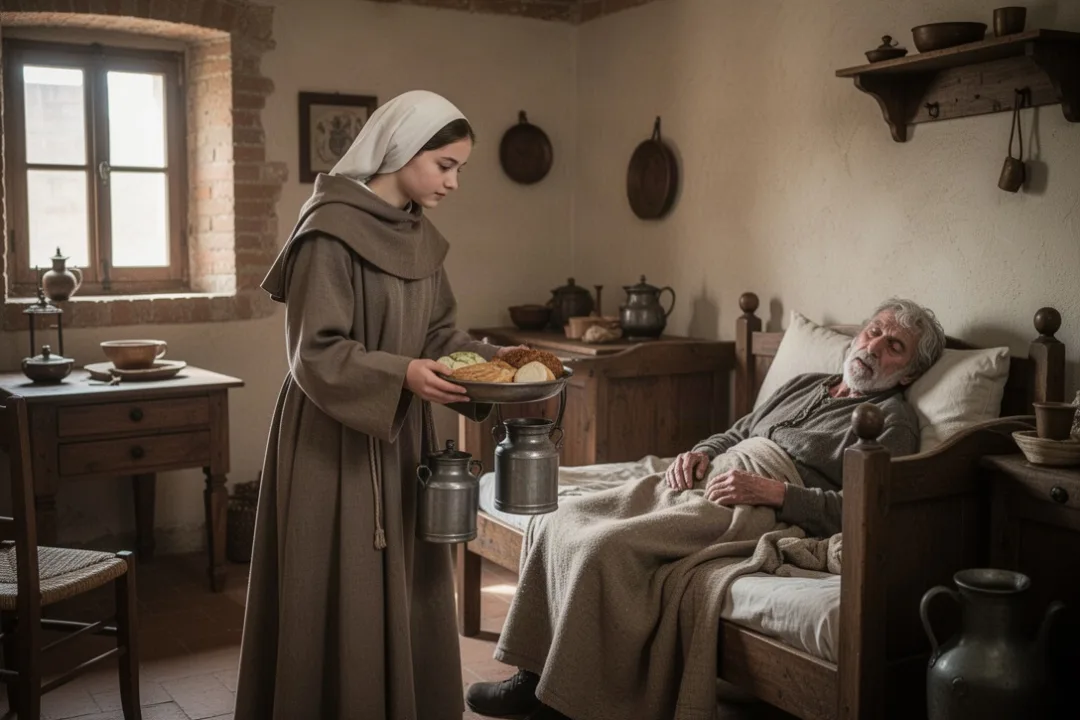
Her ministry included visiting people with serious illnesses, including those whom others avoided because of fear of infection. She cared for the poor and helped people in distress. These acts were not separate from her theological writing. They gave concrete form to her belief that Christ is encountered in the neighbor who needs mercy.
How Katherine understood humility and freedom
Katherine’s teaching about humility was not a call to passivity or self-contempt. She described humility as seeing oneself truthfully before God: dependent on divine grace, limited in knowledge, and responsible for one’s choices. That self-knowledge could produce freedom because a person no longer had to protect an inflated reputation.
She also connected humility with a realistic knowledge of other people. Instead of expecting everyone to behave perfectly, she urged Christians to recognize weakness while still pursuing justice. Her letters frequently combine tenderness with stern correction, especially when she believed that fear, greed, or pride was damaging the Church.
Another recurring theme was the “cell of self-knowledge”, a phrase associated with her spiritual language. The image refers to an interior place where a person examines motives and recognizes both human limitations and God’s mercy. It was not meant to promote isolation from the world. Rather, self-knowledge was supposed to prepare someone to act with greater charity.
Her letters, teachings, and major writings
Katherine’s surviving correspondence is one of the clearest records of her public activity. More than 300 letters are generally attributed to her, addressed to people from many parts of Italian society. Her correspondents included popes, cardinals, monarchs, city officials, religious communities, friends, and ordinary people seeking spiritual guidance.
The letters vary in tone. Some offer encouragement, while others press a leader to make a difficult decision. She often begins with a devotional greeting and returns to several connected ideas: love of God, the need for reform, courage in suffering, and responsibility toward the common good.
Although she was not ordained, Katherine spoke with unusual authority. Her authority did not come from holding an office. It came from her reputation as a holy woman, her connections with Dominican religious life, and the confidence of people who believed she had spiritual insight.
Her most famous theological work is The Dialogue, sometimes called The Dialogue of Divine Providence. It presents a conversation between God and a human soul. The work covers sin, grace, free will, prayer, discernment, the sacraments, Christ’s sacrifice, and the responsibilities of Church leaders.
The dialogue form allowed Katherine to organize complex ideas as a spiritual conversation. God explains divine mercy, while the soul asks questions and responds. Readers should not assume that every line is a verbatim transcript of a supernatural conversation. The work reflects Katherine’s prayer, teaching, biblical imagination, and theological language as shaped through dictation and later transmission.
Her theology is strongly Christ-centered. She presents Christ’s humanity as the bridge through which people come to know divine love. The cross is not merely an event to remember; it reveals the seriousness of sin and the depth of mercy. For Katherine, receiving that mercy creates an obligation to show mercy to others.
What her teaching says about discernment
Katherine repeatedly warns against judging spiritual experiences by emotion alone. Genuine devotion, in her view, should produce recognizable fruits: greater charity, perseverance, honesty, and willingness to serve. A person who claims spiritual insight but becomes cruel, proud, or irresponsible has misunderstood the purpose of that experience.
She also believed that discernment requires action. Prayer can clarify what must be done, but clarity is tested through obedience to conscience, patient endurance, and concern for the common good. This helped her address practical questions about reconciliation, leadership, and reform rather than treating spirituality as a private feeling.
Prayer should deepen love rather than encourage withdrawal from human need.
Self-knowledge should lead to humility and honest moral judgment.
Mercy should be expressed through concrete care for other people.
Courage is necessary when truth must be spoken to powerful leaders.
Discernment should be judged by the character and actions it produces.
Katherine’s role in Church and Italian politics
Katherine lived during a period of serious political and religious division. The papacy had been based in Avignon since the early 14th century, and many people in Italy wanted the pope to return to Rome. Italian cities were also divided by rivalry, war, shifting alliances, and disputes over papal authority.
She wrote to Pope Gregory XI, urging him to pursue reform and return the papal court to Rome. Gregory did return to Rome in 1377, although the decision resulted from multiple political and ecclesiastical factors rather than from Katherine’s influence alone. It is accurate to say that she was one of the prominent voices encouraging this change, not that she single-handedly caused it.
Katherine also worked for peace among Italian communities and urged leaders to stop using violence when reconciliation was possible. Her letters to political figures often use direct language because she believed public authority carried moral obligations. Leaders, in her view, were accountable for the effects of war, corruption, and injustice on ordinary people.
After Gregory XI died, the election of Urban VI in 1378 was followed by a disputed election and the beginning of the Western Schism. Rival claimants to the papacy divided the obedience of Christians in Europe. Katherine supported Urban VI and traveled to Rome, where she encouraged him and his supporters.
Her position during the schism must be understood within the information available to her and the religious loyalties of the time. The division lasted for decades and involved complicated questions of canon law, politics, and recognition. Katherine’s response was consistent with her broader conviction that Church unity was essential, but the crisis was not resolved during her lifetime.
Historical perspective: Katherine’s political influence was real but limited. She advised important people and helped shape conversations about reform and peace, yet she did not control papal decisions or eliminate the conflicts of her era.
Her public role challenges the assumption that medieval women were absent from political and religious life. Women without formal office could influence events through correspondence, spiritual counsel, family networks, charitable work, and relationships with religious communities. Katherine was unusual in the reach of her influence, but she was part of a wider tradition of women whose religious authority affected public decisions.
Her final years, death, and recognition as a Doctor of the Church
Katherine spent her last years in Rome, supporting Pope Urban VI and praying during the crisis created by the Western Schism. Her health declined, possibly because of years of intense ascetic practice and physical strain. She died on April 29, 1380, and was buried in Rome. Her head was later taken to Siena, where it is associated with the Basilica of San Domenico.
Her feast day is April 29. She was canonized in 1461 by Pope Pius II, a fellow Sienese who had been born Enea Silvio Piccolomini. Centuries later, Pope Paul VI named her a Doctor of the Church in 1970, alongside Teresa of Ávila, making them the first women to receive that designation in the Catholic Church.
Being named a Doctor of the Church does not mean that every historical detail about a saint is certain or that the person’s writings replace Scripture or official doctrine. It recognizes the enduring value of a saint’s teaching for Christian understanding. Katherine’s recognition reflects the influence of her theology, spiritual writing, and witness to active charity.
She is also honored as a patron saint of Italy and Europe. Her patronage reflects her association with Italian religious and civic life, her efforts for unity, and the continuing importance of her writings. She is often invoked by people seeking courage in public service, care for the sick, and faithfulness during conflict.
Katherine’s writings remain useful because they connect private spiritual practice with public responsibility. She does not present prayer as a way to avoid difficult relationships or moral decisions. Instead, she asks whether prayer has made a person more truthful, more merciful, and more willing to accept responsibility.
Her example can also correct a narrow idea of leadership. She had no formal political office, military power, or academic title, but she communicated with people who possessed those forms of authority. Her influence came through moral clarity, persistence, service, and relationships built over time.
At the same time, her life should not be copied without historical and medical judgment. Practices such as extreme fasting and self-denial belonged to a particular religious culture and caused serious physical strain. The lasting lesson is not to imitate every ascetic detail, but to consider how discipline, compassion, and responsibility shape a life of faith.
Her approach to conflict offers another practical lesson. Katherine did not confuse peace with avoidance. She urged reconciliation, but she also confronted leaders and named failures. A constructive approach to conflict may require both patience with people and firmness about injustice.
Readers can apply her central themes in ordinary ways:
Set aside regular time for honest reflection rather than reacting immediately to every problem.
Pair prayer or meditation with a concrete act of care for someone who needs help.
Examine whether your convictions make you more humble and patient with others.
Speak respectfully but clearly when a decision harms vulnerable people.
Seek reconciliation without pretending that wrongdoing does not matter.
Read spiritual texts alongside historical context instead of treating every passage as detached from its time.
Katherine’s legacy is especially relevant to people who feel caught between contemplation and action. Her life shows that deep prayer and public engagement do not have to be opposing paths. For her, they belonged together: prayer revealed the demands of love, and love required service in the real conditions of family life, illness, politics, and Church division.
Frequently asked questions
Was Katherine of Siena a nun?
No. Katherine was a lay Dominican, often described as a Dominican tertiary or Mantellata. She did not live as a cloistered nun, although she followed a demanding spiritual discipline and wore a religious habit. Her vocation included prayer, charitable service, correspondence, travel, and spiritual counseling rather than life inside a convent.
What is Katherine of Siena best known for?
She is best known for her mystical writings, service to the sick and poor, letters to Church and political leaders, and efforts to encourage papal reform and unity. Her major work, The Dialogue, presents teachings about divine mercy, prayer, sin, grace, and Christian responsibility.
Why is Katherine of Siena called a Doctor of the Church?
The title recognizes the lasting importance of her teaching and spiritual writings. Pope Paul VI named her a Doctor of the Church in 1970. Her theological influence comes especially from The Dialogue and her extensive letters, which connect prayer with humility, mercy, moral courage, and service.
When is Katherine of Siena’s feast day?
Her feast day is April 29. She died on April 29, 1380, in Rome. In Catholic tradition, she is honored on that date as a saint and is also remembered as a patron saint of Italy and Europe.













Leave a Reply