Saint Pius X: Life, reforms, and lasting influence
Saint Pius X: Life, reforms, and lasting influence
If you have seen Saint Pius X named on a church, school, parish organization, or prayer card, you may wonder what made this pope so influential. Was he mainly a reformer of the Mass, a champion of religious education, or the pope who fought modernism? The answer includes all three, but his central concern was simple: help ordinary Catholics know and live their faith.
Born Giuseppe Melchiorre Sarto, Saint Pius X served as pope from 1903 to 1914. He encouraged frequent Communion, strengthened Catholic teaching, promoted sacred music, reorganized the Roman Curia, and responded forcefully to theological ideas he believed threatened core Christian doctrine. His approach combined pastoral warmth with a strong defense of tradition.
Giuseppe Sarto was born on June 2, 1835, in Riese, in the Kingdom of Lombardy-Venetia. His family was not wealthy, and his father worked as a village official. The young Sarto received early education locally and then studied for the priesthood with the support of people who recognized his ability and dedication.
He was ordained a priest in 1858. His first assignments included parish ministry, where he became known for preaching clearly, visiting the sick, hearing confessions, and teaching children. These years shaped the practical style that later marked his papacy: he wanted Catholic doctrine to reach people in language they could understand and apply.
Sarto became bishop of Mantua in 1884 and patriarch of Venice in 1893. Pope Leo XIII made him a cardinal that same year. As a bishop, he dealt with clergy formation, religious education, parish administration, and the spiritual needs of working families. His reputation was that of a disciplined administrator who remained personally accessible.
Essential context: Saint Pius X came to the papacy from parish and diocesan ministry rather than from a career as a major Vatican diplomat. That background helps explain his focus on preaching, catechism, confession, and the Eucharist.
How Saint Pius X became pope in 1903
Pope Leo XIII died in July 1903. The cardinals gathered in a conclave to choose his successor. One of the leading candidates was Cardinal Mariano Rampolla, Leo XIII’s secretary of state, but the representative of Emperor Franz Joseph of Austria-Hungary announced a veto against his election. The practice of governments attempting to influence a conclave was later explicitly prohibited by Pius X.
Cardinal Sarto initially resisted the possibility of becoming pope. After repeated ballots and further discussion, he accepted the election and chose the name Pius X. His choice connected him with earlier popes named Pius, especially Pius IX, while also signaling continuity with the Church’s recent defense of Catholic teaching.
His papal motto was “To restore all things in Christ”, drawn from Ephesians 1:10 in the Vulgate tradition. The phrase expressed his understanding of the papal office: Christian life, worship, family life, education, public conduct, and social relationships should be brought into harmony with Christ.
What Saint Pius X changed during his papacy
Saint Pius X’s work can be understood through several connected priorities. He did not treat the liturgy, religious education, Eucharistic practice, and theological discipline as separate projects. He believed that Catholics needed sound teaching, active sacramental life, and worship that directed the mind and heart toward God.
He promoted frequent Communion and encouraged Catholics to receive the Eucharist more often when properly prepared.
He lowered the usual age for First Communion, emphasizing that children who had reached the age of reason could receive with suitable instruction.
He supported sacred music reform, especially the restoration of Gregorian chant and the use of music suited to Catholic worship.
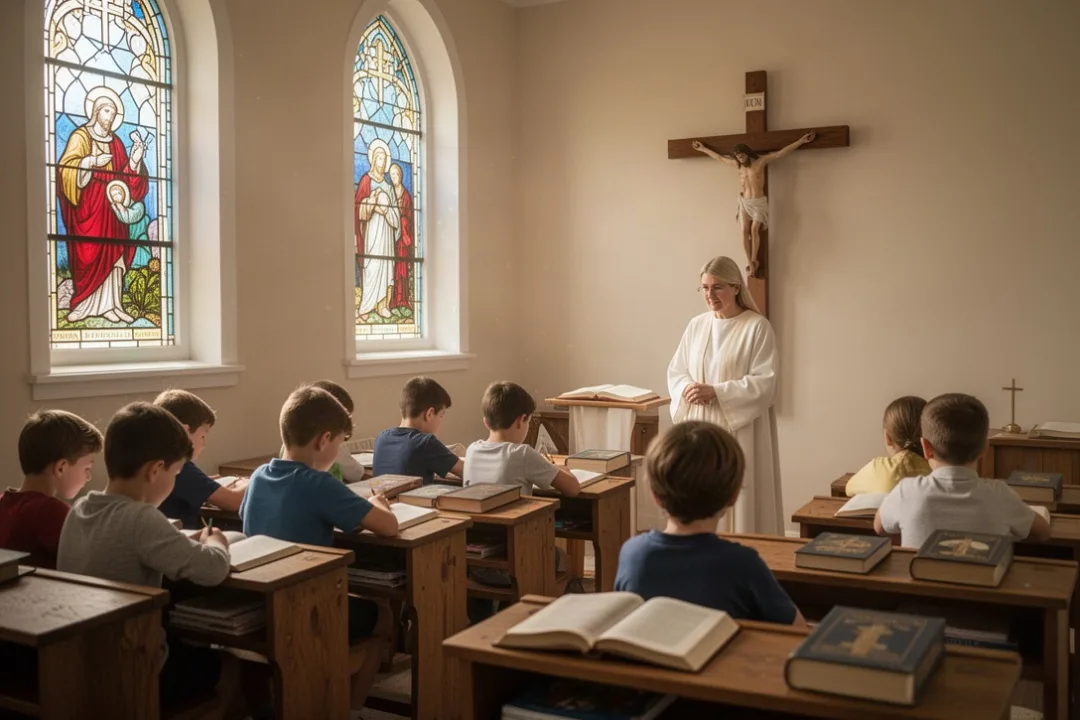
He strengthened catechesis through clearer teaching and better preparation of clergy and laity.
He reorganized Church administration and helped begin the systematic codification of canon law.
He opposed modernism, a broad set of theological and intellectual tendencies that he viewed as undermining revealed doctrine.
These priorities were not merely administrative. Pius X believed that a parish became stronger when people understood the faith, participated reverently in the sacraments, and received reliable pastoral guidance. His reforms therefore reached from the Vatican to the classroom, the choir loft, and the family table.
Why the Eucharist was central to Saint Pius X
Saint Pius X is strongly associated with the Eucharist because he wanted Communion to be a normal part of a faithful Catholic life rather than an exceptional event reserved for a few major feast days. In 1905, the decree Sacra Tridentina Synodus encouraged frequent and even daily Communion for Catholics who were properly disposed.
The decree did not mean that preparation was unimportant. Catholics were still expected to be free from serious sin, approach the sacrament with the right intention, and observe the Church’s requirements. Pius X’s emphasis was that the Eucharist should nourish Christian life, not be withheld simply because a person was not spiritually perfect.
In 1910, the decree Quam singulari addressed the admission of children to First Communion. It supported the practice of admitting children around the age of reason, commonly understood as approximately seven, provided they could understand the basic nature of the sacrament and receive appropriate preparation.
This policy changed Catholic family and parish life. Children could be introduced to the Eucharist earlier, and religious instruction became more closely connected to sacramental preparation. The emphasis was on basic understanding and sincere devotion, not on requiring children to master advanced theology.
Practical meaning: Saint Pius X’s Eucharistic teaching joined two ideas that belong together: the Eucharist is a gift that strengthens Christians, and receiving it still calls for reverence, preparation, and a life directed toward God.
How Saint Pius X approached the Mass and sacred music
Pius X considered the liturgy the primary setting in which Catholics encounter the Church’s prayer. In his 1903 instruction Tra le sollecitudini, he called for sacred music to serve worship rather than function as entertainment or performance. He favored music marked by holiness, beauty, and connection to the liturgical action.
He gave particular importance to Gregorian chant, which he regarded as especially suited to the Roman liturgy. He also supported the renewal of polyphonic music associated with earlier Catholic tradition, including the work of Giovanni Pierluigi da Palestrina. His aim was not simply to establish a preferred musical style. He wanted music to help the congregation pray and to keep the focus on the words and actions of the Mass.
The reform of sacred music was part of a broader interest in liturgical renewal. During his pontificate, attention was given to the Roman breviary and to the arrangement of the Church’s calendar and worship. Some developments associated with the liturgical movement continued after his death and eventually contributed to later reforms, though those later changes should not be attributed to Pius X alone.
For Catholics today, his principles can be applied by asking whether music is appropriate to sacred worship, whether it supports prayer, and whether it allows the liturgical texts to be heard and understood. Different communities may use different musical forms while still taking those principles seriously.
Why catechesis mattered so much to Saint Pius X
Pius X believed that weak religious instruction left Catholics vulnerable to confusion, indifference, and misleading arguments. He therefore promoted clear catechesis for children, adults, converts, and candidates for the priesthood. He wanted the central teachings of Catholicism to be presented in an orderly way rather than left to vague impressions.
His name is often connected with the Catechism of Pius X, a concise question-and-answer catechism first issued in Italian. It explained subjects such as the Creed, the sacraments, the Commandments, prayer, sin, and Christian conduct. Its short answers were designed for memorization and regular use in religious instruction.
The catechism’s exact editions and translations have varied, and Catholics should not assume that every book called the “Catechism of Saint Pius X” is an official universal catechism for the entire Church. The current universal reference is the Catechism of the Catholic Church, promulgated after the Second Vatican Council. Still, the older catechism reflects Pius X’s conviction that basic doctrine should be accessible and taught systematically.
His approach offers several useful habits for religious education:
Begin with the central beliefs of the faith rather than isolated controversies.
Use precise definitions, especially when explaining the sacraments and moral teaching.
Connect memorized answers with prayer, worship, and daily conduct.
Adapt explanations to the learner’s age without abandoning doctrinal accuracy.
Give children and adults regular opportunities to ask questions and receive clarification.
What Saint Pius X meant by opposing modernism
Modernism was not a single organization with one official program. The term was used for a range of theological and intellectual positions that appeared in the late nineteenth and early twentieth centuries. Some thinkers applied historical criticism to the Bible, questioned traditional ways of describing revelation, or argued that doctrines changed primarily according to religious experience and historical development.
In 1907, the Holy Office issued Lamentabili sane, a list of propositions judged erroneous, and Pius X published the encyclical Pascendi dominici gregis. He presented modernism as a system that could reduce revealed truth to changing human experience and weaken the authority of the Church’s teaching office.
His response was severe. In 1910, clergy were required to take the Anti-Modernist Oath, which affirmed Catholic teaching on revelation, faith, and the Church’s authority. Pius X also supported measures intended to monitor and restrict theological writings and teaching suspected of promoting modernist ideas.
Supporters saw these actions as a necessary defense of doctrinal stability during a period of rapid intellectual change. Critics have argued that the measures sometimes treated legitimate scholarly questions as if they were disloyalty and created an atmosphere of suspicion. A fair understanding of Pius X should acknowledge both realities: he wanted to protect the faith, and some methods associated with the anti-modernist campaign had damaging effects on Catholic scholarship and pastoral life.
His concern remains relevant whenever Catholics ask how to hold together faith, historical study, reason, and Church authority. His answer placed doctrinal continuity first. Later Catholic theology developed more nuanced ways of engaging historical research, but it continued to treat revelation as more than a product of changing human opinion.
Administrative and legal reforms under Saint Pius X
Pius X was not only a preacher and liturgical reformer. He also worked to make the central administration of the Church more coherent. The apostolic constitution Sapienti consilio, issued in 1908, reorganized the Roman Curia and clarified the responsibilities of its offices.
He also supported the project of gathering the Church’s universal laws into a single code. The first Code of Canon Law was promulgated in 1917, after his death, during the pontificate of Benedict XV. Because Pius X initiated and encouraged the work, historians often include canon-law codification among the major administrative projects of his pontificate, while recognizing that the completed code belongs to a later period.
These reforms addressed a practical problem: Church law had accumulated through councils, papal documents, custom, and decisions from different periods. A more systematic legal structure could help bishops, priests, religious communities, and tribunals understand their responsibilities and procedures.
How Saint Pius X responded to social and political pressures
The early twentieth century brought industrialization, secular political movements, nationalism, labor conflict, and changes in education and family life. Pius X did not develop a single political program that solved these problems. Instead, he emphasized the Church’s spiritual mission, the formation of Catholics, and the defense of principles he considered essential to Christian society.
Relations between the Catholic Church and the French government were especially difficult. The separation of Church and state in France in 1905 led to disputes over church property, public worship, and the legal status of religious institutions. Pius X opposed arrangements that he believed compromised the Church’s independence or placed its internal life under political control.
He also faced the continuing effects of the Italian question, which had shaped relations between the papacy and the Kingdom of Italy since the loss of the Papal States. His pontificate therefore operated within a Europe where religious authority and national governments frequently competed for influence.
Pius X did not live to see the full course of World War I. The war began in July 1914, and he died on August 20, 1914. Contemporary accounts describe him as deeply distressed by the conflict. His successor, Benedict XV, became pope during the war and made peace efforts a major part of his pontificate.
How Saint Pius X was canonized
Pius X was beatified in 1951 and canonized by Pope Pius XII on May 29, 1954. The canonization recognized his holiness and pastoral dedication, not the idea that every administrative decision or disciplinary measure connected with his pontificate must be treated as beyond criticism.
His liturgical feast is celebrated on August 21 in the current Roman calendar. Before calendar changes after the Second Vatican Council, his feast was observed on September 3. Catholic communities may follow approved local calendars that differ in certain details, so the parish calendar is the best guide for a particular celebration.
Saint Pius X is often invoked by people concerned with catechesis, priests, altar service, sacred music, and Eucharistic devotion. His life is also remembered as an example of pastoral service that began in ordinary parish work and continued through the highest office in the Church.
How to honor Saint Pius X in practical ways
You do not need to study every papal document to draw something useful from Saint Pius X’s example. His priorities can become concrete practices in parish and personal life.
Review the basics of Catholic teaching: Revisit the Creed, the sacraments, the Commandments, and the Lord’s Prayer using an approved catechetical resource.
Prepare for Communion thoughtfully: Take time for prayer before Mass and remain attentive during the Eucharistic celebration.
Support good religious education: Encourage age-appropriate instruction that combines memorization, explanation, prayer, and lived practice.
Listen to sacred music attentively: Learn why the parish uses particular musical forms and whether they help the congregation pray.
Pray for priests and teachers: Pius X regarded the formation of clergy and the instruction of the faithful as essential responsibilities.
Study with intellectual honesty: Ask difficult questions respectfully while distinguishing genuine scholarship from claims that deny the foundations of Christian faith.
A parish observing his feast might offer a catechetical session, organize a period of Eucharistic adoration, sing Gregorian chant, or provide a brief presentation on the history of First Communion. The best observance will connect learning, worship, and service rather than turning his memory into a purely historical exercise.
What Saint Pius X’s legacy means today
Saint Pius X remains a significant and sometimes debated figure because his legacy includes both renewal and conflict. Many Catholics appreciate his efforts to make Communion more frequent, strengthen children’s religious education, and restore a more prayerful approach to sacred music. Others focus on the restrictive side of his response to modern theological movements.
Those elements should be considered together. Pius X believed that pastoral care required firm teaching, and he believed that clear doctrine should lead to sacramental life. His critics remind readers that defending doctrine can become counterproductive when suspicion replaces careful discernment or when intellectual questions are dismissed without adequate examination.
His most enduring contribution may be the conviction that ordinary Catholic practice deserves serious attention. The way a child learns the faith, the way a congregation sings, the way a person prepares for Communion, and the way a priest teaches all shape the Church’s life. For Pius X, reform began close to the ground, in the habits that form Christian people over time.
When you encounter the name Saint Pius X, it is therefore useful to remember more than a list of papal documents. Remember a parish priest who became a bishop, a cardinal, and a pope; a leader who wanted Catholics to know their faith and receive the Eucharist; and a controversial defender of doctrinal continuity whose decisions still invite careful historical and theological discussion.
Frequently asked questions
Was Saint Pius X a traditionalist pope?
Yes, Saint Pius X strongly defended Catholic tradition, sacramental practice, and the authority of Church teaching. However, he was also a reforming pope. He changed administrative structures, encouraged frequent Communion, supported earlier First Communion for children, improved clergy formation, and promoted renewed sacred music. Calling him simply “traditionalist” can miss the practical reforms he introduced.
Did Saint Pius X write the Catechism of the Catholic Church?
No. The universal Catechism of the Catholic Church was published many decades after his death. Saint Pius X was associated with a shorter question-and-answer catechism developed for religious instruction, especially in the Italian-speaking world. That work reflects his emphasis on clear basics, but it is not the same book as the modern universal catechism.
Why is Saint Pius X connected with First Communion?
His 1910 decree Quam singulari supported admitting children to First Communion around the age of reason, commonly understood as about seven, when they had suitable preparation. This helped move First Communion earlier in childhood and emphasized that children did not need advanced theological knowledge to receive the Eucharist reverently.
What is Saint Pius X’s feast day?
Saint Pius X’s feast is celebrated on August 21 in the current Roman calendar. Older calendars listed his feast on September 3, so you may still find that date in older books or devotional materials. A parish may follow an approved local calendar, making its published schedule the most reliable guide for local observance.











Leave a Reply