Saint Dominic Savio was an Italian student and follower of Saint John Bosco who died at age 14 and was canonized by Pope Pius XII in 1954. He is remembered for his joyful devotion, strong conscience, friendship, and practical commitment to doing good in ordinary life.
Dominic was not a priest, missionary, or martyr. He was a young layperson who studied, prayed, played with friends, helped classmates, and tried to live faithfully at school and home. His story is especially meaningful for children, teenagers, parents, teachers, and anyone seeking holiness through daily responsibilities.
Dominic Savio was born on April 2, 1842, in Riva di Chieri, near Turin, Italy. His parents, Carlo and Brigida, raised him in a practicing Catholic household. His father worked as a blacksmith, and his mother was known for her steady care of the family.
From an early age, Dominic showed a serious interest in prayer and the sacraments. He received his first Communion at the age of seven, which was unusually young for his time. His preparation and conduct made a strong impression on the adults around him.
At the age of 12, Dominic met Saint John Bosco, a priest who cared for poor and working-class boys in Turin. Don Bosco recognized Dominic’s character and invited him to study at the Oratory of Saint Francis de Sales. Their relationship became one of the most important influences in Dominic’s short life.
Dominic died on March 9, 1857, at Mondonio, now known as Mondonio San Domenico Savio. He had been suffering from serious illness, and his health weakened after he returned home. The Church canonized him on June 12, 1954, during the pontificate of Pius XII.
The central lesson: Dominic Savio’s holiness was expressed through ordinary actions—praying sincerely, avoiding deliberate wrongdoing, treating others with respect, studying responsibly, and bringing peace to his companions.
Why Saint Dominic Savio is remembered
Dominic’s reputation does not rest on a long career or public achievements. His importance comes from the way he responded to the opportunities and limits of his short life. He took childhood and adolescence seriously without treating them as obstacles to holiness.
His example also challenged the idea that holiness requires dramatic or unusual circumstances. Dominic tried to become a better Christian through small, repeated decisions: telling the truth, correcting conflicts, keeping his promises, participating in worship, and helping others.
Don Bosco later wrote about Dominic’s life, and that biography shaped how many people came to know him. Some details are presented through Don Bosco’s spiritual interpretation and the customs of nineteenth-century Catholic biography. Readers can still appreciate the main themes while remembering that the account reflects its historical setting.
Dominic Savio’s life in important moments
Early family life: Dominic grew up in a Catholic family near Turin and learned prayer, work, and responsibility at home.
First Communion: At seven, he approached the sacrament with unusual seriousness and formed personal resolutions about living faithfully.
Meeting Don Bosco: At 12, he joined the Oratory of Saint Francis de Sales, where he studied and lived among other boys.
Growing in friendship: Dominic encouraged his companions, helped create a supportive community, and opposed fighting and bullying.
Founding a youth group: With several friends, he helped establish the Company of the Immaculate Conception, devoted to prayer, service, and good example.
Final illness: His health declined, and he returned to his family home, where he died in 1857.
Canonization: The Catholic Church declared him a saint in 1954, recognizing his life as an example of youthful Christian holiness.
Dominic’s childhood and family formation
Dominic’s early years were shaped by a combination of family faith and practical discipline. His household was not wealthy, and the family understood the demands of work. That setting helped him connect religious belief with ordinary obligations rather than treating prayer as separate from daily life.
Accounts of his childhood describe a boy who was attentive to religious instruction and eager to participate in worship. His parents supported this development, but Dominic’s faith was not simply passive conformity. He gradually made his own decisions about prayer, confession, Communion, and personal conduct.
His early first Communion is often associated with four resolutions: frequent confession and Communion, keeping holy days, treating Jesus and Mary as friends, and choosing death rather than deliberate sin. The exact wording varies in English versions, but the meaning is consistent: he wanted faith to shape his choices, not merely his religious identity.
His meeting with Saint John Bosco
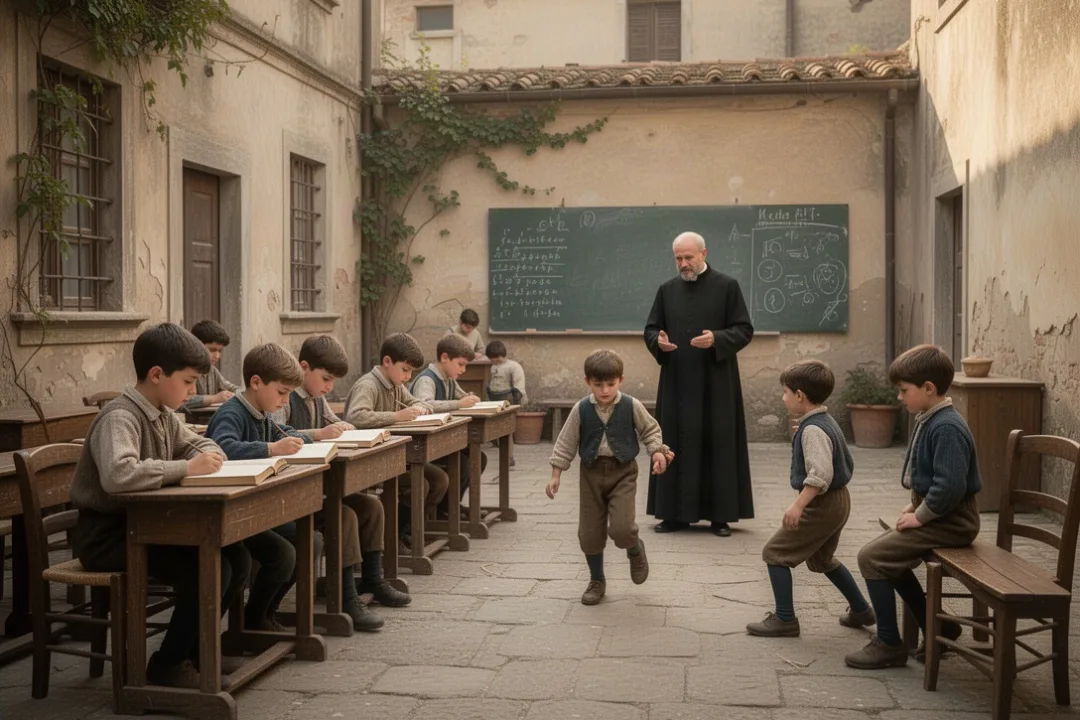
Dominic met Don Bosco in 1854, when he was 12. Don Bosco was already known for welcoming boys who needed education, guidance, and a stable community. The Oratory combined classes, religious formation, recreation, and practical support.
According to Don Bosco’s account, their first meeting left a strong impression on both of them. Dominic wanted to become a good Christian, and Don Bosco saw that the boy had the maturity and determination to grow through disciplined formation.
At the Oratory, Dominic was not placed in isolation from ordinary teenage life. He studied, spent time with friends, took part in recreation, and dealt with the same kinds of tensions that can arise in any community. His holiness developed through those relationships.
Don Bosco’s approach emphasized reason, religion, and loving-kindness. Rather than relying mainly on punishment, he aimed to create an environment in which young people felt known, guided, and responsible. Dominic responded well to this approach and became one of its clearest examples.
The lessons Dominic drew from Don Bosco
One of the most important moments in Dominic’s formation came when Don Bosco explained that holiness was not reserved for monks, priests, or people who performed extraordinary acts. A young person could become holy by being faithful to responsibilities, maintaining a cheerful spirit, and seeking to do what was right.
This teaching mattered because Dominic initially seems to have associated holiness with severe penance and demanding spiritual practices. Don Bosco redirected him toward a balanced life that included prayer, study, recreation, obedience, and service.
The guidance did not make Dominic less serious. It helped him become more practical. Instead of seeking holiness through dramatic gestures, he learned to express it in patience, self-control, and care for people around him.
Pray sincerely: Give God regular attention rather than treating prayer as a performance.
Do your duties well: Study, work, and family responsibilities can become acts of faith.
Choose joy: A healthy Christian life includes recreation, friendship, and gratitude.
Repair conflict: Do not allow anger, pride, or rivalry to control relationships.
Serve quietly: Help others without needing recognition.
Dominic Savio’s approach to holiness
Dominic’s spirituality can be understood through several connected virtues. These virtues were not abstract ideals; they appeared in his behavior at school, in the Oratory, and among friends.
Prayer and the sacraments
Dominic placed prayer and the sacraments at the center of his life. He valued confession and Communion as sources of conversion and strength. For him, religious practice was meant to change how a person lived with others.
His example does not require every person to follow identical devotional habits. It does invite you to consider whether prayer leads to greater honesty, patience, compassion, and self-control. Those practical effects were central to the way Dominic understood faith.
Joy without carelessness
Dominic was known for being cheerful, but his joy was not the same as constant amusement or avoidance of responsibility. He enjoyed recreation and friendship while remaining attentive to prayer, study, and the needs of others.
This balance is one reason his example remains accessible to young people. He did not present holiness as becoming gloomy, withdrawn, or unlike yourself. He showed that joy can coexist with seriousness of purpose.
Firmness about right and wrong
Dominic had a strong conscience. He took deliberate wrongdoing seriously and tried to avoid habits that damaged his relationship with God or other people. His well-known phrase, often rendered as “Death rather than sin,” expresses his willingness to value faithfulness above comfort.
The phrase should not be interpreted as a rejection of life or as permission for reckless behavior. It describes a moral priority: do not knowingly choose serious wrongdoing simply to gain approval, pleasure, or convenience.
Peacemaking among classmates
Dominic intervened when classmates were angry with each other. One traditional account describes him stepping between two boys who were preparing to fight and asking them to look at a crucifix before continuing. The episode illustrates his preference for reconciliation over humiliation.
Peacemaking did not mean pretending that harmful behavior was acceptable. It meant refusing to answer anger with more anger and seeking a better way to address the problem. For students and adults alike, that can involve slowing down, listening carefully, and asking what repair is needed.
The Company of the Immaculate Conception
Dominic and several companions formed the Company of the Immaculate Conception at the Oratory. This was a group of boys who wanted to grow in Christian life and support one another. It was not a club built around status; its purpose was prayer, service, and good example.
Members helped with practical tasks, supported other boys, and tried to encourage a healthier community. Their efforts included caring for students who were newer, poorer, or more isolated. Dominic’s leadership was based less on authority than on personal example.
The group shows how Dominic understood friendship. Friends were not only people with whom he shared recreation. They could also help one another resist harmful behavior and become more generous. His approach offers a useful model for youth groups, classrooms, parish communities, and families.
Make room for people who seem left out.
Correct problems without public humiliation.
Share responsibilities instead of leaving work to a few people.
Pray for one another and encourage positive habits.
Use leadership to serve the community rather than gain control.
Dominic’s illness and death
Dominic’s health began to fail while he was still a student. He was sent home for medical care, but his condition did not improve. He died at Mondonio on March 9, 1857, less than a month before his 15th birthday.
His death can be difficult for modern readers, especially because of his young age. The Church’s devotion to Dominic is not meant to glorify illness or early death. His significance lies in the way he lived, not in the fact that his life was brief.
Don Bosco remembered Dominic as a young person whose spiritual maturity had developed through grace, education, friendship, and disciplined choices. Later generations found in him an example of sanctity that is possible within adolescence.
A balanced perspective: Dominic’s story should encourage young people to live with purpose, not pressure them to imitate every detail of a nineteenth-century religious biography. Holiness includes receiving appropriate medical care, asking for help, and growing at a human pace.
Canonization and patronage
Pope Pius XII canonized Dominic Savio in 1954. His canonization recognized him as a saint for the universal Catholic Church and highlighted the possibility of holiness for young people who have not reached adulthood.
Dominic is especially associated with boys, choir members, altar servers, students, and young people. Some communities also seek his prayers for children and adolescents facing moral or personal difficulties. Patronage customs can vary by country, diocese, and devotional tradition, so local Catholic sources may list additional associations.
His liturgical memorial is commonly celebrated on May 6 in the Roman Catholic calendar. Some religious communities or local calendars may observe his feast differently. Churches and schools named for him often mark the day with Mass, prayer, service activities, or educational programs.
What Saint Dominic Savio can teach students today
Dominic’s life has practical value for students because it addresses pressures that remain familiar: the desire to fit in, conflicts with peers, fear of failure, distraction, and the challenge of balancing obligations with friendship.
His example begins with small choices rather than a promise of instant perfection. A student might decide to stop spreading gossip, apologize after an argument, include a classmate, complete an assignment honestly, or set aside a short time for prayer.
These actions may appear modest, but they form character. Dominic’s life suggests that repeated ordinary faithfulness can be more significant than occasional public displays of devotion.
Choose one daily responsibility: Complete it carefully instead of rushing through it.
Identify one relationship needing repair: Speak honestly and respectfully to the person involved.
Replace one harmful habit: Begin with a realistic change, such as reducing gossip or dishonest excuses.
Make space for prayer: Use a short, consistent practice rather than waiting for ideal conditions.
Serve someone unnoticed: Help at home, support a classmate, or contribute to a parish task.
Review the day: Ask where you acted with love and where you need forgiveness or growth.
How families and teachers can present his story
Adults can introduce Dominic to children without presenting him as an unreachable ideal. Begin with concrete events: he studied, played, prayed, faced conflicts, formed a group with friends, and tried to do what was right.
It helps to discuss both his strengths and the process of formation. Dominic was not simply born fully mature. He learned through family guidance, Don Bosco’s instruction, religious practice, and life in a community.
What is the difference between being cheerful and avoiding responsibility?
When does correcting a problem become unkind or humiliating?
What small habit could help you become more honest or patient?
How can friends encourage one another without becoming judgmental?
These questions connect Dominic’s story to real decisions. They also prevent the discussion from becoming only a list of dates and devotional phrases.
Praying with Saint Dominic Savio
Catholics who pray with Saint Dominic Savio may ask for his intercession for young people, students, families, educators, and anyone trying to live faithfully under pressure. Prayer can mention a specific concern, such as a school conflict, a difficult friendship, an examination, or the desire to make a better moral choice.
A simple prayer might ask God to give you Dominic’s faith, courage, peace, and generosity, while also asking for help to serve others in your own circumstances. You can pray privately, with family, in a classroom, or in a parish setting.
Devotion to a saint is not a substitute for responsible action. If a young person is being bullied, abused, threatened, or pressured into dangerous behavior, prayer should be accompanied by help from a trusted adult, school counselor, medical professional, pastor, or appropriate authority.
How to observe Saint Dominic Savio’s feast day
A feast day can be observed simply and meaningfully. The focus does not need to be an elaborate event. A short biography, a prayer, a service project, or a conversation about peacemaking can bring Dominic’s example into daily life.
Attend Mass or spend time in personal prayer on May 6.
Read a reliable biography of Dominic and discuss its historical context.
Invite children or students to name one practical act of service.
Pray for young people, teachers, parents, and those experiencing peer pressure.
Visit a church, school, or parish community named for Dominic Savio.
Resolve a conflict through a respectful conversation or written apology.
The best observance reflects the values Dominic practiced: faith, friendship, responsibility, reconciliation, and service. A feast day becomes more than a date when it leads to a concrete act of love.
Why his example still matters
Saint Dominic Savio’s life remains compelling because it presents holiness as both demanding and attainable. He took moral choices seriously, yet he also valued friendship, recreation, learning, and community. His example does not separate spiritual life from school, family, or ordinary social situations.
His story also gives young people a visible place in the life of the Church. They are not merely future adults waiting to become useful. Like Dominic, they can encourage others, create peaceful communities, serve people in need, and make responsible choices now.
For adults, Dominic offers a reminder to guide young people with patience and trust. For young people, he offers a model of courage that does not depend on popularity. His short life points toward a steady form of discipleship: pray sincerely, do your duties, treat people well, and choose what is right even when it costs you.
Frequently asked questions
What is Saint Dominic Savio the patron saint of?
Saint Dominic Savio is particularly associated with young people, students, choir members, and altar servers. Catholic communities may also ask for his intercession for children, adolescents, educators, and those facing moral or peer pressure. Patronage lists can differ by region, so a parish or diocesan calendar may identify additional local associations.
What was Saint Dominic Savio’s motto?
His best-known motto is commonly translated as “Death rather than sin.” The phrase expresses his determination not to choose deliberate wrongdoing for the sake of comfort, popularity, or convenience. It should be understood as a statement about moral faithfulness, not as encouragement to reject life, avoid medical care, or act recklessly.
When is Saint Dominic Savio’s feast day?
Saint Dominic Savio’s feast day is generally celebrated on May 6 in the Roman Catholic calendar. Local dioceses, schools, and religious communities may use different calendars or observances. Many mark the day with Mass, prayer for young people, educational activities, or a service project connected with Dominic’s concern for friendship and community.
How old was Saint Dominic Savio when he died?
Dominic Savio died on March 9, 1857, at Mondonio in northern Italy. He was 14 years old and would have turned 15 in early April. His young age is significant because the Church presents him as an example of holiness during adolescence, not because early death itself is considered a spiritual achievement.













Leave a Reply