Saint Bosco: His life, work, and lasting influence
Saint Bosco: His life, work, and lasting influence
If you have heard the name Saint Bosco connected with a school, youth center, or Catholic parish, you may wonder who he was and why his work still matters. Saint John Bosco was an Italian priest, educator, and founder who devoted his life to young people, especially boys living in poverty or facing neglect.
Known as Don Bosco, he believed that education should help young people become capable, responsible, and hopeful. His method emphasized reason, religion, and loving-kindness rather than fear and punishment. The communities and religious orders he established eventually carried that approach around the world.
Who Saint Bosco was and why Catholics remember him
Saint John Bosco was born on August 16, 1815, in Becchi, a small community near Castelnuovo d’Asti in the Piedmont region of northern Italy. He grew up in a farming family and lost his father when he was very young. His mother, Margaret Occhiena, played a major role in forming his faith and practical concern for people in need.
He became a Catholic priest in Turin in 1841. At the time, Turin was expanding rapidly because of industrial development, and many young people arrived from rural areas looking for work. Some had little education, unstable employment, or no safe family support. Don Bosco recognized that these young people needed more than occasional charity.
He worked to provide friendship, religious instruction, schooling, job training, and a safe place to belong. His ministry eventually became associated with the Oratory of Saint Francis de Sales, a community where boys could pray, learn, play, and receive practical help. The word “oratory” in this setting refers to a youth center connected with religious formation, not simply a room for prayer.
Saint Bosco died in Turin on January 31, 1888. Pope Pius XI canonized him in 1934. His feast day is celebrated on January 31, and he is widely recognized as the patron saint of youth, boys, apprentices, and educators.
How Saint Bosco’s childhood shaped his ministry
Don Bosco’s early life included hardship, work, and a strong religious upbringing. His family had limited resources, so he learned discipline and responsibility early. He also developed a determination to study, even though formal education was not easily available to him.
As a child, he was known for organizing other children and using skills such as juggling, storytelling, and simple performances to gain their attention. These activities were not distractions from his religious purpose. They helped him build trust and create opportunities to speak with young people about character, prayer, and wise choices.
A formative experience often associated with his vocation was a dream he described from childhood. In the dream, he saw himself trying to change unruly boys and received the message that gentleness rather than force was the proper way to help them. Don Bosco interpreted this experience as guidance for his future ministry.
His mother also taught him to connect faith with daily conduct. For Don Bosco, religion was not limited to formal ceremonies. It meant learning to tell the truth, work faithfully, forgive others, use freedom well, and care for people who were vulnerable.
Central idea: Saint Bosco did not begin with the question, “How can young people be controlled?” He asked how adults could earn their trust and guide them toward good choices.
Why Turin’s poor youth needed more than punishment
When Don Bosco arrived in Turin, the city’s industrial growth had created new opportunities but also serious social problems. Young workers could be exploited, live in crowded conditions, or become involved in crime. Young people who had migrated without their families were especially vulnerable.
Many institutions of the period relied heavily on strict rules and punishment. Don Bosco believed that a young person who had already experienced rejection would not usually respond well to more humiliation or violence. He wanted to prevent misconduct by building relationships before problems became crises.
His first efforts included visiting prisons, meeting apprentices, and searching for young people who needed support. He saw that many young offenders had grown up without stable guidance, education, or a reliable adult presence. His response was not to excuse harmful behavior, but to address the conditions that made it more likely.
Don Bosco’s centers offered several kinds of help at the same time:
Religious formation: prayer, sacramental preparation, and instruction in Christian living.
Education: literacy, basic academic subjects, and opportunities to continue studying.
Work preparation: apprenticeships, technical skills, and guidance about employment.
Community life: games, music, celebrations, conversation, and a dependable place to spend time.
Personal guidance: adults who knew the young people by name and noticed when someone was struggling.
This combination was significant. Don Bosco did not separate a young person’s spiritual life from education, health, work, friendships, or family circumstances. He treated the whole person as worthy of attention and development.
Saint Bosco’s educational approach is commonly called the preventive system. The term does not mean preventing every mistake or protecting young people from every consequence. It describes a way of accompanying them so that good decisions become more likely and serious problems can be addressed early.
Don Bosco summarized the approach through three foundations: reason, religion, and loving-kindness. These words can sound simple, but they describe a demanding form of education that requires consistency, presence, patience, and respect.
Reason means clear guidance and respectful conversation
Reason means explaining expectations instead of relying on arbitrary commands. Young people should understand what a rule protects, what behavior is expected, and what consequences may follow from a poor choice. Adults still set boundaries, but they do so in a way that recognizes a young person’s ability to think and grow.
For Don Bosco, reason also meant avoiding needless severity. Rules should be fair, understandable, and applied consistently. When a young person made a mistake, the adult’s goal was correction and growth rather than public embarrassment.
Religion means a life shaped by faith and conscience
In Don Bosco’s Catholic vision, religion gave young people a foundation for moral decisions and hope. Prayer, the sacraments, the example of the saints, and service to others were meant to form conscience rather than create fear.
His ministry centered on the belief that every young person had dignity and the possibility of holiness. He encouraged ordinary practices of faith, including frequent prayer, participation in the Church, honesty, and care for neighbors. He presented Christian discipleship as something lived in school, at work, at home, and among friends.
Loving-kindness means presence, warmth, and trust
The Italian term often associated with this third principle is amorevolezza. It is sometimes translated as loving-kindness, affection, or loving presence. The idea is not sentimental indulgence. It means that young people should know they are valued by the adults who guide them.
Don Bosco insisted that educators should be present among young people, not only watching from a distance. A teacher, mentor, or youth leader who knows the group’s interests can notice changes in mood, identify conflict early, and offer correction without making a child feel unwanted.
This principle places responsibilities on adults. They must control their own anger, keep promises, avoid favoritism, and make time for conversation. A warm tone cannot replace boundaries, but boundaries are more effective when they exist within a relationship of trust.
How Don Bosco used school, work, and recreation together
Don Bosco understood that young people need multiple ways to learn. Some did well in academic studies, while others responded better to hands-on work, music, art, sports, or practical tasks. His programs therefore included both classroom education and vocational preparation.
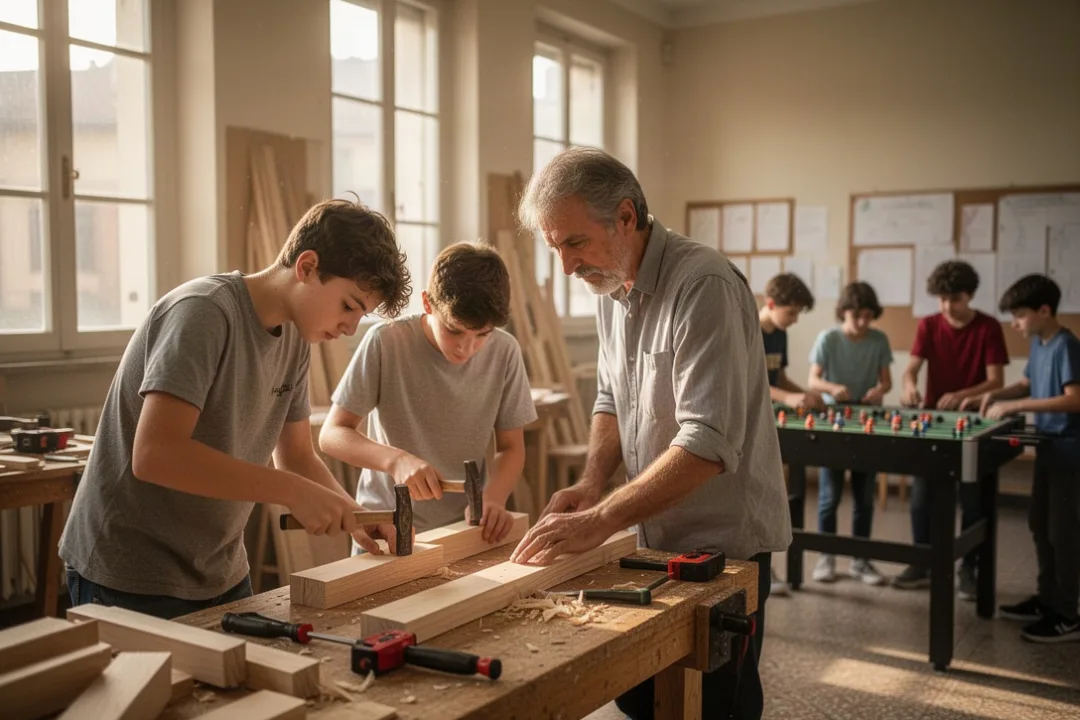
He helped establish workshops where boys could learn trades such as printing, carpentry, bookbinding, and shoemaking. These programs aimed to give young workers a better chance of finding fair employment and becoming self-sufficient. Training was connected with moral responsibility: skills should be used honestly and for the good of others.
Recreation also had a serious role. Games and celebrations created a setting where young people could relax and form friendships. They also gave educators natural opportunities to build relationships. Don Bosco believed an educator who was willing to share appropriate activities would be better able to guide a young person when difficult decisions arose.
His model can be understood as a balanced pattern:
Welcome the young person before demanding improvement.
Build a safe community with clear and reasonable expectations.
Teach useful knowledge and skills for school, work, and daily life.
Offer spiritual and moral formation according to the community’s beliefs.
Correct mistakes privately and constructively whenever possible.
Encourage responsibility instead of creating dependence on adults.
This pattern explains why Don Bosco’s work was more than a shelter or classroom. It was a community-based form of education that linked belonging with responsibility.
Who the Salesians are and how Saint Bosco’s work spread
To continue serving young people, Don Bosco founded the Society of Saint Francis de Sales, commonly called the Salesians of Don Bosco. He named the congregation after Saint Francis de Sales, a bishop and spiritual writer whom he admired for his gentle and patient approach to teaching and evangelization.
Don Bosco also founded the Daughters of Mary Help of Christians with Saint Mary Domenica Mazzarello. This congregation became known as the Salesian Sisters and extended similar educational and pastoral work to girls and young women. In addition, a wider family of lay people and religious communities developed around the Salesian mission.
Salesian organizations now serve in schools, parishes, youth centers, vocational programs, universities, missions, and social projects in many countries. Their work varies according to local needs. One community may focus on technical education, while another may support street-connected children, migrants, students, or young people facing poverty.
The essential connection is not that every program looks exactly like Don Bosco’s original oratory. It is that the work seeks to combine education, faith, practical support, and close personal accompaniment. The Salesian approach is adapted to culture and circumstance while retaining its concern for young people who need opportunity and dependable guidance.
Saint Dominic Savio and the young people Don Bosco guided
Saint Dominic Savio is one of the best-known young people associated with Don Bosco. Dominic met him at the Oratory of Saint Francis de Sales and became a student and member of his community. Don Bosco recognized Dominic’s strong faith and wrote about his life after the boy died at a young age.
Dominic is remembered not because Don Bosco expected every student to become identical to him, but because his life illustrated a form of holiness available in ordinary circumstances. He tried to grow in friendship, responsibility, prayer, and service while living as a student among other young people.
Don Bosco also worked with many boys whose stories were less widely recorded. His ministry was not limited to exceptional students or those already prepared for religious life. He wanted to reach young people who were confused, disruptive, poor, or overlooked.
That point matters when considering his legacy. Saint Bosco’s vision was not simply to create impressive graduates. It was to help each young person develop according to his or her abilities, circumstances, and calling.
Common mistakes when applying Saint Bosco’s approach
People sometimes admire Don Bosco’s emphasis on kindness but reduce his method to being permissive. Others focus on discipline and overlook the trust that made his discipline effective. A more accurate application avoids both extremes.
Being friendly without setting limits: Warm relationships need clear expectations. Young people feel safer when boundaries are predictable.
Using public shame as correction: Humiliation may produce silence, but it rarely builds mature responsibility or trust.
Giving rules without explanation: Reasonable explanations help young people understand the purpose behind a standard.
Waiting until misconduct becomes severe: Regular presence and early conversation can prevent small problems from becoming serious.
Treating recreation as unimportant: Shared activities often create the relationships that make guidance possible.
Expecting one method to fit everyone: Students differ in learning style, temperament, family situation, and ability.
Confusing religious formation with pressure: Faith should be taught with integrity, respect, and a concern for conscience.
Ignoring professional safeguards: A welcoming youth program still needs appropriate supervision, reporting procedures, boundaries, and child-protection policies.
Don Bosco’s emphasis on personal presence should never be interpreted as permission for unsafe or secretive relationships. Modern schools, parishes, and youth organizations must combine relational care with clear safeguarding standards and accountable structures.
Practical test: Before correcting a young person, ask whether the person knows the expectation, understands its purpose, and believes the adult wants genuine growth rather than revenge.
Ways families, teachers, and youth leaders can use his principles
You do not need to run a religious school or work for a Salesian organization to apply elements of Saint Bosco’s approach. Parents, coaches, teachers, mentors, and volunteers can use the same basic habits in ordinary settings.
Make welcome visible and consistent
Greet young people by name, learn something about their interests, and notice who tends to stand apart from the group. A young person who feels invisible may not respond to a lecture about belonging, but a consistent welcome can slowly change that experience.
Explain rules before problems occur
State expectations in direct language and connect them with safety, fairness, learning, or respect. If a rule applies differently in different situations, explain why. Young people are more likely to accept limits when they can see that adults are applying them for a reason rather than reacting impulsively.
Correct behavior without rejecting the person
Name the behavior that needs to change, describe its effect, and state what should happen next. Avoid labels that define a child as bad, lazy, or hopeless. A correction should leave room for the person to make a better decision and return to the group.
Provide meaningful responsibility
Young people grow when they have real duties rather than only receiving instructions. Depending on age and setting, they might help prepare an activity, welcome newcomers, care for equipment, mentor a younger participant, or contribute to a service project.
Connect learning with real life
Academic concepts, religious teaching, and moral guidance become more useful when linked with practical situations. Discuss how honesty affects work, how patience affects friendships, and how responsible choices shape freedom. Saint Bosco’s method treated daily life as a place where education proves its value.
Many young people still face circumstances that resemble the challenges Don Bosco saw in nineteenth-century Turin: unstable housing, family stress, exclusion, unemployment, educational gaps, and a lack of trusted adults. The details have changed, but the need for belonging and guidance remains.
His example suggests that effective youth work should not focus only on correcting visible behavior. Programs should ask what support a young person lacks and how adults can provide it without removing personal responsibility. A safe place, a patient mentor, useful skills, and a community that expects the best can influence a life over time.
His approach also challenges adults to see education as relational. Curriculum, rules, and activities matter, but young people often remember whether an adult listened, kept a promise, defended their dignity, or gave them another chance.
For Catholic communities, Saint Bosco offers a model of evangelization that begins with service and presence. Religious teaching is more credible when young people encounter a community that welcomes them, takes their struggles seriously, and helps them develop practical gifts.
For schools and community organizations outside that tradition, his educational principles can still be useful when adapted respectfully. Reasonable expectations, positive relationships, early support, meaningful activities, and skill development are not limited to one type of institution.
How to celebrate Saint Bosco’s feast day
Saint Bosco’s feast day on January 31 can be observed in a way that reflects his priorities rather than treating it as only a historical commemoration. A parish, school, or youth group might organize an activity that brings together prayer, learning, service, and recreation.
Learn about Don Bosco’s work with young workers and underserved youth.
Invite students or parishioners to identify a local need affecting young people.
Collect school supplies, work clothing, books, or other useful items for a community organization.
Offer a skills workshop led by a trusted adult or qualified instructor.
Make time for games, music, art, or shared food that helps participants build friendships.
Pray for parents, teachers, mentors, social workers, and all young people facing hardship.
The most faithful celebration is one that makes a young person feel welcomed and gives the community a practical way to serve. Don Bosco’s legacy is best understood through action: patient guidance, honest education, responsible care, and hope grounded in everyday relationships.
Why Saint Bosco remains relevant
Saint Bosco remains relevant because he combined compassion with structure. He did not define care as removing every difficulty, and he did not define discipline as making young people afraid. He sought to help them become free enough to choose what is good and capable enough to build stable lives.
His legacy invites adults to pay attention to the young people who are easiest to overlook: the student who is behind academically, the teenager who acts out, the newcomer who has no friends, or the apprentice who lacks family support. Such young people may need more than a warning. They may need a patient relationship, practical opportunity, and someone who refuses to give up on them.
For that reason, Saint John Bosco is remembered not only as a Catholic priest from nineteenth-century Italy, but as a model of hopeful education and committed service to youth. His central question remains practical: what kind of adult presence helps a young person choose growth instead of giving up?
Frequently asked questions
Is Saint Bosco the same person as Don Bosco?
Yes. Saint Bosco usually refers to Saint John Bosco, the Italian priest and educator commonly called Don Bosco. “Don” is an Italian title used for a priest. After his canonization in 1934, he became known officially as Saint John Bosco, while “Don Bosco” remains the familiar name used by the Salesian family and many schools, parishes, and youth organizations.
What is Saint Bosco the patron saint of?
Saint John Bosco is widely recognized as the patron saint of youth, boys, apprentices, and educators. His patronage reflects his lifelong work with poor and vulnerable young people, his attention to vocational training, and his belief that teachers and mentors should guide students through encouragement, clear expectations, faith, and practical support.
What are the three principles of Saint Bosco’s educational method?
The three principles are reason, religion, and loving-kindness. Reason calls for clear rules and respectful explanations. Religion provides spiritual and moral formation within his Catholic vision. Loving-kindness means being personally present, treating young people with dignity, and correcting mistakes without humiliation or rejection.
When is Saint Bosco’s feast day?
Saint Bosco’s feast day is January 31, the date associated with his death in Turin in 1888. Schools, parishes, and Salesian communities often mark the day with prayer, educational activities, service projects, talks about youth ministry, and recreation that reflects his belief in building welcoming communities for young people.














Leave a Reply