Saint John Baptist de La Salle: life, work, and legacy
Saint John Baptist de La Salle: life, work, and legacy
When a school is trying to serve children who have few educational opportunities, the same question often arises: what should a teacher’s work accomplish beyond delivering lessons? Saint John Baptist de La Salle answered by making education a vocation centered on faith, discipline, practical learning, and personal care for students.
Born in seventeenth-century France, De La Salle became a priest and gave up a comfortable life to organize schools for children from poor families. He trained lay teachers, created a religious community devoted to education, and helped shape methods that influenced Catholic schooling around the world. He is recognized as the patron saint of teachers, Christian educators, and educational work.
Saint John Baptist de La Salle was a French Catholic priest, educational reformer, and founder of the Brothers of the Christian Schools. The community is also known in English-speaking countries as the Christian Brothers and in French as the Frères des Écoles Chrétiennes.
He was born in Reims, France, on April 30, 1651, into a well-connected family. His early life suggested that he might follow a traditional path within the church while maintaining a respectable social position. Instead, his encounter with teachers working among poor children gradually changed the direction of his life.
De La Salle believed that children needed more than occasional charity or basic religious instruction. They needed stable schools, capable teachers, sound habits, and an education that prepared them for responsible Christian and civic life. His work brought together teacher formation, organized schooling, and concern for students who were often overlooked.
The central idea: De La Salle treated teaching as a serious vocation. For him, educators were responsible not only for academic instruction but also for helping students grow in character, faith, and practical wisdom.
How De La Salle moved from priesthood to education
De La Salle was ordained a priest in 1678. Around this period, he became involved with a group of lay teachers who were serving children in Reims. Their work was difficult: many teachers lacked training, schools were poorly organized, and poor families often had limited access to formal education.
At first, De La Salle helped the teachers with advice and practical support. His commitment deepened when he began sharing his home and daily life with them. This decision separated him from the expectations attached to his family background and placed him directly alongside the educators he hoped to serve.
He discovered that establishing a school was only part of the problem. A school also needed teachers who understood classroom management, lesson planning, student relationships, and the spiritual purpose of education. As a result, he focused on forming a stable community of teachers rather than relying on isolated individuals.
This change was costly. De La Salle faced opposition from established educational interests, financial uncertainty, criticism from some church authorities, and disagreements within the community. He also experienced periods of discouragement. His response was to refine the organization and continue building a model that could last beyond his own lifetime.
What Saint John Baptist de La Salle changed in education
De La Salle’s educational contribution was not one isolated invention. It was a connected system of ideas and practices designed to make schooling more effective and more accessible. His work can be understood through several major changes.
He developed teacher communities: Educators lived and worked together, shared responsibilities, and supported one another in their vocation.
He emphasized teacher preparation: Teachers were expected to learn how to teach, not simply to know the subject matter.
He promoted instruction in the local language: Students could learn more effectively when lessons were given in a language they understood, rather than only in Latin.
He encouraged orderly classrooms: Clear routines, consistent expectations, and careful use of time helped students learn.
He supported practical education: Reading, writing, arithmetic, religion, and useful skills were connected to daily life.
He sought access for poor children: His schools were intended to reach students whose families could not easily afford elite education.
These practices may seem familiar now, but they were significant in a period when schooling was often irregular and heavily dependent on private arrangements. De La Salle helped move education toward a more organized, communal, and professional model.
How his schools were organized
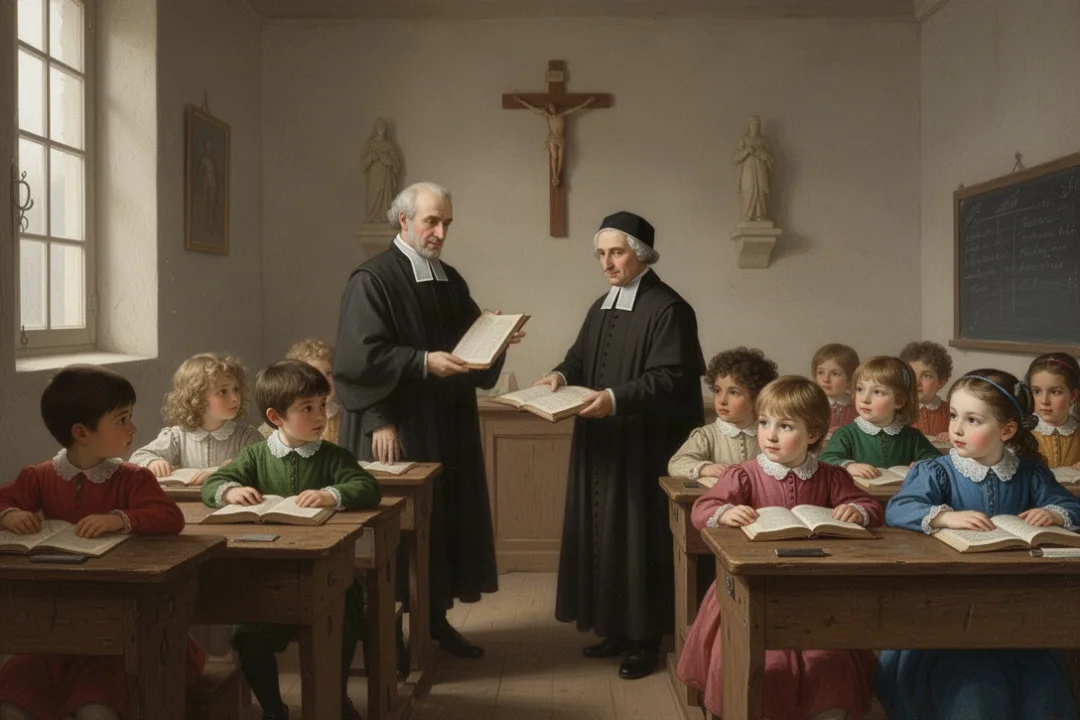
One of De La Salle’s best-known contributions was the development of a structured classroom system. His schools generally brought students together in groups rather than teaching each child separately. This allowed one teacher to instruct more students while maintaining a defined progression through the material.
Lessons were planned according to the students’ level. Children could move through stages of learning instead of receiving random instruction based on whichever teacher happened to be available. The system also made it possible to establish common expectations for attendance, conduct, reading, writing, and religious formation.
De La Salle paid close attention to classroom details because he understood that small habits influence the quality of learning. He addressed questions such as how teachers should speak to students, how classes should begin, how mistakes should be corrected, and how order could be maintained without needless harshness.
His approach was not identical to modern education. Some disciplinary practices of his era differ sharply from current standards, and his schools operated within the religious and social assumptions of seventeenth-century France. Still, his insistence on trained teachers, consistent routines, and respect for the student’s formation remains influential.
De La Salle viewed teachers as more than hired instructors. He believed they were entrusted with the development of young people and therefore needed intellectual, moral, and spiritual preparation. A teacher’s personal example mattered because students learned from conduct as well as from formal lessons.
His community gave teachers a shared rule of life, common training, and a sense of mission. The goal was not simply to place adults in classrooms. It was to build a group capable of sustaining schools, evaluating its work, correcting weaknesses, and serving students consistently.
Several principles from his approach remain relevant for educators today:
Know the students: Effective teaching begins with attention to students’ abilities, circumstances, language, and needs.
Prepare carefully: Clear objectives and organized lessons make learning more accessible.
Set firm, fair expectations: Students benefit from structure when rules are explained and applied consistently.
Correct with dignity: Discipline should address behavior without reducing a student to a mistake.
Work as a professional community: Teachers improve when they share strategies, concerns, and responsibility.
Connect education with life: Knowledge becomes more meaningful when students can use it in practical and moral decisions.
These principles help explain why De La Salle is remembered by educators even outside the schools directly connected with his religious order. His legacy is tied to the conviction that the quality of education depends greatly on the formation and support of teachers.
The founding of the Brothers of the Christian Schools
The teachers gathered around De La Salle gradually became a distinct religious community. Unlike many traditional religious orders, the members of this community were not ordained priests. They were lay Brothers whose primary work was education.
This was a significant choice. De La Salle wanted the community to remain focused on schools and on the daily work of teaching. The Brothers lived in community, followed a shared rule, and dedicated themselves to the education of children, particularly those who lacked access to good schools.
The community became known as the Institute of the Brothers of the Christian Schools. Its members established schools in different places, trained new teachers, and carried De La Salle’s educational methods beyond Reims. The organization’s stability helped preserve and extend his work after his death.
De La Salle also helped create schools with different purposes. These included elementary schools, programs connected with trade and practical work, and institutions for teacher preparation. His educational vision was broad enough to include ordinary children, apprentices, young people in need of additional support, and educators themselves.
Important writings associated with De La Salle
De La Salle wrote or helped prepare materials for teachers and students. These writings reveal his concern for both classroom practice and spiritual formation. They were intended to guide the community’s daily work, not merely to express abstract educational theory.
The Conduct of the Christian Schools
The Conduct of the Christian Schools offered detailed guidance for organizing classrooms and carrying out instruction. It addressed schedules, student groupings, reading lessons, teacher behavior, discipline, and other practical matters. The work is valuable because it shows how carefully De La Salle considered the ordinary mechanics of teaching.
The Rules of Christian Decorum and Civility
This work presented standards for courteous behavior and social conduct. It reflected the customs of De La Salle’s period, but its broader purpose was to teach students how their actions affect other people. Respect, self-control, attentiveness, and appropriate speech were treated as parts of education rather than separate from it.
Meditations for the Time of Retreat
In his meditations for teachers, De La Salle described education as a form of service and encouraged educators to see their students as entrusted to their care. He connected teaching with patience, responsibility, prayer, and personal example. The writing is especially important for understanding why he considered education a vocation.
His works were practical and pastoral. They did not separate academic achievement from the formation of the whole person. For De La Salle, reading and arithmetic mattered, but so did honesty, responsibility, compassion, and the ability to live well with others.
What De La Salle believed about students
De La Salle’s view of students was shaped by Catholic theology and by close observation of children’s daily realities. He believed young people were created by God and worthy of serious care. At the same time, he recognized that students needed guidance, correction, and habits that would help them make responsible choices.
His schools aimed to serve children who might otherwise be excluded from sustained education. This concern for access was not based only on economic efficiency. He believed that education helped students understand their dignity, participate in society, support their families, and live according to Christian principles.
He also understood that children do not all learn in the same way or at the same pace. Grouping students by level, using repetition, and creating predictable routines were ways of responding to real classroom needs. His methods sought to make instruction understandable rather than reserving serious education for a small elite.
For modern readers: De La Salle’s methods should be read in historical context. His lasting contribution is not that every old classroom practice should be copied, but that schools should take student access, teacher preparation, and humane instruction seriously.
Challenges and criticism during his lifetime
De La Salle’s work did not develop without conflict. Teachers’ guilds and established schools sometimes viewed his free or affordable educational model as a threat. Expanding access could challenge systems that depended on tuition, private tutoring, or restricted admission.
He also faced financial difficulties. Operating schools for poor children required buildings, supplies, food, and trained staff. The community’s commitment to serving families with limited resources made financial planning a continuing concern.
Within his own community, members did not always agree about leadership, discipline, or the direction of the schools. De La Salle’s decisions could be demanding, and his determination to preserve the community’s mission sometimes produced tension. His later years included illness, opposition, and periods when he withdrew from active leadership.
These difficulties show that his achievement was not simply the result of a clear plan carried out easily. He built an institution while responding to changing needs, resistance, and limited resources. The durability of the Christian Brothers came from adapting the work without abandoning its central purpose.
His death, canonization, and recognition
Saint John Baptist de La Salle died in Rouen, France, on April 7, 1719. The date is observed as his feast day in the Catholic Church. His life had already influenced a growing network of schools, but recognition of his sanctity continued through the church’s formal process.
He was canonized by Pope Leo XIII in 1900. In 1950, Pope Pius XII proclaimed him the patron saint of all Christian educators. This title reflects the connection between his spiritual life and his practical work in schools.
His memorial is especially meaningful to teachers, school administrators, catechists, education students, and members of the Lasallian tradition. People may also turn to him when seeking guidance for students who are struggling, schools serving disadvantaged communities, or educational work that requires patience and perseverance.
How schools and educators honor Saint John Baptist de La Salle
Schools connected with the Christian Brothers often identify themselves with the Lasallian tradition. “Lasallian” refers to the educational heritage associated with De La Salle and the Brothers of the Christian Schools. The tradition has spread across many countries and includes schools, colleges, universities, educational centers, and social ministries.
These institutions do not all look alike. Some are explicitly Catholic; others serve wider communities while preserving values associated with De La Salle. Common themes include faith, service, respect for human dignity, concern for the poor, and the belief that education can contribute to social change.
A school may honor him through:
A feast-day liturgy or prayer service on or near April 7.
An assembly focused on teachers’ service and students’ responsibilities.
Community service for families experiencing poverty or exclusion.
Teacher formation based on the Lasallian tradition.
Recognition of educators who demonstrate patience, fairness, and dedication.
Reflection on how school policies affect students with the fewest resources.
The strongest way to honor De La Salle is not simply to display his image or repeat his name. It is to examine whether a school’s daily practices reflect care for students, respect for educators, and a serious commitment to accessible learning.
What Saint John Baptist de La Salle can teach teachers today
Teachers working in modern classrooms face circumstances De La Salle could not have imagined, including digital learning, multicultural student populations, complex support needs, and rapidly changing professional expectations. His historical methods cannot answer every current question, but his central principles still offer useful direction.
First, he reminds educators that preparation matters. Good intentions are not enough when students depend on a teacher’s judgment every day. Planning, professional learning, collaboration, and honest reflection improve the chances that students will receive effective instruction.
Second, he emphasizes the importance of relationships. Students are more likely to engage when they know that an educator sees them as people rather than as test scores or discipline problems. This does not eliminate high standards; it makes those standards more credible and more humane.
Third, his example points toward service. Education can reproduce inequality when schools ignore barriers related to poverty, language, disability, or family circumstances. A Lasallian approach asks educators to look closely at who is being left out and what the school can change.
Finally, De La Salle presents teaching as shared work. Teachers, families, administrators, counselors, and community partners all contribute to a student’s formation. Schools become stronger when educators are not expected to solve every problem alone.
How to pray with or learn from De La Salle
A person may approach Saint John Baptist de La Salle through prayer, study, or practical service. Catholics often ask for his intercession for teachers, students, schools, and educational decisions. A simple prayer can name a specific need rather than relying on general language.
For example, a teacher might pray for patience with a difficult class, wisdom in supporting a struggling student, or courage to advocate for fair treatment. A student might ask for help with perseverance, respectful relationships, or responsible use of opportunities. A school community might pray for unity and concern for families facing hardship.
Learning from De La Salle can also take concrete forms:
Identify one student or group whose needs are easily overlooked.
Ask what practical barrier is making learning more difficult.
Consult colleagues or families instead of relying on assumptions.
Choose one realistic change in classroom routine or support.
Review the results and adjust the approach with patience.
This process reflects his preference for education that is organized, attentive, and connected to real circumstances. His legacy is strongest when reflection leads to better service.
Why Saint John Baptist de La Salle remains relevant
De La Salle remains relevant because the questions he faced have not disappeared. Who receives a good education? How are teachers prepared? What does a school owe students whose families have limited resources? How should discipline protect learning while preserving dignity?
His answer joined educational quality with social responsibility. He did not treat poor children as recipients of occasional kindness. He helped create institutions designed to serve them consistently and to prepare teachers for that work.
His life also shows that educational reform requires endurance. Schools change through policies and programs, but they also change through the daily choices of teachers: explaining one more time, noticing a quiet student, correcting without humiliation, and making a lesson accessible to someone who has fallen behind.
For that reason, Saint John Baptist de La Salle is remembered not only as a historical founder but as a model for educators who see teaching as a disciplined form of service. His message is practical: build strong schools, prepare teachers well, make learning accessible, and treat every student as worthy of careful attention.
Frequently asked questions
What is Saint John Baptist de La Salle the patron saint of?
Saint John Baptist de La Salle is the patron saint of teachers and Christian educators. His patronage reflects his work forming teachers, establishing schools, and developing a community devoted to educating children. He is especially associated with Catholic education, schools serving disadvantaged students, and educators who understand teaching as both a professional responsibility and a spiritual vocation.
When is the feast day of Saint John Baptist de La Salle?
His feast day is April 7, the date of his death in 1719. Schools and Catholic communities may observe the day with Mass, prayer services, teacher recognition, student activities, or service projects. The observance can focus on his commitment to accessible education and the dignity of both students and teachers.
Did Saint John Baptist de La Salle found the Christian Brothers?
Yes. He founded the Institute of the Brothers of the Christian Schools, commonly called the Christian Brothers in English-speaking contexts. The members were lay Brothers dedicated primarily to education rather than ordained priests. They lived in community, received formation, and worked to provide organized schooling for children, particularly those from poor families.
What is the Lasallian educational tradition?
The Lasallian tradition is the educational heritage associated with De La Salle and the Brothers of the Christian Schools. It commonly emphasizes faith, service, respect for human dignity, teacher formation, community, and concern for people affected by poverty or exclusion. Schools and institutions may express these values in different ways according to their location and mission.

















Leave a Reply