Madeleine Sophie Barat: life, work, and lasting influence
Madeleine Sophie Barat: life, work, and lasting influence
Madeleine Sophie Barat founded the Society of the Sacred Heart of Jesus in 1800, creating a Catholic religious community devoted especially to the education of girls and young women.
Born in France in the aftermath of the Revolution, Barat lived through a period of major political, social, and religious change. She helped rebuild Catholic education at a time when many religious communities had been suppressed, schools had been disrupted, and women had limited access to advanced learning. Her response was a network of schools shaped by faith, intellectual formation, personal attention, and service.
Madeleine Sophie Barat’s early life in revolutionary France
Madeleine Sophie Barat was born on December 12, 1779, in Joigny, France, a town in Burgundy. Her family lived during the French Revolution, when traditional institutions, including the Catholic Church, faced intense pressure. Religious houses were closed, priests were forced into hiding or exile, and public religious life was sharply restricted.
Barat’s father, Jacques Barat, worked as a cooper and vine grower. Her mother, Madeleine, came from a Catholic family. The household provided Sophie with a serious religious education, but her early formation was not limited to devotional practice. Her older brother, Louis Barat, recognized her intellectual ability and arranged an unusually demanding course of study for a girl of her time.
Under Louis’s direction, she studied subjects that were often unavailable to women, including Latin, literature, philosophy, history, and theology. This education later influenced her approach to teaching. She believed that girls and women deserved an education that developed the mind as well as the moral and spiritual life.
Her brother eventually became a priest and was connected with Joseph Varin, a Jesuit priest who wanted to establish a new religious community. The Jesuits had been suppressed in many places, and the wider Catholic Church was seeking new ways to serve communities emerging from revolutionary upheaval. Varin saw in Barat a person with the discipline, learning, and spiritual depth needed for this work.
Barat entered religious life as a young woman, but the path ahead was uncertain. The community she helped establish would need to operate in changing political conditions, develop a clear educational mission, and form members who could serve in different countries. She became its first superior general while still very young and remained its central leader for the rest of her life.
Why her childhood matters: Barat’s own education shaped her conviction that girls should receive serious intellectual training rather than an education limited to domestic accomplishments or basic religious instruction.
How the Society of the Sacred Heart began in 1800
The Society of the Sacred Heart of Jesus was founded in 1800, only a few years after the most disruptive phases of the French Revolution. The new congregation belonged to a Catholic renewal that sought to restore religious education and strengthen Christian life through schools, retreats, and community formation.
Joseph Varin played an important role in the foundation, but Madeleine Sophie Barat became the community’s defining leader. She was chosen to guide the first members and to establish the congregation’s practical and spiritual character. The Society placed devotion to the Sacred Heart of Jesus at the center of its life, expressing a focus on Christ’s love, compassion, and self-giving.
The Society did not begin simply as a school system. Its members prayed together, lived according to a common rule, and sought to serve the Church through education and religious formation. Schools became the principal way the congregation carried out its mission, particularly among girls from families who could afford formal schooling.
Barat understood education as a long-term form of service. A student’s formation involved religious belief, but it also included habits of thought, judgment, responsibility, and concern for others. The aim was not only to prepare students for social respectability. It was to form women capable of living their faith thoughtfully and contributing to their communities.
Early communities faced practical difficulties. Members had to find suitable buildings, establish schools, recruit and train religious women, manage finances, and respond to local expectations. Political authorities differed from one country to another, and Catholic institutions did not always have complete freedom to expand. Barat’s leadership required patience as well as firm judgment.
She also had to preserve a consistent identity across growing communities. A school in one city could not simply copy every practice from another location. Local languages, customs, laws, and educational needs varied. Barat worked to maintain common standards of prayer and formation while allowing communities enough flexibility to serve the people around them.
What Madeleine Sophie Barat believed about education
Barat’s educational vision joined academic learning with spiritual and personal development. She did not treat religious instruction as an isolated subject added to an otherwise secular curriculum. Instead, she saw faith as something that should influence a student’s understanding of truth, relationships, responsibility, and the dignity of other people.
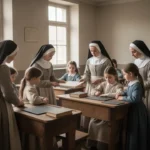
Her schools generally offered girls a broader education than was customary in many settings at the time. Programs could include religious studies, languages, literature, history, geography, music, and other academic or practical subjects. The exact curriculum differed according to place and period, but the underlying principle remained: girls were capable of serious study and deserved opportunities to develop their abilities.
Barat also placed strong emphasis on the relationship between teacher and student. Education required more than delivering information. Teachers were expected to know their students, recognize different needs, and guide them with both discipline and kindness. This approach gave personal accompaniment an important role in the life of a Sacred Heart school.
Her method was shaped by the religious culture of nineteenth-century Catholicism, so it should be understood in its historical setting. At the same time, several features remain recognizable in contemporary education:
Educating the whole person: intellectual, emotional, ethical, social, and spiritual growth were treated as connected.
Respect for each student: teachers were encouraged to see students as individuals rather than as a uniform group.
Formation for service: learning was connected with responsibility toward family, Church, and society.
High expectations: students were expected to develop their abilities rather than be defined by narrow assumptions about women’s roles.
Community life: education took place within relationships among students, teachers, families, and religious communities.
Barat’s work also reflected a belief that women could become important agents of religious and social renewal. A well-educated woman could influence a family, teach children, support charitable work, and participate responsibly in public life. Her schools therefore had effects beyond the classroom.
Her approach was not based on a single teaching technique. It was a pattern of priorities: sustained attention, careful formation, intellectual seriousness, and a stable spiritual environment. The Society’s members adapted those priorities to boarding schools, day schools, parish work, retreats, and other forms of ministry.
Barat’s educational mission treated learning as a way to form people who could recognize truth, practice responsibility, and serve others.
How Barat led the Society across Europe and beyond
Madeleine Sophie Barat led the Society for more than six decades. During that time, the congregation expanded from its beginnings in France to other parts of Europe and eventually to regions outside Europe. This growth required an organizational structure capable of supporting communities separated by distance and shaped by different cultures.
Barat traveled to visit communities and worked through correspondence when travel was impossible. Letters were essential tools for leadership in the nineteenth century. Through them, she encouraged members, addressed disagreements, reviewed the progress of schools, and helped religious communities maintain a shared purpose.
Her leadership combined close attention to practical details with a strong spiritual focus. A school needed good teachers and sound administration, but it also needed a community whose daily conduct reflected the values it claimed to teach. Barat was concerned with both dimensions.
The Society’s expansion followed several routes:
New schools: communities opened educational institutions for girls in additional French cities and other countries.
Religious formation: novitiates and other houses prepared women to join the congregation and serve its mission.
International communities: members carried the Society’s educational approach across national and linguistic boundaries.
Different educational settings: the mission developed through boarding schools, day schools, retreats, and other forms of formation.
Barat’s correspondence shows the pressures faced by a founder responsible for a rapidly growing institution. She had to address questions about community discipline, financial stability, relationships with Church authorities, the quality of instruction, and the well-being of individual members. Expansion could not be allowed to weaken the standards or identity of the congregation.
She was also leading women in a Church and society where women’s formal authority was limited. As superior general, she exercised substantial responsibility within the Society, but she did so within the structures of nineteenth-century Catholic religious life. Her influence came through governance, formation, correspondence, personal relationships, and the institutions she helped establish.
The Society’s international character became one of its defining features. Members encountered different cultures and educational systems, which required adaptation. The central mission could remain recognizable without forcing every school to look exactly the same.
A useful distinction: Barat did not personally teach every student in the schools associated with the Society. Her lasting contribution was to found, guide, and form the religious community that carried the educational mission into many places.
Barat’s spirituality and Catholic legacy
Barat’s spirituality centered on the Sacred Heart of Jesus, a Catholic devotion emphasizing Christ’s love and mercy. For the Society she founded, this devotion was not merely a private religious practice. It shaped community life, prayer, teaching, and the way members understood their service to students and families.
Her spirituality also included a strong sense of interior life. Prayer, self-examination, simplicity, and fidelity to ordinary responsibilities were important elements of the Society’s formation. Rather than separating spiritual life from daily work, Barat presented teaching and administration as places where religious commitment had to be lived consistently.
She encouraged members to combine firmness with compassion. Schools needed order and clear expectations, yet education could not be reduced to punishment or control. Students required patience, personal guidance, and opportunities to mature. The teacher’s example was part of the lesson.
Barat died in Paris on May 25, 1865. By then, the Society had grown well beyond its original French setting. Her death marked the end of a long period of personal leadership, but not the end of the educational tradition she had established.
The Catholic Church declared her a saint in 1925, during the pontificate of Pope Pius XI. Her liturgical feast is observed on May 25. She is commonly known as Saint Madeleine Sophie Barat, and Catholic educational communities associated with the Society continue to remember her as their founder.
Her legacy can be seen in several connected areas:
Women’s education: she helped establish institutions that gave girls access to sustained academic and religious formation.
Religious life: she created a congregation in which women exercised leadership through education and community organization.
International Catholic education: the Society developed schools and ministries across multiple countries.
Whole-person formation: her educational approach linked knowledge with character, faith, and service.
Leadership through formation: she prepared generations of members to continue the mission rather than making it dependent only on her personality.
Why Madeleine Sophie Barat remains relevant
Barat’s relevance does not depend only on the age of the schools founded during her lifetime. Her work raises questions that remain central to education: What knowledge should students receive? How should schools balance achievement with character? What responsibilities do teachers have toward students who need individual attention? How can education prepare people to serve a society marked by inequality and change?
Her answer placed human dignity at the center of formation. Students were not simply future workers, spouses, parents, or members of a social class. They were persons with intellectual and spiritual capacities that deserved to be developed. That conviction helped challenge assumptions that women needed only a limited education.
Her legacy also offers a model of institution-building. Barat’s achievement was not a single school or a memorable speech. She formed people, created structures, developed a common mission, and sustained them over many years. The work required daily decisions that rarely attracted public attention but made long-term expansion possible.
Modern Sacred Heart schools and communities do not reproduce every nineteenth-century practice unchanged. Educational methods, social conditions, and understandings of inclusion have developed over time. Still, many retain themes associated with Barat: attention to the whole person, respect for each individual, serious learning, community, and service to others.
Her life can also be read as part of the history of women’s leadership in the Catholic Church. She operated within the limitations of her period while creating a body in which women taught, governed communities, managed institutions, and shaped the education of thousands of students. That combination of spiritual commitment and organizational skill helps explain why her influence endured after her death.
Madeleine Sophie Barat is remembered, then, not only as a French religious founder or as the patron of a particular network of schools. She stands for an educational vision in which faith and reason, discipline and compassion, and personal growth and service belong together. Her central contribution was to make that vision practical through a community capable of carrying it across generations and borders.
Frequently asked questions
What is Madeleine Sophie Barat best known for?
Madeleine Sophie Barat is best known for founding the Society of the Sacred Heart of Jesus in 1800. The congregation developed schools and other ministries focused especially on educating girls and young women. Barat led the Society for more than sixty years and helped establish its emphasis on religious formation, academic learning, personal attention, and service.
When is Saint Madeleine Sophie Barat’s feast day?
Saint Madeleine Sophie Barat’s feast day is May 25, the date of her death in 1865. The Catholic Church canonized her in 1925. Schools and communities connected with the Society of the Sacred Heart often mark the day through prayer, liturgy, educational programs, or activities that reflect her commitment to formation and service.
Where was Madeleine Sophie Barat born?
Madeleine Sophie Barat was born in Joigny, France, on December 12, 1779. Her childhood took place during the French Revolution, a period that deeply disrupted Catholic institutions and religious education. Her older brother, Louis Barat, gave her an advanced education that included subjects rarely offered to girls at that time.
What did the Society of the Sacred Heart teach?
The Society’s schools taught Catholic religious formation alongside academic subjects such as languages, literature, history, music, and other areas of study. The precise curriculum varied by location and era. Its broader purpose was to educate the whole person by connecting intellectual development with character, spiritual life, responsibility, and service.














Leave a Reply