Gregory the Great: His life, work, and lasting influence
Gregory the Great: His life, work, and lasting influence
You may know the name Gregory the Great from Gregorian chant, a church calendar, or a quotation about spiritual leadership. But who was Gregory, and why does a sixth-century pope still matter? The short answer is that he was a Roman administrator, monk, theologian, writer, and bishop of Rome whose work helped shape medieval Christianity in the West.
Gregory lived during a period of war, disease, political uncertainty, and economic hardship. He did not lead the church from a quiet distance. As pope from 590 to 604, he organized relief for Rome, negotiated with rulers, supported missionaries, guided clergy, and wrote extensively about Christian life. His influence came not only from his office but also from his practical understanding of human weakness and responsibility.
Gregory was born in Rome around 540 into a wealthy and influential Christian family. His father, Gordianus, served in the Roman administration, and Gregory received the education expected of a member of the Roman elite. He studied grammar, rhetoric, law, and public affairs, preparing for a career in government rather than church leadership.
That career developed quickly. Gregory became prefect of Rome, the city’s chief civil official, while still a relatively young man. The position required him to manage public administration in a city facing serious decline. Rome had suffered from military conflict, famine, disease, and the breakdown of older imperial systems.
After his father’s death, Gregory chose a different direction. He converted much of his family property into monastic foundations, established monasteries, and entered monastic life himself. His monastery at Sant’Andrea on the Caelian Hill in Rome became an important spiritual home. He valued prayer, disciplined study, communal work, and service to others.
Gregory did not abandon administration when he became a monk. His ability to organize people and resources later became one of his greatest strengths as pope. He carried the habits of a Roman official into the service of the church, while his monastic formation gave that service a strong emphasis on humility, prayer, and moral responsibility.
Why Gregory became pope during a crisis
Gregory was ordained a deacon and sent to Constantinople as the pope’s representative, probably from 579 to 585. He served in the imperial capital during a period when the eastern Roman Empire remained powerful, while Rome and much of Italy faced repeated disruptions. After returning to Rome, he resumed monastic life and became abbot of Sant’Andrea.
In 590, Gregory was elected bishop of Rome, an office later commonly called the papacy. He reportedly resisted the election, preferring the quiet of the monastery, but the circumstances of Rome made strong leadership necessary. Flooding, famine, disease, and political instability had placed enormous pressure on the city.
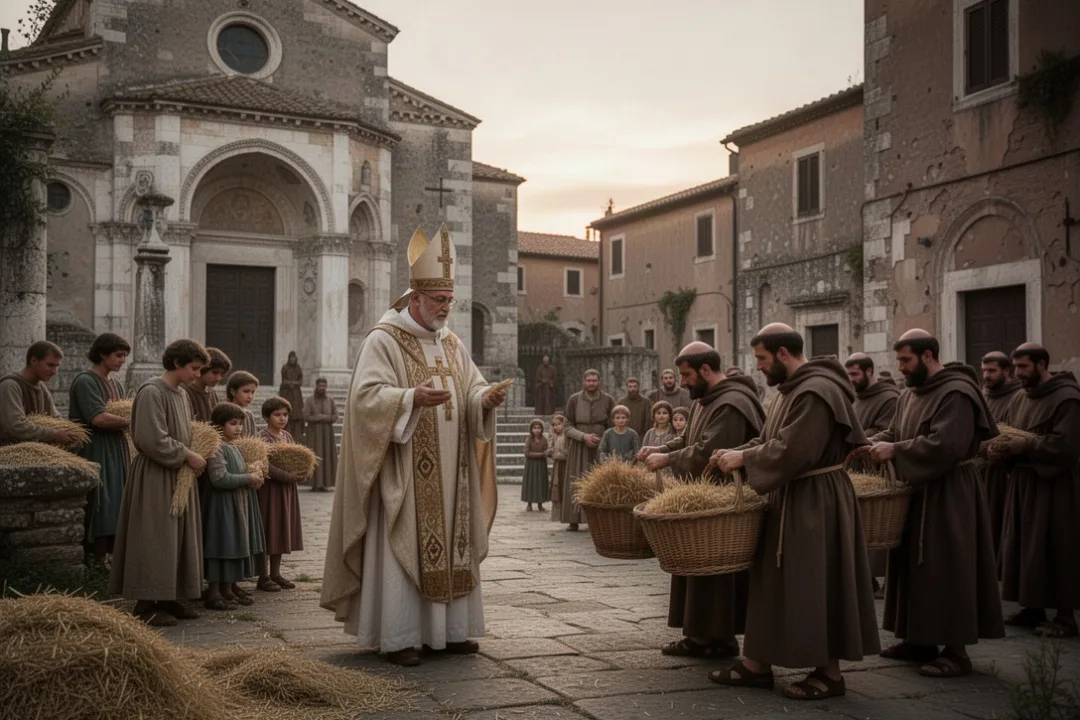
Gregory’s response combined spiritual leadership with practical relief. The church’s estates produced grain and other resources, and Gregory directed those resources toward people in need. He became involved in feeding the poor, ransoming captives, caring for refugees, and maintaining church administration in areas where civil government was weak.
A useful way to understand Gregory: he did not see prayer, theology, and public service as separate responsibilities. For him, a Christian leader had to care for souls while also responding to hunger, displacement, injustice, and disorder.
Gregory also had to deal with Lombard pressure in Italy and the limited ability of imperial authorities to protect Rome. He negotiated when necessary, communicated with local officials, and managed relationships with rulers without treating political power as the church’s ultimate authority. His letters show a leader constantly balancing ideals with urgent practical decisions.
Gregory’s understanding of the pope’s responsibility
Gregory developed a strong view of the bishop’s pastoral duty. A bishop, in his understanding, was not simply an administrator or a dignified religious figure. The bishop was a guardian of Christian teaching, a preacher, a judge in disputes, a protector of the vulnerable, and a physician for wounded consciences.
He was cautious about pride in church leadership. Gregory sometimes described the office of bishop as a heavy burden because it exposed a person to public expectations, temptation, and the danger of seeking honor. Leadership could corrupt the leader if it became a way to pursue status rather than serve people.
His famous work Pastoral Rule, also called Regula Pastoralis, explains how clergy should guide different kinds of people. Gregory argued that a pastor should not use the same approach with everyone. The strong, the weak, the wealthy, the poor, the educated, the uneducated, the joyful, and the grieving may all need different forms of counsel.
This does not mean Gregory supported inconsistency or manipulation. He believed the underlying Christian truth remained stable, while the pastoral method had to fit the person and situation. A grieving person may need comfort before correction. A proud person may need honest challenge. Someone crushed by guilt may need reassurance and a path toward restoration.
What Gregory taught in Pastoral Rule
Pastoral Rule begins with the character of the person who wants to lead. Gregory’s concern is not merely whether a leader can speak well or manage an institution. The leader must first examine whether he or she is spiritually prepared to guide other people.
Gregory warns that public religious authority can hide personal weakness. A person may want an office because it offers influence, respect, or a sense of importance. Yet the same office requires patience, self-control, knowledge, courage, and the willingness to accept criticism.
The work then considers how a pastor should teach and correct. Gregory emphasizes that good guidance requires attention to individual circumstances. Advice that helps one person may harm another if it ignores temperament, responsibilities, health, knowledge, or emotional condition.
He also stresses the importance of example. A leader cannot expect people to practice humility while displaying vanity, or to forgive while holding grudges. For Gregory, credibility grows when a teacher’s conduct supports the message being taught.
Examine your motives: ask whether service or recognition is driving your desire to lead.
Know the person: listen before offering correction or advice.
Match the response to the need: comfort, instruction, warning, or encouragement may each be appropriate.
Practice what you teach: personal conduct gives moral weight to public words.
Remain accountable: authority does not remove the need for self-examination and correction.
Although written for clergy, these principles can apply to parents, teachers, managers, counselors, and anyone responsible for other people. Gregory’s central question remains useful: does your way of leading help people become wiser and more faithful, or does it mainly make you feel important?
Gregory and the mission to England
Gregory is closely associated with the Christian mission to the Anglo-Saxons. According to the traditional account, he encountered enslaved Anglo-Saxon boys in a Roman market and became concerned that people who had not yet heard the Christian message were being treated as outsiders. Whether every detail of the story is preserved exactly as it happened, the account reflects Gregory’s interest in the peoples of Britain.
He later sent Augustine, a monk from Gregory’s monastery, with a group of missionaries to England. The mission began around 596, and Augustine reached Kent around 597. King Æthelberht of Kent allowed the missionaries to settle and preach, influenced in part by his Christian wife, Bertha, who came from a Frankish Christian background.
Gregory did not personally travel to England. Instead, he supported the mission through letters and instructions. He advised Augustine about church organization, relations with local customs, and the use of existing religious sites. One often-discussed instruction encouraged missionaries to adapt some local practices rather than destroy everything connected with earlier worship, while redirecting buildings and customs toward Christian use.
This approach reveals Gregory’s practical understanding of conversion. He wanted Christian teaching to be clear, but he also recognized that communities change gradually. Missionaries needed patience, local knowledge, and sensitivity to customs. At the same time, his mission took place within the political and cultural assumptions of late antiquity, so it should not be judged as though it operated with modern ideas about religion, empire, or cultural exchange.
The mission helped establish Christianity more firmly in parts of Anglo-Saxon England. Augustine became the first archbishop of Canterbury, and Canterbury later developed into a major center of English Christianity. Gregory’s role was therefore indirect but significant: he provided the vision, personnel, correspondence, and institutional support for a mission that had lasting consequences.
Did Gregory the Great write the Gregorian chant?
The name Gregorian chant comes from Gregory, but the traditional picture of Gregory personally composing the entire chant repertory is not supported by the historical evidence. The chant tradition associated with him developed over a long period, especially through the interaction and blending of Roman and Frankish musical practices.
Gregory did care about worship, church music, and the training of clergy. Later tradition remembered him as a major organizer of liturgical song, sometimes portraying him with a dove representing divine inspiration. That image helped connect his name with sacred music, but it does not prove that he composed the chants attributed to him.
A careful description is that Gregorian chant is a medieval liturgical tradition named in Gregory’s honor, not a collection that he can be shown to have written personally. The earliest surviving musical manuscripts associated with the repertory come from centuries after Gregory’s death.
His broader contribution to worship was still important. Gregory worked to strengthen consistency in church practice, encouraged the education of clergy, and understood liturgy as a central way communities learned Christian belief. In his view, worship was not merely decoration around doctrine. It formed memory, habits, and shared identity.
Gregory wrote across several genres, including biblical commentary, letters, sermons, spiritual instruction, and accounts of holy people. His books were widely read in the Middle Ages and helped shape Christian theology, preaching, monastic ideals, and ideas about the afterlife.
Moralia on Job
Moralia in Job, often called Morals on the Book of Job, is Gregory’s extensive interpretation of the biblical book of Job. He reads the text at several levels: as a historical account, as moral guidance, and as a spiritual interpretation pointing toward Christ and the church.
The work is not a short explanation of suffering. It explores patience, temptation, pride, grief, justice, repentance, and the hidden movements of the heart. Gregory repeatedly asks how a person should respond when outward circumstances are confusing and when suffering does not appear to match a person’s actions.
His interpretation can feel demanding because he expects readers to examine their motives carefully. He is concerned not only with obvious wrongdoing but also with subtle forms of self-deception, resentment, vanity, and spiritual complacency.
Pastoral Rule
Pastoral Rule became one of Gregory’s most influential works on Christian leadership. It was translated into several languages and read by clergy throughout the medieval West. The book’s practical emphasis distinguishes it from a purely abstract treatment of church office.
Gregory connects authority with responsibility. A pastor must teach, but also listen. A pastor must correct, but also heal. A pastor must defend the faith, but also recognize personal limits and avoid turning every disagreement into a contest of power.
Dialogues
Dialogues presents conversations about holy people, miracles, visions, and the spiritual life in Italy. Its second book, devoted to Benedict of Nursia, helped make Benedict’s name and monastic ideals widely known. The work is also one of the main sources for the traditional biography of Benedict.
Modern readers should approach Dialogues with care. Gregory was not writing a modern investigative history, and the book’s purpose was to encourage faith and moral reflection. Its stories should be read as evidence of late antique Christian spirituality and the kinds of holiness Gregory wanted to promote, rather than treated uncritically as a contemporary news report.
Letters and sermons
Gregory’s correspondence gives an unusually direct view of his daily responsibilities. His letters address bishops, clergy, monks, civil officials, soldiers, land managers, rulers, and ordinary concerns involving church property and discipline.
These letters show that Gregory could be firm and administrative. He opposed abuses, expected church officials to manage resources responsibly, and objected when vulnerable people were exploited. They also show a leader concerned with personal relationships, pastoral care, and the spiritual condition of those under his authority.
How Gregory shaped medieval Christianity
Gregory’s influence spread through a combination of institutional leadership and accessible writing. He offered a model of the bishop as a servant-administrator, a model of the monk as a disciplined seeker of God, and a model of Christian teaching that joined doctrine with moral formation.
Medieval clergy drew on his writings for sermons and guidance. Monastic communities valued his emphasis on prayer, obedience, study, and humility. His interpretations of Scripture influenced later theologians, and his ideas about judgment, repentance, and the afterlife became part of Western Christian imagination.
His reputation as “the Great” developed after his lifetime. The title does not mean he was flawless or that every later claim about him is historically certain. It reflects the breadth of his impact and the high regard in which later generations held his work.
Gregory also helped define the relationship between contemplation and action. He respected the withdrawal of monastic prayer, yet he accepted public responsibility when the church required it. His life suggests that service in the world and devotion in solitude can support each other, even though the tension between them remains real.
Common mistakes when learning about Gregory the Great
Gregory’s long influence has produced legends and simplified summaries. These mistakes can make his life seem either more straightforward or more modern than it actually was.
Credit him with composing all Gregorian chant. The chant tradition formed over centuries, even though it bears his name and he was connected with liturgical reform.
Picture him only as a mystic. Gregory wrote about prayer and visions, but he also managed food supplies, church property, diplomacy, personnel, and public crises.
Assume he was a modern humanitarian. His care for the poor and enslaved people was significant, but he lived within the social and political structures of late antiquity.
Treat every story in the Dialogues as modern biography. The work has a spiritual and exemplary purpose as well as historical value.
Separate his theology from his administration. Gregory’s practical decisions grew from his beliefs about sin, responsibility, mercy, and the role of Christian leaders.
Assume “Great” was his own title. It is a later honorific that reflects his reputation in the church.
These cautions do not diminish Gregory. They make his achievement clearer. He was not a figure from a simple age with simple answers; he was a complex leader trying to preserve Christian institutions and serve suffering communities amid social breakdown.
What Gregory the Great can teach readers today
Gregory’s writings are especially useful for anyone thinking about ethical leadership. He insists that leadership should begin with self-knowledge. Before correcting other people, a leader should recognize personal blind spots, emotional reactions, and the temptation to enjoy authority.
He also offers a strong case for context-sensitive communication. A single speech, policy, or correction will not help every person equally. Good guidance requires listening, accurate judgment, and the humility to recognize that the leader may not understand the whole situation.
His example also challenges the idea that spiritual work is separate from practical care. Feeding people, protecting church resources, negotiating peace, educating clergy, and preaching were all connected in Gregory’s understanding of Christian responsibility.
When reading Gregory, you can use these practical questions:
What problem is Gregory addressing: pride, despair, injustice, poor leadership, or confusion?
What assumptions belong to his sixth-century setting rather than to Christian teaching generally?
How does he connect inner character with public action?
Does his advice offer a useful principle for your situation, or does it depend on a historical role you do not share?
Where does he show compassion, and where does his language reflect the limits of his period?
Gregory the Great remains important because he joined intellectual depth with public responsibility. He inherited a damaged political world, entered religious life, accepted an office he did not seek, and spent his years trying to make leadership serve people rather than personal ambition. His writings preserve a demanding vision of Christian character: thoughtful, disciplined, compassionate, and accountable.
When Gregory the Great is commemorated
Western Christian traditions commonly commemorate Gregory on September 3, the date associated with his feast day. He is recognized as a pope, theologian, church teacher, and patron connected with musicians, singers, and educators in some traditions.
His historical importance does not depend on accepting every medieval legend about him. Gregory can be studied as a late Roman statesman, a monk shaped by Benedictine ideals, a bishop responding to crisis, a writer on Scripture, and an influential architect of Western Christian practice. Those several identities explain why his name has endured for more than fourteen centuries.
Frequently asked questions
Was Gregory the Great the first pope to use the title “servant of the servants of God”?
Gregory is strongly associated with the title “servant of the servants of God,” which he used to express humility in papal leadership. He did not invent every element of papal language, but he made this phrase especially prominent. It contrasted with claims to excessive ecclesiastical status and reflected his belief that authority should be exercised through service.
Did Gregory the Great meet Augustine of Canterbury?
Gregory sent Augustine and other missionaries to England, but he did not travel there himself. Augustine had been a monk connected with Gregory’s monastery in Rome. Gregory supported the mission through instructions and correspondence, while Augustine carried out the work in Kent and became the first archbishop of Canterbury.
What denomination considers Gregory the Great a saint?
Gregory is honored as a saint in the Roman Catholic Church, Eastern Orthodox churches, Anglican traditions, and some other Christian communities. He is also recognized as a major church teacher in the West. Different traditions may emphasize different parts of his legacy, including his theology, pastoral writing, monastic life, or connection with sacred music.
What is the best Gregory the Great book to read first?
Pastoral Rule is often the most accessible starting point because it directly addresses character, responsibility, teaching, and leadership. Readers interested in monastic spirituality may prefer selections from Dialogues, especially the life of Benedict. Moralia on Job is substantial and better approached through selected passages or a guided edition.












Leave a Reply