When you see a Bible in Latin, visit an ancient Christian cemetery, or hear about the early church’s struggle to define orthodox belief, you are touching subjects connected with Pope Damasus I. He led the church of Rome from 366 to 384, during a period when Christianity was gaining public influence but remained divided by serious disputes.
Damasus is remembered especially for supporting the biblical scholar Jerome, promoting the memory of martyrs in Rome, and defending the Nicene understanding of Christian faith. His papacy was also marked by a contested election, political pressure, and accusations of violence. To understand him fairly, you need to see both sides: he was a major organizer and patron of Christian culture, but he governed during a harsh and unstable age.
Damasus I was bishop of Rome from October 366 until his death on December 11, 384. He was probably born around 305, although the exact year and place of his birth are uncertain. Many accounts connect his family with the Iberian Peninsula, but the evidence is not strong enough to make that detail certain.
Before becoming pope, Damasus served in the Roman clergy. He worked as a deacon and later as a priest, gaining experience in administration, worship, and the care of Christian burial sites. His knowledge of Rome’s churches and cemeteries helped shape the priorities of his later papacy.
His election followed the death of Pope Liberius. The result was not accepted by everyone. A rival group elected Ursinus, creating a schism that lasted for years and forced civil authorities to intervene. Damasus eventually secured recognition as the legitimate bishop of Rome, but the conflict left a lasting shadow over his reputation.
The short answer: Damasus I was a fourth-century pope who strengthened Rome’s authority, defended Nicene Christianity, promoted the veneration of martyrs, and encouraged Jerome’s work on the Latin Bible.
Why was Damasus elected during a church crisis?
The Roman church was already divided when Liberius died. Some clergy and supporters chose Damasus, while others backed Ursinus. The dispute was not simply a private disagreement between two candidates. It involved competing factions, theological tensions, large crowds, and the growing relationship between Christian leaders and Roman government officials.
Violence broke out between supporters of the rival candidates. Ancient sources describe deaths and clashes, though they differ in their perspective and reliability. Damasus’ opponents accused him of using force and political influence to secure the office. His supporters presented him as the lawful bishop defending the unity of the Roman church.
The emperor Valentinian I did not settle the matter through a theological debate alone. Civil authorities eventually supported Damasus, and Ursinus was sent away from Rome. Ursinus returned more than once, and the rivalry continued to trouble the early years of Damasus’ pontificate.
Modern readers should avoid reducing the episode to a simple story of a saintly leader against an obvious villain. The sources were written in a polemical environment, and some were designed to damage Damasus’ name. At the same time, the conflict clearly shows that the Roman episcopate had become a position of considerable social and political importance.
What the disputed election reveals
Church leadership was becoming public and political: the appointment of a bishop of Rome affected urban order and attracted the attention of imperial officials.
The Roman church was not automatically united: rival groups could challenge an election and maintain separate claims.
Theological and personal loyalties overlapped: clergy and laypeople supported candidates for a mixture of doctrinal, regional, and institutional reasons.
Later judgments require caution: hostile accounts may preserve real events but present them from a partisan point of view.
How did Damasus defend Nicene Christianity?
Damasus became pope during the aftermath of the Arian controversy. The dispute centered on how to understand the relationship between the Father and the Son. The Council of Nicaea in 325 had affirmed that the Son shared the same divine nature as the Father, but disagreement continued for decades over language, authority, and the political consequences of different theological positions.
Several eastern bishops and church leaders favored formulas that avoided the Nicene term or interpreted it differently. Others believed that abandoning Nicene language weakened the full divinity of Christ. Damasus supported the pro-Nicene side and worked with other western bishops to oppose teachings associated with Arianism and related movements.
His position was not merely a matter of repeating a phrase from an earlier council. Damasus also had to deal with disputes over bishops, regional church authority, and the status of theological leaders. His correspondence and the documents associated with his pontificate show a Roman bishop presenting himself as a guardian of apostolic teaching.
In this setting, Rome’s authority grew partly because western Christians looked to the city for support when eastern controversies became difficult to interpret. Damasus did not resolve every disagreement, but he helped establish a clearer Roman alignment with the theology that later became dominant in the Catholic tradition.
A synod held in Rome in 382 is closely associated with Damasus and is important for understanding the development of biblical and doctrinal lists in the western church. The meeting addressed questions involving the Trinity, the divinity of the Holy Spirit, the authority of bishops, and the books recognized for Christian reading.
A document sometimes connected with this meeting lists books of the Old and New Testaments. However, the history is complicated. Later manuscripts and collections combined materials from different periods, and the document often called the Decree of Damasus cannot be treated as a simple, securely preserved transcript written personally by Damasus.
It is more accurate to say that Damasus’ Roman circle participated in a period when western church leaders were clarifying which books had authoritative status. The list associated with Rome in this era resembles the canon later received in the Latin Catholic tradition, but the process of recognition developed over time and was not created by one person in a single meeting.
Historical caution: Damasus is often described as the pope who officially fixed the entire biblical canon. The evidence supports a Roman role in canon discussions, but not the idea that one isolated decree instantly settled every question for all Christians.
How did Pope Damasus I work with Jerome?
Damasus is closely linked with Jerome, one of the most influential biblical scholars of late antiquity. Jerome came to Rome and served as a secretary and adviser to Damasus for a period in the early 380s. The pope valued Jerome’s command of Latin, Greek, and Hebrew and consulted him about biblical wording and difficult passages.
Latin-speaking Christians used several biblical texts that had developed through copying and local usage. These versions did not always agree with one another. Differences in wording could affect public reading, theological discussion, and the work of clergy who needed reliable texts.
Damasus encouraged Jerome to revise the Latin Gospels by comparing them with Greek manuscripts. Jerome’s work eventually became part of the long process that produced the Latin Vulgate. The Vulgate was not completed in its familiar form during Damasus’ lifetime, and Jerome’s later translation of much of the Old Testament from Hebrew went beyond the original assignment.
That distinction matters. Damasus did not personally translate the Bible, and the Vulgate was not created as a finished volume by the pope and Jerome working together. Instead, Damasus helped provide institutional support at a crucial early stage in the revision of Latin biblical texts.
What Damasus asked Jerome to improve
Consistency among Latin Gospel texts: revisions could reduce confusing differences in wording and order.
Accuracy in public reading: clearer Latin helped clergy and congregations hear a more stable text.
Relationship to Greek sources: Jerome could compare Latin copies with Greek manuscripts rather than relying only on inherited Latin forms.
Scholarly attention to difficult passages: the project encouraged careful examination of grammar, meaning, and textual variation.
Jerome’s association with Damasus also shows that Roman Christianity was not isolated from the intellectual life of the wider church. The pope relied on a scholar who had traveled widely and knew eastern Christian traditions. Their relationship helped connect Roman institutional leadership with the developing study of Scripture.
Why did Damasus place inscriptions at martyrs’ tombs?
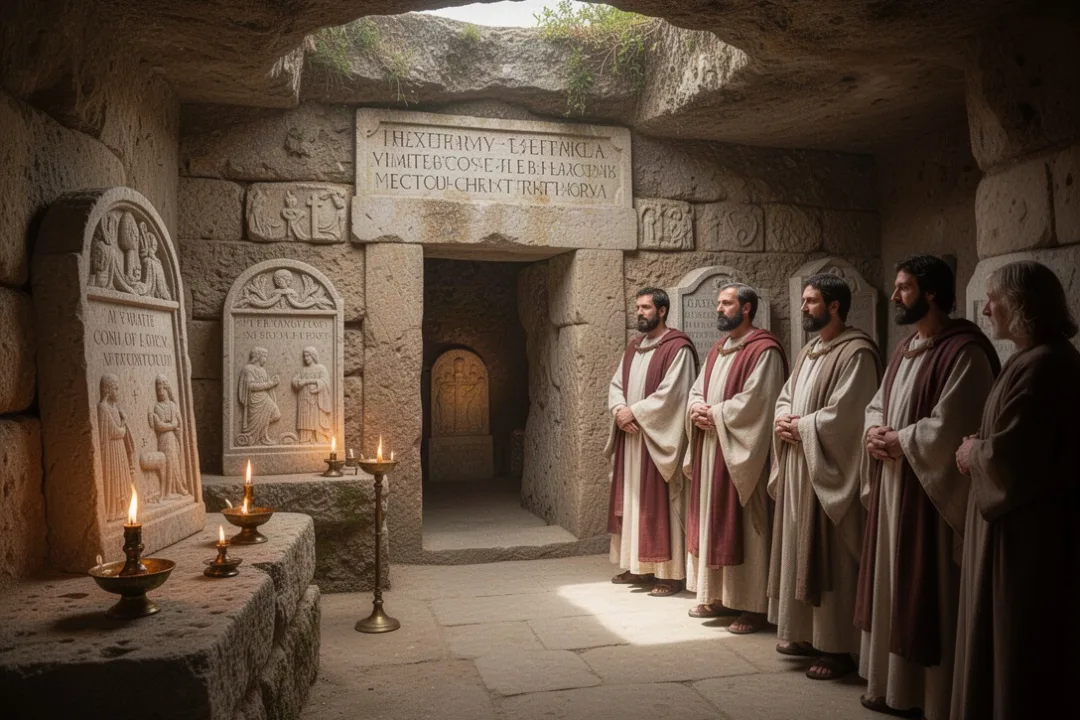
One of Damasus’ most visible contributions was his work in the catacombs and other Christian burial places around Rome. He commissioned inscriptions honoring martyrs and arranged for their tombs to be made easier to find and visit. These projects helped preserve the memory of Christians who had died for their faith during earlier periods of persecution.
The inscriptions were usually written in elegant Latin verse. Damasus composed some of the poems himself, while professional calligraphers and stoneworkers prepared them for installation. The lettering was associated especially with the craftsman Furius Dionysius Filocalus, whose distinctive style is known from surviving examples.
These texts were more than decorative labels. They told visitors who the martyr was, how the person had remained faithful, and why the burial place mattered. They also connected the living church with its local history, turning Rome’s cemeteries into places of prayer, teaching, and communal identity.
Damasus’ inscriptions often emphasize the courage of martyrs and the power of Christian faith. They do not provide complete biographies, and they sometimes reflect devotional memory rather than modern historical documentation. Their value lies in showing how fourth-century Christians remembered holiness and presented Rome as a city marked by the blood of witnesses.
How did Damasus change Christian worship and memory in Rome?
By the fourth century, Christian worship was becoming more public. The church could build, repair, and decorate significant sites in ways that had been impossible during periods of persecution. Damasus used this new freedom to strengthen Rome’s network of churches, shrines, and cemeteries.
He encouraged the restoration and identification of martyr sites, helping pilgrims and local worshipers connect specific places with the church’s past. He also promoted celebrations connected with saints and martyrs. These practices supported a developing Christian calendar in which communities remembered faithful witnesses on particular days.
The focus on martyrs served several purposes:
It honored people who had suffered for Christian belief.
It gave local congregations a shared history rooted in Rome.
It taught theological ideas through public poetry and ritual.
It strengthened the connection between Christian worship and specific places.
It presented the Roman church as a custodian of apostolic and martyr memory.
Damasus also promoted the idea that Rome’s authority was linked to its martyrs, especially Peter and Paul. By highlighting the city’s sacred geography, he gave physical form to the claim that Rome preserved an unusually important Christian inheritance.
What did Damasus contribute to the growth of the papacy?
The modern office of the pope developed gradually, and Damasus should not be treated as if he exercised the same kind of authority claimed by later medieval popes. Still, his papacy helped strengthen several features that became important in later centuries.
First, Damasus presented the bishop of Rome as a defender of correct doctrine. His support for Nicene Christianity connected Roman leadership with a broad theological movement that eventually gained imperial and ecclesiastical dominance.
Second, he used letters, synods, clergy, and Roman administrative structures to address disputes outside the city. His relationship with Jerome and his dealings with eastern controversies show a bishop who understood that Rome’s influence depended on communication beyond its own congregations.
Third, Damasus linked authority with memory. The Roman church was not merely a community with a current bishop. It was also the guardian of ancient tombs, apostolic traditions, and the stories of martyrs. This connection between place, doctrine, and succession became a lasting feature of Roman claims.
Finally, the controversy surrounding his election illustrates how much was at stake in the Roman episcopate. A contested succession could lead to violence, exile, and government intervention. The office had become too influential to be viewed as a purely local pastoral position.
What are the main criticisms of Damasus I?
Damasus’ legacy is not entirely positive. The violence connected with his election is the most serious concern. Ancient reports accuse his supporters of attacking opponents, and some accounts describe deaths in or around Roman churches. Because the sources were often partisan, historians debate the details, but the conflict cannot simply be ignored.
Critics also argue that Damasus benefited from imperial power when church leadership should have been settled internally. The removal of Ursinus by civil authority demonstrates how closely ecclesiastical disputes had become tied to Roman political administration.
Another criticism concerns the way Damasus presented himself. His inscriptions and correspondence often emphasize Roman prestige and the authority of the apostolic see. Supporters see this as a legitimate defense of church unity; critics may see it as an early example of institutional self-promotion.
These criticisms do not erase his accomplishments. They do show that the late fourth-century church was not a peaceful institution separate from public life. Christian leaders operated within systems of wealth, patronage, imperial law, and urban competition. Damasus’ career reflects those realities as clearly as it reflects devotion and scholarship.
How should Damasus’ relationship with Jerome be understood?
Jerome respected Damasus as a patron and authority, but their relationship was not free of tension. Jerome’s sharp personality and strong opinions made him valuable as a scholar but difficult for some Roman clergy and patrons. After Damasus died, Jerome eventually left Rome and continued his work in the East, especially at Bethlehem.
This later separation should not be used to dismiss their earlier collaboration. Damasus gave Jerome an important opportunity to revise Latin biblical texts, and Jerome’s abilities helped Damasus address a practical problem facing western Christianity. Their partnership also shows that major intellectual work often depended on institutional support from church leaders.
Jerome’s later biblical achievements became much larger than the work initially associated with Damasus. Even so, Damasus deserves recognition for understanding the need for improved Latin Scripture and for placing a capable scholar in a position to contribute to that effort.
What did Damasus leave behind after his death?
Damasus died in 384 and was buried in a basilica on the Via Ardeatina, near the burial places of his mother and sister. His own epitaph emphasized his Christian identity and his hope in the resurrection. Later generations remembered him as a pope, a defender of orthodoxy, a patron of biblical scholarship, and a promoter of martyr devotion.
His influence continued through several connected developments:
Latin biblical revision: Jerome’s work helped shape the textual tradition that became central in western Christianity.
Roman martyr cults: inscriptions and restored tombs preserved local memories and encouraged pilgrimage.
Pro-Nicene theology: his support contributed to the western defense of the doctrine that became orthodox Christianity.
Roman institutional identity: his papacy strengthened the presentation of Rome as a guardian of apostolic teaching and sacred history.
Christian epigraphy: his poetic inscriptions became important evidence for language, worship, and memory in late antique Rome.
For historians, Damasus is especially valuable because his legacy survives in different kinds of evidence. Letters reveal disputes and relationships. Church records show theological concerns. Inscriptions reveal how Christians shaped public memory. Archaeological remains show the physical work involved in making Rome’s holy places accessible.
Why does Pope Damasus I still matter?
Damasus matters because his papacy sits at a turning point. Christianity was no longer a persecuted minority in the Roman world, yet it had not become a unified institution. Bishops still argued over doctrine, rival leaders competed for office, and local traditions were being reorganized for a newly public church.
His work also connects several subjects that are often studied separately: the development of the papacy, the formation of biblical traditions, the memory of martyrs, and the relationship between religion and imperial power. Damasus helped shape each of these areas, even when his role was one of patronage or administration rather than direct authorship.
The most balanced judgment sees him as a capable but controversial church leader. He promoted Christian learning, supported Jerome, strengthened Roman devotion to martyrs, and defended Nicene theology. At the same time, his rise depended partly on political intervention, and the violence surrounding his election remains a serious part of his historical record.
Remembering Damasus I therefore means holding together achievement and conflict. He helped define what the Roman church wanted to be: a guardian of doctrine, a keeper of apostolic memory, a patron of Christian scholarship, and an institution with growing authority in the public life of the empire.
Frequently asked questions
Was Pope Damasus I the first pope to use the title “pope”?
No. The title developed gradually and was used in different ways for bishops and church leaders before and during Damasus’ lifetime. Damasus was important in strengthening the authority of the Roman bishop, but he was not the first person to use the term in the broad historical sense associated with it.
Did Pope Damasus I write the Latin Vulgate?
No. Jerome produced the major scholarly work behind the Latin Vulgate. Damasus supported Jerome and asked him to revise Latin Gospel texts, but the Vulgate developed over a longer period and included work completed after Damasus’ death.
Is Damasus I considered a saint?
Yes. Damasus I is honored as a saint in the Catholic Church, with a feast day on December 11. His traditional patronage is connected with archaeologists and those who study Christian inscriptions, reflecting his efforts to identify and honor martyr tombs.
Did Damasus I personally decide which books belong in the Bible?
The claim is too simple. A Roman synod associated with his papacy discussed Scripture and is linked with a list of biblical books, but the surviving evidence has a complex history. Recognition of the biblical canon developed through a broader process involving churches, councils, and long-standing usage.











Leave a Reply