Pope Leo I: life, teachings, and lasting influence
Pope Leo I: life, teachings, and lasting influence
Pope Leo I, also known as Leo the Great, served as bishop of Rome from 440 to 461. He is remembered for defending orthodox Christian teaching about Jesus Christ, negotiating with invading rulers, and establishing a clearer understanding of the pope’s pastoral and doctrinal authority.
Leo became pope during a period of political instability and theological conflict. The western Roman Empire was weakening, while disputes over Christ’s identity divided Christian communities. His letters, sermons, and diplomatic actions made him one of late antiquity’s most influential church leaders.
Leo was probably born in Italy around the end of the fourth century, although the exact year and place are uncertain. He entered church service in Rome and became a trusted adviser and deacon of the Roman Church under Popes Celestine I and Sixtus III.
His early responsibilities included handling correspondence, representing Roman interests, and assisting with important theological and administrative matters. These duties gave him experience in both church leadership and diplomacy before he became pope.
Leo was elected in 440 while he was away from Rome on a diplomatic mission in Gaul. He had been sent to help resolve a dispute among high-ranking officials, showing that church leaders could be called upon to address problems affecting the wider empire. After his election, he returned to Rome and was ordained bishop.
His papacy lasted more than two decades, from September 440 until November 461. During that time, Rome faced military threats, economic pressure, political fragmentation, and disagreements about Christian doctrine. Leo’s authority developed in response to all of these challenges rather than through one isolated event.
Key point: Pope Leo I was not only a theologian. He was a preacher, administrator, diplomat, and public representative of Rome during the final generations of the Western Roman Empire.
How Leo the Great strengthened the Roman bishop’s role
Leo understood the bishop of Rome as responsible for guarding the unity of the church. He grounded this responsibility in the apostle Peter, whom Christian tradition identified as the first bishop of Rome and a central witness to Jesus’ teaching.
In Leo’s view, the pope’s authority did not mean replacing local bishops. Instead, it involved preserving shared doctrine, correcting serious errors, and supporting the order of the wider church. His letters frequently addressed disputes in other regions, but he also expected bishops to exercise their own pastoral responsibilities.
Leo often described his ministry as an extension of Peter’s service. He did not claim that personal ability made him authoritative. Rather, he believed that the Roman bishop served the church through an office connected to Peter and through the grace of God.
This approach helped shape later ideas about papal primacy. Leo’s understanding was developed in a fifth-century setting, so it should not be treated as identical to every later Catholic teaching about the papacy. Still, his writings became important evidence for later discussions of the pope’s place in the church.
His letters also show that authority required practical care. Leo dealt with questions about clerical discipline, church property, marriage, penance, ordination, and the responsibilities of bishops. The papacy’s influence grew through these ordinary decisions as much as through major theological controversies.
What Pope Leo I taught about Jesus Christ
Leo’s most famous theological contribution concerns the identity of Jesus Christ. He taught that Jesus Christ is one person who possesses both a complete divine nature and a complete human nature.
This teaching rejected two opposite errors. One error weakened Christ’s humanity by treating his human experience as incomplete or unreal. Another separated Christ’s humanity and divinity so sharply that they seemed to belong to two different persons. Leo argued that both natures must remain fully present without being confused or divided.
His position preserved the meaning of Christian claims about Jesus’ birth, suffering, death, and resurrection. If Christ were not truly human, his suffering and human experience would not be genuine. If he were not truly divine, Christian worship and the belief in salvation would be fundamentally altered.
Leo expressed the relationship between Christ’s humanity and divinity with careful balance. Christ acts as one person, but what belongs to his divine nature and what belongs to his human nature must not be confused. This framework became central to the Christological teaching associated with the Council of Chalcedon.
“The same one is truly Son of God and truly son of man.”
This brief formulation reflects Leo’s central concern: Christian faith must hold together the full divinity and full humanity of Christ. The wording above is a concise paraphrase of his teaching rather than a quotation from a modern Bible translation.
Why the Tome of Leo became a major theological document
In 449, Leo wrote to Flavian, the patriarch of Constantinople, during a dispute over the teaching of Eutyches. The letter is commonly called the Tome of Leo. It explained Leo’s understanding of Christ’s person and responded to concerns that Eutyches had compromised Christ’s true humanity.
Leo’s letter emphasized that Christ’s two natures remain present in the unity of one person. His argument drew on earlier Christian teaching, biblical themes, and the authority of bishops who had defended the faith before him. The letter was not written as an abstract philosophical essay; it was a pastoral intervention in a dispute that had become politically and ecclesiastically serious.
A council held at Ephesus in 449 rejected or failed to give proper consideration to Leo’s position. Later Catholic writers often refer to that meeting as the Robber Council, reflecting its lack of accepted procedure and the coercion surrounding it. Flavian was treated harshly and died soon afterward.
Leo protested the proceedings and called for a properly conducted council. After the emperor Marcian came to power, church leaders gathered at Chalcedon in 451. The council examined Leo’s letter alongside Scripture, earlier councils, and the teachings of recognized church fathers.
When the bishops accepted the theological content of the Tome, they reportedly acclaimed, “Peter has spoken through Leo.” This phrase expresses the council’s recognition that Leo’s teaching agreed with the apostolic faith associated with Peter. It should not be read as meaning that the council simply accepted every papal statement without examination.
The Council of Chalcedon adopted a definition teaching that Jesus Christ is one person in two natures, divine and human. It rejected the idea that Christ’s natures were mixed or that they were separated into two persons. Leo’s Tome was a major influence on this decision, although the council’s definition also depended on the broader tradition of the church.
Read the controversy carefully: The Council of Chalcedon affirmed Leo’s Christology, but the theological disputes continued afterward. Different Christian communities interpreted the council and its language differently, and those divisions have lasted for centuries.
How Leo’s sermons explained Christian faith to ordinary people
Leo was an accomplished preacher whose sermons were designed for public worship. Many survive, especially sermons connected with Christmas, Epiphany, Lent, Easter, and the feasts of the apostles.
His preaching joined doctrinal teaching with practical moral guidance. He explained complex ideas about Christ in language intended for congregations, then connected those ideas to fasting, generosity, prayer, humility, and care for the poor.
In his Christmas sermons, Leo presented the incarnation as a reason for Christians to recognize their dignity while remaining humble. Because Christ took human nature, believers should not treat human life as worthless or use spiritual claims as an excuse for pride.
His Lenten sermons emphasized that fasting should be joined to mercy. Giving up food or other comforts had little value if a person ignored the needs of neighbors. Leo repeatedly connected religious observance with concrete acts of charity.
He also warned wealthy Christians against allowing possessions to control their lives. His criticism was not limited to one social class, since he addressed greed, vanity, resentment, sexual wrongdoing, and neglect of the poor as dangers affecting the whole community.
Leo’s sermons are valuable historical sources because they show how a fifth-century Roman bishop addressed a congregation. They provide evidence about liturgical life, Christian moral expectations, biblical interpretation, and the social pressures affecting Roman believers.
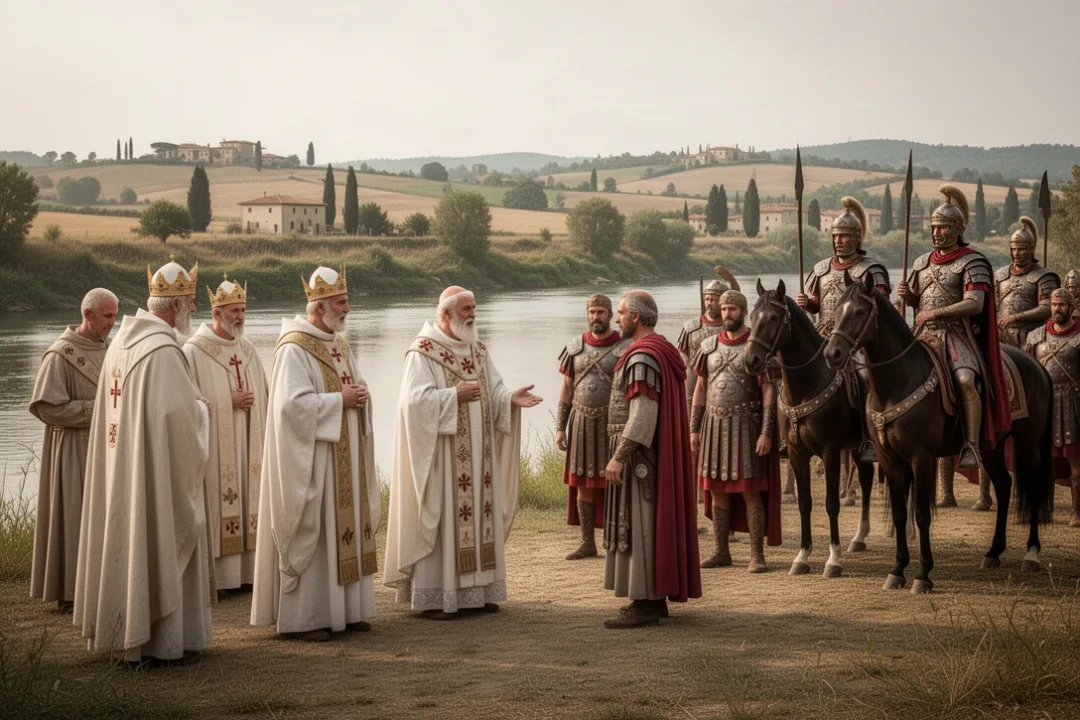
In 452, Attila and his forces invaded northern Italy. The western imperial government was struggling to respond, and Rome faced the possibility of a devastating attack. Leo joined an embassy that met Attila near the Mincio River in northern Italy, close to Mantua.
The exact details of the meeting are not known. Later accounts portray Leo as persuading Attila to withdraw through the force of his spiritual authority. A more cautious historical account recognizes that several factors may have influenced Attila’s decision, including logistical difficulties, disease, food shortages, political calculations, and the risk of an eastern Roman military response.
Leo’s participation still mattered, even if the meeting cannot be reduced to a miraculous diplomatic intervention. A bishop of Rome had become one of the most visible representatives available to negotiate on behalf of Roman society. His role shows the overlap between religious leadership and public diplomacy in the late empire.
Paintings and later stories often show Leo confronting Attila with the apostles Peter and Paul behind him. These images are devotional interpretations, not direct historical evidence. They express the belief that Leo’s authority rested on the protection and witness of the apostles.
How Leo responded to the Vandal sack of Rome
In 455, the Vandal king Genseric captured Rome. This event followed the murder of Emperor Valentinian III and a rapid political crisis. Unlike the earlier encounter with Attila, Leo could not prevent the city from being entered and plundered.
Leo did negotiate with Genseric. According to historical accounts, he obtained an agreement that the city would not be burned and that residents would not be killed indiscriminately. The Vandals still carried out a major sack, and many people were taken captive, but the negotiations may have reduced the destruction.
Leo’s response illustrates the limits of his political power. He was influential, but he did not command a stable army or control the imperial government. His authority was primarily ecclesiastical and moral, yet he used it to seek protection for Roman civilians, churches, and public buildings.
The famous stories about Leo and invading rulers sometimes make him appear to have single-handedly saved Rome. The evidence supports a more measured interpretation: he represented the city, negotiated under dangerous conditions, and tried to limit harm in a situation he could not fully control.
How Leo governed the church of Rome
Leo’s papacy involved much more than high-profile encounters. He organized the Roman clergy, responded to letters from distant bishops, and clarified expectations for Christian ministers. His correspondence reveals an administration dealing with real problems across a wide geographic area.
He addressed the selection and conduct of bishops, the handling of church property, and the return of people who had abandoned the faith during persecution or political turmoil. He also wrote about marriage and ordination, insisting that church discipline should be guided by both truth and appropriate pastoral judgment.
Leo opposed bishops taking advantage of their office for personal advancement. He expected church leaders to show restraint, protect the vulnerable, and follow established procedures. These concerns helped reinforce a model of episcopal leadership based on service, accountability, and doctrinal responsibility.
His letters also reveal a church operating across regional boundaries. A local dispute could involve several bishops, imperial officials, and the Roman bishop. Leo’s interventions helped create a stronger sense that churches shared one faith and common standards, even when communication was slow and political authority was divided.
Common mistakes when learning about Pope Leo I
Confusing Leo I with later popes named Leo. Leo the Great lived in the fifth century. He is not the same person as Leo III, Leo X, Leo XIII, or other popes with that name.
Attributing the Leonine Walls to him. The walls around the Vatican area commonly called the Leonine Walls were built centuries later under Pope Leo IV.
Assuming Leo personally stopped Attila’s invasion. Leo took part in negotiations, but Attila’s withdrawal likely had several political and practical causes.
Describing the Council of Chalcedon as accepting only Leo’s opinion. The council evaluated his Tome within the wider Christian tradition and its own deliberations.
Treating the Vandal sack as prevented. Leo negotiated limits on violence and destruction, but Rome was still sacked in 455.
Using modern papal categories without historical context. Leo strongly defended Roman authority, but the institutional papacy developed over many later centuries.
How to read Leo’s writings with better historical context
Leo’s surviving works include sermons and letters, but they do not provide a complete biography. They are official and pastoral texts, often written to persuade, correct, or teach. That means they show what Leo wanted audiences to understand, not every detail of his private life or political reasoning.
When reading the Tome of Leo, focus on its central question: how can Christian teaching affirm both the full divinity and full humanity of Jesus? The letter makes the most sense when read alongside the debates about Eutyches, Flavian, and the Council of Chalcedon.
When reading Leo’s sermons, pay attention to how he moves between doctrine and daily conduct. His theology is not separated from moral responsibility. The incarnation, in his preaching, should lead Christians toward humility, generosity, self-control, and care for people in need.
His letters should also be read within the political conditions of the fifth century. Travel was difficult, imperial institutions were unstable, and church leaders often had to perform diplomatic tasks. Leo’s strong language about Roman authority reflects both theological conviction and the practical need to coordinate a widely scattered church.
Why Pope Leo I is called “the Great”
The title Leo the Great reflects the lasting influence of his leadership, especially in Christian theology and the history of the papacy. It is not simply a claim that he was powerful or politically successful.
Leo gave a clear and influential account of Christ as one person with two complete natures. His teaching helped guide the Council of Chalcedon and became a major reference point in later Catholic theology.
He also strengthened the public identity of the Roman bishop. By presenting the pope’s ministry as a continuation of Peter’s service, Leo provided a theological foundation for Roman leadership that shaped later generations.
His diplomatic work contributed to his reputation as a protector of Rome, although the results were limited by circumstances beyond his control. His sermons and letters added a literary and pastoral dimension to that reputation.
The Catholic Church honors Leo as a saint and a Doctor of the Church, a title recognizing especially important teachers of Christian doctrine. His feast is observed on November 10. He remains one of the earliest popes whose writings survive in substantial form and whose theological influence can be traced clearly through later church history.
What remains significant about Leo’s legacy
Leo’s legacy rests on the connection he made between doctrine, pastoral care, and public responsibility. He did not treat theology as an issue detached from worship or human suffering. The way Christians understand Christ, he argued, should shape the way they live, serve, and respond to crisis.
His Christology continues to influence Christian discussions about the incarnation. His account of Roman authority remains important for Catholic teaching about the papacy, while also providing historians with evidence about how church leadership functioned in late antiquity.
Leo’s career also offers a realistic picture of religious leadership during political collapse. He could negotiate with kings, appeal to emperors, guide bishops, and preach to congregations, but he could not control every result. His influence came from a combination of office, theological clarity, institutional skill, and personal credibility.
For readers interested in early Christianity, Pope Leo I is especially useful to study because his life connects several subjects that are often treated separately: the development of doctrine, the rise of papal authority, the transformation of the Roman world, and the practical demands of caring for a vulnerable urban population.
Frequently asked questions
Was Pope Leo I the first pope to be called “the Great”?
Leo I is one of the earliest and most famous popes to receive the title “the Great,” but the title is honorific rather than an official rank. It refers to his influence as a theologian, preacher, diplomat, and church administrator. His defense of Chalcedonian Christology and his strong presentation of Roman authority are the main reasons later generations remembered him this way.
Did Pope Leo I personally defeat Attila the Hun?
No. Leo did not defeat Attila militarily. He participated in a diplomatic meeting with Attila in 452, and Attila later withdrew from Italy. Historians generally consider several possible factors, including supply problems, disease, political circumstances, and military concerns. Leo’s role was significant as a negotiator, but the withdrawal cannot confidently be credited to him alone.
What is the main idea in the Tome of Leo?
The Tome teaches that Jesus Christ is one person who is fully divine and fully human. His divine and human natures are neither blended into one nature nor separated into two persons. This explanation addressed a major fifth-century controversy and strongly influenced the Christological definition adopted by the Council of Chalcedon in 451.
How is Pope Leo I different from Pope Leo XIV?
Pope Leo I lived in the fifth century and led the church from 440 to 461. Pope Leo XIV is a modern pope from a much later period. The shared name does not indicate that they held the same historical circumstances or exercised authority in the same way. “Leo I” specifically identifies the ancient pope also known as Leo the Great.











Leave a Reply