St Dominic: life, teachings, and lasting influence
St Dominic: life, teachings, and lasting influence
St Dominic founded the Order of Preachers and dedicated his life to combining <strongcareful teaching, personal holiness, and compassion for people in spiritual crisis.
St Dominic, also known as Dominic de Guzmán, was a Spanish priest who lived during a period of serious religious and social conflict in medieval Europe. He became known for preaching the Christian faith, studying theology, living simply, and organizing a community whose members would teach wherever the Church needed them.
Dominic was born around 1170 in Caleruega, in the Kingdom of Castile, an area now located in Spain. Sources describe his family as noble, but his early life was shaped less by privilege than by education and religious formation. He studied at Palencia, where he encountered theology, Scripture, and the intellectual traditions that prepared him for public ministry.
A story from his student years illustrates the priorities associated with him. During a severe famine, Dominic is said to have sold valuable possessions, including books, to help people who were hungry. Whether every detail of the story can be verified, it reflects a consistent theme in accounts of his life: knowledge was meant to serve charity, not become a form of personal status.
Dominic joined the cathedral chapter at Osma and became a priest. He later served with Bishop Diego of Osma on a journey that exposed him to religious divisions in southern France. The experience changed the direction of his life. He came to believe that preaching would be more credible when carried out by people who practiced <strongpoverty, discipline, and humility rather than relying mainly on wealth or institutional power.
The central idea: St Dominic did not separate learning from holiness. For him, sound teaching needed a life that made the message believable, while spiritual devotion needed truth and understanding.
Dominic died in Bologna on August 6, 1221. Pope Gregory IX canonized him in 1234. His feast day is generally observed on August 8 in the Roman Catholic calendar, while some communities and liturgical traditions use other dates or commemorations.
How conflict in southern France shaped Dominic’s mission
When Dominic traveled through parts of southern France, he encountered communities influenced by beliefs that Church authorities identified as Catharism or Albigensianism. The movement was not identical everywhere, and historians continue to discuss how its ideas and organization should be described. In broad terms, Cathar teachings often presented a sharp opposition between spiritual reality and material creation, a position that conflicted with central Christian teachings about creation, the Incarnation, and the goodness of the body.
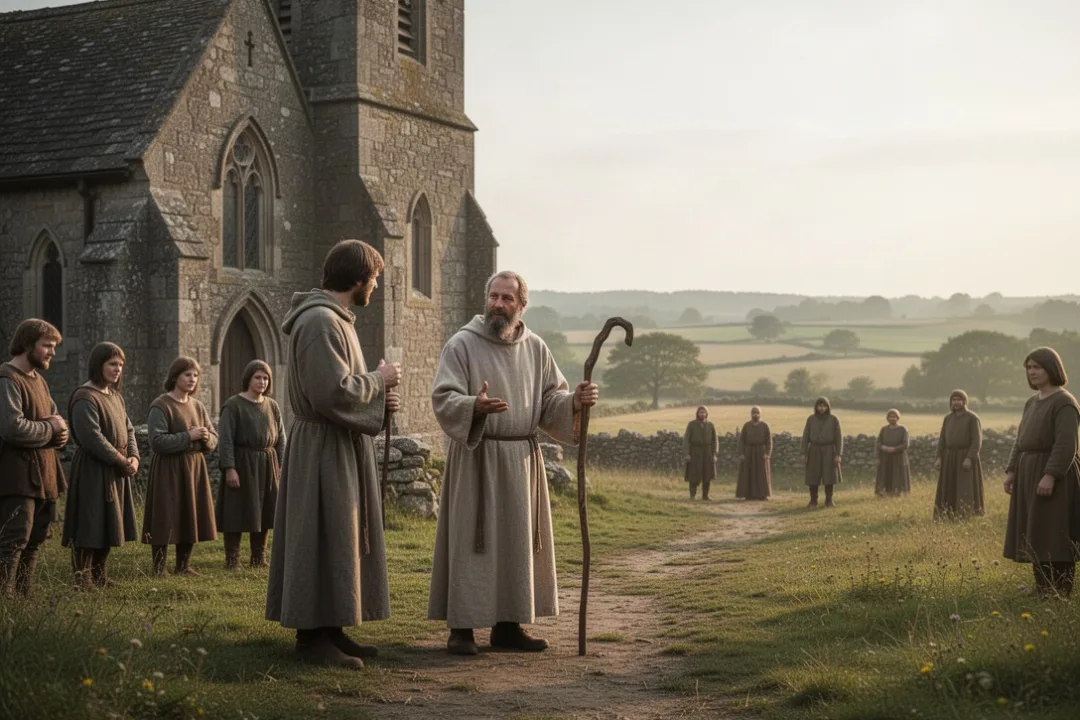
Dominic did not treat the situation as a problem that could be solved by argument alone. Accounts say he recognized that some official representatives traveled with considerable wealth and retinues, while the preachers they addressed lived more simply. Dominic therefore adopted a life of apostolic poverty, traveling on foot and preaching in a manner closer to the simplicity associated with the apostles.
His approach included public preaching, private conversations, theological debate, and patient explanation. He wanted people to understand what the Church taught and why it mattered. That emphasis helps explain why later generations associated the Dominican vocation with study and preaching rather than with one narrow form of religious activity.
The wider campaign against Catharism also involved political violence, especially the Albigensian Crusade. Dominic was active in the same historical setting, but it is inaccurate to describe him as the founder or commander of that military campaign. His own vocation centered on preaching and religious formation. The crusade’s violence remains a difficult part of the period, and a responsible account of Dominic should not romanticize the surrounding conflict.
Dominic’s work in this setting can be understood through several connected practices:
Listening: engaging people and understanding the questions behind their beliefs.
Teaching: explaining Christian doctrine through Scripture and reason.
Witness: living with enough simplicity that preaching did not appear detached from ordinary hardship.
Community: forming a stable group of trained preachers rather than depending on one individual.
Perseverance: continuing patient ministry even when immediate success was not visible.
These practices were significant because medieval preaching was not always carried out by clergy with the theological preparation needed for difficult debates. Dominic saw that the Church needed people who could explain its faith clearly and respond intelligently to objections. His solution was not simply to produce more sermons; it was to build a durable educational and missionary institution.
How Dominic founded the Order of Preachers
The community that grew around Dominic received formal approval from Pope Honorius III in 1216. Its members became known as the Order of Preachers, or Dominicans. The order’s Latin name is Ordo Praedicatorum, and its members are often identified by the initials O.P. after their names.
The new order differed from older monastic communities in its primary assignment. Monks traditionally lived in monasteries organized around prayer, work, and stability in one place. The Dominicans developed as a mendicant order: its members generally traveled to preach, taught in cities and universities, and depended on a simpler pattern of communal life rather than substantial private property.
Dominic understood that effective preaching required preparation. He sent members to important centers of learning, including universities, so they could study theology and become capable teachers. This decision helped the order grow rapidly and gave it a lasting role in Christian intellectual life.
The Dominican way of life joined several responsibilities:
Prayer and worship: communal prayer and personal devotion supplied the spiritual foundation for ministry.
Study: members examined Scripture, theology, philosophy, and the questions raised by their audiences.
Preaching: friars taught in churches, public settings, universities, and local communities.
Community life: shared rules and responsibilities supported a common mission.
Pastoral service: members accompanied people through confession, instruction, and practical religious guidance.
The order’s structure also reflected Dominic’s practical judgment. Local communities, or priories, were connected to larger provinces and governed through elected superiors and regular chapters. This arrangement allowed the order to preserve a shared identity while adapting its work to different regions.
Dominic was not the only person responsible for the order’s development. The brothers and sisters who joined it, later leaders who organized it, scholars who shaped its schools, and communities that supported its work all contributed to its growth. Still, Dominic provided its defining vision: preaching grounded in study, prayer, and a disciplined communal life.
His approach also made room for women’s religious communities connected with the Dominican family. A monastery of Dominican nuns at Prouille became closely associated with his early mission. Over time, the Dominican family expanded to include friars, nuns, sisters, priests, lay members, and other forms of apostolic service.
What St Dominic taught through his life
St Dominic left relatively few writings compared with some later saints. Much of what people know about him comes from early biographies, testimonies collected during the canonization process, and the traditions of the order he founded. His legacy therefore rests less on a single famous book and more on the pattern of life he established.
Truth should be taught with charity
Dominic’s ministry assumed that truth mattered. He was committed to Christian doctrine and did not treat every belief as equally sound. At the same time, his preaching was intended to persuade and instruct rather than merely defeat an opponent. That balance offers a useful model for religious discussion: clarity without contempt, conviction without needless hostility.
His example does not mean that every disagreement can be solved through calm conversation. Some conflicts involve injustice, manipulation, or genuine harm. It does mean that a preacher or teacher should remember the person behind the argument and avoid reducing someone to a label.
Study is part of spiritual service
Dominic treated education as a form of pastoral care. People often ask serious questions about suffering, morality, Scripture, worship, and the character of God. A sincere answer requires more than enthusiasm. It requires careful reading, intellectual honesty, and the humility to admit uncertainty when the evidence does not support a confident claim.
This remains one of the clearest Dominican contributions to Christian life. Study is not reserved for specialists. Reading Scripture, learning Church history, examining different interpretations, and asking disciplined questions can all deepen faith when they are pursued with patience and prayer.
Poverty can make service more credible
Dominic’s commitment to poverty was not simply a personal preference for fewer possessions. It was connected to the credibility of preaching. Someone who speaks about generosity while clinging to status and comfort may be heard as inconsistent. By contrast, simplicity can direct attention away from the messenger and toward the message.
Dominican poverty has taken different practical forms across centuries and cultures. Its underlying principle is that possessions, influence, and institutional resources should support the mission rather than become ends in themselves. For lay Catholics, this principle can encourage a thoughtful examination of consumption, public recognition, and the ways money shapes service.
Compassion belongs at the center of doctrine
Accounts of Dominic often portray him as deeply concerned for people who were suffering. His charity was not separate from his theology. The God Christians proclaim, in his understanding, is not an abstract idea but the living God who creates, saves, and calls people into communion.
That connection matters because religious knowledge can become cold when it is detached from mercy. Dominic’s example suggests that good preaching should lead toward conversion, hope, and practical love, not merely display the speaker’s intelligence.
Why St Dominic is associated with the Rosary
St Dominic is widely connected with the Holy Rosary. A longstanding tradition says that the Virgin Mary gave the Rosary to Dominic as a means of combating heresy and teaching the faith. This tradition played an important role in Dominican devotion and in the spread of the Rosary throughout the Catholic Church.
Historical evidence does not establish the popular story in the simple form in which it is often told. The Rosary developed over time, and its familiar structure was not fully established during Dominic’s lifetime. Earlier Christian practices of repeated prayer, including forms of the Hail Mary and the use of prayer beads, gradually contributed to the devotion that Catholics know today.
That historical qualification does not erase the connection between Dominic and the Rosary. Dominican friars and other members of the order became influential promoters of Marian devotion and Rosary prayer. The tradition also expresses something genuinely Dominican: using a clear, repeatable form of prayer to join Scripture, contemplation, and daily discipline.
Praying the Rosary involves moving through groups of prayers while meditating on events in the lives of Jesus and Mary. The repeated words provide a rhythm, but the purpose is not mechanical repetition. The prayer invites the person praying to reflect on the mystery represented by each decade.
Someone who wants to pray the Rosary in a way consistent with Dominic’s example might focus on these practices:
Read or recall the Gospel scene connected with each mystery.
Pray slowly enough to remain attentive to the meaning of the words.
Bring a specific person, difficulty, or act of thanksgiving into the prayer.
Allow questions and distractions to return gently to the mystery rather than treating them as failure.
Let the prayer lead to an act of charity, forgiveness, study, or service.
The Rosary can be valuable for people who prefer structured prayer, but it is not the only authentic way to pray. Dominic’s broader example includes communal worship, Scripture, theological study, silence, and direct service. The devotion should support a living relationship with God rather than replace participation in the wider life of the Church.
A historical distinction: Catholic tradition strongly associates Dominic with the Rosary, but historians generally describe the devotion as developing over time rather than beginning in its complete modern form with one single event.
How St Dominic’s legacy continues today
The Dominican order became one of the major teaching and preaching communities in the Catholic Church. Its members served in parishes, schools, universities, missions, courts, hospitals, and publishing ministries. Dominican theologians and spiritual writers influenced Christian thought across many centuries.
One of the most influential Dominicans was St Thomas Aquinas, who joined the order in the thirteenth century. His theological work became central to Catholic education, although his writings should not be treated as a direct record of Dominic’s own teaching. Other Dominican figures, including St Catherine of Siena, St Albert the Great, St Martin de Porres, and Fra Angelico, show the range of the Dominican family: theology, public counsel, service to the poor, and sacred art.
The order’s history also includes serious limitations and failures. Like every large institution, it has been shaped by the cultures and political systems in which it operated. Some members participated in or supported coercive structures, and Dominican involvement in inquisitorial institutions remains a subject requiring historical care. Honoring Dominic does not require ignoring the harm committed by Christians or religious institutions in later periods.
A mature understanding of his legacy can hold two truths together: Dominic’s vision of preaching, study, poverty, and compassion has borne lasting good, and the history of the communities connected with that vision must be examined honestly. Admiration is stronger when it is informed rather than idealized.
For a person who wants to follow Dominic’s example without joining a religious order, several practical applications are possible:
Set aside regular time to read Scripture and reliable Christian teaching.
Practice explaining your beliefs without exaggeration or personal attacks.
Choose a simpler habit that makes more room for generosity.
Learn about a difficult historical or theological question from more than one serious source.
Pair prayer with a concrete act of mercy or service.
Support education, preaching, or charitable work that helps people seek truth with dignity.
St Dominic’s life ultimately points toward a form of Christian witness that is both intellectual and personal. He believed people needed the truth, but he also understood that truth had to be carried by lives marked by prayer, humility, courage, and love. His influence endures because that combination remains demanding and useful long after the original medieval disputes have changed.
Frequently asked questions
When is St Dominic’s feast day?
St Dominic’s feast day is generally celebrated on August 8 in the Roman Catholic Church. He died on August 6, 1221, but the liturgical date associated with his public celebration has changed in some calendars and traditions. Dominican communities may observe additional commemorations connected with his translation, canonization, or particular local customs.
Is St Dominic the founder of the Dominican order?
Yes. Dominic de Guzmán established the community that became the Order of Preachers, commonly called the Dominican order. Pope Honorius III formally approved it in 1216. Dominic supplied its central mission of preaching supported by prayer, theological study, communal life, and a commitment to evangelical poverty.
Did Mary really give the Rosary to St Dominic?
The story is an important Catholic tradition, especially within Dominican devotion, but historians do not have firm evidence that the Rosary appeared in its complete familiar form through one event in Dominic’s lifetime. The devotion developed gradually from earlier forms of repeated prayer and meditation on the Gospel.
What is St Dominic the patron saint of?
St Dominic is commonly regarded as a patron of astronomers, scientists, and the Dominican order. The connection with astronomers relates partly to traditional artistic imagery, including a star associated with his holiness. Patronage customs can vary by region and devotional tradition, so local calendars may emphasize different aspects of his life.













Leave a Reply