The history of the Rosary: how the prayer developed
The history of the Rosary: how the prayer developed
When you move through a familiar prayer almost automatically—during a commute, before sleep, or while waiting for an appointment—you may wonder how the Rosary came to have its particular beads, prayers, and mysteries. The short answer is that the Rosary developed gradually over many centuries. It was not created all at once by a single person, even though several important traditions connect its growth with the Dominican order and devotion to Mary.
Its history combines ancient methods of counting prayers, medieval Christian meditation, changing forms of the Hail Mary, and the efforts of religious communities to make prayer accessible to ordinary people. The familiar five-decade Rosary is the result of that long development. Earlier Christians used prayer cords and counted repetitions, while later Christians connected groups of prayers with scenes from the lives of Jesus and Mary.
The practice of using objects to count prayers is older than the Rosary itself. Christians in the early centuries sometimes counted repeated prayers with pebbles, knotted cords, or strings of beads. This was useful for people who wanted to maintain a steady rhythm of prayer without having to keep track mentally.
One influence came from monks who prayed the Psalms regularly. The Psalter contains 150 psalms, and monastic communities often recited all or part of it according to an established schedule. Many lay Christians could not read or did not have access to books, so they adopted simpler forms of prayer that echoed this pattern, especially the Lord’s Prayer.
These repeated prayers were not necessarily considered empty repetition. In the Christian tradition, repeating a familiar prayer can create a stable structure for attention and reflection. The words provide a rhythm, while the person praying brings particular intentions, gratitude, sorrow, or concern to each repetition.
By the Middle Ages, strings used to count the Lord’s Prayer were commonly associated with the Latin word Pater, meaning “Father.” In English, these prayer counters became known as paternoster beads. They were an important predecessor of the Rosary, although they did not yet have the Rosary’s Marian prayers or mysteries.
Key distinction: Prayer beads existed before the Rosary. The Rosary emerged when counted prayer was joined to repeated Hail Marys and meditation on episodes from the Gospel.
How the Rosary developed from medieval prayer traditions
The Rosary took shape through several overlapping developments rather than a single founding moment. The process can be understood through a few major stages:
Prayer counting: Christians used cords, knots, or beads to keep track of repeated prayers.
Lay participation: People who could not recite the full Psalter adopted sets of Lord’s Prayers or other familiar prayers.
Marian devotion: The greeting addressed to Mary became increasingly common in medieval prayer.
Grouping prayers: Repeated Hail Marys were organized into sets, eventually connected with episodes from Christ’s life.
Standardization: Religious communities, confraternities, and church authorities helped establish a more consistent form.
Worldwide spread: Printing, devotional books, missionaries, and organized Rosary groups carried the practice across Catholic communities.
Each stage left traces in the Rosary that Catholics pray today. The beads preserve the practical purpose of counting. The repeated prayers reflect medieval devotion. The mysteries give the prayer its meditative focus, directing attention toward events in the lives of Jesus and Mary.
The Hail Mary changed over time
The Hail Mary was also formed gradually. Its first part draws on the Gospel accounts of the Annunciation and the Visitation, especially Luke 1:28 and Luke 1:42. Medieval Christians used these biblical greetings in different devotional settings, but the prayer did not initially include the complete wording familiar to Catholics today.
The later part, asking Mary to pray for the person praying, developed over time. The prayer’s ending refers to the present moment and the hour of death, reflecting a medieval Christian concern with receiving spiritual help throughout life and at its end.
By the late Middle Ages, versions of the prayer were becoming more recognizable. The name of Jesus became a central part of the prayer, and the petition for Mary’s intercession helped distinguish the Hail Mary from a simple repetition of biblical greetings.
The exact wording became more stable as printed prayer books and official liturgical use expanded. That standardization mattered because a widely shared text made it easier for families, confraternities, and parish groups to pray together. Even so, the development of the Rosary did not depend only on having one fixed version of the Hail Mary.
The medieval connection between the Psalter and the Rosary
A major step in the Rosary’s history was the idea that a large number of repeated prayers could serve as a “Marian Psalter.” The phrase reflected an analogy: just as monks prayed 150 Psalms, laypeople might pray 150 Hail Marys as a comparable devotional practice.
These Marian prayer cycles were not always arranged in the five-decade format used now. Some included 150 prayers, while others used smaller or different groupings. The practice also varied by region and religious community. Medieval devotional life was not governed by one universal handbook that instantly settled the form of the Rosary.
The association between Mary and a spiritual “garden” or “garland” also influenced the word rosary. In medieval religious language, a collection of prayers offered to Mary could be described as a spiritual wreath or crown of roses. The Latin term rosarium was used in connection with collections of prayers and meditations, eventually giving the devotion its familiar name.
This language should not be understood as proof that the Rosary began as a single ceremonial object. The term and the practice grew together through medieval devotion, poetry, preaching, and organized prayer.
What Saint Dominic’s role really was
A widespread tradition says that the Virgin Mary gave the Rosary to Saint Dominic in the early 13th century. This story became influential in Dominican art, preaching, and devotional life. It presents the Rosary as a powerful response to heresy and as a prayer entrusted directly to the founder of the Order of Preachers.
Historians, however, generally distinguish between the devotional tradition and the documentary evidence. Early sources do not clearly establish that Saint Dominic received or invented the complete Rosary in the form known today. The prayer’s basic elements were developing through broader Christian practices before and during his lifetime.
That does not make the Dominican connection unimportant. Dominican communities played a significant part in promoting Marian devotion and preaching the Rosary. Dominican confraternities helped organize groups of laypeople, and later Dominican writers contributed to the prayer’s popularity and structure.
A careful description is therefore more accurate than the simple claim that Dominic invented the Rosary. He and the Dominican tradition helped spread and shape it, while the devotion itself emerged from a much longer history of prayer.
Historical caution: The traditional story about Saint Dominic explains the Rosary’s importance in Dominican spirituality, but the surviving evidence does not show that he single-handedly created its complete form.
How the mysteries gave the Rosary its meditative structure
The Rosary became more than a sequence of repeated prayers when each group of Hail Marys was connected with a mystery. Here, “mystery” means an event or truth of Christian faith for contemplation, not a puzzle that must be solved.
Early forms of Marian prayer sometimes included brief references to episodes from Jesus’ life. A person might repeat a Hail Mary while remembering the Annunciation, the Nativity, the Crucifixion, or another scene from the Gospel. These short references helped prevent the prayer from becoming detached from the life of Christ.
Over time, lists of mysteries became more organized. Different writers and prayer books proposed various sets, and the number of meditations was not always the same. Some traditions focused on the joy of Christ’s birth, others on his suffering, and others on his glory.
The mysteries also explain why the Rosary is fundamentally a Christ-centered prayer, even though the Hail Mary is repeated throughout it. Mary’s role is to direct attention toward her Son. The events remembered in the Rosary concern the Incarnation, Christ’s ministry, his Passion, his Resurrection, and the life of the Church.
When the three traditional sets became established
By the late medieval and early modern periods, the Rosary was increasingly arranged around three broad groups: the Joyful Mysteries, the Sorrowful Mysteries, and the Glorious Mysteries. Each group contained five decades, for a total of 15 decades.
The Joyful Mysteries contemplate events surrounding Christ’s birth and early life, including the Annunciation and the finding of Jesus in the Temple. The Sorrowful Mysteries focus on the suffering and death of Jesus. The Glorious Mysteries turn to the Resurrection and the glorification of Christ and Mary.
This arrangement became a widely recognized form of the Rosary, particularly through preaching, printed manuals, and confraternities. It offered a manageable daily practice while preserving the older connection with 150 Hail Marys. Praying all 15 decades represented a Marian counterpart to the 150 Psalms.
The traditional structure did not mean every community used exactly the same customs. People differed in how they announced each mystery, what prayers they added, and whether they prayed five decades or a larger portion. The core pattern, however, became increasingly familiar across Catholic regions.
How printing and Rosary confraternities spread the devotion
The growth of printing helped the Rosary move beyond local customs. Printed prayer books could present the prayers, mysteries, and instructions in a consistent form. They also made it easier for people to learn the devotion privately or in a parish group.
Rosary confraternities were another major force. These associations brought laypeople together for shared prayer and encouraged members to practice the devotion regularly. They could be connected with religious orders, parish churches, or local communities.
Confraternities gave the Rosary a social setting as well as a personal one. Members might pray for the dead, support one another during illness, or gather for feast days and processions. The beads became a visible sign of participation in a wider devotional community.
Churches dedicated to the Rosary and images showing Mary with the Christ Child also helped establish its identity. Religious art often pictured the beads being presented by Mary or held by saints, reinforcing the association between the prayer and Marian protection.
Books provided a repeatable set of prayers and meditations.
Confraternities gave people a regular group in which to pray.
Preachers explained the mysteries and encouraged frequent use.
Religious art made the devotion recognizable in churches and homes.
Missionary activity introduced the Rosary to new communities and cultures.
How the Rosary became associated with Catholic identity
From the early modern period onward, the Rosary was closely associated with Catholic identity and public devotion. Catholics carried beads, prayed them in homes, and used them during parish gatherings and religious processions. In many places, the Rosary became part of family life, especially in the evening or during times of crisis.
Its popularity also reflected its flexibility. Someone could pray a single decade in a few minutes or pray a full set of mysteries over a longer period. The beads could be held in a church, carried during travel, or used quietly at home. The same structure worked for individuals and large groups.
Popes and bishops frequently encouraged the devotion, especially during periods of war, political conflict, or perceived threats to the Church. Such appeals sometimes emphasized the Rosary as a prayer for peace, family life, conversion, or protection. The historical meaning of those appeals depends on their particular context, but they helped keep the Rosary prominent in Catholic practice.
The devotion also traveled through migration and missionary work. Catholic immigrants brought familiar Rosary customs into new countries, while missionaries adapted instruction and group prayer to local languages and cultures. As a result, the Rosary developed many regional expressions while retaining a recognizable core.
Why October and the Feast of Our Lady of the Rosary matter
October is widely associated with the Rosary in the Catholic calendar. The month’s connection grew through church celebrations, papal encouragement, and the spread of organized Rosary devotion. Many parishes use October for public recitation, educational programs, and special services.
The feast of Our Lady of the Rosary is observed on October 7. Its historical background is connected with a 16th-century naval battle remembered in Catholic Europe as a victory attributed, in part, to prayer through Mary’s intercession. The feast’s name and emphasis changed over time, but its connection with the Rosary remained.
It is useful to separate the history of this feast from the entire history of the devotion. The Rosary was already developing before the feast received its modern association, and the prayer continued to change afterward. The feast helped strengthen an existing tradition rather than creating it from nothing.
How the modern Rosary received the Luminous Mysteries
For centuries, the standard Rosary was commonly prayed with 15 mysteries: five Joyful, five Sorrowful, and five Glorious. In 2002, Pope John Paul II proposed a fourth group, the Luminous Mysteries, in his apostolic letter Rosarium Virginis Mariae.
The Luminous Mysteries focus on significant moments in Jesus’ public ministry. They include his Baptism in the Jordan, the wedding at Cana, his proclamation of the Kingdom of God, the Transfiguration, and the institution of the Eucharist. These meditations fill a perceived gap between Christ’s childhood and his Passion.
The proposal did not erase the traditional groups. Instead, it expanded the commonly used form from 15 to 20 decades. Many Catholics pray the Luminous Mysteries on Thursdays, although local customs differ and no single schedule is required for every person.
This development shows that the Rosary has remained a living devotion. Its basic rhythm is old, but its use can receive new emphasis as the Church encourages deeper meditation on the Gospel.
What the Rosary’s prayers and beads mean today
A standard five-decade Rosary usually begins with the Sign of the Cross, followed by an opening prayer, one Lord’s Prayer, three Hail Marys, and a Glory Be. The person praying then announces a mystery and prays one Lord’s Prayer, ten Hail Marys, and a Glory Be for each decade.
Many people also add a prayer associated with Fatima after each Glory Be, though this is a common devotion rather than an essential part of the historic structure. Some begin or end with other prayers, including petitions for particular people or intentions.
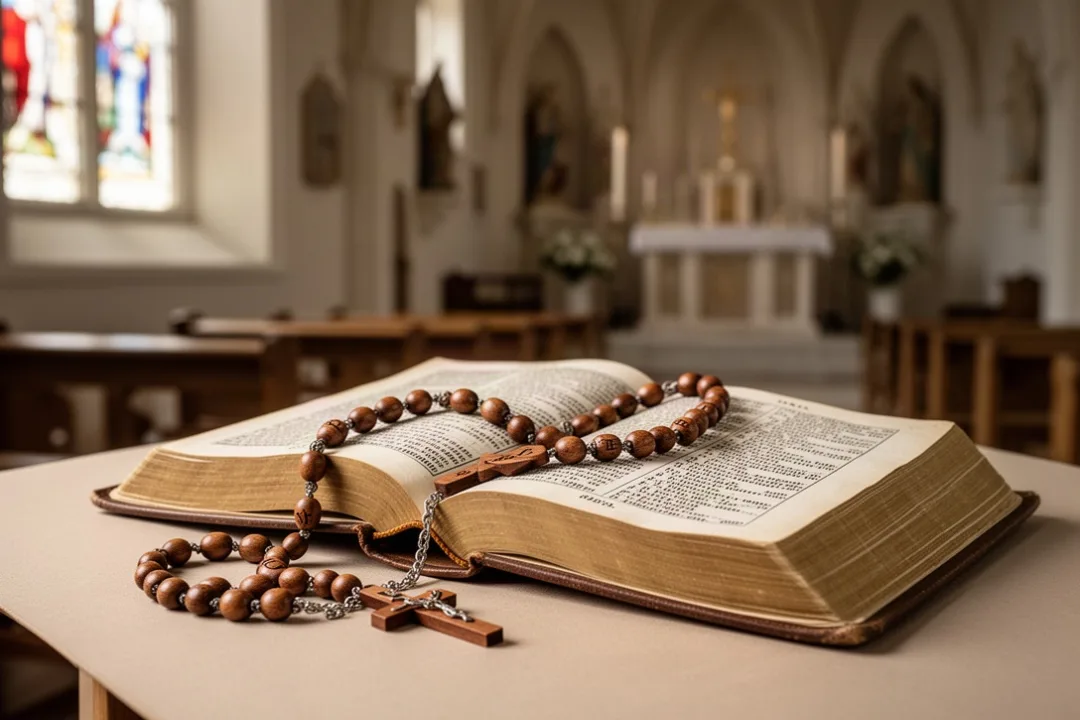
The beads provide a physical sequence:
The crucifix recalls Christ’s Passion and begins the prayer.
The larger beads generally mark the Lord’s Prayer.
The smaller beads mark the Hail Marys within each decade.
The grouped sections help organize meditation on one mystery at a time.
The closing prayers allow the person praying to place the whole devotion in a broader intention.
The beads are not magical objects, and the number of repetitions does not guarantee a particular result. Their purpose is practical and devotional: they help you keep your place, settle your attention, and move through a pattern of prayer that connects words with the Gospel.
How to pray the Rosary in its historical form
If you want to pray the Rosary in the form that became widely established before the addition of the Luminous Mysteries, use the three traditional groups. You can pray five decades at a time or continue through all 15 decades when you want to echo the older Marian Psalter pattern.
Begin at the crucifix with the Sign of the Cross and the opening prayers used in your tradition.
Announce the first mystery before starting its decade. Name the Gospel event rather than treating the prayer as a disconnected series of repetitions.
Pray the Lord’s Prayer on the large bead that begins the decade.
Pray ten Hail Marys while keeping the mystery in mind. You may reflect on a particular detail, person, or spiritual meaning.
Pray the Glory Be at the end of the decade, along with any additional prayer you normally use.
Continue through five mysteries, then finish with the customary closing prayers or a personal intention.
The history can make the practice easier to understand. You are using an ancient prayer-counting method, repeating a prayer that took centuries to reach its familiar form, and meditating on scenes that organized medieval and modern Christian devotion. The Rosary’s long development is part of what gives its simple structure such depth.
Why the history of the Rosary still matters
Knowing the history prevents two common misunderstandings. First, the Rosary was not invented in a single moment by one saint. Second, its repeated prayers are not meant to replace reflection. The devotion developed precisely by combining repetition with meditation.
The history also explains why different Catholics may pray the Rosary with slightly different customs. One person may include the Luminous Mysteries, another may use only the three traditional sets, and a third may add local prayers. Those differences usually reflect the Rosary’s long development rather than a lack of seriousness.
At its center, the Rosary remains a structured way to remember the Gospel with Mary. Its beads connect the body and the mind to a steady sequence; its prayers link personal concerns with communal Christian language; and its mysteries keep the focus on the life, death, and glory of Jesus.
Frequently asked questions
Did Saint Dominic invent the Rosary?
Saint Dominic is strongly associated with the Rosary through Dominican tradition, preaching, and religious art. However, historical evidence does not show that he invented the complete Rosary in its modern form. Prayer beads, repeated Lord’s Prayers, Marian devotion, and Gospel meditation were already developing. The Dominican order played a major role in promoting and organizing the devotion.
When was the Rosary first created?
There is no single creation date. Its earliest foundations reach back to Christian prayer practices that counted repeated prayers with cords or beads. The form recognizable today developed gradually during the Middle Ages and became more standardized through printed books, confraternities, religious orders, and church encouragement during the early modern period.
Why are there 10 Hail Marys in each decade?
The ten-bead decade is part of the structure that became widely established as the Rosary developed. Five decades made one commonly used set of mysteries, while three sets produced 15 decades and echoed the 150 Psalms. The arrangement gave people a practical way to combine repeated prayer with meditation on specific events from Christ’s life.
When were the Luminous Mysteries added?
Pope John Paul II proposed the Luminous Mysteries in 2002 in Rosarium Virginis Mariae. They focus on five episodes from Jesus’ public ministry, including his Baptism, the wedding at Cana, the proclamation of God’s Kingdom, the Transfiguration, and the Eucharist. They supplement rather than replace the Joyful, Sorrowful, and Glorious Mysteries.












Leave a Reply