You may have a rosary in your hand and still wonder, “How do I pray the Rosary in Latin?” The answer is straightforward: use the same five-decade structure as an English Rosary, but substitute the traditional Latin prayers. You do not need perfect pronunciation, a memorized translation, or a formal setting. A slow, reverent attempt is enough to begin.
The Rosary combines vocal prayer with meditation on scenes from the life of Jesus and Mary. Latin can give the prayers a consistent form and connect your personal devotion with centuries of Catholic prayer. You can pray entirely in Latin, use Latin prayers with English meditations, or read each Latin prayer followed by its meaning.
Start simply: Pray one decade in Latin today rather than waiting until you can recite every prayer from memory. Understanding and attention matter more than speed or flawless pronunciation.
The phrase rosary Latin generally refers to praying the Catholic Rosary with its ordinary prayers in Latin. Those prayers include the Sign of the Cross, Apostles’ Creed, Our Father, Hail Mary, Glory Be, and often the Fatima Prayer and Hail, Holy Queen.
Latin does not create a different set of mysteries or beads. The structure of the Rosary remains the same: an opening sequence, five decades, and closing prayers. The main difference is the language used for the spoken prayers and, if you choose, the language used for announcing the mysteries.
Some people use the traditional Latin forms found in older prayer books. Others use the Latin commonly printed in contemporary Catholic resources. Minor differences in punctuation, capitalization, or optional closing prayers may appear, but the essential prayers are recognizable across these forms.
The basic order of a Latin Rosary
Before beginning, choose the set of mysteries you plan to meditate on. Hold the crucifix, make the Sign of the Cross, and proceed through the opening prayers. The first large bead is used for the Our Father, followed by three Hail Marys on the smaller beads and a Glory Be.
Each decade follows the same pattern. Announce one mystery, pray the Our Father on the large bead, pray ten Hail Marys on the smaller beads, and finish with the Glory Be. Many people also add the Fatima Prayer after the Glory Be.
Crucifix: Make the Sign of the Cross and pray the Apostles’ Creed.
First large bead: Pray the Our Father.
Three small beads: Pray three Hail Marys, often for growth in faith, hope, and charity.
After the three beads: Pray the Glory Be.
Five decades: Announce each mystery, then pray one Our Father, ten Hail Marys, and one Glory Be.
After each decade: Add the Fatima Prayer if that is your custom.
At the end: Pray the Hail, Holy Queen and any additional closing prayer you prefer.
The beads are a physical aid, not a requirement for validity. If you lose count, simply return to the last bead you clearly remember and continue calmly. Prayer is not a counting contest, and a small mistake does not undo the time you have spent praying.
The main Latin prayers of the Rosary
The following forms are widely used for praying the Rosary in ecclesiastical Latin, the pronunciation traditionally associated with Catholic liturgical prayer. You may print them, keep them in a prayer book, or read them from a phone until they become familiar.
Sign of the Cross
In nomine Patris, et Filii, et Spiritus Sancti. Amen.
This means, “In the name of the Father, and of the Son, and of the Holy Spirit. Amen.” Make the Sign of the Cross at the beginning and end of the Rosary. Many people also use it when they need to pause and recollect themselves.
Apostles’ Creed
Credo in Deum, Patrem omnipotentem, Creatorem caeli et terrae. Et in Iesum Christum, Filium eius unicum, Dominum nostrum, qui conceptus est de Spiritu Sancto, natus ex Maria Virgine, passus sub Pontio Pilato, crucifixus, mortuus, et sepultus, descendit ad inferos, tertia die resurrexit a mortuis, ascendit ad caelos, sedet ad dexteram Dei Patris omnipotentis, inde venturus est iudicare vivos et mortuos. Credo in Spiritum Sanctum, sanctam Ecclesiam catholicam, sanctorum communionem, remissionem peccatorum, carnis resurrectionem, vitam aeternam. Amen.
The Creed is prayed on the crucifix. It summarizes central Christian beliefs about God, Jesus Christ, the Holy Spirit, the Church, forgiveness, resurrection, and eternal life. You do not need to understand every Latin word immediately; learning its meaning in sections can make the opening prayer easier to follow.
Our Father
Pater noster, qui es in caelis: sanctificetur nomen tuum; adveniat regnum tuum; fiat voluntas tua, sicut in caelo et in terra. Panem nostrum cotidianum da nobis hodie; et dimitte nobis debita nostra, sicut et nos dimittimus debitoribus nostris; et ne nos inducas in tentationem; sed libera nos a malo. Amen.
The Our Father is prayed once at the start of each decade. It asks that God’s name be honored, God’s kingdom come, and God’s will be done. It also asks for daily provision, forgiveness, strength to forgive others, and protection from evil.
Ave, Maria, gratia plena, Dominus tecum. Benedicta tu in mulieribus, et benedictus fructus ventris tui, Iesus. Sancta Maria, Mater Dei, ora pro nobis peccatoribus, nunc et in hora mortis nostrae. Amen.
The Hail Mary is prayed ten times in each decade. Its first part reflects the angel’s greeting and Elizabeth’s blessing in the Gospel; its second part asks Mary to pray for those who say it. The prayer directs attention to Jesus as the fruit of Mary’s womb, not away from him.
Glory Be
Gloria Patri, et Filio, et Spiritui Sancto. Sicut erat in principio, et nunc, et semper, et in saecula saeculorum. Amen.
The Glory Be praises the Father, Son, and Holy Spirit. It is prayed after each decade and is a short reminder that the Rosary is ultimately a Trinitarian prayer. The closing phrase expresses enduring praise across all ages.
Fatima Prayer
O mi Iesu, dimitte nobis peccata nostra, libera nos ab igne inferni, perduc in caelum omnes animas, praesertim eas quae misericordiae tuae maxime indigent.
This prayer asks Jesus for forgiveness, deliverance from hell, and the salvation of all souls, especially those most in need of divine mercy. It is commonly added after each Glory Be, although the Rosary can be prayed without it.
Hail, Holy Queen
Salve, Regina, mater misericordiae, vita, dulcedo, et spes nostra, salve. Ad te clamamus, exsules filii Hevae. Ad te suspiramus, gementes et flentes in hac lacrimarum valle. Eia ergo, advocata nostra, illos tuos misericordes oculos ad nos converte. Et Iesum, benedictum fructum ventris tui, nobis post hoc exsilium ostende. O clemens, O pia, O dulcis Virgo Maria.
The Hail, Holy Queen is traditionally prayed after the five decades. It addresses Mary as a mother of mercy and asks her to lead believers toward Jesus. Some people also add a prayer asking that the Rosary’s fruits shape their daily conduct.
How to pronounce common Latin Rosary words
You do not need a specialized accent to pray the Rosary. Ecclesiastical Latin is often pronounced with sounds similar to Italian, while classical Latin uses some different sounds. Catholic prayer books and parish communities may follow either a familiar local tradition, so consistency and reverence are more useful than anxiety over small differences.
c before e or i usually sounds like “ch,” as in “caeli.”
g before e or i usually sounds like the “j” in “Jesus,” as in “regina.”
ae is commonly pronounced like “eh,” so “caeli” is often said approximately “CHEH-lee.”
oe is commonly pronounced like “eh,” as in “coelis” in forms where it appears.
gn has a sound similar to the “ny” in “canyon,” as in “regnum.”
j in printed Latin may represent the same consonant sound as “i” in some older spellings.
v is generally pronounced like the English “v” in ecclesiastical Latin.
Written pronunciation guides can help, but listening to a reliable recording is often easier. Repeat one line at a time, then connect the lines. Do not rush to imitate speed; a measured pace gives you time to breathe and attend to the prayer’s meaning.
Pronunciation tip: Pick one pronunciation tradition and stay with it. Changing sounds every few words is more distracting than using a simple, imperfect pronunciation throughout the decade.
The four sets of mysteries to meditate on
The Rosary is not only a sequence of repeated prayers. Each decade is connected to a mystery from the Gospel and Christian tradition. As your lips pray in Latin, your mind can picture the event, consider its meaning, or quietly offer a personal intention connected with it.
The Joyful Mysteries
The Joyful Mysteries focus on the early life of Jesus and the events surrounding his birth. They are commonly prayed on Monday and Saturday.
The Annunciation
The Visitation
The Nativity
The Presentation of Jesus in the Temple
The Finding of Jesus in the Temple
These mysteries can be fruitful when you are thinking about family life, waiting, service, hidden work, or a new beginning. For example, while praying the Visitation, you might bring to mind someone who needs practical help rather than merely good wishes.
The Sorrowful Mysteries
The Sorrowful Mysteries contemplate the suffering and death of Jesus. They are commonly prayed on Tuesday and Friday.
These decades can lead you to pray for people experiencing grief, illness, persecution, addiction, or loneliness. Meditation should remain prayerful rather than becoming an attempt to imagine every physical detail. Keep returning to Christ’s love, obedience, mercy, and self-giving.
The Glorious Mysteries
The Glorious Mysteries turn to the Resurrection and the glory of Christ and Mary. They are commonly prayed on Wednesday and Sunday.
The Resurrection
The Ascension
The Descent of the Holy Spirit
The Assumption of Mary
The Coronation of Mary
These mysteries are suited to prayers for hope, perseverance, the Church, and the promise of eternal life. They can be especially meaningful when life feels dominated by discouragement, because they place suffering within a wider vision of resurrection and redemption.
The Luminous Mysteries
The Luminous Mysteries reflect significant moments in the public ministry of Jesus. They are commonly prayed on Thursday.
The Baptism of Jesus in the Jordan
The Wedding at Cana
The Proclamation of the Kingdom of God
The Transfiguration
The Institution of the Eucharist
These mysteries invite reflection on Jesus’ identity, signs, teaching, glory, and sacramental presence. They can help you pray for conversion, faithful witness, marriage, discipleship, and deeper participation in worship.
Ways to meditate while praying in Latin
Latin can occupy your voice while your mind rests on the mystery. You do not have to translate every word during every repetition. Before each decade, read or recall a short description of the mystery, then let the repeated Hail Marys create a steady rhythm for reflection.
One approach is to focus on a single word or theme for the decade. During the Annunciation, that theme might be “yes” or “trust.” During the Carrying of the Cross, it might be “perseverance” or “compassion.” The repetition gives you a way to return when your attention wanders.
Another approach is to place yourself near the Gospel scene without trying to invent dialogue. Notice who is present, what the people may be facing, and how the mystery reveals Jesus. You can also pray for a specific person or need at the beginning of the decade, then allow the intention to remain quietly present.
When you do not understand a Latin phrase, use an English translation before or after prayer. Understanding supports devotion, but constant mental translation is not the only way to pray. Many people alternate: one Rosary in English for close verbal understanding, another in Latin for a slower contemplative rhythm.
Practical tips and common mistakes when praying the Latin Rosary
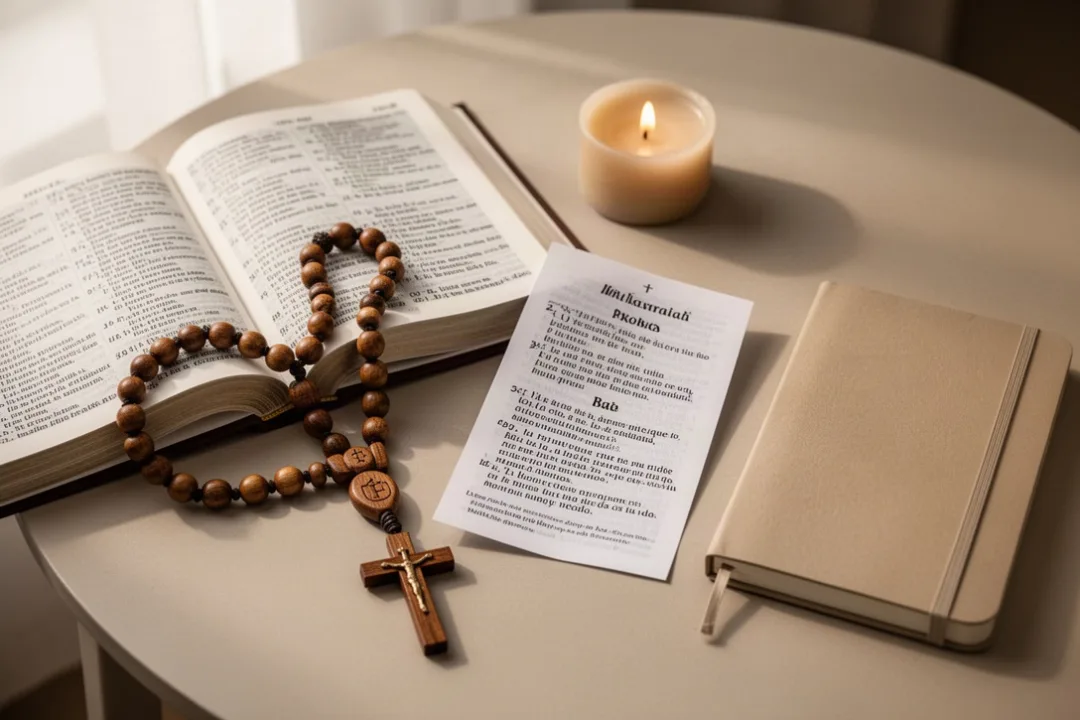
Learning the prayers is easier when you remove avoidable obstacles. A small card with the Latin text, a pronunciation recording, and a consistent place to pray can make the practice more sustainable.
Begin with one decade. Learn the Our Father, Hail Mary, and Glory Be before adding every optional prayer.
Mark the stressed syllables. A personal pronunciation guide can keep you from stopping repeatedly.
Use a physical Rosary. The beads help you maintain your place without looking at a screen.
Announce the mystery clearly. A decade without a meditation can become mechanical.
Slow down at punctuation. Natural pauses make unfamiliar Latin easier to understand.
Keep the translation nearby. Consult it between decades instead of interrupting every line.
Pray with others when possible. A parish or family group can teach pronunciation through repetition.
Do not restart for every slip. Correct the word if needed and continue without self-criticism.
One common mistake is treating Latin as a test of religious ability. It is a language of prayer, not a measure of holiness or intelligence. Another is focusing so intensely on pronunciation that the mystery disappears. Clear enough, attentive, and humble is a better goal than theatrical perfection.
Some people also assume they must use every optional prayer or a particular schedule. The standard five-decade Rosary is already complete. Local customs differ, so it is reasonable to follow the form used by your parish, prayer group, or trusted prayer book.
How long a Latin Rosary usually takes
A five-decade Rosary often takes around fifteen to thirty minutes, depending on the pace, pauses, and additional prayers. Latin may take longer at first because you are reading or recalling unfamiliar words. As the prayers become familiar, your pace will usually become more natural.
If you have only a few minutes, pray one decade with care. You can also pray the opening prayers now and finish the remaining decades later. The Rosary is commonly prayed as a complete group of five decades, but a single decade can still be a meaningful act of devotion when circumstances limit your time.
Choose a pace that allows you to breathe comfortably and hear the words. Very fast recitation may help a group stay together, but private prayer does not require speed. A quiet pause after announcing each mystery can make a substantial difference in concentration.
How to learn the Latin prayers without feeling overwhelmed
Learn the prayers in layers. Start by memorizing the Sign of the Cross, Our Father, and Glory Be. Then learn the Hail Mary, which appears fifty times in a full Rosary. Add the Apostles’ Creed, Fatima Prayer, and Hail, Holy Queen after the central pattern feels comfortable.
Read the Latin aloud while following an English translation.
Practice one sentence until its rhythm feels familiar.
Pray one decade from the page without trying to memorize it.
Cover part of the text and recall the missing words.
Use the prayer in a complete Rosary even if you still need occasional help.
Memorization usually develops through repetition rather than force. You may find that the Hail Mary becomes familiar first because of its frequent use. Keep a printed version available even after memorizing the prayers; it can help when you are tired, traveling, or praying with a different traditional form.
Why people choose to pray the Rosary in Latin
Some Catholics choose Latin because they appreciate its connection with the historic prayer life of the Church. The language can also create a sense of continuity when people pray with family members, parish groups, or communities in different countries.
Others find that Latin reduces the temptation to skim familiar phrases. Because the words are less automatic, the person praying may pay closer attention to posture, pace, and intention. That benefit is personal rather than guaranteed; unfamiliar language can also become distracting if the meaning is ignored.
Latin is not inherently more powerful than English or another language. The value of the Rosary comes from faithful prayer and meditation on Christ, not from using a particular language as a spiritual shortcut. Pray in the language that helps you remain present, and use Latin when it genuinely supports that purpose.
“Pray for us sinners, now and at the hour of our death.”
This short petition from the Hail Mary captures one reason the Rosary remains accessible: it brings ordinary human weakness directly into prayer. Whether spoken in Latin or English, the words ask for help in the present moment and at the end of life.
A simple routine for praying the Rosary in Latin
Set aside a regular time and choose a place where interruptions are limited. You might pray during a quiet morning, while walking, during a commute when you are not driving, or before sleep. Keep the Rosary and Latin text together so beginning does not require a search.
Before the first prayer, take one slow breath and name your intention. It may be a person, a family situation, gratitude, repentance, or a desire to grow in a particular virtue. Then proceed at a steady pace, allowing the mystery—not the mechanics—to remain central.
At the end, you can remain silent for a moment before making the Sign of the Cross. If you became distracted, do not judge the entire prayer by those moments. Notice the distraction, return to the words or mystery, and continue. That gentle return is itself part of learning to pray.
With regular use, the Latin prayers will become easier to pronounce and remember. More importantly, the beads can become a dependable way to pause, reflect on the life of Jesus, ask Mary’s intercession, and bring the needs of others before God.
Frequently asked questions
Do I have to know Latin to pray the Rosary in Latin?
No. You can read the prayers from a card or prayer book while learning them. It helps to understand their meaning, but perfect fluency is unnecessary. Many people begin by praying the Latin words aloud and reviewing an English translation between decades. A sincere, attentive prayer is not made invalid by an accent, hesitation, or occasional pronunciation mistake.
Which Latin pronunciation should I use for the Rosary?
Most Catholic Rosaries use ecclesiastical Latin, whose pronunciation resembles Italian in several ways. Some people use a classical pronunciation because of their education or community tradition. Either can work for private prayer. If you pray with a group, follow its established pronunciation so everyone can remain together.
Can I pray the Rosary partly in Latin and partly in English?
Yes. You might pray the ordinary prayers in Latin while announcing the mysteries and reading meditations in English. You could also pray one decade in Latin and the next in English. Combining languages is especially practical while you are learning, and it can preserve both the familiar meaning of the prayer and the rhythm you appreciate in Latin.
What if I lose count of the Hail Marys?
Continue from the last bead you clearly remember rather than restarting the decade. If you are uncertain, you can finish the remaining beads with the intention of completing the decade. The beads assist prayer; they are not a scorecard. A brief counting error does not cancel the meditation, intention, or prayer you have already offered.













Leave a Reply