The Rosary is a structured prayer that combines repeated prayers with meditation on key events in the life of Jesus and Mary.
To recite the Rosary, you move through five groups of ten Hail Marys, called decades, while reflecting on a particular mystery. The repeated words give your attention a steady rhythm, but the heart of the prayer is the mystery you are considering.
You do not need to pray quickly or perfectly. A Rosary can be prayed alone, with family, in a church, while walking, or during a quiet part of your day. What matters most is deliberate prayer: allowing the words and the mystery to turn your mind toward God.
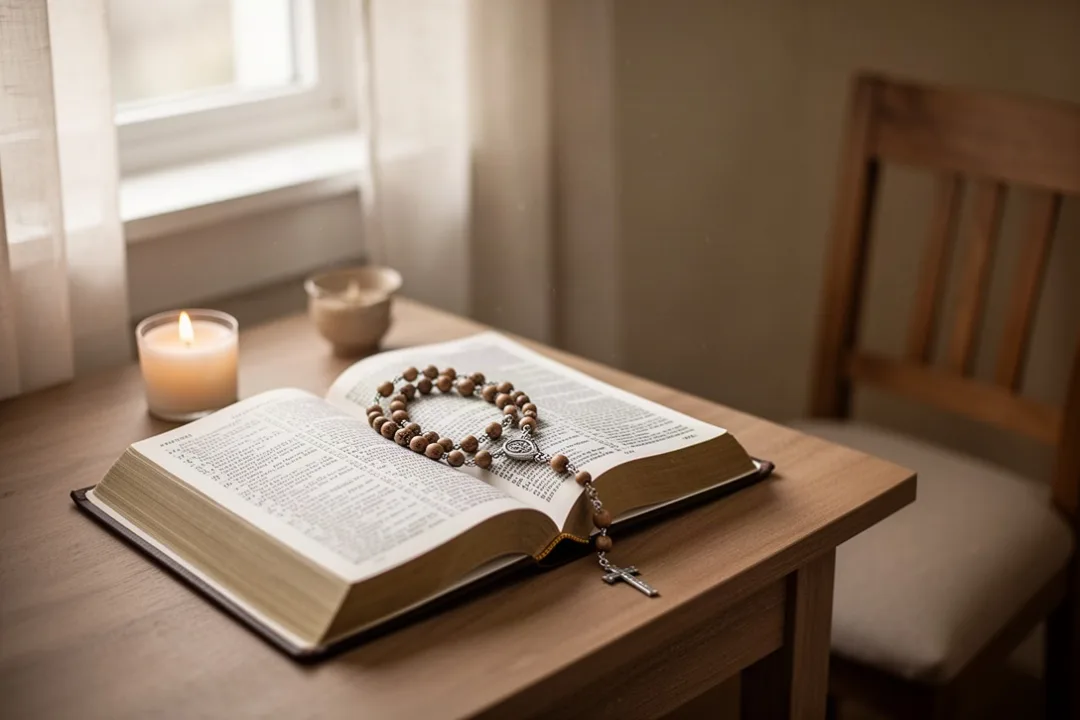
The physical Rosary has a crucifix, several individual beads, and groups of beads arranged in decades. You can use the beads to keep your place, but they are not required. If you do not have a Rosary, count on your fingers or use a written guide.
Before starting, choose a reasonably quiet place and decide which set of mysteries you will pray. It can help to place your phone out of reach, sit comfortably, and take a few unhurried breaths. These simple preparations reduce distractions without making the prayer feel complicated.
You may also choose an intention. An intention is the person, situation, or need you bring to prayer, such as a family member, a difficult decision, people who are grieving, or greater patience in your own life. The intention does not replace the mysteries; it gives your prayer a particular direction.
Practical reminder: If you lose your place, do not restart the entire Rosary. Pause, identify the bead or decade you were praying, and continue peacefully.
Choose the mysteries for the day
The mysteries are grouped according to the major events they contemplate. Each group contains five mysteries, one for each decade. The traditional weekly pattern is widely used, although individuals and prayer groups may follow a different schedule.
Joyful Mysteries: usually prayed on Monday and Saturday. They focus on the Annunciation, the Visitation, the Nativity, the Presentation of Jesus, and the Finding of Jesus in the Temple.
Sorrowful Mysteries: usually prayed on Tuesday and Friday. They focus on Jesus’ agony, scourging, crowning with thorns, carrying of the cross, and crucifixion.
Glorious Mysteries: usually prayed on Wednesday and Sunday. They focus on the Resurrection, Ascension, descent of the Holy Spirit, Assumption of Mary, and her Coronation.
Luminous Mysteries: usually prayed on Thursday. They focus on Jesus’ Baptism in the Jordan, the wedding at Cana, the proclamation of the kingdom, the Transfiguration, and the institution of the Eucharist.
These are commonly associated with particular days, not strict rules that make another choice invalid. You may pray the Joyful Mysteries when you need to reflect on hope and humility, or the Sorrowful Mysteries when you are accompanying someone through suffering.
Some people pray all twenty mysteries in one sitting, sometimes calling this a full Rosary. The more common practice is to pray one set of five mysteries, which takes roughly fifteen to thirty minutes depending on your pace and whether you add other prayers.
How to recite the Rosary in the correct order
The sequence below follows the standard form of the Rosary. Prayer groups may add an opening or closing prayer, but these additions do not change the basic structure.
Begin with the Sign of the Cross. Make the sign while invoking the Father, Son, and Holy Spirit.
Pray the Apostles’ Creed on the crucifix. This is a concise profession of Christian faith.
Pray the Our Father on the first large bead.
Pray three Hail Marys on the next three small beads. These are traditionally offered for growth in faith, hope, and charity.
Pray the Glory Be on the next large or separated bead.
Name the first mystery. State the mystery clearly and take a moment to picture its meaning.
Pray the Our Father on the next large bead.
Pray ten Hail Marys on the ten small beads while meditating on the first mystery.
Pray the Glory Be after the ten Hail Marys. Some people also add a short Fatima Prayer at this point.
Repeat the same pattern for the second, third, fourth, and fifth mysteries.
Finish with a closing prayer, traditionally the Hail Holy Queen, and then make the Sign of the Cross again.
The first group of three Hail Marys is not one of the five decades. The five decades begin after the opening prayers, with the announcement of the first mystery. That distinction helps explain why a standard Rosary includes fifty-three Hail Marys in total: three at the beginning and ten in each of five decades.
The Rosary uses a small set of familiar prayers. If you are learning, it is perfectly reasonable to use a printed card, prayer book, or parish handout until the words become familiar. The names and order of the prayers are more important at first than memorizing them immediately.
The crucifix and opening prayers
The Apostles’ Creed on the crucifix expresses the central beliefs of Christianity, including belief in God, Jesus Christ, the Holy Spirit, the Church, forgiveness, resurrection, and eternal life. It establishes the faith context for the meditation that follows.
On the first large bead, the Our Father directs attention to God’s holiness, the coming of God’s kingdom, daily needs, forgiveness, and protection from evil. On the three small beads, the Hail Mary is repeated three times. The prayer asks Mary to pray for you and places the life of Jesus at its center.
The Glory Be is a short prayer of praise to the Trinity. It closes the opening sequence and later marks the end of each decade. Its placement creates a simple rhythm: an Our Father, ten Hail Marys, and a Glory Be.
The five decades
Before every decade, announce the mystery by name. For example, you might say, “The First Joyful Mystery: the Annunciation,” and then briefly consider what this event reveals about trust, humility, or God’s action. You do not need to give a long explanation.
Pray the Our Father on the large bead, then the ten Hail Marys on the small beads. During those ten prayers, keep returning to the mystery. You might imagine the setting, consider the people involved, or ask how the event relates to your own responsibilities and relationships.
After the tenth Hail Mary, pray the Glory Be. If your custom includes the Fatima Prayer, say it after the Glory Be. The Fatima Prayer is optional; it is not necessary to include every devotional addition for the Rosary to be complete.
Then announce the next mystery and continue. The beads help you count, but they are not a scorecard. If your attention wanders, gently bring it back to the mystery rather than criticizing yourself for losing focus.
The closing prayers
After the fifth decade, many Catholics pray the Hail Holy Queen, a prayer that asks Mary to intercede for those who live amid difficulty and hope for mercy. Some also pray a concluding prayer that asks for the grace to imitate what the mysteries teach.
There is no need to rush through the ending. You can briefly name your intention again, offer thanks, or sit in silence for a few moments before making the Sign of the Cross. A quiet ending can help carry the prayer into the rest of your day.
How to meditate instead of merely counting beads
Reciting the words is only one part of the Rosary. The other part is meditation on the mystery. Repetition is meant to support attention, not replace it.
One useful approach is to focus on a single detail for each decade. In the Annunciation, you might consider Mary’s willingness to receive an unexpected calling. In the Nativity, you might reflect on humility and simplicity. In the Agony in the Garden, you might bring a personal fear to God without pretending it does not exist.
Another approach is to ask one question before beginning each decade:
What virtue or attitude does it invite me to practice?
Who needs this mystery in a particular way today?
What part of this event do I find difficult to understand?
How can I remain present to God while praying these words?
You can also use a short mental image. Picture the road, room, hillside, or garden associated with the mystery without trying to create a detailed theatrical scene. The purpose is not to produce a perfect image; it is to give your attention a concrete place to rest.
Some people find it helpful to connect each Hail Mary with a specific person or need. Others prefer to remain with one broad theme throughout the decade. Both approaches can work. The Rosary is not a test of concentration, and different forms of attention may be appropriate on different days.
How long it takes to recite the Rosary
A standard five-decade Rosary commonly takes about twenty minutes, although the time varies. A person praying slowly, reading from a guide, or including additional prayers may take longer. A group praying together may also move at a different pace than someone praying privately.
Do not treat speed as a sign of devotion. Rushing can make the words blur together and leave little room for meditation. At the same time, you do not have to force long pauses between every prayer. A steady, natural pace is usually the most sustainable.
If you have only a few minutes, you can pray one decade and return to the rest later. You may also pray a single decade for a particular intention. While that is not the complete five-decade form, it is a meaningful way to continue praying when your schedule or circumstances are limited.
Common mistakes when learning the Rosary
Most difficulties come from uncertainty about the order or from expecting yourself to pray with perfect concentration. The following points can make the practice more manageable.
Starting the decades too early: Remember that the Apostles’ Creed, Our Father, three Hail Marys, and Glory Be come before the first mystery.
Forgetting to announce each mystery: Say the name before the decade so your mind has a clear subject for meditation.
Focusing only on the beads: Counting helps, but the mystery gives the decade its spiritual focus.
Trying to eliminate every distraction: Notice the distraction, release it, and return to the prayer without starting over.
Assuming a mistake invalidates the prayer: Correct the error if you notice it, then continue. Do not turn a small mistake into a reason to quit.
Praying too fast: Choose a pace that allows you to hear and understand the words.
Adding too many practices at once: Learn the basic sequence first, then add optional prayers or meditations gradually.
Believing you must use beads: The beads are a helpful counting tool, not a requirement.
When attention wanders: Do not measure the value of your prayer by how many uninterrupted thoughts you had. Returning gently to the mystery is itself an act of faithfulness.
Ways to make the Rosary part of regular prayer
A regular time and place can make the Rosary easier to remember. Some people pray in the morning before responsibilities begin, while others pray in the evening as a transition from work to rest. You might keep a Rosary near a favorite chair, in a prayer space, or with the items you carry each day.
If you are new to the practice, begin with a manageable goal. One decade each day can help you learn the sequence without making prayer feel like another obligation. Once the order becomes familiar, you may naturally want to pray all five decades.
Praying with another person can provide structure. In a family or prayer group, one person often announces the mysteries and leads the prayers while everyone responds. When praying in a group, listen for the pace of the leader and leave enough space for the responses to be heard clearly.
Audio recordings can also help you learn, especially if you are unsure of the prayers. Choose a recording that follows the traditional order and allows enough time for meditation. A recording should support your prayer, not make you feel pressured to match an uncomfortable pace.
How to pray the Rosary during difficult seasons
The Rosary can be prayed when you feel peaceful, but it can also be a steady form of prayer when you feel anxious, distracted, angry, or tired. You do not need to wait until your emotions are settled. Bring your actual state of mind into the prayer.
If grief makes the words difficult, pray slowly and let the mysteries hold what you cannot express. If you are worried about someone, place that person before God at the beginning and return to the intention whenever your mind wanders. If you feel spiritually dry, continue with modest expectations rather than trying to manufacture a strong feeling.
The Sorrowful Mysteries may be especially meaningful when you are facing pain, but you are not limited to them. The Joyful, Luminous, and Glorious Mysteries can also speak to hardship by placing suffering within a larger story of love, service, transformation, and hope.
Prayer should not be used as a substitute for necessary medical, mental health, legal, or practical help. You can pray while also seeking appropriate support from trusted people and qualified professionals.
What the Rosary is meant to form in your life
The repeated prayers can shape more than a single quiet period. Over time, the mysteries invite you to notice humility, compassion, courage, patience, and trust in ordinary decisions. The goal is not simply to finish a set number of prayers, but to let contemplation influence how you treat people and respond to difficulty.
The Rosary also brings together different forms of prayer. It includes praise, petition, repentance, remembrance, and intercession. Because the structure is familiar, you can spend less energy deciding what to say and more energy becoming attentive.
There is room for personal expression within the traditional form. You may pray in your own language, use a different approved set of opening or closing prayers, or include a brief silence before each decade. Keep the central pattern recognizable: announce the mystery, pray the decade, and return your attention to its meaning.
After the final prayer, consider carrying one idea from the mystery into a concrete action. You might listen more patiently, apologize, visit someone who is isolated, make a difficult phone call, or accept a responsibility without seeking recognition. In that way, the Rosary continues beyond the beads and becomes part of how you live.
Frequently asked questions
Do I have to pray the Rosary in exactly the traditional order?
The traditional order provides a helpful framework, especially when you are learning, but small variations are common. You can use different opening or closing prayers, pray one decade at a time, or follow a prayer group’s custom. The essential pattern is meditation on the mysteries through five decades of ten Hail Marys, with the Our Father and Glory Be marking each decade.
Can I recite the Rosary without knowing all the prayers by heart?
Yes. Use a prayer card, book, printed guide, or audio recording until the words become familiar. You can also pray the names of the prayers and follow the bead sequence while learning. Reading from a guide does not make the prayer less sincere; it simply gives you support while you develop familiarity with the structure.
What should I do if I cannot concentrate during the Rosary?
Continue gently rather than judging yourself. Slow down, say the mystery aloud again, or focus on one person or need during the decade. If you lose count, estimate where you were and continue. You can also pray fewer decades and return later. Attention often improves through repeated practice rather than force.
Is it acceptable to pray the Rosary for someone who is not Catholic?
Yes. You may offer the prayer for anyone, including a friend, relative, or community facing hardship. You can name the person or situation before beginning and ask for peace, healing, wisdom, protection, or whatever is appropriate. Respect the other person’s beliefs when speaking about your intention or offering to pray with them.
















Leave a Reply