When October arrives, you may see rosary prayers scheduled at church, hear the month called a special Marian season, or wonder how to observe it at home. The month of the holy rosary is traditionally October, a time when Catholics give particular attention to the Rosary as a prayer centered on Jesus Christ and the life of his mother, Mary.
You do not need an elaborate program to take part. You can pray one decade during a quiet break, gather with family for a full Rosary, or use the mysteries as a guide for reflecting on Scripture. The purpose is not simply to repeat words or complete a religious task, but to let prayer shape your attention, gratitude, repentance, and concern for other people.
October became closely associated with the Rosary through the Catholic Church’s long-standing encouragement of this devotion. Pope Leo XIII strongly promoted the Rosary in the late nineteenth century and connected October with special prayer through papal teaching and guidance. That tradition helped establish October as the Month of the Rosary in Catholic life.
The month also includes the Memorial of Our Lady of the Rosary on October 7. The feast developed in connection with Christian gratitude for the Battle of Lepanto in 1571, when Pope Pius V asked Christians to pray the Rosary for help. The Church’s observance eventually became a broader celebration of Mary’s role in leading believers toward her Son.
The historical background matters, but October is not meant to be treated as a period when the Rosary has magical power. A rosary is a string of beads, and the prayer is a Christian meditation. Its value comes from turning the mind and heart toward the Gospel, not from the object itself or from saying a certain number of prayers mechanically.
Core idea: The Rosary is a Christ-centered prayer with a Marian form. Mary is honored as a mother and disciple who directs attention toward the life, death, and resurrection of Jesus.
The Rosary can be prayed at any time of year, but October offers a useful rhythm for beginning or renewing the practice. Churches may hold public Rosaries, families may set aside a regular evening, and individuals may use the month to return to prayer after a long interruption.
What the Rosary helps you meditate on
The Rosary combines familiar prayers with a sequence of Gospel scenes called the mysteries. “Mystery” does not mean a puzzle that must be solved. It refers to an event in Christ’s life that can be contemplated repeatedly, with new understanding as your circumstances change.
Traditionally, the mysteries are arranged in four groups. The Joyful Mysteries focus on Christ’s beginnings and Mary’s response to God. The Sorrowful Mysteries remember his suffering and death. The Glorious Mysteries contemplate the Resurrection and the hope of eternal life. The Luminous Mysteries, introduced by Pope John Paul II, highlight important moments in Jesus’ public ministry.
Joyful Mysteries: the Annunciation, Visitation, Nativity, Presentation, and Finding of Jesus in the Temple.
Luminous Mysteries: the Baptism of Jesus, Wedding at Cana, proclamation of the Kingdom, Transfiguration, and institution of the Eucharist.
Sorrowful Mysteries: the Agony in the Garden, Scourging, Crowning with Thorns, Carrying of the Cross, and Crucifixion.
Glorious Mysteries: the Resurrection, Ascension, descent of the Holy Spirit, Assumption of Mary, and Coronation of Mary.
Each group offers a different way to bring prayer into ordinary life. The Joyful Mysteries may speak to someone waiting for a child, making a difficult family decision, or learning to recognize God in small responsibilities. The Sorrowful Mysteries can accompany grief, illness, injustice, or fear without pretending that suffering is easy.
The Glorious Mysteries keep Christian hope connected to real events of faith rather than vague optimism. The Luminous Mysteries invite reflection on Jesus’ teaching and public mission, including his call to conversion, compassion, and trust in God.
Many Catholics follow a customary weekly pattern: Joyful Mysteries on Monday and Saturday, Sorrowful on Tuesday and Friday, Glorious on Wednesday and Sunday, and Luminous on Thursday. This schedule is a helpful tradition, not a rule that makes another choice invalid. You may select mysteries according to the needs of your prayer or use the day’s customary set.
A decade includes one Our Father, ten Hail Marys, and one Glory Be. Before the prayers begin, name the mystery and picture the Gospel event with reverence. You might consider what Jesus is doing, how Mary or another person responds, what the scene reveals about God, and how it connects with your own life.
It is normal for your attention to wander. When you notice that your mind has moved to a task, conversation, or worry, gently return to the mystery without scolding yourself. The repeated prayers can provide a steady framework for returning to God.
The Rosary is a school of prayer because it teaches attention through repetition and contemplation.
How to pray the Rosary during October
A full Rosary usually consists of five decades, beginning with introductory prayers and ending with a closing prayer. If you are unfamiliar with the sequence, use a printed guide, a parish handout, or a trusted Catholic prayer resource. You can also ask someone experienced to pray with you and show you the order.
Choose a place and time. Sit somewhere reasonably quiet, silence unnecessary notifications, and allow enough time that you do not feel rushed.
Begin with the Sign of the Cross and the customary opening prayers, including the Apostles’ Creed, an Our Father, three Hail Marys, and a Glory Be.
Name the first mystery and read or recall its Gospel setting. Keep one intention in mind, such as a person who is sick or a need in your community.
Pray the decade: one Our Father, ten Hail Marys, and one Glory Be. Let the repeated words support meditation on the mystery.
Continue through five mysteries, pausing briefly between decades if helpful. You may include a short prayer associated with the Rosary after each decade.
Close with a Marian prayer, such as the Hail Holy Queen, and finish with the Sign of the Cross.
The opening prayers are not a test of expertise. If you forget a line, continue with the words you know and consult a guide later. A person learning the Rosary can begin with one decade and gradually become familiar with the complete form.
Some people use a physical rosary, while others pray with their fingers, a prayer book, or a rosary app. A physical rosary can help you keep your place, but it is not required. If you do use one, handle it respectfully as a prayer aid, not as a lucky charm or protective object.
For a busy day: Pray one decade slowly rather than abandoning prayer because you cannot complete all five. A consistent, attentive decade can be a more fruitful practice than rushing through a full Rosary.
You may also divide the prayer across the day. Pray one decade after waking, another during a commute if you are not driving, and the remaining decades in the evening. This approach can make the Rosary part of your daily routine without requiring one uninterrupted block of time.
Ways to observe the month of the holy rosary at home
October can become more meaningful when the Rosary is connected with concrete acts of care. A household might place a rosary and Bible in a common area, choose a regular prayer time, and invite each person to name an intention. The goal is a peaceful habit, not pressure that turns prayer into a source of conflict.
Families with young children may pray a decade rather than the entire Rosary. Use simple language to describe the mystery, let children hold or count the beads, and allow them to offer intentions for classmates, relatives, animals, or people experiencing hardship. Short participation can be genuine participation.
Set aside a specific evening each week for a family Rosary.
Read a short Gospel passage before each mystery.
Invite different family members to lead individual prayers.
Keep a written list of people and situations you want to remember.
Pair prayer with a practical act of mercy, such as a phone call, meal, donation, or visit.
Attend a parish Rosary if praying alone at home feels difficult.
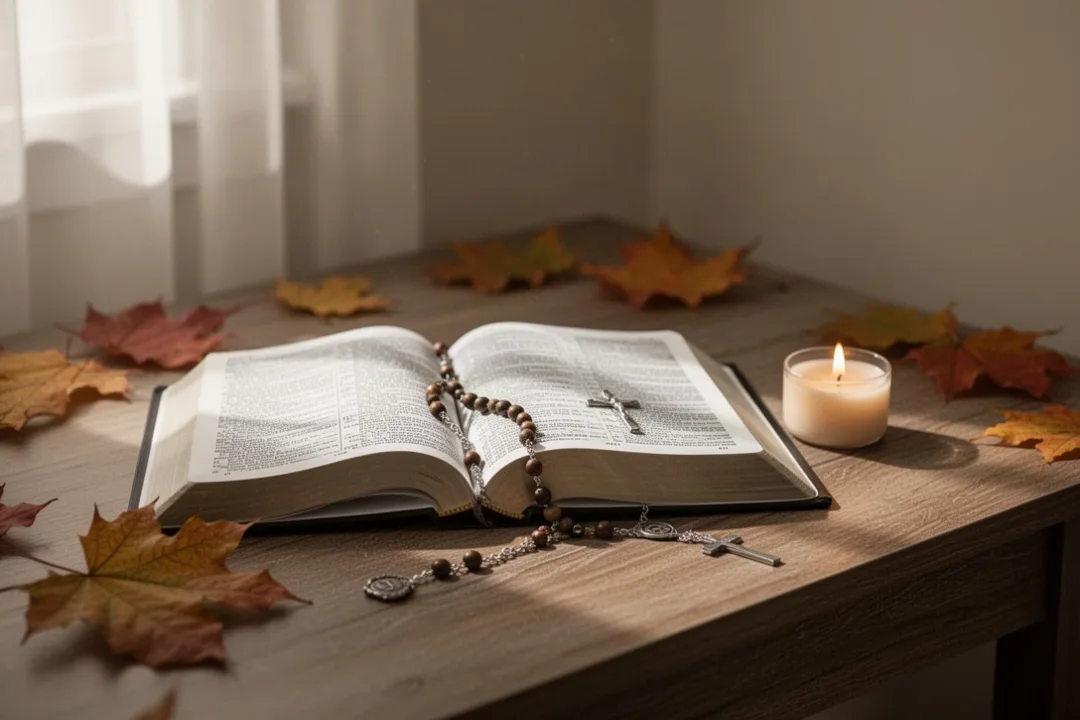
If you live alone, create a modest ritual that makes prayer easier to begin. Light a candle where permitted, sit in the same chair, keep your rosary beside your Bible, or schedule a reminder for a particular time. These simple signals can help your mind shift from daily tasks to deliberate prayer.
Music may help some people settle into prayer, while silence is better for others. You can pray while walking, provided you remain attentive to safety and your surroundings. The setting matters less than bringing a sincere intention to meditate on the mysteries.
October is also a natural time to join a parish or community Rosary. Public prayer can provide structure and companionship, especially if you have struggled to maintain a private practice. Listen respectfully to the local custom, since communities may differ in the prayers they add or the pace they use.
Prayer intentions can include personal needs, but they should not stop there. Consider people affected by war, poverty, loneliness, addiction, persecution, natural disasters, or political division. You may pray for those who have died, for people who have hurt you, and for the grace to respond to difficult circumstances with wisdom and mercy.
How the Rosary can shape daily Christian life
The Rosary is not intended to replace the rest of Christian life. It can support participation in Mass, Scripture reading, confession, service, and acts of charity, but it should not be used as a substitute for responsibilities or for seeking appropriate professional help in a crisis.
Its repeated prayers can teach patience. You may not receive an immediate answer to a problem, yet the practice gives you a regular place to bring the problem before God. Over time, meditation on the mysteries can influence how you respond to family tension, disappointment, temptation, and suffering.
The Rosary can also deepen your understanding of Mary. Catholic devotion does not treat Mary as a replacement for God. It honors her as the mother of Jesus and a faithful disciple whose life points beyond herself to Christ’s saving work.
When you pray the Joyful Mysteries, you may notice the importance of humility, trust, and service. The Visitation, for example, can prompt reflection on how Mary brings encouragement to another person rather than keeping her own experience private. The Nativity can turn your attention toward vulnerable people and the dignity of humble circumstances.
The Luminous Mysteries can encourage a renewed hearing of Jesus’ call. The proclamation of the Kingdom raises questions about repentance, justice, forgiveness, and practical love of neighbor. The Wedding at Cana can lead you to consider attentiveness to another person’s need, while the Transfiguration invites hope when faith feels clouded.
The Sorrowful Mysteries require honesty. They do not ask you to describe abuse, violence, or loss as good. Instead, they place human suffering before the crucified Christ and can help you pray for courage, healing, justice, and companionship for those who suffer. People dealing with trauma may need to adapt the practice or speak with a pastor or counselor.
The Glorious Mysteries keep suffering from having the last word in Christian hope. They focus on resurrection, the Holy Spirit, and the promise of life with God. That hope can coexist with grief and unanswered questions; it does not require you to deny pain or pretend that everything is already resolved.
Keeping the practice honest and sustainable
Choose a form of prayer you can actually maintain. If five decades every day leaves you discouraged, begin with one decade three times a week. If a group prayer moves too quickly for meditation, pray privately at another time as well.
Try these adjustments when the Rosary becomes routine or difficult:
Slow down at the beginning of each decade and state a specific intention.
Read the Gospel passage connected with the mystery before praying.
Change your posture or location when distraction has become habitual.
Pray for someone else instead of focusing only on your own concerns.
Use a shorter practice during illness, travel, or demanding seasons.
Return without guilt after missing several days.
Repetition can feel empty when you are tired, distracted, or grieving. That experience does not automatically mean that prayer has failed. You can offer God the very difficulty you are experiencing and continue quietly, or pause and return later with a simpler prayer.
Avoid judging your prayer by emotional intensity. Some days may bring peace, while others may feel ordinary. The discipline of returning to prayer can be valuable even when there is no strong feeling attached to it.
Questions to consider throughout October
The month of the holy rosary becomes more than a calendar observance when the mysteries lead to reflection and action. After a decade, sit in silence for a moment and ask what the scene invites you to notice. You do not need a complicated answer; one honest response is enough.
Where do I need greater trust, patience, or courage?
Who needs my prayer and practical attention right now?
What suffering am I bringing honestly before God?
Where am I being called to forgive, seek forgiveness, or repair harm?
How can my prayer lead to greater compassion rather than remain private?
You can keep a brief prayer journal during October. Write the date, the mysteries prayed, one intention, and a sentence about what stood out. This record may help you recognize patterns in your concerns and notice ways that prayer is changing your choices.
For a parish, October can include a Rosary before Mass, a home prayer invitation, a teaching session on the mysteries, or a service project connected with prayer intentions. For an individual, it may be as simple as carrying a rosary, learning one new mystery, and setting aside a few minutes each evening.
There is no single perfect way to observe the month. The strongest practice is one that remains faithful, respectful, and connected to love of neighbor. Let October provide a beginning, a renewal, or a return to prayer, and let the mysteries continue to guide your attention long after the month has ended.
Frequently asked questions
Is October officially the month of the holy rosary?
October is traditionally recognized in the Catholic Church as the Month of the Rosary. The association grew through papal encouragement, especially under Pope Leo XIII, and through the October 7 celebration of Our Lady of the Rosary. It is a strong devotional tradition rather than a requirement that every Catholic must follow in exactly the same way.
Do I have to pray all five decades every day in October?
No. A complete Rosary traditionally contains five decades, but you may pray one decade, a single set of mysteries, or the full prayer according to your circumstances. Consistency and attentiveness are more helpful than forcing a schedule that leaves you discouraged. A parish may have its own custom, but private prayer can be adapted.
What should I do if I do not know all the Rosary prayers?
Begin with the prayers you know and use a printed Catholic prayer guide or a parish handout to learn the rest. You can listen to a trusted guided Rosary or pray with someone experienced. It is perfectly acceptable to learn gradually, and forgetting a prayer does not invalidate the time you have already spent praying.
Can non-Catholics pray the Rosary?
Anyone may choose to learn about or respectfully pray the Rosary, although it is specifically a Catholic devotion. Non-Catholics may find it helpful as a structured meditation on Gospel events, while recognizing its Marian language and Catholic meaning. If particular prayers raise theological questions, a local priest or knowledgeable Christian leader can provide context.














Leave a Reply