St Sabina in Rome: history, art, and visiting guide
St Sabina in Rome: history, art, and visiting guide
St Sabina, formally the Basilica of Saint Sabina, is an early Christian church on Rome’s Aventine Hill. Its calm interior, ancient columns, historic wooden doors, and connection with the Dominican Order make it one of Rome’s most significant churches for Christian history and architecture.
The basilica is usually identified in Italian as Santa Sabina all’Aventino. It is an active Catholic church, a Dominican center, and a traditional station church for Ash Wednesday. Visitors come for its age and art, but also for the unusually clear sense of an early Roman basilica that survives inside the modern city.
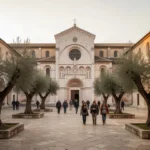
St Sabina stands at Piazza Pietro d’Illiria on the Aventine, one of Rome’s quieter hills. The church is close to the Orange Garden, the Basilica of Saint Alexis, and the famous keyhole viewpoint at the nearby Priory of the Knights of Malta.
The setting helps explain the basilica’s atmosphere. The Aventine is elevated above much of the surrounding city, and its streets are more peaceful than the busy areas around the Colosseum, Trevi Fountain, or Vatican Museums. From the church and its surroundings, you can experience a part of Rome shaped by monastic life, ancient churches, gardens, and broad views.
St Sabina is within walking distance of the Circus Maximus and the Palatine Hill, although the uphill walk can be tiring in hot weather. The nearest public transportation options may change with road works and service changes, so check a current Rome transit map before setting out.
Plan for a religious site: St Sabina is not only a monument. Masses, prayer, religious events, and private observances can affect access, photography, and noise levels.
Who Saint Sabina was
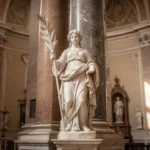
The basilica is traditionally dedicated to Saint Sabina of Rome, a Christian woman associated with the early church in the city. Accounts of her life come from later traditions and should be treated with care, since the surviving evidence about her biography is limited.
Christian tradition commonly presents Sabina as a woman of status who converted to Christianity and supported the faith community. Some accounts connect her with Saint Serapia, described as a servant or companion who was also honored as a martyr. The details differ among later sources, but Sabina’s name became permanently associated with the Aventine church.
As with many ancient saints, the devotional importance of Sabina does not depend on having a complete modern biography. Her name represents the memory of Rome’s early Christian communities, whose worship continued during periods when Christianity was still establishing its public presence.
The basilica’s dedication also shows how Roman churches often preserve several layers of memory at once. A visitor encounters the name of a saint, the remains of an imperial-era neighborhood, the liturgical tradition of the city, and the later history of the religious order that has cared for the site.
When the Basilica of Saint Sabina was built
The present basilica was built in the fifth century, traditionally dated to the period from about 422 to 432. It was commissioned by Peter of Illyria, a priest from the eastern part of the Roman world who served in Rome during the papacy of Celestine I.
Unlike some Roman churches built over dramatic pagan temples or imperial monuments, St Sabina appears to have been constructed in a residential area that included earlier Roman buildings. Archaeologists have identified remains beneath and around the basilica, including evidence of domestic structures. These layers show how the Aventine changed as Christian worship became increasingly visible in Rome.
The church was built during a period when Christianity had moved from a persecuted religion to an established force within the Roman Empire. That change influenced the design of churches. Instead of borrowing the form of a pagan temple, many Christian basilicas used a large hall with a central nave, side aisles, a raised end, and space for communal worship.
St Sabina is especially valuable because it preserves the scale and proportions of an early Christian basilica more clearly than many churches that were heavily remodeled in later centuries. It has undergone repairs and restorations, but its overall character remains closely connected to its ancient form.
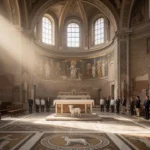
The first impression inside St Sabina is one of light, height, and order. A broad central nave is separated from the side aisles by rows of columns. The long perspective leads the eye toward the sanctuary, following a basic arrangement that became familiar in Christian church architecture.
Many of the columns are ancient materials reused from earlier Roman buildings. This practice, often called spolia, was common in late antique construction. Reusing marble columns was practical, but it also gave a new Christian building a visual connection with Rome’s older architectural world.
The columns have Corinthian capitals, recognizable by their leafy carved forms. Their repeated rhythm gives the interior a measured, almost mathematical calm. Rather than overwhelming the visitor with a crowded collection of later chapels, the design emphasizes space, repetition, and the movement from entrance to altar.
The upper walls originally included windows that helped illuminate the nave. Light was essential to the experience of an early basilica, especially before the installation of the elaborate lamps and painted decoration commonly found in later churches. The open arrangement allows you to read the building as architecture instead of seeing it only as a container for artworks.
Look upward and along the nave before focusing on individual details. The relationship between the rows of columns, high windows, apse, and timber roof is one of the church’s most important features. A quick visit focused only on the famous door can miss the reason St Sabina is so important to architectural history.
What to see inside St Sabina
The interior includes several features from different periods, but the most significant elements relate to the basilica’s early Christian structure and its later Dominican history. Give yourself time to move slowly from the entrance toward the sanctuary rather than treating the church as a single photograph.
The nave: Study the long, balanced space and the rows of reused ancient columns.
The side aisles: Notice how they frame the central area and support the basilica’s processional layout.
The apse and sanctuary: Observe the visual focus created at the eastern end of the church.
The ancient wooden door: Examine the surviving carved panels and their Christian imagery.
The marble and liturgical furnishings: Look for later additions that reveal how worship changed over time.
The Dominican associations: Pay attention to references connected with Saint Dominic and the order’s long presence at the site.
Some areas may be altered, closed, or visually restricted during services and restoration work. The basilica should be read as a living church rather than as an untouched archaeological object. Its layers of use are part of what makes the visit meaningful.
Why the wooden door is famous
St Sabina’s wooden door is one of the most celebrated surviving objects from late antique Christian art. It is generally dated to the fifth century, close to the period when the basilica was built. The door consists of carved panels, although not every original panel remains in place.
The reliefs show scenes from the Bible and Christian tradition. One panel is particularly famous because it is considered one of the earliest surviving visual representations of the Crucifixion of Jesus. The figures are shown in a compact, direct manner, reflecting an early stage in the development of Christian crucifixion imagery.
The carving does not resemble the dramatic crucifixions familiar from later medieval and Renaissance art. The composition is more restrained, and the figures are presented with a strong emphasis on symbol and identity. It is best understood within the visual culture of late antiquity, when artists were developing ways to represent central Christian beliefs for worshippers.
Look at the door from a respectful distance and allow your eyes to adjust to the low relief. The panels have experienced centuries of wear, repairs, movement, and environmental change. Their importance lies not only in the individual scenes but also in the fact that a large portion of an ancient Christian door has survived at its original church.
Viewing tip: The door’s carvings are easier to understand when you focus on the overall panel arrangement first, then examine individual figures and scenes. A guidebook or museum-quality reference can help identify the imagery.
St Sabina, Saint Dominic, and the Dominican Order
St Sabina has been associated with the Dominican Order for centuries. The order took responsibility for the basilica in the thirteenth century, and the church became closely linked with the order’s religious, educational, and administrative life.
Saint Dominic, founder of the Order of Preachers, is traditionally connected with the Aventine complex. Dominican tradition holds that he lived and prayed at Santa Sabina, and the site includes spaces associated with his memory. Some of these areas are more modest and devotional than monumental, which suits the atmosphere of the complex.
The Dominican presence helps explain why the church has a different character from a purely archaeological monument. The basilica remains part of a living religious institution. Its history includes preaching, study, community life, liturgy, and the preservation of a major early Christian building.
The adjacent Dominican buildings and gardens may have separate access arrangements from the main basilica. Do not assume that entering the church automatically gives access to every surrounding space. Ask locally if you want to visit areas connected with the religious community.
Why St Sabina matters on Ash Wednesday
Rome’s historic churches participate in the city’s station church tradition, in which particular churches are associated with the liturgy of specific days, especially during Lent. St Sabina is traditionally the station church for Ash Wednesday, the beginning of the Western Christian season of Lent.
On that day, the pope has traditionally celebrated Mass at the basilica, followed by a procession connected with the start of Lent. This practice gives St Sabina a role that reaches beyond its architecture. It places the church within the ceremonial geography of Rome, where ancient basilicas continue to shape the city’s calendar.
The Ash Wednesday liturgy can create a very different experience from an ordinary tourist visit. Crowds, security controls, reserved areas, and altered access may be present. Anyone hoping to attend should check official Vatican and diocesan information close to the date rather than relying on a general sightseeing schedule.
Even outside Lent, the station church tradition helps explain the importance of St Sabina. The basilica is not simply one old church among many. It is part of a network of places that preserve the history of Roman Christian worship through recurring ceremonies.
How to visit St Sabina respectfully
St Sabina welcomes visitors, but it remains a place of worship. Dress should be suitable for a Catholic church, with shoulders and knees generally covered. Keep your voice low, silence your phone, and avoid walking through areas reserved for prayer or liturgy.
Photography rules can vary, particularly during services. If photography is permitted, avoid flash and do not photograph people who are praying without permission. Tripods, large equipment, or extended filming may not be allowed.
Check the current schedule: Look for official information about opening times, Masses, feast days, and temporary closures.
Allow time for security or entry procedures: Events connected with the church or the surrounding institutions may change access.
Visit outside the busiest period when possible: Morning or late afternoon can be calmer, depending on the liturgical schedule.
Enter quietly: Pause near the doorway and let your eyes adjust before moving farther inside.
Examine the main features in order: Start with the nave, then the columns, sanctuary, furnishings, and wooden door.
Respect restricted areas: Barriers and signs may protect fragile art or mark spaces used by the religious community.
Common mistakes visitors make at St Sabina
The basilica is not difficult to visit, but a few common assumptions can lead to disappointment. The most frequent mistake is treating it as a quick stop between the Orange Garden and the keyhole viewpoint. The church rewards a slower visit, especially if you want to understand its historical importance.
Expecting a museum-style entrance: Religious buildings may close temporarily for prayer, ceremonies, or community use.
Looking only for the door: The wooden panels are important, but the basilica’s architecture is equally significant.
Assuming every surrounding site is included: The church, Dominican complex, garden, and nearby priory can have different access rules.
Visiting without checking the liturgy: Mass times can affect where you may stand and how long you can remain.
Using flash photography: This can disturb worshippers and may harm the atmosphere of a quiet historic interior.
Ignoring the hill: Wear comfortable shoes and allow extra time for walking on sloping streets, particularly in summer.
A useful approach is to combine St Sabina with nearby sites without rushing through any of them. You might visit the basilica first, spend time in the Orange Garden afterward, and then walk toward the Aventine keyhole if access and queues allow.
What to see near the basilica
The Aventine offers several destinations within a compact area. Santa Maria del Priorato, connected with the Knights of Malta, is known for its distinctive architecture and the keyhole view toward Saint Peter’s dome. Access to the priory itself is not the same as access to the public viewpoint, so check current arrangements.
The Orange Garden provides a broad view over Rome and is a natural companion to a visit to St Sabina. Its atmosphere changes with the season and time of day. It can be busy around sunset, while earlier visits may offer a quieter experience.
The nearby Basilica of Saint Alexis adds another layer of Christian and medieval history to the hill. The churches are close enough to visit together, but their interiors and historical identities are different. Allow extra time if you want to appreciate the devotional spaces rather than simply collect exterior photographs.
From the Aventine, you can continue toward the Circus Maximus, the Baths of Caracalla, or the southern edge of the historic center. The route is more enjoyable when planned around the heat and the amount of uphill walking involved.
How long to spend at St Sabina
A focused visit can take about 20 to 30 minutes, allowing time to see the nave, wooden door, sanctuary, and major architectural features. That is enough for a first impression, but it may feel rushed if you want to study the carvings or sit quietly.
Plan closer to an hour if you are interested in early Christian architecture, Dominican history, or the relationship between the basilica and its setting. Add more time for nearby churches, the Orange Garden, and the walk toward the keyhole viewpoint.
The best length depends on the church schedule and your purpose. A traveler making a broad tour of Rome may need a short visit, while a student of Christian art should allow time for careful observation and supporting reading.
Why St Sabina remains significant
St Sabina brings together several histories that are often studied separately: the development of Christian worship in late antique Rome, the reuse of Roman architectural materials, the emergence of Christian narrative art, medieval religious orders, and the continuing liturgical life of the city.
Its importance is not based on a single spectacular monument. The basilica’s value comes from the survival of an early Christian spatial design, the exceptional wooden door, the continuity of Dominican care, and the church’s place in Rome’s annual religious traditions.
For visitors, the strongest experience often comes from the contrast between St Sabina and Rome’s more crowded landmarks. The basilica does not depend on a grand façade or a crowded collection of later masterpieces. Its impact comes from proportion, age, silence, and the sense that the building has remained part of Roman worship for many centuries.
Approach the church as both an architectural monument and a functioning sacred place. That perspective makes the columns, door panels, liturgical furnishings, and Dominican associations easier to understand—and gives the visit a depth that a quick photograph cannot provide.
Frequently asked questions
Is St Sabina free to visit?
The basilica has traditionally been accessible without a standard museum admission fee, but arrangements can change for special events, guided visits, or restricted areas. Because it is an active church, entry may also be limited during Masses, ceremonies, or restoration work. Check current official information before traveling, especially if your visit is tied to Ash Wednesday or another major liturgical celebration.
Can visitors see Saint Dominic’s room at St Sabina?
The Aventine complex contains spaces associated with Saint Dominic and the Dominican community, but access is not necessarily included with entry to the basilica. Some areas may be devotional, enclosed, or available only at certain times. Ask on site about current opening arrangements, and do not enter community or restricted spaces without clear permission.
What is the most important artwork at St Sabina?
The fifth-century wooden door is generally considered the basilica’s most famous artwork. Its carved panels include biblical scenes, including an early surviving representation of the Crucifixion. The door should be viewed alongside the church’s architecture, since the nave, reused columns, high windows, and early Christian layout are central to St Sabina’s significance.
Is St Sabina suitable for children?
Yes, provided children understand that the basilica is a quiet place of worship. The ancient door, tall columns, and spacious interior can be interesting for school-age visitors, especially with a simple explanation of how early Christian churches were designed. Keep children close, avoid running, and plan a shorter visit if the church is holding a service.











Leave a Reply