St Peter in Chains: history, meaning, and Rome’s basilica
St Peter in Chains: history, meaning, and Rome’s basilica
St Peter in Chains refers both to the biblical story of the apostle Peter’s imprisonment and to the Roman basilica traditionally believed to preserve the chains that bound him.
The phrase has three closely connected meanings. It describes Peter’s captivity for preaching about Jesus, the ancient Christian tradition surrounding the chains associated with that imprisonment, and the Basilica of San Pietro in Vincoli—literally, Saint Peter in Chains—in Rome.
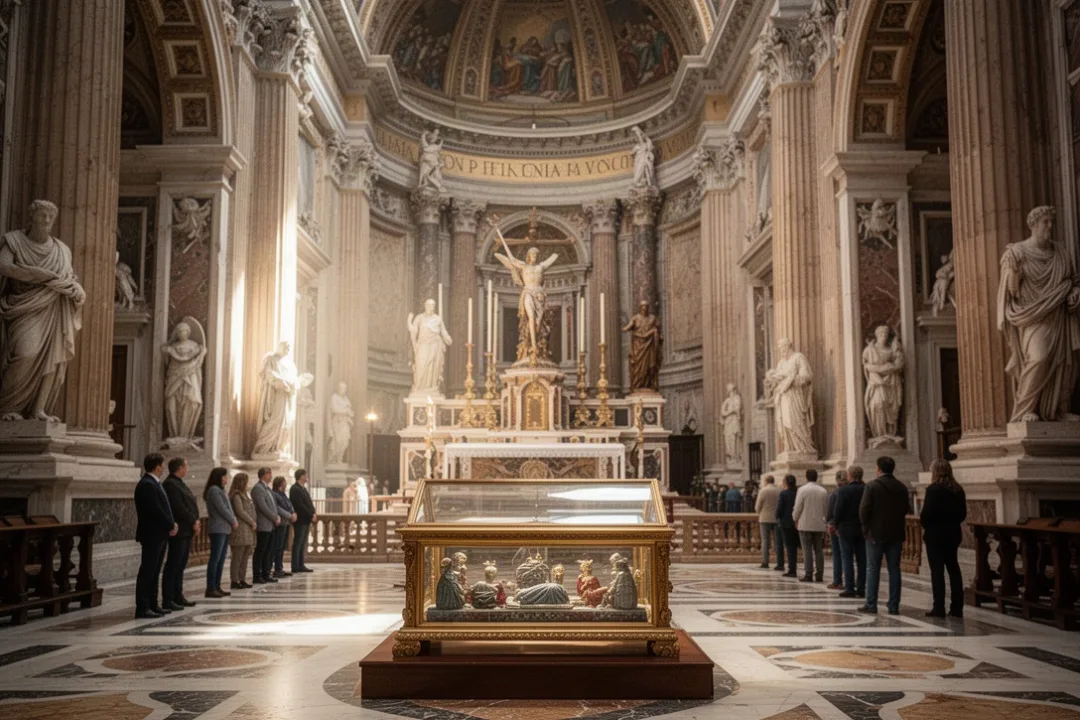
For many visitors, the most direct reference is the church on the Esquiline Hill. Its central relic is displayed beneath the main altar, while the basilica is also famous for Michelangelo’s statue of Moses. For Christians, however, the chains are more than an archaeological object or an artistic detail. They represent Peter’s suffering, courage, freedom in faith, and the cost of public witness.
The biblical accounts do not present Peter as a figure who avoided danger. In the Book of Acts, he is arrested more than once, and his release is described as an answer to the prayers of the Christian community. The story traditionally connected with the Roman relic is especially associated with Acts 12, where Peter is imprisoned in Jerusalem under Herod Agrippa I.
The central idea: St Peter in Chains is not simply a relic or a church name. It is a reminder that physical imprisonment did not prevent Peter from remaining faithful to his mission.
How Peter’s chains appear in the Book of Acts
According to Acts 12, Peter was arrested during a period of persecution in Jerusalem. He was placed under heavy guard, fastened with chains, and held in prison while the Christian community prayed for him. The account describes an angel waking Peter, the chains falling away, and the apostle being led out of the prison.
The biblical passage emphasizes both Peter’s vulnerability and the unusual calm with which he faces the night. He is sleeping when the angel comes to him, despite the danger around him. The story then turns on a sequence of simple actions: Peter gets up, dresses, follows his guide, and reaches safety before fully understanding what has happened.
Acts 12 is not a technical record of prison procedures, and it does not identify the precise physical chains now kept in Rome. The connection between the biblical imprisonment and the Roman relic belongs to the ancient tradition of the church. That distinction allows the religious meaning of the relic to be appreciated without treating every detail of the later tradition as a direct statement from the biblical text.
Peter’s imprisonment also fits the wider pattern of Acts. The early apostles repeatedly face threats, interrogations, beatings, and confinement. Their response is not presented as a search for suffering for its own sake. Instead, the stories show them continuing to teach, pray, and serve the community even when authorities attempt to silence them.
How the relic tradition connects Jerusalem and Rome
The chains preserved at San Pietro in Vincoli are traditionally associated with two different imprisonments: one in Jerusalem and another in Rome. According to the tradition, the chains from the two locations were brought together, and they miraculously joined into a single length when placed near each other.
This story is part of the devotional history of the relic. It expresses the belief that the same apostle endured captivity in both cities and that his ministry connected the Christian communities of the East and the West. The tradition also explains why the basilica’s identity centers on chains rather than on a more general dedication to Peter.
The Roman church is traditionally linked with the chains Peter wore while imprisoned in Rome under the emperor Nero. The exact historical circumstances of that imprisonment are less fully documented than the biblical account in Acts 12. Early Christian memory, Roman tradition, and the development of the basilica’s relic cult gradually shaped the story known to pilgrims today.
Visitors should therefore distinguish between historical evidence, biblical testimony, and devotional tradition. These categories can overlap in a religious site, but they are not identical. The chains have been honored for centuries as a tangible connection to Peter, even though modern historical methods cannot verify every stage of their journey.
The meaning of St Peter in Chains becomes clearer when the story is considered in a few stages:
Peter is arrested. The apostle’s preaching brings him into conflict with political and religious authorities.
He is bound and guarded. The chains represent the concrete reality of imprisonment, fear, and the attempt to control his movement.
The Christian community prays. Acts places communal prayer alongside Peter’s captivity, showing that he is not forgotten or abandoned.
Peter is released. The biblical story presents his escape as divine deliverance rather than as a human military victory.
The chains become a memorial. In Rome, the relic tradition preserves the memory of Peter’s suffering and links it to the continuing life of the church.
The symbol is interpreted spiritually. The chains can suggest persecution, but also steadfastness, liberation, and the freedom to remain faithful under pressure.
This sequence explains why the relic has attracted pilgrims for so long. It is not valued only because it might have touched Peter. It also condenses a larger Christian story into a physical object that invites prayer and remembrance.
The Basilica of San Pietro in Vincoli in Rome
The Basilica of San Pietro in Vincoli stands in the Monti area of Rome, near the Colosseum and the Roman Forum. Its name identifies its principal dedication: Saint Peter in Chains. The church is not the same as St. Peter’s Basilica in Vatican City, although both are major Roman churches connected with the apostle Peter.
San Pietro in Vincoli was founded in the fifth century, traditionally during the pontificate of Pope Leo I. The church was built to house and honor the chains associated with Peter. Over time, it was altered and restored, so the building visitors see today reflects multiple periods of Roman architectural and artistic history.
The basilica’s interior is comparatively restrained in its overall arrangement, but several features draw immediate attention. The relic of the chains is displayed beneath the main altar, and Michelangelo’s Moses occupies a prominent position in the tomb monument of Pope Julius II. The combination of relic, architecture, and sculpture gives the church a distinctive identity among Rome’s historic sanctuaries.
The basilica remains a place of worship, not merely a museum. Visitors may encounter people praying quietly before the altar, attending Mass, or venerating the relic. Respect for the church’s religious purpose matters even when your primary interest is history or art.
Where to see the chains inside the church
The chains are kept in a reliquary beneath the main altar. Their placement gives them a central liturgical position rather than treating them as an unrelated exhibit. The setting encourages visitors to see the relic in relation to the altar, the Eucharistic celebration, and the church’s dedication to Peter.
Because the basilica is an active place of worship, access and visibility can vary according to religious services, restoration, crowd levels, or local arrangements. A visitor may be able to approach the area closely at one time and need to remain farther back at another. The respectful approach is to follow signs and the instructions of church staff.
When viewing the relic, consider several details:
Its location beneath the altar: this connects the chains with the church’s central act of worship.
The reliquary: the container reflects the long history of formally preserving and presenting sacred objects.
The surrounding space: the relic is part of an architectural and devotional setting, not an isolated artifact.
The tradition behind it: the object is understood through centuries of Christian memory as well as through physical examination.
Photography policies may differ from one part of the church to another, and flash photography is often inappropriate in a worship space. If you are visiting as part of a larger sightseeing itinerary, allow time to pause rather than treating the chains as a quick stop between monuments.
Why Michelangelo’s Moses is in the basilica
Many people enter San Pietro in Vincoli because they want to see the chains and then discover that the church also contains one of Michelangelo’s most famous sculptures. Moses forms the central figure of the tomb monument commissioned for Pope Julius II.
Michelangelo began work on the tomb project in the early sixteenth century. The monument was revised several times, and the final version is much smaller than the grand structure originally envisioned. Moses was completed in the early sixteenth century and placed in San Pietro in Vincoli, where the tomb monument remains one of the church’s defining artistic features.
The sculpture shows Moses seated with the stone tablets associated with the Law. Michelangelo gives the figure a powerful physical presence, with a concentrated expression and carefully modeled drapery. The statue is often discussed for its treatment of the beard, the pose, the muscles, and the impression of contained energy.
The relationship between Moses and Peter is also meaningful within the church’s setting. Moses is associated with the giving of the Law and the formation of Israel, while Peter is associated with the apostolic church and the proclamation of the gospel. The basilica therefore brings together Old Testament authority, apostolic witness, and the artistic ambitions of Renaissance Rome.
For art-focused visitors: look at Moses from several angles, but also step back to see how the sculpture functions within the entire tomb monument and the basilica’s interior.
What the chains symbolize for Christian prayer
The chains have a meaning that extends beyond the historical question of provenance. In Christian devotion, they can represent the forces that limit human freedom: persecution, fear, addiction, injustice, imprisonment, and the pressure to abandon conscience. Their significance depends on the story of Peter’s faithfulness under those conditions.
At the same time, the chains do not turn suffering into something desirable. Peter’s release in Acts is presented as good news. The Christian interpretation is not that bondage should be accepted passively, but that God’s presence and human faithfulness can endure even in circumstances that are unjust or frightening.
The relic may therefore prompt several kinds of prayer:
Prayer for people held unjustly or separated from their families.
Prayer for those constrained by fear, violence, illness, or destructive habits.
Prayer for courage when speaking or acting according to conscience.
Prayer of gratitude for freedom and for those who protect the vulnerable.
Prayer for Christian communities facing persecution or discrimination.
For some visitors, the most powerful aspect of the chains is their plainness. They are not a royal crown or an elaborate ceremonial object. They evoke metal, weight, restraint, and the limited physical space of a prison. That simplicity makes the spiritual interpretation immediate.
The feast of St Peter in Chains
The traditional feast associated with St Peter in Chains is observed on August 1. In older Roman Catholic calendars, the day was known as the Feast of Saint Peter in Chains and was an important occasion for honoring the relic kept in Rome.
Calendar reforms changed the status and observance of many older feast days. The commemoration may not appear in the same way on every modern calendar, and local churches can preserve particular customs connected with it. The basilica itself continues to retain its dedication and devotional importance.
The date also has an interesting relationship with the wider calendar of Peter’s life. Other commemorations honor events such as Peter and Paul’s martyrdom or the Chair of Saint Peter. The St. Peter in Chains observance focuses specifically on Peter’s imprisonment and deliverance, making it distinct from celebrations centered on his leadership or martyrdom.
If you want to attend a service connected with the feast, check the basilica’s current schedule or a reliable local church source. Service times, access arrangements, and special celebrations can change, especially during religious holidays and restoration work.
How to visit San Pietro in Vincoli respectfully
The basilica is easy to combine with a visit to other ancient sites in central Rome, but its location can be slightly less obvious than its fame suggests. It sits uphill from the Colosseum area, and the final approach includes streets and steps typical of Rome’s historic center.
A thoughtful visit begins by treating the church as both a heritage site and a living sanctuary. You do not need to be Catholic to appreciate the architecture, relic tradition, or sculpture, but appropriate behavior helps preserve the atmosphere for people who have come to pray.
Check current opening information. Hours can change because of liturgical celebrations, maintenance, or special events.
Dress for a church setting. Modest clothing is the safest choice, particularly if you plan to visit other Roman churches on the same day.
Enter quietly. Keep conversations low and silence your phone near the altar and chapels.
Look for the relic and Moses. They are the two features most visitors expect to see, but take time to notice the wider interior.
Observe photography rules. Do not use flash if photography is permitted, and never photograph a service in a way that disturbs worshippers.
Allow extra time for prayer or Mass. Services take priority over sightseeing access.
Do not assume that a nearby landmark has the same name or dedication. St. Peter’s Basilica is at the Vatican, while San Pietro in Vincoli is a separate church in central Rome. If you are using a map, search for the full Italian name rather than only “St. Peter’s.”
What historians can and cannot establish
Historical research can establish that the basilica is an ancient Roman church dedicated to Peter and that the chains have been venerated there for many centuries. It can also examine the chain’s material characteristics, the church’s architectural development, and written records of its cult.
What research cannot establish with complete certainty is that every link can be traced directly to the apostle’s hands. The New Testament confirms that Peter was imprisoned and chained, but it does not provide a documented chain of custody for the relic later preserved in Rome.
This does not make the tradition meaningless. Religious relics often function within a framework of memory, ritual, and inherited testimony. A visitor can acknowledge the limits of historical proof while still understanding why generations of Christians have regarded the chains as a profound reminder of Peter’s witness.
The most responsible description is therefore careful: the basilica houses chains traditionally associated with Saint Peter. That wording respects both the importance of the tradition and the difference between devotional belief and independently verifiable documentation.
Why St Peter in Chains still matters
St Peter in Chains continues to matter because it brings together a biblical story, an ancient relic, a functioning church, and a major work of Renaissance art. Each element changes the way the others are understood. The chains give the church its spiritual focus; the church gives the relic a liturgical home; Moses gives the building an artistic landmark; and Peter’s story gives the entire setting its human urgency.
The phrase also speaks to a question that remains recognizable: how can a person act faithfully when freedom is limited? Peter’s story does not promise that faithful people will avoid danger. It presents courage as continued trust, prayer, and action in circumstances that appear to have closed every path forward.
Whether you visit Rome, study early Christianity, admire Michelangelo, or simply encounter the phrase in a church calendar, St Peter in Chains points beyond the metal itself. It preserves the memory of an imprisoned apostle and invites reflection on freedom, suffering, conscience, and hope.
Frequently asked questions
Is St Peter in Chains the same church as St. Peter’s Basilica?
No. San Pietro in Vincoli, or St Peter in Chains, is a separate basilica in Rome’s Monti district. St. Peter’s Basilica is located in Vatican City. San Pietro in Vincoli is especially known for the traditional chains associated with Peter and Michelangelo’s Moses, while the Vatican basilica is built over the traditional site of Peter’s tomb.
Are the chains in Rome definitely the ones Peter wore?
The chains are traditionally believed to be connected with Peter’s imprisonments in Jerusalem and Rome, but their complete historical provenance cannot be proven with certainty. The New Testament confirms Peter was imprisoned and chained, while the specific relic tradition developed through centuries of Christian memory and devotion.
When is the feast of St Peter in Chains?
The traditional feast is August 1. Its status and prominence differ among modern Christian calendars, especially after calendar reforms. San Pietro in Vincoli continues to preserve the dedication, and local observances may vary. Check current information from the basilica or a local Catholic source before planning a visit for the feast.
What else should you see inside San Pietro in Vincoli?
The church’s other major attraction is Michelangelo’s Moses, part of the tomb monument made for Pope Julius II. You can also observe the basilica’s historic interior, chapels, altar, and devotional setting. Visit quietly, because it remains an active church and religious services may limit access to certain areas.












Leave a Reply