St Peter is traditionally believed to have died by crucifixion in Rome, probably during the persecution of Christians under Emperor Nero in the 60s CE. Early Christian tradition says he was crucified upside down because he felt unworthy to die in the same position as Jesus, although the upside-down detail comes from later sources rather than the New Testament.
The Bible does not give a full account of Peter’s death or name a date for it. It does, however, contain a statement from Jesus in John 21:18–19 that Christians have long understood as a prediction of Peter’s martyrdom. The strongest early evidence outside the Bible links Peter’s death with Rome, but several details remain uncertain.
Peter’s death is generally placed in Rome, where he is said to have been executed as a Christian leader. Most historians connect it with the period after the fire of Rome in 64 CE, when Nero’s government punished Christians in the city. A precise year cannot be established with confidence, and ancient writers do not provide a complete official record of the execution.
The usual account says that Peter was crucified, the same form of execution used against Jesus. The tradition that he was crucified upside down appears in a later Christian account, commonly known as the Acts of Peter. That source presents the unusual position as Peter’s request, expressing humility before Christ.
Several points should be kept separate when discussing the evidence:
Peter’s martyrdom: This is supported by early Christian testimony and is widely accepted as historically plausible.
Rome as the location: The earliest surviving traditions strongly associate Peter’s death with Rome.
Crucifixion: This is the dominant tradition and fits the later descriptions of his death.
Crucifixion upside down: This detail is important in Christian tradition but is not stated in the New Testament or the earliest surviving reference to Peter’s martyrdom.
The exact date: It is uncertain, although the 60s CE is the most common historical setting.
The clearest answer: Peter most likely died as a martyr in Rome during the 60s CE, probably by crucifixion. The claim that he was crucified upside down belongs to later tradition and cannot be confirmed with the same level of confidence.
What the Bible says about Peter’s future death
The Gospel of John contains the main biblical passage associated with Peter’s death. In John 21:18–19, Jesus tells Peter that when he is older, another person will dress him and take him where he does not want to go. The Gospel explains that this refers to the kind of death by which Peter would glorify God.
The passage does not describe an execution scene, identify Rome, or say that Peter would be crucified upside down. Its language is broad enough to indicate violent death and loss of personal control, which explains why later Christians connected it with martyrdom. The reference to stretched-out hands has also been read as an allusion to crucifixion, but that interpretation does not settle every detail.
John 21 is set after Jesus’ resurrection and includes Peter’s restoration after his earlier denial of Jesus. The passage therefore links Peter’s future suffering with his renewed leadership and loyalty. It presents death not as a random ending, but as the final cost of his public witness.
Other New Testament passages describe Peter’s ministry but do not narrate his death. Acts presents him as a leading figure in the early Christian community, especially in Jerusalem, and later chapters shift attention toward Paul. First Peter identifies its author as Peter, although questions about its composition and date have been discussed by scholars; it does not provide a narrative of how Peter died.
Why historians connect Peter’s death with Rome
The connection between Peter and Rome appears in several early Christian traditions. First Clement, a letter associated with the church of Rome and usually dated near the end of the first century, refers to Peter’s suffering and martyrdom. It does not provide the full execution story found in later accounts, but it shows that Peter’s death was remembered early within Roman Christian circles.
The Roman connection is also supported by the writings of later Christian authors. Ignatius of Antioch, writing in the early second century, refers to Peter and Paul in a way that reflects their importance to the Roman church. By the second century, writers such as Irenaeus clearly associate both apostles with Rome and treat their deaths there as part of the church’s remembered history.
This evidence is not the same as a surviving government document or eyewitness report. Ancient historical records are incomplete, especially for executions of people outside the Roman political elite. Still, the early and consistent association between Peter and Rome gives the tradition substantial historical weight.
Rome also fits the broader setting of the first Christian century. Peter was one of the best-known leaders of the movement, and the city contained a growing Christian community. If authorities wanted to punish prominent Christians or make an example of them, a public execution in the imperial capital would have carried a strong warning.
How Nero’s persecution may relate to Peter’s death
In 64 CE, a major fire damaged much of Rome. The Roman historian Tacitus later wrote that Emperor Nero blamed Christians for the disaster and subjected some of them to brutal punishments. Tacitus does not name Peter, but his account confirms that Christians in Rome faced lethal persecution during Nero’s reign.
According to Tacitus, Christians were executed in different ways, including being crucified. Some were also used in public spectacles. This background makes the traditional setting of Peter’s death historically plausible, although it does not prove that Peter was executed during the fire-related persecution or establish the exact circumstances.
The phrase “Nero’s persecution” can suggest a single, empire-wide campaign, but the evidence is more limited. Tacitus describes punishment in Rome rather than a detailed policy covering every province. Peter’s death is therefore best placed within the known danger faced by Christians in Rome under Nero, not assigned to a precisely documented execution order.
Most reconstructions place Peter’s death sometime between 64 and 68 CE, the final years of Nero’s rule. Some traditions favor a date near 67 CE, but that date is not certain. The safest historical wording is that Peter probably died in Rome during the Neronian period.
Where the upside-down cross tradition came from
The story of Peter’s upside-down crucifixion is associated especially with the Acts of Peter, an early Christian text that survives in later forms and is generally dated to the second century. The work is not part of the New Testament and is classified as an apocryphal or noncanonical writing. It contains legendary material alongside traditions about Peter’s preaching and death.
In this account, Peter asks to be crucified head downward because he does not consider himself worthy to die in the same manner as Jesus. The story gives the position a theological meaning: Peter honors Jesus while acknowledging the difference between the teacher and the disciple.
The upside-down cross was not originally presented as an insult to Christianity. In traditional Christian use, it can represent Peter’s humility and martyrdom. Its meaning depends on context, since modern popular culture sometimes uses the symbol in ways that have little connection to the historical Christian tradition.
The account should be treated carefully. It is valuable evidence for what some Christians believed about Peter’s death by the second century, but it is not a contemporary record from the time of the execution. Historians distinguish between a tradition being old and a detail being independently verified.
What the earliest sources do and do not establish
Evidence about Peter’s death comes from different types of sources, written at different times and for different purposes. Reading them together helps separate the central tradition from details that became more elaborate over time.
The Gospel of John: It refers to Peter’s future death in symbolic and theological language, but it does not name the place, date, or method.
First Clement: It remembers Peter as a figure who suffered and died as a martyr, providing early testimony but few practical details.
Tacitus: He describes Nero’s punishment of Christians in Rome, confirming the historical setting of persecution without mentioning Peter.
Second-century Christian writers: They increasingly connect Peter’s death with Rome and strengthen the tradition of Peter’s role in the Roman church.
The Acts of Peter: It supplies the upside-down crucifixion story, but its later date and legendary style require caution.
This pattern is common in ancient history. A central event may be remembered consistently while specific features, such as the exact position of an execution, develop in later retellings. Peter’s martyrdom in Rome is better supported than the exact mechanics of his death.
The absence of a Roman execution record should not be overstated. Ancient records have been lost, and many people executed by Roman authorities were not documented in surviving texts. At the same time, the absence of direct documentation means responsible accounts should distinguish probability from certainty.
What happened to Peter’s body according to tradition
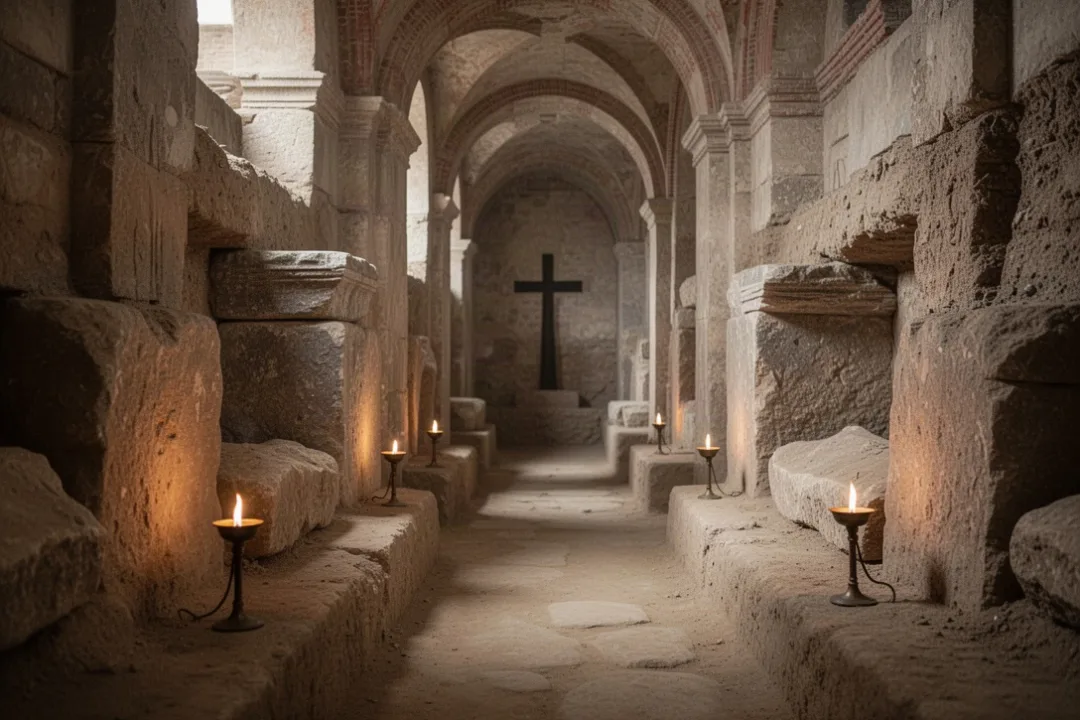
Christian tradition places Peter’s burial near the site of his death, traditionally in the area now associated with Vatican Hill. Over time, the location became one of the most important pilgrimage sites in Christianity. The present-day Basilica of St. Peter stands above a complex of earlier structures and burial areas.
Archaeological work beneath the basilica has revealed a Roman necropolis and a tomb associated with the traditional location of Peter’s burial. Excavations and the interpretation of human remains have been the subject of scholarly discussion. The findings support the existence of an early Christian memory centered on the site, but they cannot prove every part of the later narrative.
The Vatican has long maintained that Peter’s remains are connected with the basilica. In the mid-20th century, excavations beneath St. Peter’s produced a set of bones that church authorities associated with the apostle. The identification remains a matter of interpretation rather than a conclusion that can be demonstrated with complete certainty.
The physical site matters because it shows how early and strongly Roman Christians preserved a memory of Peter’s burial. It does not independently prove that he was crucified upside down, nor does it provide a precise date for his death. Archaeology and written tradition answer different questions and should not be treated as interchangeable evidence.
Why Peter’s death mattered to early Christians
Peter’s death became important because he was remembered as one of Jesus’ closest disciples and as a leading witness to the resurrection. His martyrdom represented the cost of publicly identifying with the Christian message in a hostile environment. It also shaped the identity of the church in Rome, which regarded Peter as one of its founding authorities.
Peter’s story has a distinctive emotional arc. The Gospels portray him as outspoken and devoted, but also as a disciple who denied knowing Jesus during the arrest and trial. The later tradition of his martyrdom presents a contrast: the man who once recoiled from danger ultimately remained faithful under threat of death.
That contrast helps explain why the account of Peter’s death was remembered as more than a historical detail. It became an example of repentance, perseverance, and humble discipleship. The tradition does not erase Peter’s earlier failure; instead, it interprets his later witness as evidence of transformation.
For the early church, martyrdom also served as public testimony. The Greek word martys, from which “martyr” is derived, originally carried the sense of a witness. Peter’s death was therefore understood as a final witness to his belief, even though Christian writers differed in how they described the event.
Common mistakes when researching St Peter’s death
Popular retellings often combine biblical material, later tradition, art, and modern assumptions into one confident story. These practical checks help you evaluate claims about Peter without dismissing the tradition or overstating what the evidence can show.
Do not say the Bible directly reports Peter’s crucifixion. John 21 points toward a violent death, but the Gospel does not narrate the execution.
Do not treat the upside-down detail as equally certain. It comes from a later source than the earliest references to Peter’s martyrdom.
Do not confuse Tacitus’s account with a biography of Peter. Tacitus describes Christians persecuted in Rome, but he does not mention Peter by name.
Do not present 67 CE as a proven date. It is a commonly suggested date within the broader Neronian period, not a securely documented one.
Do not assume every image of an inverted cross has the same meaning. In Christian tradition, it can refer specifically to Peter’s humility.
Do not use archaeological claims as if they settle the entire story. A burial site may support an early tradition without confirming the execution method.
A careful way to describe the tradition: “Early Christian evidence indicates that Peter was martyred in Rome, probably under Nero. Later tradition says he was crucified upside down, but that detail is not independently confirmed by the earliest sources.”
How Peter’s death is represented in Christian art
Christian art frequently shows Peter with keys, a reference to the authority attributed to him in Matthew 16:19, or as an older man with a short beard. Scenes of his martyrdom may show a cross being raised upside down or Peter approaching execution. These images usually communicate theological meaning as much as historical reconstruction.
The inverted cross became a recognizable symbol of Peter in Catholic art, church decoration, and religious literature. It can signal his special association with Rome and his humility before Jesus. The symbol should therefore be interpreted according to the surrounding image and its historical setting rather than assigned one universal meaning.
Artists have also depicted Peter’s death alongside the crucifixion of Paul. This pairing reflects the longstanding Roman tradition that both apostles died in the city, although their deaths were understood to have occurred in different ways. Peter’s crucifixion and Paul’s execution by beheading became complementary symbols of apostolic witness.
What can be said with confidence about Peter’s final years
Peter was active as a prominent Christian leader after Jesus’ death, and he is strongly connected with the earliest Christian communities. By the end of the first century, Christians were already remembering him as a martyr. The Roman setting appears early enough and consistently enough to be more than a late medieval invention.
The details beyond that core are less secure. Historians cannot establish the exact day of Peter’s death, the precise location of the execution, the words spoken at the scene, or the position of the cross from the surviving evidence. The upside-down account remains a significant and ancient Christian tradition, but it should be identified as tradition rather than presented as a directly documented fact.
A balanced account can therefore hold two ideas together: Peter’s martyrdom is historically credible, and the later narrative details require qualification. This approach respects both the importance of Christian memory and the limits of the surviving historical record.
Why St Peter’s death is still remembered
Peter’s death remains central to Christian memory because it connects the life of a particular apostle with the growth of the church in Rome. The story also gives meaning to a difficult human pattern: a person who failed publicly can become a courageous witness through repentance and renewed commitment.
For many Christians, the upside-down cross represents Peter’s refusal to place himself on the same level as Christ. For historians, the tradition provides evidence of how early communities interpreted Peter’s death and preserved his memory. For visitors to Rome, the basilica and the excavated burial area make that memory visible in a physical place.
The most responsible answer is neither to reject the tradition simply because every detail cannot be proved nor to present later legends as eyewitness history. Peter probably died by crucifixion in Rome during Nero’s reign; the upside-down position remains an old, meaningful, but less certain part of the account.
Frequently asked questions
When did St Peter die?
The exact date is unknown. Most historical reconstructions place Peter’s death in Rome sometime during the 60s CE, likely during Emperor Nero’s reign. Dates near 67 CE are sometimes suggested, but no surviving source establishes a precise year or day. The broader setting is more secure than the specific date.
Was St Peter really crucified upside down?
The upside-down crucifixion is an ancient Christian tradition, especially associated with the second-century Acts of Peter. It is not described in the New Testament and does not appear in the earliest surviving reference to Peter’s martyrdom. Historians regard crucifixion as likely, but the inverted position as less certain.
Where was St Peter buried?
Christian tradition places Peter’s burial beneath the area now occupied by St. Peter’s Basilica in Vatican City. Archaeological excavations uncovered a Roman necropolis and a tomb connected with this tradition. The site strongly reflects an early memory of Peter’s burial, although identifying specific remains with absolute certainty remains difficult.
Did the Roman authorities execute Peter under Nero?
Early Christian tradition connects Peter’s death with Rome, and Tacitus confirms that Christians in Rome faced deadly persecution during Nero’s reign. Tacitus does not name Peter, so the connection cannot be proven from his account alone. Still, Peter’s traditional death during the Neronian period fits the known historical circumstances.












Leave a Reply