If you were trying to work out what happened after Jesus’ crucifixion, you might begin with a simple question: Who actually saw him alive again? The New Testament describes several resurrection appearances, involving individual followers, groups of disciples, and eventually a very large gathering.
These accounts do not present one continuous scene. They describe encounters in different places and at different times, beginning near the tomb in Jerusalem and continuing in Jerusalem, on the road to Emmaus, and in Galilee. The writers emphasize that Jesus was not merely remembered through visions of his teaching. They portray him as the same Jesus who had been crucified, now alive, speaking with his followers, eating with them, showing his wounds, and commissioning them to continue his work.
The phrase resurrection appearances refers to the occasions when Jesus’ followers reported seeing him after his death and burial. The four Gospels and Paul’s First Letter to the Corinthians preserve several of these reports, while Acts gives further details about the period before Jesus’ ascension.
Each account has its own emphasis. Matthew focuses on the women at the tomb and the disciples in Galilee. Mark’s shorter ending reports the discovery of the empty tomb but stops before describing an appearance; the longer ending, found in later manuscripts, includes resurrection appearances. Luke concentrates on encounters in and around Jerusalem, especially the road to Emmaus. John presents personal meetings with Mary Magdalene, Thomas, Peter, and other disciples.
Paul does not narrate each meeting in the same way as the Gospels. Instead, in 1 Corinthians 15, he lists a sequence of witnesses: Peter, the Twelve, more than five hundred believers, James, all the apostles, and finally Paul himself. This list shows that belief in Jesus’ resurrection was not a later idea added generations afterward. It was part of the message Paul said he had received and passed on to the Corinthian church.
Central point: The resurrection appearances are presented as encounters with a living person, not only as private experiences of grief, memory, or inspiration. The New Testament connects them with the empty tomb, physical recognition, shared meals, teaching, and a renewed mission.
The accounts also make a distinction between Jesus’ resurrection and ordinary resuscitation. The Gospels do not describe Jesus as returning to his previous life only to die again. His risen life is portrayed as transformed: recognizable, embodied, and continuous with his earthly identity, yet no longer subject to death.
Who saw the risen Jesus and where the meetings occurred
The New Testament names or identifies a broad range of witnesses. Some encounters are personal, while others involve several disciples. The following list brings together the principal witnesses and locations described in the biblical texts:
Mary Magdalene encountered Jesus near the tomb, according to John 20, and was among the first people sent to tell the disciples.
Other women who had followed Jesus encountered him as they left the tomb area in Matthew 28.
Peter is named as a witness in Luke 24 and 1 Corinthians 15, although the Gospels provide few narrative details about that private meeting.
Two disciples traveling to Emmaus spoke with Jesus on the road and recognized him during a meal, as recorded in Luke 24.
The disciples gathered in Jerusalem saw Jesus when he came among them, according to Luke 24 and John 20.
Thomas encountered Jesus with the other disciples a week later, after initially doubting the earlier reports, in John 20.
Seven disciples beside the Sea of Galilee met Jesus during a miraculous catch of fish, according to John 21.
A large group of more than five hundred believers is mentioned by Paul in 1 Corinthians 15, although no Gospel gives a full narrative of that meeting.
James, identified in Paul’s list, received a separate appearance.
All the apostles are included in Paul’s summary, and Jesus gave his final instructions before the ascension in the closing scenes of Luke and Acts.
Paul later experienced the risen Jesus in connection with his conversion and calling, as described in Acts 9, 22, and 26 and mentioned in 1 Corinthians 15.
The locations are significant. Jerusalem was where Jesus had been executed, so appearances there directly confronted the place of his death. Galilee was the region where much of his ministry had taken place and where many of his disciples lived. The movement between these settings gives the accounts a geographical shape without reducing them to one carefully arranged itinerary.
Not every witness is identified by name. Paul’s reference to more than five hundred people suggests a larger communal appearance, but he does not tell readers exactly where it happened or describe the participants individually. The New Testament therefore gives both detailed personal stories and brief summary statements.
How the Gospel accounts describe the main appearances
Mary Magdalene and the first reports from the tomb
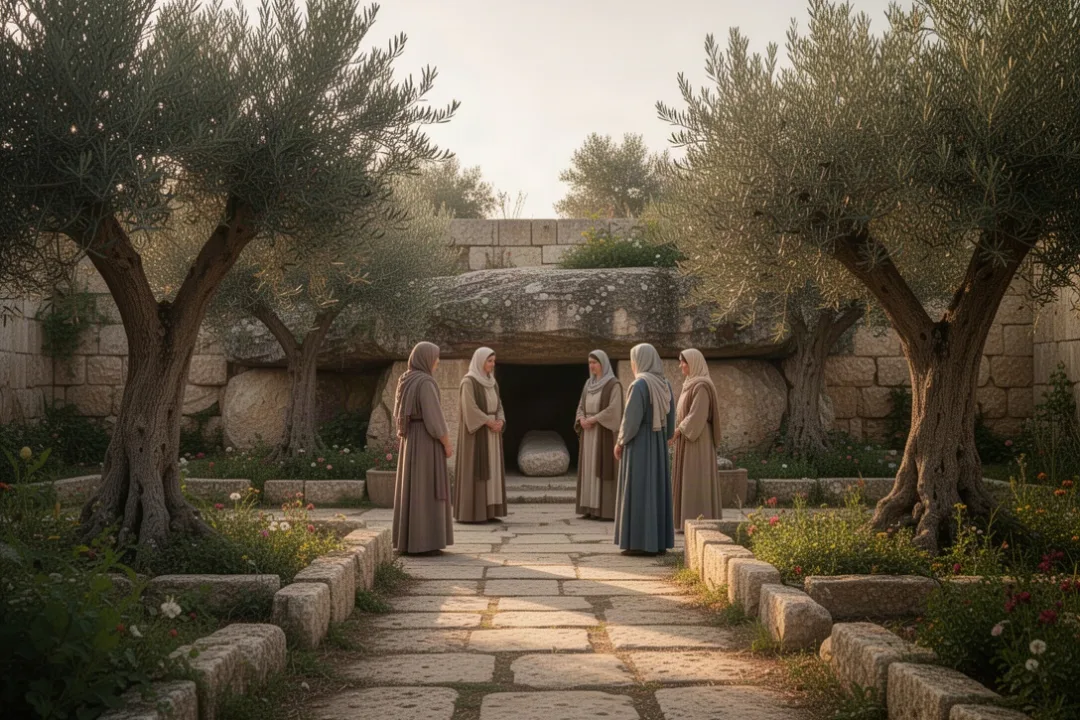
All four Gospels begin the resurrection morning with women finding that Jesus’ tomb is open and his body is absent. The details differ: the Gospel writers mention different women, messengers, and responses, but they agree on the central discovery that the tomb no longer contained Jesus’ body.
John 20 gives the fullest account of Mary Magdalene’s personal meeting. At first, she does not recognize Jesus and thinks he may be the gardener. Recognition comes when he addresses her, after which she returns to the disciples with a report that she has seen the Lord. John’s account gives special attention to this personal exchange and to Mary’s role as a messenger to the other disciples.
Matthew 28 describes Jesus meeting the women as they leave the tomb. He reassures them and directs them to tell the disciples to go to Galilee. This encounter connects the resurrection morning with the later commissioning scene in Galilee.
The road to Emmaus
Luke 24 describes two disciples traveling from Jerusalem to Emmaus. Jesus joins them, but they do not recognize him immediately. They discuss the crucifixion and the reports from the tomb while Jesus explains how the Scriptures point toward the Messiah’s suffering and glory.
Recognition occurs during a meal, when Jesus takes bread, blesses it, breaks it, and gives it to them. Luke then describes the disciples returning to Jerusalem to report what happened. The story highlights gradual recognition, the importance of Scripture, and the way a shared meal becomes the setting in which the disciples understand who Jesus is.
Peter and the gathered disciples in Jerusalem
Peter’s meeting with Jesus is named in Luke 24 and 1 Corinthians 15, but neither text gives a detailed scene. That silence is useful to remember: the New Testament does not claim to provide a complete transcript of every appearance. Some events are reported through brief references rather than extended narratives.
Luke then describes Jesus appearing among the disciples in Jerusalem. They are frightened and initially think they are seeing a spirit. Jesus invites them to observe that he has a real body and eats in their presence. He explains the significance of his death and resurrection and teaches them how his mission fulfills the Scriptures.
John 20 presents a related gathering in which Jesus comes to the disciples despite the doors being shut. He gives them peace, shows his wounds, and sends them as the Father sent him. Thomas is absent from the first meeting, and his response becomes central to the next appearance.
Thomas and the question of physical evidence
Thomas had not been present when the other disciples first saw Jesus. He says that he needs more than their testimony before he will believe. When Jesus appears again, he addresses Thomas directly and shows that the risen one is the same person who was crucified.
John does not portray Thomas as a detached observer conducting an experiment. His story is about the movement from grief and uncertainty to recognition and faith. The episode also addresses readers who will not see Jesus in the same way as the first witnesses. John 20 presents their faith as grounded in the testimony preserved by the Gospel.
The appearance beside the Sea of Galilee
John 21 moves the narrative to the Sea of Galilee, where seven disciples fish through the night without success. At daybreak, Jesus stands on the shore and directs them toward a large catch. They recognize him after the result of this instruction and share breakfast with him.
The scene then turns toward Peter. Jesus asks Peter three times whether he loves him and gives him responsibility for caring for the flock. This repeated exchange recalls Peter’s three denials before the crucifixion and shows restoration through renewed service. The appearance is therefore both a recognition scene and a commissioning scene.
How the different accounts fit together
Readers sometimes expect the Gospels to provide a single, perfectly synchronized timeline. They do not. The accounts vary in the order of some events, the people named, and the amount of detail given. These differences have led to many proposed harmonies, but the texts themselves do not explain every transition.
A careful reading can still identify a broad sequence:
Women discover the empty tomb early on the first day of the week and receive a message that Jesus has risen.
Some women and Mary Magdalene report what they have seen to the disciples, who initially struggle to accept it.
Jesus appears to individuals, including Mary Magdalene and Peter, and to the two disciples traveling to Emmaus.
Jesus appears to groups in Jerusalem, teaches them, and demonstrates continuity between his crucified and risen body.
Further appearances occur in Galilee, including the meeting by the sea and the commissioning of the disciples.
Jesus continues teaching the apostles before his ascension, which Acts places after a period of forty days.
This sequence should be treated as a general framework rather than a complete day-by-day schedule. Matthew emphasizes Galilee, while Luke emphasizes Jerusalem. John includes details absent from the other Gospels, such as Mary’s encounter, Thomas’s meeting, and the breakfast by the sea.
The differences do not mean that every detail can be combined without difficulty. For example, the Gospel accounts vary in how they describe the messengers at the tomb and the disciples’ movements afterward. It is better to acknowledge those differences than to force every detail into a reconstruction that the texts themselves do not explicitly provide.
Reading tip: Compare each Gospel on its own terms first. Ask what the writer emphasizes—recognition, doubt, mission, Scripture, forgiveness, or the identity of Jesus—before trying to merge every detail into one timeline.
At the same time, the differences occur within substantial agreement. The accounts place the resurrection on the first day of the week, connect it with the empty tomb, identify women among the first witnesses, describe appearances to the disciples, and present Jesus as commissioning them to proclaim the message.
Why the appearances matter to Christian belief
The resurrection appearances are central because they form the foundation for the Christian claim that Jesus truly rose from the dead. In the New Testament, resurrection is not simply a symbol for the survival of Jesus’ ideals. It is God’s act of raising the crucified Jesus and vindicating him as Messiah and Lord.
Paul makes this point forcefully in 1 Corinthians 15. He argues that if Christ was not raised, Christian preaching and faith have no reliable foundation. He also connects Jesus’ resurrection with the future resurrection of believers, treating Jesus as the beginning of a wider victory over death.
The appearances also establish the identity of the risen Jesus. He is not presented as a replacement for the earthly Jesus or as an unrelated spiritual being. He bears the wounds of crucifixion, speaks with the same disciples, recalls their relationship, and continues the mission he began before his death.
Yet the risen Jesus is not simply returned to ordinary life. He appears in ways that sometimes prevent immediate recognition, enters a gathering despite locked doors in John’s account, and is eventually taken from the disciples’ sight at the ascension. These features express the New Testament’s view that resurrection brings transformed embodied life, not merely a return to the old conditions.
The appearances also turn frightened or disappointed followers into witnesses. Mary reports what she has seen. The disciples in Emmaus return to Jerusalem. Peter is restored to leadership. Thomas moves from resistance to confession. The apostles receive a mission to announce repentance and forgiveness to the nations, as Luke 24 describes.
That mission is not based only on private certainty. The early Christian proclamation includes named witnesses, group appearances, public preaching in Jerusalem, and Paul’s later encounter. In Acts, the apostles repeatedly describe themselves as witnesses to what God has done in raising Jesus.
For Christian readers, the appearances therefore answer several connected questions. They identify who was raised, show how the first disciples came to believe, explain the origin of the church’s message, and point toward the hope of resurrection for those who belong to Christ.
The resurrection appearances were not described as continuing indefinitely. Acts 1 says Jesus met with the apostles over a period of forty days and spoke about the kingdom of God. He then gave them instructions about their witness and promised the coming of the Holy Spirit.
The ascension marks a change in the disciples’ experience. They would no longer expect Jesus to remain visibly present in the ordinary way. Instead, they were to wait in Jerusalem, receive the Spirit, and carry the message outward from Jerusalem to Judea, Samaria, and the ends of the earth.
Paul’s encounter belongs to a later period. According to Acts, Paul—then known as Saul—was traveling to Damascus to oppose Jesus’ followers when he experienced a heavenly appearance of the risen Jesus. The three accounts in Acts emphasize different details, but each connects the event with Paul’s calling to proclaim the gospel.
Paul includes himself in the witness list of 1 Corinthians 15, while describing his appearance as occurring last and in an unusual way. His experience was not identical to the meetings in Jerusalem or Galilee, yet he considered it decisive evidence that Jesus had appeared to him and had commissioned him for apostolic work.
The New Testament thus presents the appearances as a foundation for ongoing witness rather than as isolated private memories. The disciples preached, baptized, formed communities, cared for one another, and endured opposition because they believed God had raised Jesus and sent them to announce what they had seen and heard.
For someone studying the accounts, the most responsible approach is to read the passages together while allowing each writer to speak clearly. The variations invite careful attention to perspective, but the shared message remains direct: Jesus was crucified, the tomb was found empty, and his followers encountered him alive afterward.
Frequently asked questions
How many resurrection appearances of Jesus are recorded in the Bible?
The Bible does not give one numbered list that includes every appearance. The Gospels describe meetings with Mary Magdalene, other women, Peter, the Emmaus disciples, the apostles, Thomas, and disciples in Galilee. Paul adds appearances to James, more than five hundred people, all the apostles, and himself. Depending on how group references are counted, readers may arrive at different totals.
Did Jesus appear only to his closest disciples?
No. The accounts include Mary Magdalene and other women, who were among the first witnesses, as well as the two disciples traveling to Emmaus. Paul also refers to a gathering of more than five hundred believers. The New Testament presents both individual encounters and appearances to groups, although it does not identify every participant by name.
Were Jesus’ resurrection appearances physical or spiritual?
The New Testament presents them as encounters with a risen, embodied Jesus. He shows his wounds, invites the disciples to recognize his physical continuity, and eats in their presence. At the same time, his risen body is portrayed as transformed and no longer subject to ordinary death. The accounts therefore do not describe a return to normal earthly life.
Why do the Gospel accounts differ in their details?
Each Gospel selects and arranges material for its own purpose. Matthew emphasizes Galilee, Luke focuses strongly on Jerusalem, and John includes distinctive meetings with Mary, Thomas, and Peter. They differ in some details about the tomb and the sequence of events, but agree on the empty tomb, the witnesses, the appearances, and the disciples’ commission.











Leave a Reply