Jesus resurrection passage: where to read the Easter story
Jesus resurrection passage: where to read the Easter story
The central Jesus resurrection passage is found across all four Gospels, with the clearest theological explanation in 1 Corinthians 15: Jesus died, was buried, rose from the dead, and appeared to his followers.
The resurrection is not described in only one isolated passage. Each Gospel gives its own account of the discovery of the empty tomb and the appearances of the risen Jesus. The main references are Matthew 28, Mark 16, Luke 24, and John 20–21.
The New Testament also explains the meaning of the resurrection in letters and sermons. Important passages include 1 Corinthians 15:1–8, Acts 2:22–36, Romans 6:4–11, Romans 8:11, and Philippians 3:10–11. Together, these texts present both the event itself and its significance for Christian faith.
When people search for “Jesus resurrection passage,” they may be looking for several different things: the first Easter morning, a short Scripture reading, evidence for the resurrection, or an explanation of what the resurrection means. The best passage depends on that purpose.
Most direct starting point: Read Luke 24 for a detailed narrative, then read 1 Corinthians 15:1–8 for the early Christian summary of Jesus’ death, burial, resurrection, and appearances.
Quick guide to the main Jesus resurrection passages
These passages overlap, but they are not identical. Each writer selects details and arranges the story to emphasize particular witnesses, places, and responses.
Matthew 28:1–20: Women discover the empty tomb, an angel announces Jesus’ resurrection, Jesus appears to the women and later to his disciples in Galilee.
Mark 16:1–8: Women find the stone moved and receive the announcement that Jesus has risen. Some Bibles distinguish Mark 16:9–20 from the earliest and most widely attested ending of the Gospel.
Luke 24:1–53: Women find the tomb empty, Jesus appears on the road to Emmaus and to the gathered disciples, and the Gospel ends with his ascension.
John 20:1–31: Mary Magdalene discovers the empty tomb, Jesus appears to her and the disciples, and Thomas responds to a later appearance.
John 21:1–25: Jesus appears to several disciples beside the Sea of Galilee and restores Peter through a conversation about faithful service.
1 Corinthians 15:1–8: Paul gives an early summary of the gospel message and lists resurrection appearances to Peter, the Twelve, and others.
For a short public reading, John 20:1–18 focuses on Mary Magdalene and her encounter with Jesus. For a fuller account that includes teaching and the disciples’ changing understanding, Luke 24 is a strong choice.
What happened on the first day of the week
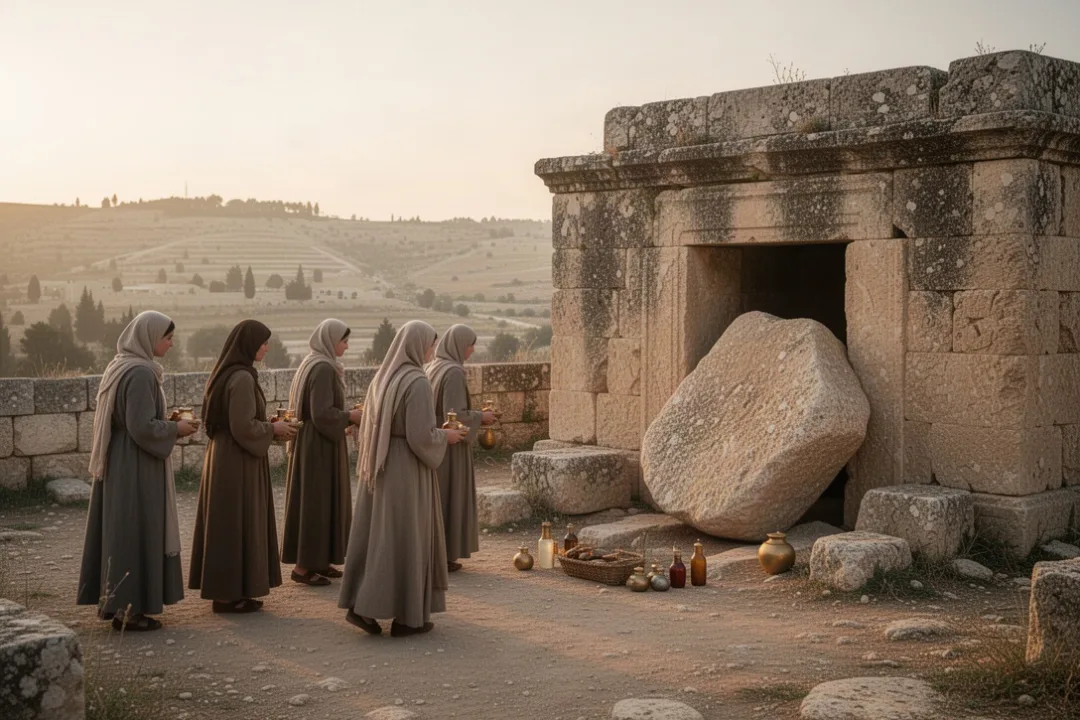
According to all four Gospels, women went to Jesus’ tomb early on the first day of the week. They found that the stone had been moved and that Jesus’ body was not there. The accounts differ in how they describe the visitors, the heavenly messengers, and the sequence of events, but they agree on the essential claim: the tomb was empty, and Jesus’ followers came to believe that God had raised him from the dead.
The women are significant witnesses in each account. In the social setting of the ancient world, their testimony was not always given the same public weight as that of male witnesses. The Gospel writers nevertheless place them at the center of the first discovery, naming several of them and showing that they carried the news to the disciples.
The first reaction is not simple confidence. The women are frightened or confused, and in Luke the disciples initially regard their report as unbelievable. John describes Peter and another disciple running to the tomb and observing the burial cloths. These details show a movement from shock and uncertainty toward recognition and faith.
Matthew’s account in Matthew 28
Matthew describes an earthquake, an angel who rolls away the stone, and guards who become terrified. The angel tells the women that Jesus has risen and directs them to tell the disciples that he will meet them in Galilee.
Jesus then appears to the women as they leave. Later, the disciples meet him on a mountain in Galilee. Matthew’s account ends with Jesus commissioning them to make disciples among all nations, baptize them, and teach them to follow his commands. The passage therefore connects the resurrection with the continuing mission of the church.
Matthew also includes a report that the guards were instructed to say that Jesus’ disciples stole the body while they slept. The Gospel presents this as a competing explanation and places it beside the disciples’ proclamation that Jesus had been raised.
Mark’s account in Mark 16
Mark 16:1–8 is brief and moves quickly. Mary Magdalene, Mary the mother of James, and Salome go to the tomb intending to anoint Jesus’ body. They discover that the stone has already been rolled away and encounter a young man in white clothing who announces that Jesus has risen.
The women are told to inform the disciples and Peter that Jesus will meet them in Galilee. The earliest ending of Mark closes with the women fleeing from the tomb in fear and astonishment. Many modern Bibles separately identify Mark 16:9–20 because the oldest surviving manuscripts do not include those verses in the same form.
That manuscript question does not remove the resurrection message from the New Testament. The resurrection is also reported in Matthew, Luke, and John and is summarized in Paul’s letters. When studying Mark, it is helpful to read the passage with attention to its abrupt ending and its emphasis on fear, amazement, and the need to respond to the announcement.
Luke’s account in Luke 24
Luke gives one of the fullest resurrection narratives. The women find the stone rolled away and hear that Jesus is alive. The disciples initially doubt the report, but Peter investigates the tomb.
Luke then describes two disciples traveling to Emmaus. They speak with an unfamiliar traveler about Jesus’ death and the reports concerning the empty tomb. They do not recognize him until later, when their understanding changes and they return to Jerusalem to tell the others.
Jesus appears among the gathered disciples and helps them understand that his death and resurrection fit within the story of Scripture. Luke emphasizes that Jesus is not merely an idea or a vision in the disciples’ minds. He shows his hands and feet and eats in their presence, presenting the risen Jesus as embodied and truly alive.
The Gospel ends with Jesus leading his disciples toward the area near Bethany and being taken up into heaven. Luke continues this story in Acts, where the disciples proclaim Jesus’ resurrection and await the promised Holy Spirit.
John’s account in John 20 and 21
John begins with Mary Magdalene arriving at the tomb while it is still dark. She sees that the stone has been removed and runs to tell Peter and the beloved disciple. After they inspect the tomb, Mary remains and encounters Jesus, though she initially mistakes him for the gardener.
John highlights recognition through personal relationship. Jesus addresses Mary, and she realizes who he is. The passage then shows Jesus appearing to the disciples, offering peace, and sending them out. Thomas is absent from the first appearance and later says that he needs to see and touch the evidence before he will believe.
When Jesus appears again, Thomas responds with a confession of faith. John then explains the purpose of the Gospel: its signs have been recorded so that readers may believe Jesus is the Messiah and receive life through him. John 21 adds a later appearance by the Sea of Galilee, where Jesus provides breakfast and recommissions Peter.
How to read the resurrection accounts step by step
A careful reading does not require forcing every Gospel into identical wording or treating every difference as a contradiction. Start with each account on its own terms, then compare the central claims and distinctive details.
Read one complete account first. Choose Matthew 28, Mark 16:1–8, Luke 24, or John 20. Notice the setting, the witnesses, and the response before comparing it with another Gospel.
Mark the shared events. Look for the first-day visit to the tomb, the missing body, the announcement of resurrection, and appearances to followers.
Identify each writer’s emphasis. Matthew stresses Galilee and mission, Luke stresses Scripture and witness, John stresses recognition and belief, and Mark emphasizes fear and astonishment.
Separate direct statements from interpretation. The Gospel accounts report what the women and disciples saw and heard. Later passages explain what the resurrection means for sin, death, hope, and new life.
Read an apostolic explanation. After a Gospel account, read 1 Corinthians 15:1–8 or Acts 2:22–36 to see how the earliest Christian preaching presented the resurrection.
Consider the response requested by the passage. The texts move readers toward belief, repentance, worship, witness, obedience, hope, and a transformed way of living.
Reading in this order helps you avoid a common mistake: using one Gospel’s details to erase another Gospel’s distinct voice. The four accounts share a foundation while giving different perspectives on the same central event.
What 1 Corinthians 15 says about Jesus’ resurrection
For a concise statement of Christian belief, 1 Corinthians 15:1–8 is one of the most important resurrection passages in the Bible. Paul reminds the Corinthians of the message he preached to them: Christ died for sins in accordance with the Scriptures, was buried, was raised on the third day, and appeared to witnesses.
Paul names appearances to Cephas, or Peter, the Twelve, a larger group of believers, James, all the apostles, and finally Paul himself. The passage does not provide a full narrative of each appearance. Instead, it presents a compact tradition that links the resurrection proclamation to recognized witnesses within the early Christian movement.
The chapter then addresses people in Corinth who questioned the future resurrection of believers. Paul argues that the resurrection of Jesus is not a minor detail that can be removed while Christianity remains intact. If Christ has not been raised, he says, Christian preaching and faith lose their foundation.
Paul continues by describing Jesus as the firstfruits of those who have died. The image means that Christ’s resurrection is the beginning and guarantee of a larger resurrection hope. He later explains that the resurrection body is transformed and imperishable, while still connected to the person who died.
Read the surrounding chapter: 1 Corinthians 15:1–8 states the core message, but verses 12–28 explain why the resurrection matters, and verses 35–58 address questions about the resurrection body and Christian hope.
Why the empty tomb and appearances both matter
The resurrection accounts include two kinds of evidence within their own narrative: the discovery of an empty tomb and encounters with the risen Jesus. Neither detail is presented as a substitute for the other. The empty tomb points to the absence of Jesus’ body, while the appearances identify the living Jesus and establish the disciples’ commission.
The Gospel writers do not describe the resurrection itself as a witnessed moment inside the tomb. Instead, they describe what happened before and after: Jesus was dead and buried, the tomb was later found empty, and his followers encountered him alive. This distinction is useful when reading the passages carefully.
The appearances also have a repeated pattern of misunderstanding followed by recognition. Mary mistakes Jesus for the gardener. The Emmaus disciples do not recognize him during their conversation. Thomas demands evidence. These scenes present belief as a response to an encounter and a process of understanding, rather than as an effortless assumption.
At the same time, the risen Jesus is not portrayed as merely returning to ordinary mortal life. The Gospel accounts show continuity with the crucified Jesus, including his wounds and identity, but they also describe a new mode of life. This is why Christian teaching distinguishes Jesus’ resurrection from stories of someone temporarily restored to life.
How Acts presents the resurrection in early preaching
Acts records the resurrection as the center of the apostles’ public message. In Acts 2, Peter speaks to a crowd in Jerusalem about Jesus’ death and God’s action in raising him. He connects the event with Israel’s Scriptures and presents the apostles as witnesses.
Acts 3 again links the death of Jesus with God’s raising and glorifying him. In Acts 4, the apostles are challenged by authorities because they are teaching the people and proclaiming resurrection through Jesus. In Acts 10, Peter tells Gentile listeners that Jesus was killed, raised, and seen by chosen witnesses who ate and drank with him afterward.
Paul’s preaching in Acts follows the same pattern. In Acts 13, he announces that God raised Jesus from the dead and interprets this event in light of the promises made to Israel. The resurrection is therefore not treated as a private spiritual experience. It is presented as a public claim about what God did in history and as the basis for the apostles’ witness.
These speeches also connect resurrection with forgiveness, judgment, Jesus’ authority, and the call to turn toward God. The message is not simply that something remarkable happened at a tomb. It is that God vindicated Jesus, inaugurated a new stage of salvation, and called people to respond.
What the resurrection means in Paul’s letters
Paul’s letters apply the resurrection to several areas of Christian belief and practice. In Romans 4:25, Jesus’ death and resurrection are presented together in relation to sin and being made right with God. Romans 6 uses baptism as a picture of sharing in Christ’s death and rising to a new way of life.
Romans 8:11 teaches that the Spirit who raised Jesus also gives life to believers. The passage points beyond future hope to present transformation, while still maintaining that the final renewal of the body belongs to the future.
In Philippians 3:10–11, Paul speaks of knowing Christ, the power of his resurrection, participation in suffering, and the hope of resurrection. The resurrection is therefore not only a doctrine to affirm. It shapes the believer’s relationship with Christ and the pattern of life that follows.
Colossians 2:12 and 3:1–4 connect believers’ union with Christ to his death and resurrection. Colossians 3 then turns that theological claim into practical instruction: believers are to set their minds on things above and put away behaviors that conflict with their new identity.
First Peter 1:3 describes new birth into a living hope through Jesus Christ’s resurrection. The wording emphasizes that Christian hope is active and enduring rather than a vague wish. It is grounded in God’s action and directed toward a future inheritance.
How the resurrection passages relate to the crucifixion
The resurrection cannot be separated from the death of Jesus. Each Gospel places the empty tomb after the crucifixion, and Paul’s summary in 1 Corinthians 15 deliberately holds together the claims that Christ died, was buried, was raised, and appeared.
The burial matters because it confirms that Jesus truly died rather than simply fainting or temporarily disappearing. Joseph of Arimathea is associated with Jesus’ burial in the Gospel accounts, and the women observe where the body is placed. The later visit to the tomb depends on this earlier identification of the burial place.
The resurrection also changes the meaning of the cross. Without resurrection, the crucifixion could be understood only as the execution of a religious teacher. In the New Testament, God’s raising of Jesus confirms his identity, validates his mission, and becomes the foundation for forgiveness and future resurrection.
That connection explains why Christian worship traditionally places the resurrection at the center of the week and the year. Easter is not simply a celebration of survival after suffering. It proclaims that God has acted through death and has begun the renewal of creation in Jesus.
Which resurrection passage should you read for a specific purpose?
Different needs call for different passages. A reader preparing a personal study may want a longer narrative, while someone planning a service may need a short reading that makes the central claim clearly.
For the clearest full narrative: Read Luke 24, including the empty tomb, Emmaus, the appearance to the disciples, and the ascension.
For Mary Magdalene’s encounter: Read John 20:1–18, which focuses on grief, recognition, and personal witness.
For the Great Commission: Read Matthew 28:1–20, especially the movement from the empty tomb to the disciples’ mission.
For a brief and striking account: Read Mark 16:1–8, while recognizing the textual note about the longer ending in many Bibles.
For the earliest summary of the gospel: Read 1 Corinthians 15:1–8.
For resurrection and future Christian hope: Read 1 Corinthians 15:12–58.
For resurrection and new life now: Read Romans 6:1–11.
For the resurrection in apostolic preaching: Read Acts 2:22–36 or Acts 10:34–43.
Reading several passages together gives a fuller picture. Begin with one Gospel, then use 1 Corinthians 15 to understand the early summary, and finish with Romans 6 or 8 to consider how the resurrection shapes Christian life.
Common questions that arise when comparing the Gospel accounts
Why do the Gospel accounts include different details?
The Gospels were written as distinct accounts, not as a single modern transcript. Their authors select different witnesses, conversations, locations, and teachings to serve their narrative purposes. Differences in detail do not change the shared core: Jesus was crucified, buried, found absent from the tomb, and encountered alive by his followers.
Some details are difficult to place in an exact sequence because the Gospel writers do not all provide the same timeline. It is better to identify what each passage clearly says than to claim certainty where the text leaves room for more than one reconstruction.
What does “raised from the dead” mean?
In the New Testament, the phrase means that God brought Jesus through death into transformed, bodily life. It does not describe only the survival of Jesus’ teachings, the continuation of his influence, or a private spiritual experience among his followers.
The accounts emphasize both continuity and transformation. The risen Jesus is the same Jesus who was crucified, yet his life is no longer subject to ordinary death. First Corinthians 15 uses the language of an imperishable resurrection body to explain this change.
Why is 1 Corinthians 15 so important?
It is one of the clearest early summaries of the resurrection message. Paul identifies the tradition he received and passed on, lists several witnesses, and then explains why the resurrection is essential to Christian faith.
The chapter also answers a major question: what hope do believers have after death? Paul presents Jesus as the firstfruits of a future resurrection, so the resurrection is both a past event and the foundation of Christian expectation.
A practical reading plan for studying Jesus’ resurrection
A seven-day plan can help you read the passages slowly instead of treating them as a single compressed story. Keep a notebook and record what each text says about the witnesses, Jesus’ actions, and the response required of the disciples.
Day one: Read John 20:1–18 and focus on Mary Magdalene’s experience at the tomb.
Day two: Read Matthew 28 and observe how resurrection leads to worship and mission.
Day three: Read Mark 16:1–8 and consider the women’s fear and astonishment.
Day four: Read Luke 24:1–35 and follow the movement from confusion to recognition on the road to Emmaus.
Day five: Read Luke 24:36–53 and examine Jesus’ appearance to the gathered disciples.
Day six: Read 1 Corinthians 15:1–34 and note why Paul treats resurrection as essential.
Day seven: Read Romans 6:1–11 and consider how union with Christ’s death and resurrection affects daily conduct.
As you read, ask four simple questions: What happened? Who witnessed it? What did the witnesses misunderstand or learn? How does the passage connect resurrection with faith, mission, hope, or changed behavior?
Those questions keep the study grounded in the text. They also prevent the resurrection from becoming an abstract idea detached from the people, places, grief, doubt, worship, and witness described in the New Testament.
How to cite the Jesus resurrection passage accurately
If you are preparing a sermon, study guide, Easter service, or personal note, cite the exact passage rather than referring only to “the resurrection story.” For example, write John 20:1–18 when discussing Mary Magdalene, Luke 24:13–35 for the road to Emmaus, or 1 Corinthians 15:3–8 for Paul’s summary.
Use the translation selected by your church, study group, or publication, and check whether it includes notes about textual variants. Instead of combining sentences from several Gospels as though they were one quotation, identify each source clearly and explain the shared message in your own words.
A reliable citation also distinguishes between the resurrection narrative and later interpretation. Matthew 28, Mark 16, Luke 24, and John 20–21 tell the story through Gospel scenes. Romans, Acts, and 1 Corinthians explain how the early Christians understood its meaning for salvation, witness, new life, and future hope.
Frequently asked questions
What is the shortest Jesus resurrection passage to read?
Mark 16:1–8 is the shortest of the four Gospel accounts in its earliest ending. It describes the women visiting the tomb, finding the stone moved, and hearing that Jesus has risen. For a short passage that also includes an appearance of Jesus, John 20:1–18 is a useful choice because it focuses on Mary Magdalene’s encounter with him.
Which Gospel gives the most detailed resurrection account?
Luke 24 provides one of the fullest continuous accounts. It includes the women at the tomb, the disciples’ reaction, the road to Emmaus, Jesus’ appearance to the gathered disciples, and his departure near Bethany. John 20–21 also offers substantial detail, especially about Mary Magdalene, Thomas, Peter, and the disciples by the Sea of Galilee.
Is the resurrection mentioned outside the four Gospels?
Yes. Paul summarizes the resurrection appearances in 1 Corinthians 15:1–8, while Acts repeatedly presents Jesus’ resurrection as the center of apostolic preaching. Romans 6 and 8, Philippians 3, Colossians 3, and 1 Peter 1 apply the resurrection to new life, future hope, spiritual transformation, and the believer’s union with Christ.
How should I handle the longer ending of Mark?
Many modern Bibles mark Mark 16:9–20 separately because the oldest surviving manuscripts do not include those verses in the same form. Read Mark 16:1–8 as the earliest ending represented in those manuscripts, and compare the additional material with Matthew 28, Luke 24, and John 20. The resurrection itself is independently reported throughout the New Testament.












Leave a Reply