The Jesus story: His life, teachings, death, and resurrection
The Jesus story: His life, teachings, death, and resurrection
When life feels confusing, unfair, or spiritually empty, you may find yourself asking a simple question: Who was Jesus, and why has his story mattered to so many people for centuries? The Christian answer begins with a first-century Jewish teacher from Galilee whose words, actions, death, and reported resurrection changed the course of history.
The Jesus story is told chiefly in the four Gospels of the New Testament: Matthew, Mark, Luke, and John. These accounts do not read like modern biographies. Each writer emphasizes different details, yet together they present Jesus as a teacher, healer, prophet, Messiah, and, for Christians, the Son of God who came to reconcile people to God.
Jesus was born into a Jewish family during a period when the land of Judea was under the influence and control of the Roman Empire. The Gospels of Matthew and Luke describe his birth in Bethlehem and his upbringing in Nazareth, a small town in Galilee. His mother was Mary, and Joseph is presented as the man who raised him and worked as a craftsman.
Christian belief holds that Jesus’ birth was extraordinary. Matthew and Luke connect it with divine action and describe Mary as conceiving Jesus through the Holy Spirit. They also connect his birth with Israel’s hopes for a coming Messiah, a king and deliverer promised in the Hebrew Scriptures.
Luke describes angels announcing Jesus’ birth to shepherds, while Matthew includes visitors from the East who recognize the importance of the child. Matthew also tells of King Herod’s fear that a new Jewish king might threaten his authority. These details show that the Gospel writers understood Jesus’ arrival as both a humble beginning and a moment with political and spiritual significance.
Jesus grew up in Nazareth, and the Gospels provide only a small amount of information about his childhood. Luke describes one visit to Jerusalem when Jesus was twelve, when he spoke with teachers in the temple and showed an unusual awareness of his relationship with God. After that account, the story moves forward to his adult life.
A historical setting helps explain the story: Jesus lived among Jewish people who worshiped the God of Israel, followed the Law of Moses, visited the temple, and waited for God to bring justice and restoration. Roman rule, economic pressure, religious disagreements, and hopes for freedom shaped the world in which he taught.
Before Jesus began his public ministry, John the Baptist preached near the Jordan River. John called people to repentance, meaning a sincere turning away from wrongdoing and a renewed commitment to God. He baptized people as a public sign of that change and announced that someone greater was coming.
Jesus came to John and was baptized. The Gospel accounts describe this as a defining moment: the Spirit descends upon Jesus, and a voice from heaven identifies him as God’s beloved Son. Immediately afterward, Jesus spends time in the wilderness, where he faces temptation and rejects using power for selfish purposes.
What Jesus taught about God and the kingdom
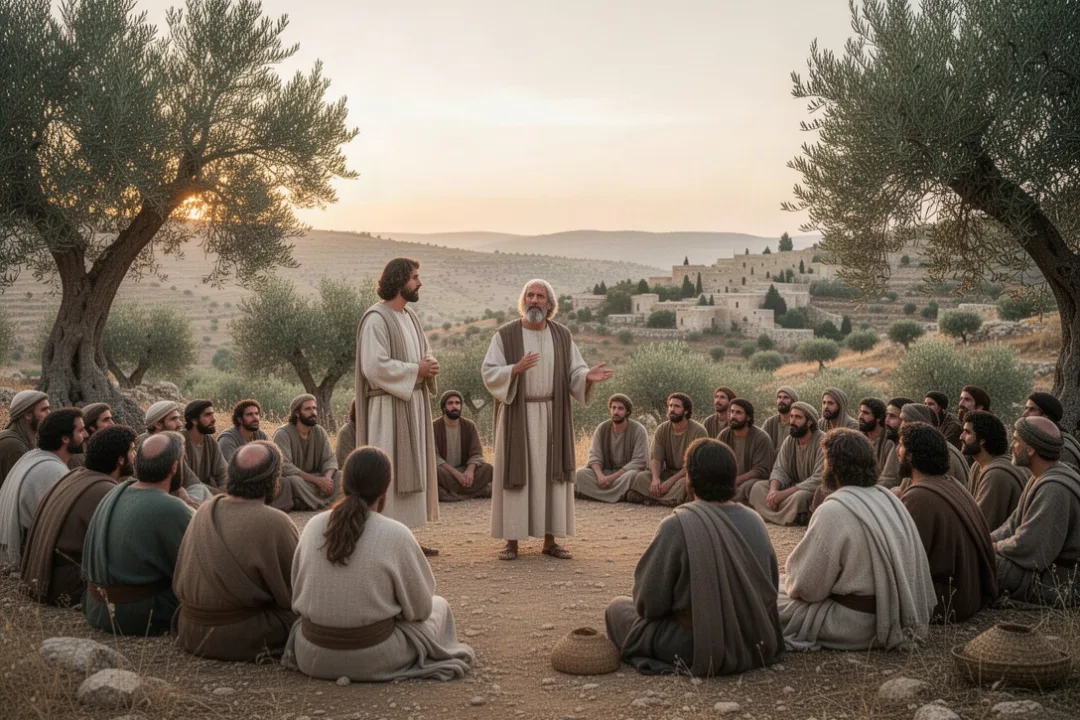
Jesus began preaching in Galilee with a message about the kingdom of God. This phrase meant more than a place in the afterlife. It referred to God’s active rule: a reality in which evil is confronted, the vulnerable are valued, people are forgiven, and creation is brought toward restoration.
Jesus called people to trust God, turn from sin, and live as citizens of this kingdom. His message was demanding because it reached beyond outward religious behavior. He spoke about the motives of the heart, the treatment of enemies, the use of wealth, sexual faithfulness, honesty, prayer, and concern for people who were overlooked by society.
In the Sermon on the Mount, recorded in Matthew 5–7, Jesus describes the character of people who belong to God’s kingdom. He honors the humble, those who mourn, the merciful, the peacemakers, and those who pursue righteousness. He also teaches that anger, contempt, lust, and dishonesty matter because inner attitudes shape outward actions.
Jesus teaches his followers to love God completely and to love their neighbors as themselves. When asked who counts as a neighbor, he tells the parable commonly called the Good Samaritan in Luke 10. The story challenges social and religious boundaries by presenting a Samaritan, a member of a group often distrusted by Jews, as the person who shows practical mercy to an injured stranger.
His teachings repeatedly place compassion above status. Jesus welcomes children, speaks with women in settings where many teachers would have avoided them, eats with tax collectors, and approaches people affected by illness or social exclusion. He does not treat every behavior as acceptable, but he refuses to define people only by their past, reputation, illness, or position.
Love of God: Jesus presents devotion to God as the foundation of life.
Love of neighbor: Compassion must become concrete help, not merely a feeling.
Forgiveness: People are called to release revenge and seek restored relationships where possible.
Humility: Greatness is measured by service rather than control or public recognition.
Integrity: Genuine faith involves the heart, private choices, and treatment of other people.
Jesus often taught through parables, short stories that invite listeners to consider a moral or spiritual truth. The parable of the sower explores how people respond differently to God’s message. The story of the lost sheep emphasizes God’s concern for those who have wandered. The parable of the prodigal son, found in Luke 15, portrays a father who welcomes a returning child and challenges the resentment of an older sibling.
These stories are not merely simple illustrations. They expose assumptions and require the listener to decide how to respond. A person may admire mercy in theory but resist it when mercy is offered to an enemy, a failure, or someone thought to be undeserving.
Jesus also teaches about prayer. In Matthew 6, he warns against praying mainly to impress other people and gives his disciples a model centered on God’s holiness, daily provision, forgiveness, and protection from evil. Prayer in the Jesus story is presented as honest dependence rather than a performance designed to gain attention.
He speaks often about money and possessions because they can quietly take the place of trust in God. Jesus does not present poverty as the only measure of faithfulness, but he warns that wealth can make people self-satisfied and less responsive to the needs of others. His teaching calls for generosity, accountability, and freedom from greed.
Why Jesus’ actions drew crowds and opposition
The Gospels describe Jesus as a teacher whose actions supported his message. He heals people with various illnesses, restores mobility to some who cannot walk, gives sight to some who are blind, and frees people described as oppressed by unclean spirits. These events are called miracles and signs because they point beyond themselves to God’s authority and compassion.
Different readers understand these accounts in different ways. Christians receive them as genuine works of God, while historians studying the texts examine what the stories reveal about the beliefs and worship of early Christian communities. Either way, healing is central to the Gospel portrait of Jesus: he notices suffering and responds with mercy rather than treating people as interruptions.
One recurring feature of the stories is Jesus’ authority to forgive sins. In Mark 2, he heals a paralyzed man after announcing forgiveness, leading religious teachers to question whether he is claiming an authority that belongs to God. The healing becomes a visible sign supporting an invisible claim.
Jesus also challenges strict interpretations of religious practice. He heals on the Sabbath, eats with people considered morally or ceremonially unclean, and allows his disciples to pick grain on the Sabbath. His point is not that God’s commands are meaningless. Rather, he insists that the Law should be understood in light of mercy, human need, and the purpose for which it was given.
This brought him into conflict with some religious leaders. The Gospels do not present every Jewish leader as opposed to Jesus, nor do they support blaming the Jewish people as a whole for his death. Jesus, his family, his disciples, and many of the people around him were Jewish. The conflicts described in the Gospels took place within the religious and political world of first-century Judaism.
Jesus’ popularity also created political danger. Crowds gathered around him, and his language about God’s kingdom could be misunderstood as a challenge to Roman rule. His entry into Jerusalem shortly before Passover, described in all four Gospels, is presented as a public sign of kingship. He rides into the city while people praise God and associate him with the hoped-for royal deliverer.
In Jerusalem, Jesus enters the temple courts and confronts commercial activity there. The action dramatizes his concern that the temple, intended as a place of prayer, has been corrupted by exploitation. His presence, public teaching, and growing following intensify opposition from authorities who fear unrest and loss of control.
Jesus’ closest followers are known as the twelve apostles. They include Peter, James, John, Matthew, and Judas Iscariot, among others. The Gospels show them as sincere but imperfect: they misunderstand Jesus, argue about status, become afraid, and eventually scatter when he is arrested.
Jesus forms a wider community of disciples as well. Women play an important role among his followers and supporters, including Mary Magdalene, Joanna, Susanna, and others named in Luke 8. The Gospel accounts later place women among the first witnesses to the empty tomb, a significant detail in communities whose public testimony was often undervalued.
What happened at the Last Supper, crucifixion, and resurrection
During the final days of his life, Jesus shares a meal with his disciples. Christians call this the Last Supper. The Gospel accounts connect the meal with Passover and describe Jesus using bread and wine as signs of his body and blood, giving the meal a lasting place in Christian worship as Communion or the Lord’s Supper.
Jesus tells his followers that betrayal, suffering, and death are approaching. He also acts as a servant, washing the disciples’ feet in John 13. This scene captures a central theme of his teaching: authority should be expressed through humble service, not domination.
After the meal, Jesus goes to a place called Gethsemane to pray. He experiences deep distress and asks his disciples to remain watchful. Judas arrives with an armed group and identifies Jesus to them. Jesus is arrested, while his disciples flee.
The precise legal and political details are presented from the perspective of the Gospel writers, but the broad sequence is clear in all four accounts. Jesus is questioned by Jewish authorities and brought before Pontius Pilate, the Roman governor. Pilate authorizes crucifixion, a Roman execution method designed to cause intense suffering and publicly disgrace the condemned person.
Jesus is crucified outside Jerusalem. The sign placed above him identifies him as “King of the Jews,” expressing the political charge associated with his execution. The Gospel accounts describe darkness, the tearing of the temple curtain, and Jesus’ death after hours on the cross. Christians understand the crucifixion as the central act through which Jesus bears sin and opens the way for reconciliation with God.
Christian interpretations of the cross use several connected ideas. Jesus is portrayed as the innocent sufferer, the Passover sacrifice, the servant who gives his life for others, and the representative human being who obeys God amid suffering. No single image exhausts the meaning Christians have found in the crucifixion.
A member of the Jewish council named Joseph of Arimathea asks for Jesus’ body and places it in a tomb. Women from Jesus’ circle observe where he is buried. The Gospels then state that, on the first day of the week, the women find the tomb open and the body absent.
The resurrection is not presented as Jesus merely surviving a near-death experience. The New Testament describes it as God raising Jesus bodily from death into transformed life. The accounts report appearances to Mary Magdalene, other women, Peter, the apostles, and additional followers. Paul later lists several groups of witnesses in 1 Corinthians 15.
For Christian faith, the resurrection is the turning point: the cross is not the end of Jesus’ story. It means that death does not have the final word, Jesus is vindicated by God, and his promises about forgiveness, judgment, and new life can be trusted.
The Gospel accounts differ in the details they emphasize, including which followers visit the tomb and how the appearances unfold. They agree on the central claim that Jesus died, was buried, and was encountered alive by his followers afterward. That conviction transformed frightened disciples into public witnesses and became the foundation of the early Christian movement.
Before his ascension, Jesus commissions his followers to make disciples among all nations. Luke and Acts describe him being taken from their sight, while the disciples return to Jerusalem with expectation and worship. The story then continues through the growth of the church, beginning in Jerusalem and spreading throughout the Roman world.
Why the Jesus story still matters to Christians and history
For Christians, Jesus is not only a figure from the past. He is the living Lord whose life reveals God’s character. Christians worship him, pray in his name, study his teachings, and seek to imitate his compassion, courage, humility, and faithfulness.
The story also gives Christian belief its central understanding of salvation. People are invited to receive forgiveness and reconciliation with God through faith in Jesus rather than relying on moral achievement, social status, or religious performance. Different Christian traditions explain the mechanics of salvation in different ways, but they share the conviction that Jesus’ death and resurrection are decisive.
Jesus’ teachings have also shaped Christian ethics. His commands to love enemies, care for the poor, forgive those who wrong you, welcome outsiders, and serve rather than dominate have influenced individual decisions, churches, charitable work, and debates about justice. Christians frequently struggle to live out these teachings, but they remain the standard by which Christian faith is measured.
His influence extends beyond Christianity. Muslims honor Jesus, known as Isa, as a significant prophet and affirm his miraculous birth, though Islamic beliefs about his identity and crucifixion differ from Christian beliefs. Jewish, Muslim, secular, and other scholars also study Jesus as a historical figure within first-century Judaism.
When reading the Jesus story, several questions can help you understand its meaning without losing sight of its historical setting:
What does Jesus reveal about God? The Gospels portray God as holy, merciful, just, and willing to seek people who are lost.
What does Jesus ask of his followers? He calls for repentance, trust, love, forgiveness, service, and perseverance.
Who receives his attention? The poor, sick, excluded, guilty, grieving, and spiritually hungry repeatedly come into focus.
Why does the cross matter? It joins suffering, sacrifice, judgment, mercy, and reconciliation in the center of Christian belief.
Why does the resurrection matter? It confirms Jesus’ identity for Christians and offers hope of life beyond death.
A useful way to read the story is to begin with the Gospel of Mark, the shortest Gospel, and then compare it with Luke or John. Look for repeated themes rather than isolated sayings: Jesus’ concern for the vulnerable, his authority to forgive, his conflict with hypocrisy, his willingness to suffer, and the call to trust God.
You do not need to understand every historical debate before asking what the story means. The central question remains personal and practical: will you respond to Jesus as a teacher to admire, a prophet to respect, a historical figure to study, or the risen Lord whom Christians worship? The Gospels invite that decision through the words and actions they attribute to him.
The Jesus story begins in an ordinary human setting—an occupied land, a family, a village, and a people waiting for God—but it claims extraordinary significance. It presents Jesus as one who welcomes the overlooked, confronts evil, gives himself for others, and rises from death. That combination of mercy, authority, sacrifice, and hope explains why his story continues to shape lives, communities, and cultures around the world.
Frequently asked questions
Is the Jesus story based on a real historical person?
Most historians agree that Jesus was a real first-century Jewish teacher who lived in Galilee, gathered followers, and was executed by crucifixion under Pontius Pilate. The Gospels are the main detailed sources about his life. Historians and Christians differ over how to assess miracles and the resurrection, but Jesus’ existence and execution are widely accepted historical conclusions.
Which Gospel should someone read first?
Mark is often a practical starting point because it is concise and moves quickly through Jesus’ ministry, death, and resurrection. Luke provides a broader narrative with particular attention to outsiders and the poor. John is more reflective and focuses strongly on Jesus’ identity. Reading a second Gospel afterward can show how different accounts emphasize complementary themes.
Did Jesus intend to start Christianity?
Jesus lived and taught as a Jew within the religious world of first-century Judaism. He called Israel to repentance and announced God’s kingdom. Christianity developed after his death and resurrection as his followers proclaimed him as Messiah and Lord. The organized church grew through the apostles and later Christian communities rather than appearing as a separate institution during Jesus’ lifetime.
What is the main message of Jesus’ teaching?
At its center is the call to love God and love other people. Jesus also teaches repentance, trust in God, forgiveness, mercy, humility, generosity, and care for those who are vulnerable. Christian faith adds that his death and resurrection provide forgiveness and new life. Together, these ideas connect inner faith with practical treatment of other people.
















Leave a Reply