The life of Jesus centers on his announcement of God’s kingdom and his call to love, repentance, faith, and mercy.
Jesus of Nazareth was a first-century Jewish teacher and religious leader whose life, death, and reported resurrection became the foundation of Christianity. The four canonical Gospels—Matthew, Mark, Luke, and John—provide the main accounts of his life. They do not read like modern biographies; each presents Jesus through a particular theological purpose while describing his words, actions, relationships, conflict, death, and resurrection.
Most historians place Jesus’ birth sometime before the death of Herod the Great, often dated to around 4 BCE, and his public ministry in the late 20s or early 30s CE. The exact dates remain uncertain. The Gospels also emphasize different details, so some parts of Jesus’ early life cannot be reconstructed with confidence.
Matthew, Mark, Luke, and John are the primary sources for understanding Jesus. Matthew and Luke include accounts of his birth, while Mark begins with his adult ministry and John opens with a theological reflection on Jesus’ identity before describing his public work. Together, they portray him as a Jewish man who taught within the world of first-century Galilee and Judea.
The Gospels combine historical memories, teaching collections, parables, healing stories, debates, and accounts of worship. They are not identical in every detail, but they share a central sequence: Jesus was baptized, gathered disciples, proclaimed God’s kingdom, traveled through Galilee and Judea, faced opposition, was crucified in Jerusalem, and was reported by his followers to have risen from the dead.
Jesus’ life also appears in the writings of the apostle Paul and is referenced briefly by some later non-Christian writers. These sources are limited, but they fit the broad picture of a Jewish teacher who was executed under Roman authority and whose followers soon proclaimed him as the risen Messiah.
A helpful distinction: The Gospels present both Jesus as a historical person in first-century Judaism and Jesus as the Messiah and Son of God confessed by Christian faith. Reading them well means paying attention to both their historical setting and their religious claims.
Jesus’ birth and childhood in first-century Judea
According to Matthew and Luke, Jesus was born to Mary, who was engaged to Joseph, a descendant of David. Matthew places the family in Bethlehem and describes their later move to Nazareth. Luke also connects Jesus’ birth with Bethlehem and says that he grew up in Nazareth after his family returned there.
These accounts include different episodes. Matthew describes visitors from the east, a flight into Egypt, and the family’s eventual settlement in Nazareth. Luke describes the announcement of Jesus’ birth, the visit of shepherds, and Jesus being presented at the Jerusalem Temple. Both accounts connect his birth with hopes surrounding Israel’s promised king, but they emphasize different details and themes.
Jesus is commonly called Jesus of Nazareth, reflecting the village where he was raised. Nazareth was a small Galilean settlement, and Jesus’ ordinary upbringing is part of the Gospel portrait. Joseph is associated with carpentry or skilled building work, and Jesus is later identified with that trade as well, although the Greek term can refer more broadly to a craftsman.
Very little is recorded about Jesus between childhood and the beginning of his public ministry. Luke includes one story of Jesus at about twelve years old, when he is found discussing religious matters in the Temple. After that episode, the Gospel narrative moves forward to his baptism as an adult.
The political and religious world Jesus entered
Jesus lived in a land governed by Rome, a powerful empire that controlled Judea and influenced Galilee through local rulers. Herod Antipas governed Galilee during much of Jesus’ ministry, while Roman officials exercised authority in Judea. Roman taxation, military presence, and political control shaped daily life and contributed to widespread hopes for deliverance.
First-century Judaism was not a single uniform movement. Jewish people gathered around the Temple in Jerusalem, local synagogues, Scripture, prayer, festivals, and distinctive practices such as Sabbath observance and dietary customs. Groups such as the Pharisees and Sadducees differed over interpretation, authority, and religious priorities. John the Baptist and other renewal movements also called people to return to God.
Jesus’ message made sense within this setting. He spoke about Israel’s God, quoted or discussed the Hebrew Scriptures, attended Jewish festivals, taught in synagogues, and debated how the law should be understood. His disagreements with other religious leaders were generally arguments within Judaism rather than rejection of Jewish faith as a whole.
John the Baptist and Jesus’ baptism
Jesus’ public life begins with John the Baptist, a prophetic preacher who called people to repentance. John baptized people in the Jordan River as a sign of turning back to God and preparing for divine judgment and renewal. His message attracted crowds and challenged complacency based on ancestry or religious status.
All four Gospels connect Jesus with John’s baptism, although they tell the scene differently. The event marks the beginning of Jesus’ public mission. The Gospel accounts describe the Spirit descending upon Jesus and a heavenly declaration of approval, presenting the baptism as a decisive confirmation of his calling.
Afterward, Jesus withdrew into the wilderness, where he faced testing. Matthew and Luke describe temptations involving hunger, power, and the demand to prove divine protection. The stories portray Jesus as choosing faithful obedience rather than using his identity for personal advantage or political domination.
Jesus’ ministry in Galilee
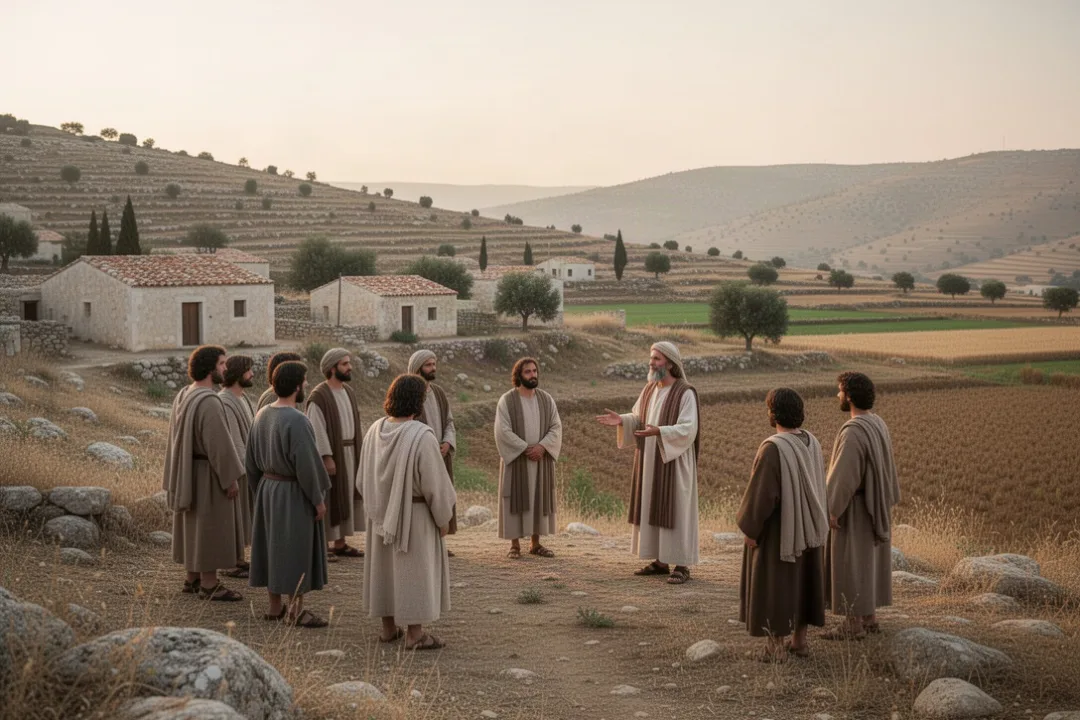
Jesus began preaching in Galilee, a region north of Jerusalem that included towns such as Capernaum, Bethsaida, and Nazareth. His central announcement concerned the arrival or nearness of God’s kingdom. This kingdom was not simply a territory; it referred to God’s active rule bringing judgment, healing, restoration, and a new pattern of life.
Jesus taught in synagogues, open spaces, homes, and along the shoreline. He attracted people from different social backgrounds, including fishermen, farmers, women, tax collectors, religious seekers, and those regarded as outsiders. His ministry combined public teaching with personal encounters, making his message concrete for people facing illness, poverty, shame, and exclusion.
He called a group of close followers, including Simon Peter, Andrew, James, John, Matthew, and others. The Twelve symbolized the twelve tribes of Israel and represented Jesus’ hope for the renewal of God’s people. They traveled with him, listened to his teaching, took part in his ministry, and often struggled to understand his mission.
The Gospels describe Jesus healing people with various illnesses, disabilities, and spiritual afflictions. These stories include restoration of sight, mobility, health, and social belonging. They present healing as a sign of God’s kingdom and as an expression of compassion, rather than merely as displays of power.
Jesus also shared meals with people considered morally compromised or religiously suspect. His meals with tax collectors and sinners became a source of criticism because table fellowship implied welcome and social connection. Jesus responded that those who recognize their need for healing are the people who seek a physician.
Jesus’ central teachings about God’s kingdom
Jesus’ teaching repeatedly joined love of God with love of neighbor. He treated care for vulnerable people, forgiveness, generosity, humility, and integrity as essential expressions of faith. Religious practice mattered, but it was not meant to become a substitute for mercy or justice.
The Sermon on the Mount in Matthew and the related teaching in Luke present blessings for the poor, grieving, meek, hungry, merciful, pure in heart, and persecuted. Jesus challenges his listeners to practice reconciliation, truthful speech, generosity, and love toward enemies. These teachings describe a life shaped by trust in God rather than by status, retaliation, or public approval.
Jesus often taught through parables, short stories that invited listeners to see familiar situations in a new way. The parable of the sower compares responses to God’s message with different kinds of soil. The parable of the Good Samaritan makes a socially despised outsider the model of compassionate neighborliness. The parable of the prodigal son portrays a father’s generous welcome toward a returning child.
These stories do not always provide simple moral formulas. They expose hidden attitudes and ask listeners to reconsider who belongs, what repentance looks like, and how God responds to people who are lost. Jesus’ use of vivid images—seeds, lamps, vineyards, debts, banquets, shepherds, and household servants—helped ordinary hearers engage difficult spiritual questions.
Jesus also taught that greatness is measured by service. He warned against religious performance designed to win admiration and criticized leaders who placed heavy burdens on others while neglecting justice and compassion. At the same time, the Gospels show him taking Scripture seriously and debating its meaning rather than dismissing it.
Jesus’ relationships with people on the margins
Women played visible roles in Jesus’ ministry and in the wider circle of his followers. The Gospels name women such as Mary Magdalene, Joanna, Susanna, Mary and Martha, and others who supported the movement. Jesus taught women publicly, received their questions, and treated them as morally and spiritually responsible participants in God’s work.
Jesus also interacted with Samaritans, Gentiles, the poor, people with skin diseases, and those whose occupations made them socially suspect. These encounters did not erase every social boundary immediately, but they showed that mercy could cross boundaries that many people treated as permanent.
His attention to outsiders did not mean that he ignored wrongdoing. Jesus called people to repentance and transformation, but he did not reduce individuals to their past actions, illness, social position, or reputation. The Gospels repeatedly connect forgiveness with changed behavior and restored relationships.
Why Jesus performed miracles in the Gospel accounts
The Gospels describe miracles as signs of Jesus’ authority and the arrival of God’s kingdom. In addition to healings, they include exorcisms, control over wind and waves, multiplication of food, and raising people from the dead. Readers understand these accounts differently: Christians receive them as acts of divine power, while historical study examines how the stories function within the Gospel tradition.
Miracle stories often focus on the faith, fear, or need of the people involved. A healing may restore someone not only physically but also to family, worship, work, and community. The stories therefore carry social and spiritual meaning alongside their supernatural claims.
Jesus sometimes instructed people not to publicize a healing, a pattern scholars often call the “messianic secret” in Mark. The Gospel narratives may use this theme to show that Jesus’ identity cannot be understood correctly through impressive deeds alone. His suffering, death, and resurrection are central to the meaning of his mission.
Conflict with religious and political authorities
Jesus’ teaching and actions brought him into conflict with some Pharisees, scribes, chief priests, and other leaders. The disputes concerned Sabbath practice, ritual purity, fasting, forgiveness, authority, and the proper use of religious traditions. The Gospels do not portray every religious leader as hostile; some, including Nicodemus in John, are shown engaging Jesus seriously.
Jesus criticized hypocrisy, especially when outward religious behavior concealed exploitation or neglect of justice. He also challenged interpretations that placed human regulations above the needs of suffering people. His actions on the Sabbath became a particular point of dispute because he healed and defended acts of mercy on that day.
His relationship with the Jerusalem Temple became especially significant. Jesus entered the Temple during the final period of his life and disrupted the activities of money changers and sellers. The accounts connect this action with his condemnation of corruption and his claim that the Temple should serve as a place of prayer. Such a public challenge could be interpreted as politically dangerous.
Jesus’ announcement of God’s kingdom also carried political implications, even though he did not lead an armed revolt. Titles such as Messiah and “king” could alarm Roman authorities and local rulers. The Gospels portray Jesus rejecting violent power while still presenting his mission as the fulfillment of Israel’s hopes.
Jesus’ final days in Jerusalem
Jesus went to Jerusalem during Passover, a festival that celebrated Israel’s liberation from Egypt. Large crowds, heightened religious feeling, and the presence of Roman soldiers made the city especially sensitive to any sign of rebellion. The Gospels describe Jesus entering the city to public acclaim, though the details and wording vary among the accounts.
He taught in the Temple and spoke with his disciples about coming suffering. At a final meal, commonly called the Last Supper, Jesus interpreted bread and wine in relation to his body and blood and instructed his followers to remember him. Christian churches later developed Communion or the Eucharist from this meal.
After the meal, Jesus prayed in Gethsemane or a nearby garden. He experienced anguish and asked his closest disciples to remain watchful. According to the Gospel accounts, Judas Iscariot then identified Jesus to an armed group, leading to his arrest.
Jesus was questioned by Jewish authorities and taken before Pontius Pilate, the Roman governor of Judea. The exact legal sequence is difficult to reconstruct because the Gospels emphasize different stages. The central historical point is that Roman authorities crucified Jesus, a punishment commonly used for people viewed as threats to public order.
Jesus’ crucifixion and burial
Crucifixion was a public and humiliating execution intended to deter rebellion. Jesus was beaten, mocked, and led to a place called Golgotha, or “Place of the Skull.” He was crucified alongside other condemned men, and a sign identified him in terms connected with kingship.
The Gospel accounts describe Jesus dying after several hours on the cross. They differ in the words and events they highlight, but all treat his death as the decisive turning point of his life. For Christian theology, Jesus’ death is understood as an atoning sacrifice that addresses sin and opens reconciliation with God.
Joseph of Arimathea is described as arranging for Jesus’ body to be placed in a tomb. Women among Jesus’ followers observed the burial or the tomb’s location, providing continuity between the crucifixion and the later resurrection accounts. The burial emphasizes that Jesus truly died rather than merely appearing to suffer.
The Gospels report that Jesus’ tomb was found empty on the first day of the week and that women were the first witnesses. They then describe appearances of the risen Jesus to Mary Magdalene, other disciples, and groups of followers. The accounts vary in location and sequence, but they agree that the disciples came to believe Jesus had been raised from the dead.
For Christianity, the resurrection of Jesus is not simply a happy ending after tragedy. It confirms his identity, vindicates his teaching, defeats the power of death, and begins the renewal of creation. It also transforms the disciples from a frightened and scattered group into public witnesses.
Paul’s letters, written earlier than the Gospels, show that belief in Jesus’ resurrection was already central to the Christian movement. Paul describes the resurrection as the foundation of Christian hope and connects it with the future resurrection of believers. The historical evidence can establish that Jesus was crucified and that his followers soon proclaimed him risen; whether the resurrection occurred is a matter of theological conviction and faith.
Common mistakes when studying the life of Jesus
Careful reading avoids reducing Jesus to a single role. He was a teacher, healer, prophet, Jewish Messiah, and—according to Christian belief—the Son of God. Different readers may emphasize one aspect, but the Gospel portraits hold these dimensions together.
Blending every Gospel detail into one scene: Matthew, Mark, Luke, and John sometimes arrange events differently or emphasize different sayings. Read each account on its own before comparing them.
Ignoring Jesus’ Jewish context: His arguments about Scripture, Sabbath, purity, prayer, and the Temple belong to first-century Jewish life and should not be treated as debates detached from that setting.
Assuming the Gospels are modern biographies: They are faith-shaped narratives that select and arrange material to proclaim who Jesus is.
Reducing the kingdom of God to politics: Jesus’ kingdom includes justice and public consequences, but it is also about repentance, worship, forgiveness, healing, and restored relationship with God.
Focusing only on miracles: The miracles matter, yet the Gospels connect them with Jesus’ teaching, compassion, authority, suffering, and call to discipleship.
Separating Jesus’ death from his life: His crucifixion is not an unrelated ending. It grows out of his proclamation, public actions, authority, and conflict.
Using isolated sayings without context: A difficult statement becomes clearer when read alongside the surrounding story, audience, Jewish Scripture, and other teachings by Jesus.
For a balanced reading: Start with Mark for a concise narrative of Jesus’ ministry, read Luke and Acts together for the growth of the early movement, compare Matthew’s emphasis on Scripture and teaching, and then read John for its distinctive reflection on Jesus’ identity.
How Jesus’ life shaped Christianity
After Jesus’ death and reported resurrection, his followers formed communities throughout Jerusalem, Judea, Galilee, and eventually the wider Roman world. They baptized new believers, shared meals, cared for the poor, taught Jesus’ sayings, and gathered for prayer. The movement included both Jewish and Gentile members and developed different local practices as it spread.
Jesus’ earliest followers called him Christ, the Greek equivalent of the Hebrew-derived title Messiah. They also used titles such as Lord, Son of God, Son of Man, and Savior. These titles expressed their belief that Jesus was not merely a respected teacher but the decisive agent of God’s saving purpose.
Christian worship came to center on Jesus’ death and resurrection. The Lord’s Supper remembered his final meal, baptism symbolized participation in his death and new life, and the reading of his teachings shaped community ethics. Generosity, forgiveness, care for the poor, sexual integrity, reconciliation, and service became recurring demands in Christian instruction.
Jesus also influenced art, literature, music, moral philosophy, social reform, and the calendar used in many parts of the world. His name has been used by institutions that served others and by people who acted unjustly, so his influence should be assessed carefully rather than assumed to be uniformly positive in every historical application.
At the center of the Gospel portrait remains a consistent challenge: to recognize God’s reign, turn away from destructive ways, receive mercy, and extend mercy to others. The life of Jesus is therefore remembered not only as a sequence of ancient events but as a pattern of teaching and faith that continues to shape how millions understand God, humanity, suffering, service, and hope.
Frequently asked questions
When did Jesus live?
Jesus was likely born a few years before 1 CE and was crucified sometime around 30–33 CE, although scholars cannot establish exact dates. He grew up in Nazareth, began his public ministry as an adult, and spent much of that ministry in Galilee before traveling to Jerusalem.
What was the main message of Jesus?
Jesus announced the arrival of God’s kingdom and called people to repentance, faith, love, mercy, justice, and faithful obedience. He taught that love of God and love of neighbor belong together, and he regularly connected spiritual commitment with practical care for vulnerable people.
Did Jesus write any books?
No surviving writing is attributed to Jesus. His teachings were remembered and shared by his followers before being written in the Gospels and other early Christian texts. Jesus taught through spoken sermons, questions, debates, parables, actions, and memorable sayings rather than through a published book.
Why is Jesus’ death important to Christians?
Christians understand Jesus’ crucifixion as the central act of God’s saving work. They believe his death addresses human sin and opens reconciliation with God, while his resurrection demonstrates that death does not have the final word. Interpretations of how atonement works differ among Christian traditions.
















Leave a Reply