Scripture about John the Baptist: Key passages explained
Scripture about John the Baptist: Key passages explained
The clearest Scripture about John the Baptist appears in the four Gospels, especially Matthew 3, Mark 1, Luke 1, and John 1. These passages describe him as the promised messenger who called Israel to repentance and prepared people to recognize Jesus as the Messiah.
Other important references include Isaiah 40:3, Malachi 3:1, Matthew 11:7-15, and Luke 7:24-35. Together, they show John as a prophetic preacher, a baptizer, a courageous witness, and the final major prophet who pointed directly to Christ.
Old Testament Scriptures that point to John the Baptist
John’s ministry was not presented as an isolated event. The Gospel writers connect him with Old Testament promises about a messenger who would appear before the Lord and prepare the way for his arrival. These references help explain why John’s preaching carried such authority.
Isaiah 40:3 describes a voice calling in the wilderness and urging people to prepare a highway for the Lord. Matthew 3:3, Mark 1:3, Luke 3:4, and John 1:23 apply this passage to John. The image is both practical and spiritual: a road is made ready for a king, while human hearts are made ready through repentance.
The phrase “in the wilderness” also fits the setting of John’s ministry. He did not begin preaching from a royal court, a prominent school, or the center of Jerusalem’s religious establishment. He appeared in the Judean wilderness, where his message called people away from spiritual complacency and toward a renewed relationship with God.
Malachi 3:1 speaks of a messenger sent to prepare the way before the Lord. In its original prophetic setting, the passage concerns God’s coming to his people and the purification that accompanies his arrival. The Gospels connect this messenger theme with John, whose preaching announced that God’s promised intervention was near.
Malachi 4:5-6 adds another significant expectation: the coming of Elijah before the great day of the Lord. John was not Elijah returned in a literal, physical sense. However, Luke 1:17 says he would go before the Lord in the spirit and power of Elijah, meaning that his ministry would resemble Elijah’s bold prophetic work of confronting sin and calling people back to God.
Isaiah 40:3: John is the voice in the wilderness preparing the Lord’s way.
Malachi 3:1: A messenger prepares the people for the Lord’s coming.
Malachi 4:5-6: Elijah’s prophetic role anticipates a messenger who turns hearts back to God.
Luke 1:17: John fulfills this Elijah-like mission through courageous, restorative preaching.
Key idea: The Old Testament references do not merely predict that a preacher will appear. They describe a messenger whose work will prepare people spiritually for the arrival and ministry of Jesus.
Scriptures about John’s birth and calling
Luke 1:5-25 tells how John’s birth was announced to his father, Zechariah, a priest. Zechariah and his wife, Elizabeth, were faithful but had no children and were advanced in age. An angel told Zechariah that their son would bring joy, turn many people toward the Lord, and serve a prophetic purpose connected with the coming Messiah.
The announcement emphasizes that John would be set apart for God from before his birth. Luke 1:15 says he would be great in the Lord’s sight and would be filled with the Holy Spirit from his mother’s womb. The passage presents his calling as God’s initiative rather than a career John selected for himself.
Luke 1:16-17 explains the shape of that calling. John would turn many in Israel back to the Lord, help restore relationships, and make ready a people prepared for God. His work would not be to gather admiration around himself. It would be to awaken repentance and readiness.
Zechariah initially questioned the angel’s announcement and became unable to speak until the promise was fulfilled. After John was born, Zechariah’s speech returned, and his prophetic praise in Luke 1:67-79 connected the child with God’s saving purposes. The song focuses primarily on God’s redemption, while John is portrayed as the prophet who will prepare the way for that salvation.
John’s name also carries meaning in the story. His relatives expected him to receive a family name, but Elizabeth insisted that he be called John, as the angel had instructed. Zechariah confirmed the name in writing, showing obedience to God’s command and marking the child as someone with a distinctive divine assignment.
Matthew 11:11 later gives John an extraordinary commendation: Jesus identifies him as greater than those born before him, while also teaching that the least in the kingdom of heaven is greater than John. This does not belittle John. It places him at the turning point between the prophetic expectation of the old covenant and the kingdom revealed through Jesus.
John’s unusual lifestyle was also foretold in the birth narrative. Luke 1:15 says he would not drink wine or other fermented drink, suggesting a life of special dedication. Matthew 3:4 and Mark 1:6 describe his clothing and food in the wilderness, reinforcing the picture of a prophet whose life itself communicated separation from ordinary comfort and social approval.
What the Gospels say about John’s message and baptism
The central word in John’s preaching was repentance. Matthew 3:1-12, Mark 1:2-8, and Luke 3:1-18 present John calling people to turn away from sin because God’s kingdom was near. His message was urgent, but it was not vague: repentance had to produce visible changes in conduct.
When crowds asked what repentance should look like, John gave practical answers. In Luke 3:10-14, he told people with extra clothing or food to share with those in need. He instructed tax collectors not to collect more than required and soldiers not to use threats or false accusations for personal gain. These examples show that repentance affects possessions, work, authority, and treatment of vulnerable people.
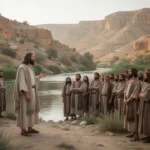
John baptized people in the Jordan River as a sign of repentance. His baptism did not replace faith or function as a magical cleansing ritual. It publicly expressed a person’s change of heart and willingness to return to God. The practice also prepared the way for Christian baptism, which would be associated with the death and resurrection of Jesus and the gift of the Holy Spirit.
John did not allow religious heritage to substitute for genuine repentance. In Matthew 3:7-10 and Luke 3:7-9, he challenged people who relied on their descent from Abraham. His warning was that God looks for spiritual fruit, not merely religious identity or family background.
John’s preaching also included a warning about judgment. He used images of an axe at the root of an unfruitful tree, a separating harvest, and a fire that consumes what is worthless. These images communicate that the Messiah’s arrival would bring both salvation and accountability. The good news of God’s kingdom does not treat sin as harmless.
At the same time, John openly admitted that he was not the Messiah. In John 1:19-28, religious leaders asked whether he was the Christ, Elijah, or the expected prophet. John denied being the Christ and described himself as a voice preparing people for someone greater. His answer shows a defining feature of his ministry: he understood his identity through the person he served.
John also distinguished his baptism from the work Jesus would perform. In Matthew 3:11, Mark 1:8, and Luke 3:16, John explains that he baptizes with water, while the coming one will baptize with the Holy Spirit and fire. The comparison makes clear that John’s ministry is preparatory; Jesus brings the deeper spiritual work John announces.
John called for repentance: people were to turn from sin rather than merely express regret.
He demanded visible fruit: changed behavior was evidence of a changed heart.
He baptized with water: the act publicly marked a person’s response to his message.
He warned of judgment: the coming Messiah would expose and deal with evil.
He pointed beyond himself: Jesus would bring the greater work of the Holy Spirit.
John the Baptist’s witness to Jesus
John’s most important role was to identify Jesus publicly. The Gospel of John records that Jewish leaders sent representatives to question him, and John made clear that he was not the central figure. His witness consistently moves attention away from his own popularity and toward Jesus.
In John 1:29-34, John sees Jesus approaching and identifies him as the Lamb of God who takes away the sin of the world. This title connects Jesus with sacrifice, deliverance, and God’s provision for sin. John does not explain every detail of the image, but he clearly presents Jesus as the one whose mission reaches beyond Israel to the world.
John says that he did not fully know Jesus’ identity until God gave him a sign. The Spirit descended and remained on Jesus, confirming that he was the one who would baptize with the Holy Spirit. John then testifies that Jesus is the Son of God, making his witness both personal and divinely confirmed.
John’s disciples also heard him identify Jesus in this way. In John 1:35-42, two of them leave John to follow Jesus after hearing his testimony. One of those disciples, Andrew, then brings his brother Simon to Jesus. The scene shows how faithful witness works: John does not try to retain every follower, but gladly directs them to the one they need.
John 3:22-36 presents the same humility in a later conversation. Some people were concerned that Jesus was attracting more followers, but John responded that his own role was assigned by God. He compared himself to the friend of the bridegroom, whose joy comes from hearing the bridegroom rather than claiming the wedding for himself.
John’s ministry becomes clearer when his repeated purpose is remembered: he is the witness, not the light; the messenger, not the Messiah.
The statement often translated as “He must increase, but I must decrease” appears in John 3:30. Rather than a slogan about low self-esteem, it is a declaration of proper spiritual order. John recognizes that Jesus’ authority, origin, and mission are greater than his own. His faithfulness includes knowing when to step out of the center.
For personal reflection: John’s example shows that Christian influence is not measured by how many people remain attached to you. A faithful witness helps people see Jesus more clearly, even when that means receiving less attention.
Scriptures about John’s doubts, imprisonment, and death
John’s courage brought him into conflict with Herod Antipas. According to Matthew 14:1-12 and Mark 6:14-29, John publicly condemned Herod’s unlawful relationship with Herodias, his brother’s wife. John’s willingness to confront a ruler demonstrates that his moral message applied to powerful people as firmly as it applied to ordinary crowds.
Herod had John arrested and eventually killed after a banquet promise made to Herodias’s daughter. The account describes political pressure, resentment, manipulation, and a ruler who feared the crowd while still choosing violence. John’s death was not caused by a failure of his mission. It was the consequence of remaining truthful when truth was dangerous.
Before his death, John sent disciples to ask Jesus whether he was the expected one or whether they should look for another. This episode appears in Matthew 11:2-6 and Luke 7:18-23. John’s question can sound surprising because he had already testified about Jesus, but imprisonment, suffering, and unmet expectations may have created real uncertainty.
Jesus did not shame John for asking. Instead, he pointed John’s disciples to what they could see and hear: the blind received sight, the lame walked, people with skin diseases were cleansed, the deaf heard, the dead were raised, and the poor received good news. These descriptions echo prophetic promises and demonstrate that Jesus’ works provide the answer.
The response does not mean every expectation about the Messiah was immediately fulfilled. John had preached about judgment, and Jesus’ ministry also included warnings about judgment. Yet Jesus’ public works at that stage emphasized mercy, healing, restoration, and proclamation. John’s disciples were given evidence rather than a simple argument.
After they left, Jesus spoke honorably about John in Matthew 11:7-15 and Luke 7:24-30. He rejected the idea that John was weak or easily swayed. John was not a reed bending in the wind, nor someone dressed for comfort in a palace. He was a prophet, and more than a prophet, because he occupied the unique position of preparing the way for Jesus.
Jesus also says that John is the Elijah figure expected before the Messiah, while John himself had denied being Elijah when questioned in John 1. These statements can be understood together: John was not Elijah in a literal identity sense, but he fulfilled the prophetic role associated with Elijah. The Gospel accounts emphasize function and calling rather than a claim that John was the ancient prophet reincarnated.
John 1:19-28: John denies being the Messiah and identifies himself as the preparatory voice.
Matthew 11:2-6: John’s disciples ask Jesus for reassurance while John is imprisoned.
Matthew 11:7-15: Jesus praises John as a courageous prophet and identifies his Elijah-like role.
Matthew 14:1-12: John’s execution follows his condemnation of Herod’s wrongdoing.
Luke 7:24-35: Jesus honors John while contrasting the different responses people gave to both ministries.
Why John the Baptist matters for Christian faith
John matters because he connects prophetic promise with the public ministry of Jesus. He stands at the threshold of the Gospel story, announcing that God’s kingdom is near and calling people to respond. His ministry makes clear that meeting Jesus is not merely an intellectual event; it calls for repentance, trust, and changed living.
John also teaches that spiritual preparation is active. Preparing the way does not mean trying to earn God’s favor through perfect behavior. It means honestly confronting sin, abandoning false confidence, practicing justice, and becoming ready to receive what God is doing.
His ministry gives a practical definition of repentance. Luke 3 shows that repentance reaches into ordinary decisions: sharing resources, refusing exploitation, speaking truthfully, and using authority without intimidation. These examples prevent repentance from becoming only an emotional response at a religious service.
John’s relationship with Jesus provides a model of humble leadership. He attracted large crowds, received public recognition, and had devoted disciples, yet he did not confuse influence with ownership. When Jesus became more prominent, John accepted that development as the proper fulfillment of his calling.
His imprisonment and death also show the cost of faithful speech. John did not make moral truth dependent on the status of the person hearing it. He challenged a ruler because God’s standards applied to rulers as well as everyone else, and he accepted the consequences without abandoning his witness.
Finally, John’s doubts offer comfort to sincere believers who struggle under pressure. The Gospels do not erase the question he sent through his disciples. They show that uncertainty can be brought to Jesus and answered through his works, promises, and identity. John remains honored even though his final season included fear, confinement, and questions.
For a focused study, read the passages in this order:
Luke 1:5-25, 57-80 to study John’s birth announcement and prophetic calling.
Matthew 3:1-17 to see his preaching, baptism, and encounter with Jesus.
John 1:19-34 to examine John’s witness to the Lamb of God.
Luke 3:1-20 to study his practical teaching about repentance.
Matthew 11:2-15 to consider his doubts and Jesus’ praise.
Matthew 14:1-12 to reflect on his courage and death.
Read together, these Scriptures present John as more than a memorable preacher in biblical history. He is the messenger who prepares people for Jesus, the prophet who demands genuine repentance, and the witness who remains faithful even when his ministry becomes costly.
Frequently asked questions
What is the main Scripture about John the Baptist?
Matthew 3:1-12 is one of the main passages because it describes John’s wilderness preaching, his call to repentance, his baptism, and his announcement that Jesus is greater than he is. Luke 3:1-20 adds practical examples of repentant living, while John 1:19-34 focuses especially on John’s testimony about Jesus as the Lamb of God.
Which Bible prophecy did John the Baptist fulfill?
The Gospel writers apply Isaiah 40:3 to John, presenting him as the voice in the wilderness preparing the Lord’s way. They also connect him with Malachi’s messenger and with the Elijah-like role described in Malachi 4:5-6. John was not literally Elijah, but Luke 1:17 says he ministered with Elijah’s spirit and power.
Why did John the Baptist baptize people?
John baptized as a public sign of repentance and readiness for God’s coming kingdom. His baptism did not operate as a magical ritual or replace a changed life. His preaching required people to demonstrate repentance through ethical behavior, including generosity, honesty, and restraint. Christian baptism later took on its fuller meaning in connection with Jesus’ death, resurrection, and the Holy Spirit.
Did John the Baptist doubt that Jesus was the Messiah?
While imprisoned, John sent disciples to ask Jesus whether he was the expected one, as recorded in Matthew 11:2-6 and Luke 7:18-23. The question may reflect suffering, unmet expectations, or a desire to strengthen his disciples. Jesus answered by pointing to his healing works and good news, then publicly honored John as a true prophet.
















Leave a Reply