John the Baptist’s mother was Elizabeth, the wife of the priest Zechariah. According to the Gospel of Luke, she was from a priestly family and was related to Mary, the mother of Jesus.
Elizabeth and Zechariah had been unable to have children for many years. An angel later announced that Elizabeth would have a son, and that child became John the Baptist, the prophet who prepared people for Jesus’ ministry.
Elizabeth appears mainly in Luke 1, which gives the account of John’s birth and the events surrounding Jesus’ conception. Luke describes her as the wife of Zechariah, a priest serving in the temple, and identifies her as a descendant of Aaron, the first high priest of Israel.
Her priestly ancestry matters because it connects John with Israel’s religious leadership. John did not come from an ordinary family with no connection to the temple. Through Elizabeth and Zechariah, he was born into a household shaped by prayer, Scripture, priestly service, and expectation for God’s promises.
Luke also says that Elizabeth and Zechariah were faithful before God. They followed the commandments but had no child because Elizabeth was unable to conceive. In the social setting of the biblical world, childlessness could bring grief, shame, and unfair judgment, even when a couple had done nothing wrong.
How Elizabeth became John the Baptist’s mother
Luke presents Elizabeth’s pregnancy as an answer to long-standing prayer and a direct act of God. The events can be followed in several stages:
Elizabeth and Zechariah remained childless. Both were advanced in age, and Elizabeth had not been able to conceive.
Zechariah served in the temple. While carrying out his priestly duties, he encountered the angel Gabriel.
Gabriel announced the coming child. The angel said Elizabeth would have a son and that his name was to be John.
The child received a special calling. John would turn many people back to God and prepare them for the Lord.
Elizabeth conceived and withdrew for five months. Luke describes her response as grateful recognition that God had removed her disgrace among her people.
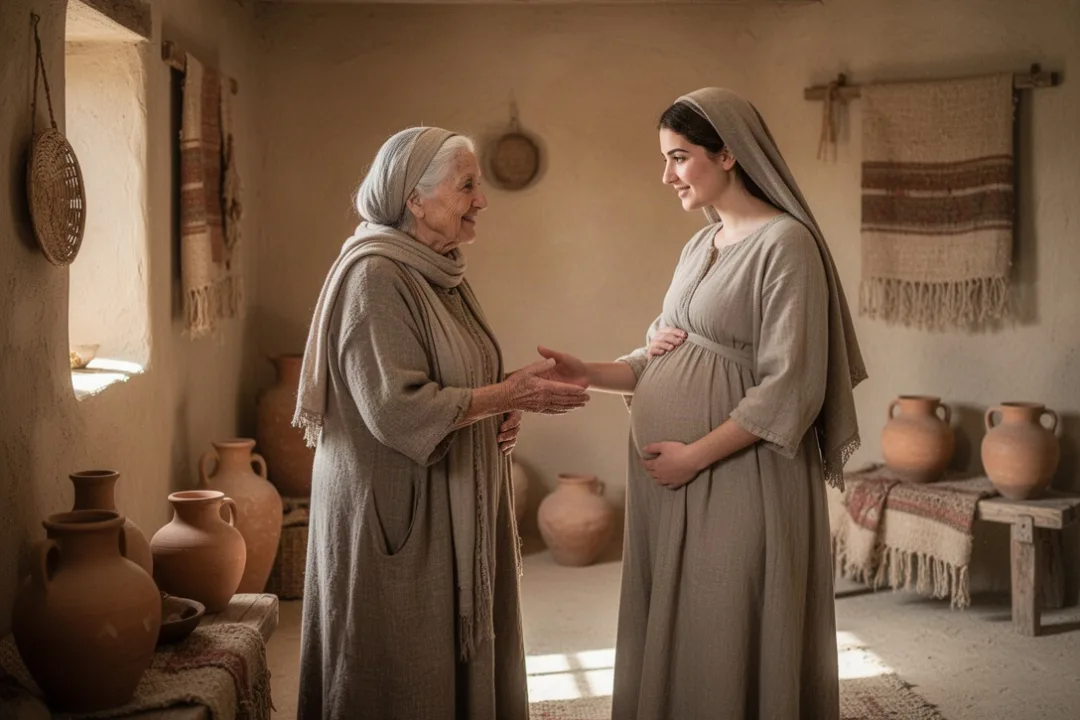
Elizabeth welcomed Mary into her home. Mary visited while both women were pregnant, and Elizabeth recognized the significance of Mary’s unborn child.
Elizabeth gave birth to John. Her neighbors and relatives rejoiced, and Zechariah confirmed that the boy’s name was John.
This sequence appears in Luke 1:5-25 and Luke 1:57-66. It presents Elizabeth’s motherhood as part of a larger pattern in Scripture: God brings new life and a prophetic mission from circumstances that seem impossible by ordinary human standards.
Direct answer: John the Baptist’s mother was Elizabeth, also called Elisabet in some translations. She was the wife of Zechariah and a descendant of Aaron.
What Luke says about Elizabeth’s family
Luke introduces Elizabeth and Zechariah as a married couple living according to their faith. Zechariah belonged to the priestly division of Abijah, while Elizabeth belonged to the daughters of Aaron. Their marriage therefore joined two people with priestly connections.
The text does not give Elizabeth’s parents’ names, her exact hometown, or her age. It does say that both she and Zechariah were advanced in years. Readers should avoid filling in those missing details with later speculation presented as biblical fact.
Elizabeth’s marriage to Zechariah was also central to John’s identity. In the ancient Jewish setting, a child’s family and religious heritage helped shape his place in the community. John’s upbringing would have connected him to Israel’s worship and traditions, even though his later ministry took place mainly outside the temple system.
Why Elizabeth’s childlessness matters in Luke’s story
Elizabeth’s inability to have children is not treated as proof of sin or divine rejection. Luke first describes her and Zechariah as faithful people, then explains that they remained childless. That contrast challenges the assumption that suffering always reflects personal wrongdoing.
Her situation also prepares readers for the announcement that John will have an extraordinary role. Elizabeth is not simply expecting a child after years of waiting; she is expecting a son who will be set apart for prophetic service. Gabriel describes John as someone who will help turn people toward God and prepare them for the Lord’s coming.
John’s birth echoes other important birth stories in the Hebrew Scriptures. Several biblical women who had struggled with infertility later became mothers of children with significant roles in God’s purposes. Elizabeth’s story has similarities to the accounts of Sarah, Rebekah, Rachel, and Hannah, although each story has its own details and meaning.
The parallel with Hannah is especially useful because Hannah also prayed for a son and dedicated him to God. Elizabeth’s story likewise shows that motherhood, prayer, and a child’s calling can be closely connected. Luke’s account, however, does not say Elizabeth copied Hannah or that their experiences were identical.
Gabriel’s message to Zechariah explains why John’s birth matters. The angel says the child will bring joy to his parents and many others. John will be spiritually significant before his birth, and his mission will involve calling people to repentance and preparing them for the one who comes after him.
Luke describes John as being filled with the Holy Spirit from before birth. The passage does not mean that John’s life will be easy or that he will be free from human limitations. It means his life will have a distinctive prophetic purpose connected with God’s work among Israel.
Zechariah initially questions how the promise can be fulfilled because he and Elizabeth are old. Gabriel responds by declaring that the announcement will come true, but Zechariah becomes unable to speak for a period of time. Elizabeth, meanwhile, conceives and later gives birth as promised.
This difference between Zechariah’s reaction and Elizabeth’s experience is part of Luke’s narrative design. Zechariah struggles to accept the announcement, while Elizabeth later interprets her pregnancy as God’s gracious action. The account does not portray her as passive; she recognizes the meaning of what has happened to her.
Elizabeth’s relationship to Mary
Luke calls Elizabeth a relative of Mary. The exact family relationship is not specified, so translations may use terms such as “relative” or “kinswoman.” Claims that Elizabeth was definitely Mary’s cousin, aunt, or another specific relation go beyond what Luke states.
Mary visits Elizabeth after Gabriel tells Mary that she will conceive Jesus. At the time of the visit, Elizabeth is pregnant with John and Mary is pregnant with Jesus. When Mary greets Elizabeth, the unborn John moves within Elizabeth, and she responds with joy and spiritual insight.
Elizabeth recognizes Mary as the mother of her Lord. She also blesses Mary for believing that God’s promise would be fulfilled. Her words show that she understands the significance of Mary’s pregnancy before Jesus is born.
This meeting connects the two birth stories. John is the forerunner, while Jesus is the Messiah whom John will announce. Elizabeth’s response therefore helps establish the relationship between the two children at the beginning of Luke’s Gospel.
Elizabeth’s role links John’s prophetic mission with Mary’s pregnancy and the arrival of Jesus.
The meeting also portrays Elizabeth as an older woman who encourages a younger relative. Mary receives welcome and confirmation from someone who has experienced her own miraculous pregnancy. The two women share faith, uncertainty, physical vulnerability, and gratitude during a major change in their lives.
What Elizabeth says during Mary’s visit
Elizabeth’s speech in Luke 1:42-45 is one of the clearest indications of her spiritual importance. She blesses Mary and the child Mary carries, then expresses amazement that the mother of her Lord has come to visit her.
She also connects Mary’s blessing with her faith. Mary is honored not merely because she is pregnant, but because she trusted God’s promise. Elizabeth’s words emphasize that faith involves receiving and relying on what God has said, even before the promise becomes visible to others.
Elizabeth’s response is remarkable because she is the older woman and the wife of a priest, yet she honors Mary rather than competing with her. She does not treat her own pregnancy as more important because it was announced first. Instead, she celebrates the greater purpose represented by Mary’s child.
Luke’s account gives Elizabeth a role as a witness to Jesus’ identity before Jesus’ birth. Her recognition is not based on public evidence or a miracle she has seen. It comes through the revelation associated with the Holy Spirit and the events surrounding both pregnancies.
Elizabeth’s song and Mary’s Magnificat
After Elizabeth greets Mary, Mary responds with a song of praise commonly called the Magnificat. The song is Mary’s, not Elizabeth’s, although Elizabeth’s greeting leads into it. Mary praises God for showing mercy, lifting the humble, and keeping promises made to Israel.
Elizabeth should therefore not be credited with the Magnificat. Her own recorded words are the blessing and recognition given during the visit. Keeping the two women’s speeches distinct helps clarify the structure of Luke 1.
The two women still share a strong theological theme: God notices people who might be overlooked and acts faithfully toward them. Elizabeth had experienced years of childlessness, while Mary faced the social and personal cost of an unexpected pregnancy. Both respond by recognizing God’s action rather than claiming personal status.
How Elizabeth chose John’s name
When Elizabeth gave birth, relatives and neighbors assumed the baby would be named after his father, Zechariah. Naming a son after a family member would have been a natural expectation in that setting. Elizabeth rejected that assumption and said the child would be called John.
Her decision agrees with Gabriel’s earlier instruction. Zechariah had been told that the baby’s name would be John, even though the name was not the obvious family choice. When Zechariah wrote the same name, his ability to speak returned.
The naming scene confirms that Elizabeth understood and accepted the divine message. She was not simply responding to a family debate. Her choice demonstrated that John’s identity and mission came from God’s calling rather than family custom.
The neighbors then asked what the child would become, because the events surrounding his birth were unusual. Luke says that the Lord’s hand was with John. This statement anticipates the public ministry John would later carry out in the wilderness.
Elizabeth’s role in John’s early life
The Bible gives very little information about John’s childhood. It does not describe Elizabeth’s daily life as a mother, the family’s home, or the specific lessons she taught him. Luke simply says that the child grew and became strong in spirit, later living in the wilderness before appearing publicly to Israel.
Because the text is brief, readers should distinguish between biblical information and imaginative reconstructions. It is reasonable to say that Elizabeth and Zechariah provided John’s family setting and religious heritage. It is not possible to state confidently how long Elizabeth lived, how she died, or exactly how she influenced John’s education.
John’s later clothing, diet, preaching, and location reflect his prophetic identity. The Gospels describe him calling people to repentance and baptizing those who responded. They do not say that Elizabeth accompanied him during his ministry or that she witnessed his encounter with Jesus as an adult.
Elizabeth’s importance in Christian interpretation
Christians have often viewed Elizabeth as an example of faithful endurance. She lived with disappointment for many years, yet Luke presents her as righteous rather than bitter or spiritually rejected. Her story can encourage readers who have experienced unanswered prayer without suggesting that every hardship will end in the same way.
She is also remembered as a woman who recognized God’s work in another person. Elizabeth welcomed Mary, blessed her, and affirmed her faith. This makes Elizabeth an important model of generous spiritual encouragement, especially because she did not seek attention for herself.
Her story also gives women a prominent voice at the beginning of Luke’s Gospel. Elizabeth speaks prophetically, interprets Mary’s pregnancy, and participates in the public confirmation of John’s name. Her role is not limited to being the mother of a famous son; she is an active witness within the story.
For Christian readers, Elizabeth’s pregnancy also points to God’s ability to work through circumstances that appear closed or hopeless. The emphasis is not on a general promise that everyone will receive the outcome they desire. It is on the particular promise given to Elizabeth and Zechariah and God’s faithfulness to that promise.
Read the details carefully: Luke identifies Elizabeth as Aaron’s descendant and Mary’s relative, but it does not provide her parents’ names, exact age, or precise relationship to Mary.
Elizabeth in relation to John’s ministry
John later became known as John the Baptist because he baptized people in connection with his call to repentance. His ministry prepared the way for Jesus and emphasized moral change, humility, and readiness for God’s kingdom.
Elizabeth did not perform John’s public ministry, but her story establishes the first stage of it. Before John preached to crowds, he was the promised child of Elizabeth and Zechariah. His unusual birth signaled that he had a special role in the unfolding story of salvation.
John’s message also reflects themes introduced in his birth announcement. Gabriel speaks of turning people back to God and preparing them for the Lord. Years later, John’s preaching calls people to change their lives and receive baptism. The connection shows continuity between the promise about John and his adult work.
John eventually points away from himself and toward Jesus. This humility is consistent with the way Elizabeth responds to Mary: she recognizes the greater work of God and celebrates it rather than placing herself at the center.
Where to read about John the Baptist’s mother
The primary biblical material about Elizabeth is found in Luke 1. These passages provide the information needed to answer who she was and explain her place in John’s birth story:
Luke 1:5-7: Elizabeth’s marriage to Zechariah, her priestly ancestry, her righteousness, and her childlessness.
Luke 1:8-25: Gabriel’s announcement to Zechariah and Elizabeth’s conception of John.
Luke 1:36: Elizabeth is mentioned in connection with Mary’s pregnancy.
Luke 1:39-45: Elizabeth welcomes Mary and recognizes the significance of her unborn child.
Luke 1:57-66: John’s birth, his naming, and the reaction of the surrounding community.
Luke 1:67-79: Zechariah’s prophecy after John’s birth, which describes John’s future mission.
John’s adult ministry is described in other Gospel passages, including Matthew 3, Mark 1, and John 1. Those passages focus on John’s preaching and relationship to Jesus rather than on Elizabeth, so they do not add much information about his mother.
What the Bible does not say about Elizabeth
Elizabeth is named clearly, but the biblical record about her is limited to the events surrounding John’s conception and birth and Mary’s visit. The text does not identify her parents or describe her later life. It also does not say that she was related to any particular famous biblical woman beyond the stated relationship to Mary.
Some later Christian traditions and artistic portrayals offer additional details, but tradition should be labeled as tradition. It should not be confused with the direct testimony of Luke. The safest answer remains the simplest one: Elizabeth was John the Baptist’s mother, Zechariah’s wife, and a descendant of Aaron.
Her importance comes from more than the fact that she gave birth to a well-known prophet. Luke presents her as a faithful woman who endured years of childlessness, received a promised son in old age, recognized Jesus’ significance, and helped confirm John’s God-given identity.
Why Elizabeth remains significant
Elizabeth stands at the meeting point of several major biblical themes: prayer, promise, prophecy, family, and faith. Her pregnancy begins the story of the prophet who will prepare the way for Jesus, while her meeting with Mary links John’s mission to the birth of the Messiah.
She also gives readers a fuller picture of the people surrounding Jesus’ birth. The story is not only about Mary and Joseph. Elizabeth and Zechariah have their own struggle, calling, and response to God. Their family becomes the setting in which John, one of the most important prophetic figures in the Gospels, enters the world.
So, when someone asks who John the Baptist’s mother was, the direct answer is Elizabeth. In Luke’s account, she is a righteous, elderly woman from a priestly family whose long-awaited son was called to prepare Israel for Jesus.
Frequently asked questions
Was Elizabeth related to Mary, the mother of Jesus?
Yes. Luke describes Elizabeth as Mary’s relative, but it does not specify the exact family connection. Some traditions identify her more precisely, but the biblical text does not say whether she was Mary’s cousin, aunt, or another relation. The important point is that the two women were family members who met during their pregnancies.
Who was Elizabeth’s husband?
Elizabeth’s husband was Zechariah, a Jewish priest. Luke presents him as a descendant of the priestly line and a member of the temple service. Zechariah and Elizabeth had been childless for many years before an angel announced that they would have a son named John, who would later become known as John the Baptist.
How old was Elizabeth when she gave birth to John?
The Bible does not give Elizabeth’s exact age. Luke says that she and Zechariah were advanced in years and that she had been unable to have children. Her age is significant because the pregnancy was presented as extraordinary, but any precise number comes from speculation rather than the biblical account.
Did Elizabeth know that John would become the Baptist?
Elizabeth knew that her son had a special calling, because Gabriel’s announcement to Zechariah described John’s future mission. However, the Bible does not record Elizabeth using the later title “John the Baptist” or describe her understanding of every detail of his adult ministry. She knew he was appointed to prepare people for the Lord.
















Leave a Reply