Angel Gabriel: his role in the Bible and Christian tradition
Angel Gabriel: his role in the Bible and Christian tradition
Angel Gabriel is a heavenly messenger who appears by name in the Book of Daniel and the Gospel of Luke. In the Bible, he explains prophetic visions to Daniel and announces two births: John the Baptist’s to Zechariah and Jesus’ to Mary.
Gabriel is not presented as a god or as an independent source of revelation. He serves God, delivers messages, and helps people understand events connected with God’s purposes. Later Jewish, Christian, and Islamic traditions expand his significance, but the clearest biblical picture comes from these direct appearances in Daniel and Luke.
The name Gabriel is generally understood as meaning “God is my strength” or “strong one of God,” based on its Hebrew form. The exact nuance can vary because ancient names often combine words in ways that allow more than one English rendering.
The name fits Gabriel’s role. He does not draw attention to personal power or independence; instead, his presence points to God’s authority. His messages concern matters that human beings could not discover by ordinary observation, including the meaning of visions and the future births of important biblical figures.
Gabriel’s name also helps distinguish him from the message he carries. In Scripture, the messenger is not the source of the message. When Gabriel speaks, the emphasis remains on the God who sends him and on the response expected from the person who hears.
Key distinction: Gabriel is a messenger of God, not a divine being to be worshiped. Biblical accounts direct worship toward God rather than toward angels.
Where Gabriel appears in the Bible
Gabriel is named in only a small number of biblical passages, but each appearance is significant. He first appears in Daniel 8, where he is instructed to help Daniel understand a troubling vision. He appears again in Daniel 9, bringing insight while Daniel is praying and confessing the sins of his people.
Centuries later, Gabriel appears in Luke 1. He tells the priest Zechariah that his wife Elizabeth will have a son, John. Six months later, Gabriel visits Mary and announces that she will become the mother of Jesus.
These scenes connect Gabriel with two related kinds of work:
Interpreting revelation: Gabriel helps Daniel understand symbolic visions and their significance.
Announcing God’s action: Gabriel tells Zechariah and Mary about births that form part of a larger redemptive story.
Clarifying what seems impossible: His messages address old age, infertility, divine promise, and the virgin conception of Jesus.
Calling for a response: The people who hear Gabriel must deal with fear, doubt, obedience, and trust.
The biblical Gabriel is therefore more than a decorative figure in religious art. He appears at moments when people need understanding and when God’s plans are moving from promise toward fulfillment.
Gabriel’s role in Daniel’s visions
In Daniel 8, Daniel sees a symbolic vision involving animals, horns, conflict, and a sanctuary. The imagery is difficult and disturbing. A heavenly voice directs Gabriel to explain the vision, and Gabriel approaches Daniel in order to give its meaning.
The passage presents Gabriel as an interpreter of symbolic prophecy. Daniel is not left to decode every image through personal speculation. Gabriel explains the broad historical and spiritual significance of what Daniel has seen, although the vision remains serious and challenging.
Daniel 9 gives Gabriel another connection: prayer and understanding. Daniel is praying about Jerusalem, the devastation of the city, and the condition of his people. Gabriel comes while Daniel is still engaged in prayer and offers insight concerning the future of Jerusalem and God’s purposes for the people.
Readers should handle these passages carefully. Daniel contains highly symbolic material, and different Jewish and Christian interpreters have reached different conclusions about the timing and fulfillment of its visions. Gabriel’s presence does not mean every detail has one universally accepted interpretation.
What the passages clearly show is that Gabriel helps Daniel receive a message that is bigger than his immediate circumstances. The angel does not satisfy curiosity for its own sake. His explanation addresses judgment, restoration, faithfulness, and hope.
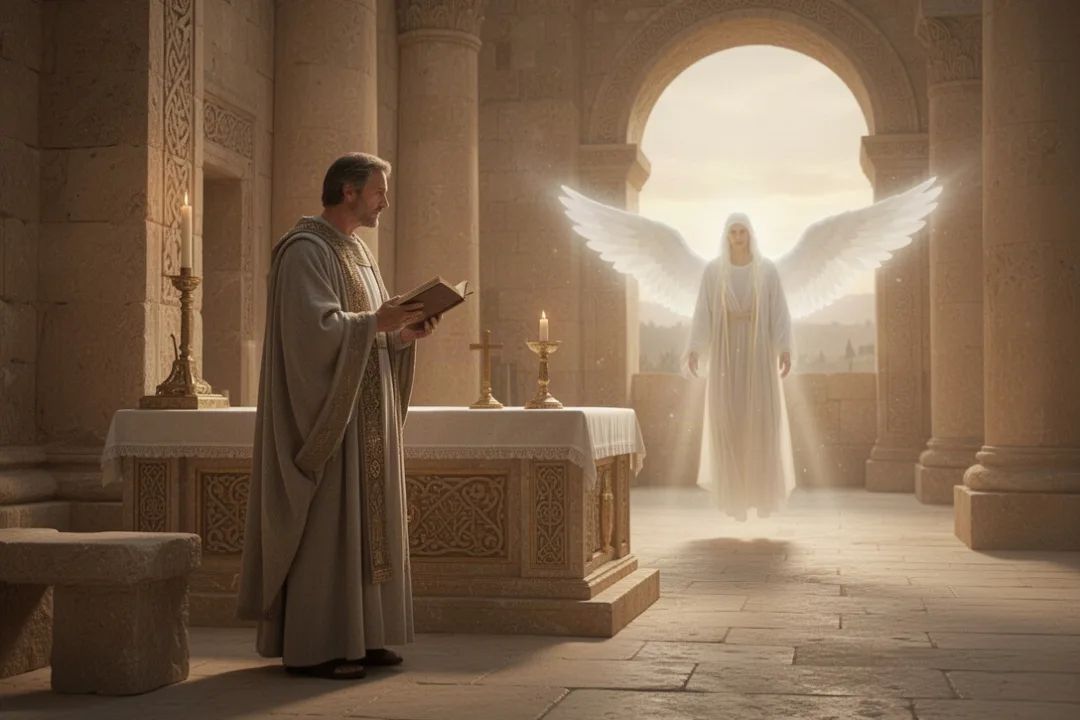
Luke 1 introduces Gabriel at the Jerusalem temple, where Zechariah is serving as a priest. Zechariah and Elizabeth are described as faithful, but they have no child and are advanced in age. Gabriel tells Zechariah that Elizabeth will give birth to a son who will be named John.
John will have a distinctive mission. He will prepare people for the Lord and call them toward repentance. Luke connects this mission with the prophetic hope associated with Elijah, showing that John’s work will prepare the way for the arrival of a much greater figure.
Zechariah struggles to accept the announcement because of the couple’s age and circumstances. Gabriel identifies himself as one who stands in God’s presence and says that he was sent to speak this good news. Zechariah’s temporary inability to speak becomes a sign connected with his doubt.
The scene does not portray doubt as a minor intellectual question. Zechariah has received a direct announcement, yet he measures the promise primarily against human limitations. His silence gives the family and community time to recognize that something extraordinary has happened.
Gabriel’s message to Zechariah also establishes a pattern found in Luke: God’s work begins in places that look hidden or unlikely. The coming of John is announced not to a ruler or military leader, but to an older couple whose long disappointment is about to change.
Gabriel’s announcement to Mary
Gabriel’s best-known appearance is the Annunciation, described in Luke 1:26–38. He is sent to Nazareth, a town in Galilee, to speak with Mary, a young woman pledged in marriage to Joseph. Gabriel tells her that she will conceive and bear a son named Jesus.
The message identifies Jesus with royal and messianic promises. He will receive the throne associated with David, and his kingdom will have no end. Luke presents this announcement as the beginning of a decisive act of God, not simply as news about an unusual birth.
Mary asks how this can happen because she has not had sexual relations with a man. Gabriel explains that the Holy Spirit will come upon her and that the child will be called holy and the Son of God. He also points to Elizabeth’s pregnancy as evidence that God is already acting in an extraordinary way.
Mary’s response is one of humble willingness. She does not pretend that the message is easy or ordinary. Instead, she accepts her role as the servant of the Lord and allows her future to be shaped by the word she has received.
The scene is central to Christian theology for several reasons:
It announces the incarnation, the Christian belief that the Son of God takes human nature in Jesus.
It presents Mary as a willing participant who receives the message with faith.
It links Jesus with the promises made to David and with the hope of an enduring kingdom.
It shows Gabriel as a messenger who explains, reassures, and directs attention to God’s action.
Gabriel’s greeting to Mary has also shaped Christian prayer and devotion, especially in traditions that use the Hail Mary or related prayers. Those practices differ among denominations, but they commonly reflect the importance of the Annunciation in Christian worship.
Why Gabriel is called an archangel
Many Christians refer to Gabriel as an archangel, but the biblical passages that name him simply call him an angel. The New Testament explicitly uses the word “archangel” for Michael in another passage, while Gabriel’s own scenes do not give him that title.
The designation “archangel” developed through later Jewish and Christian reflection on Gabriel’s importance and rank. In ordinary religious language, it identifies him as a prominent or high-ranking angel. However, readers should distinguish Scripture’s wording from later devotional and theological usage.
This distinction does not make Gabriel less important. He has a major role in Daniel and Luke, and Christian tradition reasonably recognizes him as one of the principal angels associated with God’s revelation. It simply avoids claiming that every later title appears explicitly in the biblical text.
Gabriel is often grouped with Michael and Raphael as the best-known named angels in Christian tradition. Raphael appears in the Book of Tobit, which is part of the Catholic and Orthodox biblical canons but not the Protestant canon. Michael is named in Daniel, Jude, and Revelation. Gabriel’s distinctive role is especially tied to messages and revelation.
Gabriel in Jewish tradition
Gabriel’s role in Jewish tradition extends beyond the passages in Daniel. Jewish writings and later interpretations discuss him as a powerful angel associated with judgment, protection, and divine communication. These sources are diverse, and they do not all describe Gabriel in exactly the same way.
In the Hebrew Bible, Daniel provides the essential foundation for Gabriel’s identity. He appears as a heavenly being who can interpret visions and stand before God. Later Jewish literature develops a broader angelology, but those later descriptions should not be confused with direct statements from the biblical text.
Jewish tradition also emphasizes that angels remain servants of God. They are not rival gods and do not replace the relationship between God and humanity. Even when angels are described with great power, their authority remains derived and limited.
Because Jewish interpretations vary by period and community, it is more accurate to speak of multiple Jewish traditions than of one single, uniform view. Gabriel may be associated with strength or judgment in one source and with protection or communication in another.
Gabriel in Christian tradition and worship
Christian churches commonly honor Gabriel because of his connection with the Annunciation. In Catholic, Eastern Orthodox, Anglican, and some other traditions, Gabriel is remembered in feast days, hymns, prayers, and visual art. The exact calendar date and liturgical practice depend on the denomination.
In the Roman Catholic calendar, Gabriel is commemorated together with Michael and Raphael on September 29, the Feast of the Archangels. This shared observance reflects the Church’s veneration of these named angels. It does not mean that Christians worship them; worship belongs to God alone.
Christian art often depicts Gabriel holding a lily, a scroll, a trumpet, or a staff. The lily commonly symbolizes Mary’s purity, while a scroll or book suggests a delivered message. A trumpet can represent proclamation, although the Bible’s named appearances of Gabriel do not specifically describe him blowing one.
These artistic symbols are useful reminders, but they are not all equally biblical. The strongest scriptural images are Gabriel as God’s messenger, Daniel’s interpreter, and the announcer of John’s and Jesus’ births.
Some Christians ask Gabriel to pray for them or seek his protection in devotional language. Other Christians avoid prayers addressed to angels and pray only to God. Both approaches reflect differing views about intercession and devotion, so a person’s church tradition should guide personal practice.
Gabriel in Islam
In Islam, Gabriel is known as Jibril or Jibra’il and holds a central place in the history of revelation. Islamic teaching identifies him as the angel who conveyed God’s revelations to the prophet Muhammad, including the Qur’an.
Islamic accounts also connect Jibril with earlier prophets and with Maryam, the mother of Jesus. The Qur’an refers to Mary’s encounter with a messenger and presents the birth of Jesus as a sign of God’s power. Islamic beliefs about Jesus, Mary, angels, and revelation differ in important ways from Christian doctrine, even where the figures overlap.
For Muslims, Jibril is not divine and is not worshiped. He is a trusted messenger who faithfully carries out God’s command. This emphasis resembles the biblical picture of Gabriel as a servant whose authority comes from the One who sends him.
Jewish, Christian, and Islamic traditions therefore share a broad understanding of Gabriel as a powerful heavenly messenger, while differing about the messages he carries and the theological meaning of those messages. Comparing the traditions can be helpful when it is done with precision and respect.
Common mistakes when learning about Gabriel
Gabriel is widely known, but popular images sometimes blend biblical details with later legends, artistic conventions, or descriptions of other angels. These mistakes can make it difficult to tell what the primary texts actually say.
Calling Gabriel a god: Biblical, Jewish, Christian, and Islamic traditions generally treat Gabriel as a created messenger, not a deity.
Assuming every angel has wings: The named passages about Gabriel do not focus on wings, and Scripture does not give a single standard appearance for all angels.
Claiming Gabriel is explicitly called an archangel in the Bible: The title is common in tradition, but the passages naming Gabriel call him an angel.
Confusing Gabriel with Michael: Michael is associated with heavenly conflict and protection in several texts, while Gabriel is especially associated with explanation and announcement.
Treating artistic symbols as direct quotations from Scripture: Lilies, trumpets, and specific clothing often come from tradition or art rather than the biblical accounts.
Using Gabriel to support every private prediction: The Bible does not authorize people to claim Gabriel has delivered a personal message whenever they feel strongly about an idea.
Ignoring the surrounding story: Gabriel’s words make sense within Daniel’s visions and Luke’s account of God’s promises, not as isolated inspirational sayings.
A careful reading begins with the text itself. Ask who sends Gabriel, who receives the message, what the message says, and what response follows. Those questions prevent speculation from taking the place of textual evidence.
Practical check: When someone claims to have a message from Gabriel, compare the claim with Scripture, the person’s religious tradition, and the character of the message. Do not surrender judgment simply because an angel’s name is used.
What Gabriel’s appearances teach about divine messages
Gabriel’s appearances share several themes. First, divine messages often come when people are facing uncertainty. Daniel is trying to understand frightening visions, Zechariah is living with long disappointment, and Mary is confronted with a future she could not have planned.
Second, the messages are connected to larger purposes. Gabriel does not merely offer private comfort. His words concern the destiny of Jerusalem, the preparation for the Messiah, and the arrival of Jesus in the Christian account.
Third, receiving a message does not eliminate the need for a human response. Daniel must listen and continue faithfully. Zechariah must live through a period of silence and then name his son John. Mary must accept the social, emotional, and practical consequences of her calling.
Finally, Gabriel’s presence does not make every detail simple. Daniel still faces difficult symbols, and Mary still faces a demanding vocation. Revelation can provide direction without removing all uncertainty or hardship.
How to study passages about Gabriel
If you want to study Gabriel carefully, begin with the named passages rather than later legends. Read each scene in its surrounding chapter and observe how the messenger’s appearance affects the story.
Read Daniel 8: Notice the relationship between the vision, the heavenly command, and Gabriel’s interpretation.
Read Daniel 9: Pay attention to Daniel’s prayer and the connection between prayer, confession, and understanding.
Read Luke 1:5–25: Consider Gabriel’s announcement to Zechariah and the promised role of John.
Read Luke 1:26–38: Observe Gabriel’s message to Mary, her question, the explanation given, and her response.
Compare translations carefully: Differences in wording can affect how a phrase sounds, even when the central meaning remains similar.
Separate text from tradition: Mark which details come directly from Scripture and which come from later commentary, worship, or art.
It can also help to study the passages with attention to literary context. Daniel uses visions and symbolic imagery, while Luke presents conversations and announcements within a narrative about Jesus’ birth. Gabriel’s role is consistent, but the form of revelation changes from one book to another.
What Gabriel means for readers today
For many readers, Gabriel represents the possibility that God’s purposes are larger than immediate appearances. Daniel’s circumstances do not define the whole future, and Mary’s ordinary life becomes part of a story with worldwide religious significance.
Gabriel also represents the responsibility that comes with receiving guidance. A message is not merely information; it calls for discernment, humility, and action. The biblical figures do not respond in identical ways, and their stories show that fear and questions can accompany faithful obedience.
Gabriel’s example can encourage a disciplined approach to spiritual claims. Seek clarity rather than spectacle, examine messages by their content and context, and remember that genuine religious authority does not depend on dramatic presentation. In the biblical accounts, Gabriel consistently directs attention away from himself and toward God’s work.
That is the most reliable way to understand Angel Gabriel: as a prominent heavenly messenger whose appearances mark moments of revelation, interpretation, and promise. His significance lies not in independent power, but in faithfully carrying a message that changes how people understand God’s purposes.
Frequently asked questions
Is Gabriel mentioned by name in the Bible?
Yes. Gabriel is named in Daniel 8:16 and Daniel 9:21, where he helps Daniel understand visions. He is also named in Luke 1:19 and Luke 1:26, where he announces the births of John the Baptist and Jesus. These are the principal biblical passages that identify Gabriel directly by name.
Is Gabriel the same angel who appeared to Mary?
Yes. Luke 1 identifies the messenger sent to Mary as Gabriel. He explains that Mary will conceive Jesus through the work of the Holy Spirit and connects the announcement with God’s promise concerning an everlasting kingdom. This scene is traditionally called the Annunciation.
Do Christians worship Gabriel?
Mainstream Christian teaching distinguishes worship, which belongs to God, from honoring or venerating angels. Some churches commemorate Gabriel and ask angels to pray for them, while others avoid addressing angels in prayer. Across these differences, Gabriel is understood as a created servant of God rather than a divine being.
What is Gabriel called in Islam?
In Islam, Gabriel is commonly called Jibril or Jibra’il. He is regarded as the angel who delivered God’s revelations to the prophet Muhammad and is also associated with earlier prophets and Maryam. Islamic belief treats him as a faithful messenger, not as a god or an object of worship.















Leave a Reply