Michael and Gabriel: roles, meanings, and differences
Michael and Gabriel: roles, meanings, and differences
Michael and Gabriel are not presented as interchangeable angels. In the Bible, Michael is associated with defending God’s people and confronting spiritual evil, while Gabriel is associated with delivering messages from God. Michael appears in Daniel, Jude, and Revelation; Gabriel appears in Daniel and in the opening chapters of Luke.
Their names also point toward their biblical roles. Michael is commonly understood to mean “Who is like God?” and Gabriel is commonly connected with “God is my strength” or “man of God,” depending on how the Hebrew name is analyzed. Christian tradition often calls both of them archangels, although the Bible explicitly uses the word “archangel” for Michael, not Gabriel.
The clearest way to compare Michael and Gabriel is to look at where each one appears and what each one does. Their appearances are limited but significant, and the biblical texts do not give a complete catalog of angels or their ranks.
Michael in Daniel: He is described as a chief prince who stands in support of God’s people during spiritual conflict.
Michael in Jude: He disputes with the devil over the body of Moses but responds by leaving judgment to the Lord rather than making a proud accusation.
Michael in Revelation: He leads the heavenly forces against the dragon, which represents Satan, and the dragon is cast down.
Gabriel in Daniel: He helps Daniel understand visions concerning kingdoms, suffering, and future events.
Gabriel in Luke: He announces the births of John the Baptist and Jesus, explaining God’s purposes to Zechariah and Mary.
These passages establish a useful distinction: Michael acts as a defender and warrior, while Gabriel serves as an interpreter and herald. That distinction describes their best-known biblical functions, but it should not be turned into a rigid claim that one angel can never perform any other task.
Key distinction: Michael’s biblical scenes emphasize protection, authority, and conflict with evil. Gabriel’s scenes emphasize explanation, announcement, and the delivery of God’s message.
What Michael does in Scripture
Michael protects God’s people
In Daniel 10, Michael is identified as one of the chief princes and as the prince associated with Israel. The chapter presents an unseen conflict connected with earthly kingdoms. An angelic messenger explains that opposition delayed his arrival to Daniel, and Michael came to help.
Daniel 12 continues this theme by describing Michael as the great prince who stands guard over Daniel’s people during a time of unprecedented distress. The passage connects his protective role with deliverance and the hope of resurrection. Michael is therefore not merely a powerful heavenly figure; he is specifically connected with God’s care for his people.
Michael confronts spiritual evil
Revelation 12 portrays Michael and his angels fighting the dragon and its angels. The dragon symbolizes the devil, the ancient serpent, and the accuser. Michael’s victory marks a decisive change in the heavenly conflict, although the passage also describes continuing trouble on earth.
Jude 9 shows another aspect of Michael’s character. During a dispute with the devil concerning Moses’ body, Michael does not pronounce a self-confident condemnation. Instead, he appeals to the Lord’s authority. The point of the passage is connected to humility and proper judgment: even a powerful angel does not claim authority that belongs to God.
Michael is called an archangel
Jude 9 directly calls Michael “the archangel,” a title that indicates a chief or leading angel. First Thessalonians 4:16 also mentions an archangel’s voice in connection with the return of Christ, but it does not name that archangel as Michael. Because Michael is explicitly called an archangel elsewhere, many Christians connect the two references, though the verse itself does not make that identification.
Michael’s title should not be confused with the idea that he is equal to God. Biblical texts distinguish the Creator from every angelic being. Michael is powerful and honored, but he remains a servant who acts under God’s authority.
What Gabriel does in Scripture
Gabriel explains Daniel’s visions
Gabriel first appears by name in Daniel 8. He is instructed to help Daniel understand a vision, and he provides an explanation of its meaning. In Daniel 9, Gabriel comes again while Daniel is praying and gives him insight connected with the future of Jerusalem and God’s people.
These scenes present Gabriel as an angel who makes divine purposes understandable. He does not simply deliver a short announcement. He helps a human being interpret difficult revelation, showing that heavenly messages may require explanation as well as delivery.
In Luke 1, Gabriel appears to Zechariah in the temple and announces that Zechariah’s wife, Elizabeth, will have a son. The child will be John, who will prepare people for the Lord. Zechariah struggles to believe the announcement, and Gabriel identifies himself as one who stands in God’s presence and was sent to speak to him.
The episode highlights Gabriel’s role as an authorized messenger. He does not present a personal prediction or private opinion. He brings a message connected with God’s plan, and the sign given to Zechariah confirms that the announcement will be fulfilled.
Gabriel announces Jesus’ birth to Mary
Gabriel’s most famous biblical appearance is the annunciation in Luke 1. He tells Mary that she will bear a son who will be called the Son of the Most High and who will receive the throne of David. Gabriel also explains that this conception will occur through the power of the Holy Spirit.
Mary asks how this can happen, and Gabriel answers by explaining the divine action involved. He also points to Elizabeth’s unexpected pregnancy as evidence that God can accomplish what appears impossible. Gabriel’s message is therefore both an announcement and an explanation of the beginning of Jesus’ human life.
Gabriel’s words to Mary direct attention away from the angel himself and toward God’s purpose and power.
Michael and Gabriel compared by role
The Bible gives enough information to compare Michael and Gabriel, but not enough to create a detailed heavenly organizational chart. A careful comparison focuses on repeated patterns in the passages rather than on speculation.
Primary function: Michael is shown defending God’s people and opposing spiritual evil. Gabriel is shown communicating and explaining God’s revelation.
Typical setting: Michael appears in scenes of cosmic or spiritual conflict. Gabriel appears in visions, prayer, and personal encounters involving major announcements.
Relationship to human beings: Michael protects a people in the midst of danger. Gabriel speaks directly to individuals such as Daniel, Zechariah, and Mary.
Message content: Michael’s passages concern opposition, deliverance, judgment, and victory. Gabriel’s passages concern interpretation, prophecy, birth, and God’s unfolding plan.
Explicit title: Michael is called an archangel in Jude 9. Gabriel is identified by name and authority but is not explicitly called an archangel in the biblical text.
Both angels, however, share important qualities. Neither acts independently of God, neither receives worship as God, and neither is presented as a rival deity. Their authority is delegated, and their work points beyond themselves to God’s purposes.
What the names Michael and Gabriel mean
Names in biblical narratives often carry meaning, but a name’s meaning does not by itself prove every detail of a character’s role. The name Michael is commonly explained as a question meaning, “Who is like God?” It functions as a declaration that no being compares with God.
The name Gabriel is commonly related to words for strength and God. It is often rendered as “God is my strength” or understood in a related sense as “man of God.” The exact translation depends on how the name’s elements are interpreted, but the connection with divine strength fits Gabriel’s role as a messenger carrying God’s authority.
These meanings provide helpful associations without replacing the biblical evidence. Michael’s name suits passages that emphasize God’s unmatched authority over evil. Gabriel’s name suits scenes in which God’s strength makes possible what human beings cannot accomplish on their own.
Why Michael and Gabriel are often mentioned together
Michael and Gabriel are frequently paired in Christian teaching because they are the two angels named most prominently in the Bible. Both appear in major moments of revelation, and both are connected with God’s work in human history. Their names also appear together in religious art, prayers, feast days, and popular discussions about angels.
Still, the Bible does not describe them as a regular partnership or as two members of a fixed pair. They do not appear together in the same biblical scene. Michael appears in Daniel, Jude, and Revelation, while Gabriel’s named appearances are in Daniel and Luke.
Their association is therefore based on importance and tradition rather than on a recorded conversation or shared assignment. Treating them as distinct figures preserves what the biblical texts actually say.
Keep the evidence in proportion: Scripture names Michael and Gabriel, but it does not answer every question about their appearance, rank, personality, or activities. Claims beyond the biblical passages should be identified as tradition or interpretation.
How different Christian traditions understand Michael and Gabriel
Catholic and Eastern Orthodox perspectives
Catholic and Eastern Orthodox Christians honor Michael and Gabriel as archangels and include them in devotional, liturgical, and artistic traditions. Michael is commonly invoked as a defender against evil and a protector of the Church. Gabriel is honored as the messenger of the incarnation and is closely associated with the annunciation to Mary.
These traditions may also recognize other named archangels from religious texts and longstanding tradition. The number and names of archangels can differ depending on which texts and traditions are accepted. The biblical passages about Michael and Gabriel remain the central foundation for their most widely shared roles.
Protestant perspectives
Protestant churches generally emphasize the biblical references and may differ in how much authority they give to later angelic traditions. Many Protestant readers identify Michael as an archangel and defender, and Gabriel as a messenger who announced key events in God’s plan.
Some Protestant teachers are cautious about asking angels for help or assigning them detailed personal roles, stressing that prayer is directed to God. Others may speak of angelic protection in a broader theological sense while still distinguishing angels from God and from Christ.
Michael and Gabriel in other Abrahamic traditions
Michael and Gabriel are also known in Judaism and Islam, although their roles and surrounding teachings are not identical to those found in Christian Scripture. In Jewish writings and tradition, Michael is often associated with Israel and Gabriel with judgment or divine messages, but interpretations vary across sources and periods.
In Islam, Gabriel is known as Jibril and is associated with delivering revelation to prophets, including Muhammad. Michael is known as Mika'il and is recognized as an angel of God. Islamic teachings about both angels belong to a different religious framework, so they should not be treated as simply interchangeable with Christian or Jewish interpretations.
Common misunderstandings about Michael and Gabriel
Michael is not clearly identified as Jesus in the biblical text
Some groups interpret Michael as another name or title for Jesus, often connecting Michael’s leadership, authority, and role in heavenly conflict with descriptions of Christ. Other Christians reject that interpretation and distinguish Michael as an angel from Jesus as the divine Son.
The Bible does not directly state, “Michael is Jesus,” nor does it directly state in one sentence that Michael cannot be associated with Christ. The identification depends on broader theological interpretation. Readers should distinguish the explicit text from conclusions drawn by a particular tradition.
Gabriel is not described as an angel who answers every prayer
Gabriel appears in connection with prayer in Daniel 9, but the passage does not establish him as a general receiver or answerer of prayers. He comes with a specific message from God. Christian teaching should avoid turning one biblical assignment into a universal rule about everything angels do.
The Bible does not give physical portraits of either angel
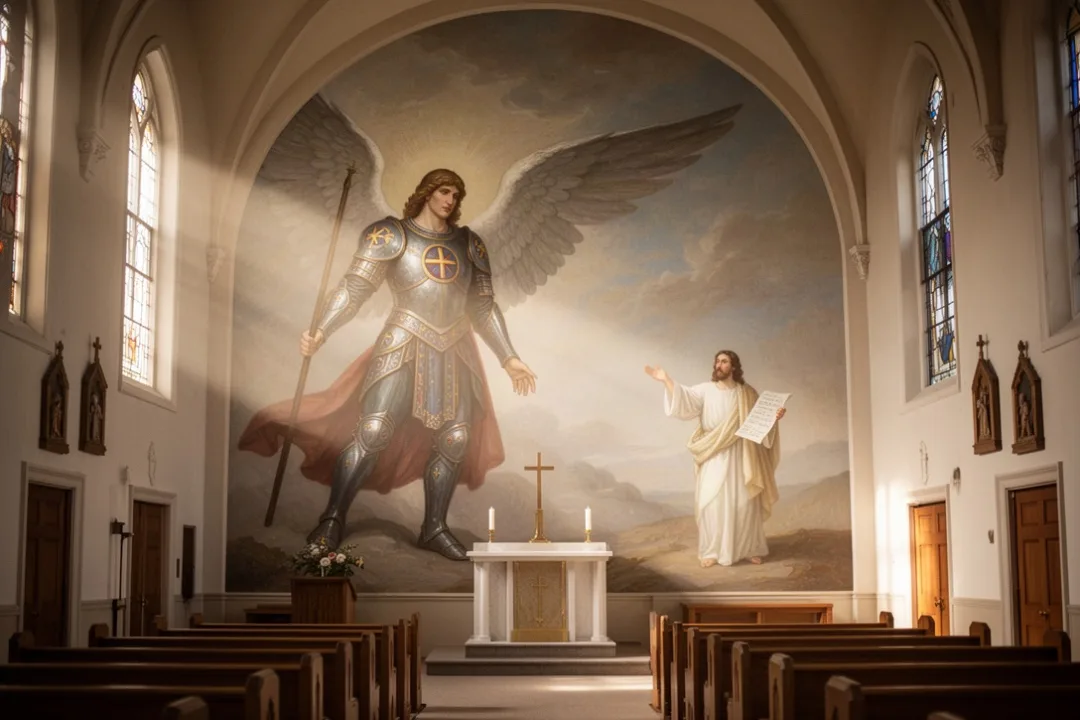
Popular images often show Michael with armor and a sword or Gabriel with wings and a lily. These symbols can communicate aspects of their traditional roles, but the biblical passages do not provide a complete physical description of either one. Revelation’s symbolic imagery should also be read as apocalyptic vision rather than as a simple portrait.
Angels are not replacements for God
Michael and Gabriel serve God; they do not compete with him. The biblical narratives repeatedly direct attention to God’s authority, God’s promises, and God’s saving work. Respect for angels should not become worship, superstition, or reliance on invented information.
What Michael and Gabriel can teach about spiritual service
The contrast between these angels offers a broad lesson about service. Michael’s work shows that faithful service may involve resistance, courage, protection, and standing firm when evil threatens. Gabriel’s work shows that service may involve speaking clearly, explaining difficult truth, and carrying a message that changes a person’s life.
Neither role is portrayed as self-promotion. Michael does not claim glory during his dispute with the devil, and Gabriel does not make Mary’s announcement about himself. Both direct attention to God and his purposes.
Michael’s example: Stand under God’s authority rather than relying on personal power.
Gabriel’s example: Communicate truth faithfully rather than reshaping it to gain approval.
Both examples: Treat spiritual authority as a responsibility, not as a reason for pride.
The shared focus: Point people toward God instead of drawing worship toward a created being.
How to study passages about Michael and Gabriel carefully
When you encounter a claim about either angel, begin with the actual biblical reference. Read the surrounding chapter, identify who is speaking, and ask whether the passage describes a specific event or makes a general statement about angelic activity.
A careful study can follow these steps:
Collect the references: Read Daniel 8, Daniel 9, Daniel 10, Daniel 12, Jude 9, Revelation 12, Luke 1, and First Thessalonians 4:16.
Separate description from interpretation: Mark what the text explicitly says before consulting later teaching or artwork.
Compare repeated roles: Notice Michael’s association with conflict and protection, and Gabriel’s association with messages and explanation.
Check the speaker’s authority: Observe how both angels act as servants of God rather than independent powers.
Identify tradition: If a claim comes from a later writing, denomination, or religious culture, label it accordingly.
Keep Christ and God central: In Christian reading, angelic activity serves the larger story of God’s revelation and redemption.
This method helps prevent two opposite mistakes: dismissing every tradition without examining its roots, or accepting every popular claim as if it were stated in Scripture. Michael and Gabriel are significant precisely because the biblical references are focused and purposeful.
What the biblical distinction means for readers today
For a reader seeking a simple answer, Michael represents God’s protection and victory over spiritual opposition, while Gabriel represents God’s message and the explanation of his purposes. Michael is especially connected with defending God’s people; Gabriel is especially connected with announcing events that advance God’s plan.
The two figures also encourage a balanced view of spiritual life. Protection matters, but so does truth. Courage in conflict matters, but so does humility. A person can admire the biblical roles associated with Michael and Gabriel without adding unsupported details about their powers or treating them as objects of worship.
The strongest common thread is not competition between two famous angels. It is their shared submission to God. Michael’s defense and Gabriel’s announcements both serve a purpose larger than the angels themselves: directing attention to the God who rules, reveals, protects, and fulfills his promises.
Frequently asked questions
Are Michael and Gabriel brothers?
No biblical passage describes Michael and Gabriel as brothers or as members of an angelic family. They are both named angels who serve God, but Scripture does not explain their personal relationship. Their frequent pairing comes from later Christian teaching, art, and devotion, as well as their importance in biblical narratives, not from a recorded family connection.
Which angel is more powerful, Michael or Gabriel?
The Bible does not provide a power ranking between Michael and Gabriel. Michael is shown leading heavenly forces and defending God’s people, while Gabriel is shown delivering and explaining major messages. Those different assignments do not establish that one is stronger. Both act with authority received from God, and neither is presented as independent of God’s will.
Did Michael and Gabriel appear together in the Bible?
No, the Bible does not record a scene in which Michael and Gabriel appear together. Michael is named in Daniel, Jude, and Revelation, while Gabriel is named in Daniel and Luke. Their roles are often compared because both are prominent named angels, but Scripture does not describe them working as a regular team.
Should Christians pray to Michael or Gabriel?
Christian traditions differ on asking angels for intercession, but all should distinguish angels from God. Many Christians direct prayer to God alone and may ask God for protection or guidance without addressing an angel. Others in historic traditions may use prayers that ask Michael or Gabriel to intercede. Whatever the practice, angels are servants, not replacements for God or objects of worship.















Leave a Reply