St. Michael the Archangel is most commonly known as the patron of soldiers, police officers, and people who defend others. He is also associated with firefighters, paramedics, sailors, paratroopers, and groups seeking protection from spiritual or physical danger.
His patronage comes from his biblical role as a powerful defender of God’s people. Different churches, countries, military units, and professional organizations recognize St. Michael in somewhat different ways, so there is no single universal list. The central idea remains consistent: Michael represents courage, protection, justice, and faithful service.
Why St. Michael is connected with protection and defense
The name Michael comes from a Hebrew expression meaning “Who is like God?” In Christian tradition, that question challenges pride and reminds believers that no created power is equal to God. Michael’s role is not to replace God’s authority, but to serve under it as a defender against evil.
The Bible presents Michael as an important heavenly figure in several passages. Daniel describes him as a great prince who stands with God’s people, Jude refers to him as an archangel, and Revelation portrays Michael leading the heavenly forces against the dragon. These passages help explain why Christians connect him with spiritual warfare and protection.
Because soldiers, police officers, firefighters, and emergency workers often place themselves between danger and vulnerable people, St. Michael became a natural patron for them. His image communicates a duty to protect without glorifying violence: strength should serve justice, restraint, and the common good.
The short answer: St. Michael is chiefly the patron of those who defend and protect others, especially soldiers and police officers. His patronage can also extend to firefighters, emergency responders, sailors, paratroopers, and people seeking spiritual protection.
Who is St. Michael the Archangel?
St. Michael is one of the few angels named in the Bible and the only one explicitly called an archangel in the New Testament. Christian tradition generally understands an archangel as a high-ranking angel with a special mission, although different denominations explain angelic ranks in different ways.
Michael is not described as a human saint who lived on earth. He is an angelic servant of God, honored by Christians because of his faithfulness and his defense of God’s people. The title “Saint” is used in many Christian traditions as a mark of holiness, even though Michael belongs to the heavenly order of angels.
His biblical appearances are brief, but they are significant. In Daniel, Michael is associated with the protection of Israel. In Jude, he disputes with the devil while remaining under God’s authority. In Revelation, he battles the dragon, a symbol of Satan and opposition to God.
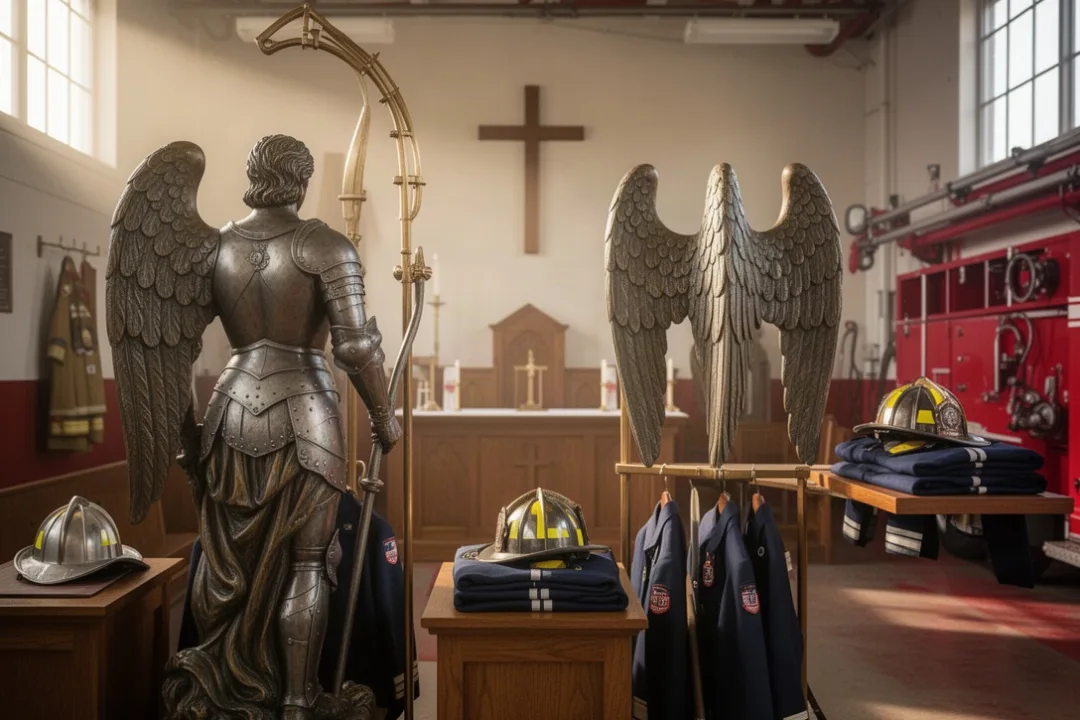
These stories shaped centuries of Christian art and prayer. Artists often show Michael wearing armor, holding a sword or spear, and standing over a defeated dragon. The image is symbolic: the armor represents readiness, the weapon represents truth and justice, and the defeated dragon represents evil that will not have the final victory.
St. Michael’s main patronages by role
People usually search for St. Michael’s patronage because they want to know whether he is connected with a particular occupation, vocation, or danger. The following list covers the most widely recognized associations.
Soldiers and members of the armed forces: Military personnel look to Michael as a defender and guardian in dangerous service.
Police officers and law enforcement: His association with justice and protection makes him a patron for those responsible for public safety.
Firefighters: Fire service organizations often honor Michael because firefighters confront danger to rescue and protect others.
Paramedics and emergency responders: His protective role has made him meaningful to people who respond during crises and medical emergencies.
Sailors and mariners: Maritime communities have traditionally sought Michael’s protection during hazardous travel and uncertain conditions.
Paratroopers and airborne troops: Some military units honor him because of his connection with courage, danger, and protection.
Security personnel and guards: Anyone entrusted with protecting people, property, or a community may find a natural connection with Michael.
People facing spiritual struggle: Christians also ask for his intercession when confronting temptation, fear, oppression, or the influence of evil.
These patronages do not mean that every Christian denomination or organization formally names Michael as its official patron. Some are rooted in longstanding tradition, while others developed through local devotion, military custom, or the dedication of a church or institution.
St. Michael as the patron of soldiers
St. Michael’s association with soldiers is probably his best-known professional patronage. A soldier’s work can involve danger, discipline, sacrifice, and responsibility for the lives of others. Those themes closely match the traditional image of Michael as a courageous defender who acts for a higher purpose.
Military devotion to Michael does not require viewing war as automatically holy or violence as automatically justified. His example can instead point to moral responsibility in the use of power. A soldier who honors Michael may be reminded to protect civilians, follow lawful orders, show restraint, and preserve human dignity even under extreme pressure.
Military units may place his image in chapels, carry a medal associated with him, or observe his feast day. Individual service members may pray for courage before deployment, protection for those in danger, strength for families, or peace after traumatic experiences.
Michael is also meaningful to veterans. His patronage can express gratitude for service while acknowledging the physical and emotional burdens that service may leave behind. For some veterans, devotion to Michael centers less on combat and more on healing, moral clarity, and the protection of fellow service members.
St. Michael as the patron of police officers
Police officers are commonly connected with St. Michael because their work involves defending people, responding to threats, and upholding public order. In this setting, Michael symbolizes the difficult balance between authority and compassion.
A police officer who looks to Michael may understand that protection involves more than physical bravery. It also requires honesty, patience, sound judgment, respect for the law, and care for people who are frightened or vulnerable. The patronage can therefore serve as a reminder that authority exists to protect the community rather than to elevate the individual who holds it.
Police chaplains, departments, and fraternal organizations may honor Michael through a badge, medal, statue, prayer service, or memorial. These practices vary widely. Some departments have a formal connection with him, while others simply regard him as a respected spiritual figure for officers and their families.
For families of police officers, Michael may represent a prayer for safe returns and protection during unpredictable calls. For officers who have witnessed violence or loss, his symbolism can also support grief, resilience, and the search for justice.
St. Michael as the patron of firefighters and emergency workers
Firefighters often identify with Michael because they enter danger while others are trying to escape it. Flames, collapsing structures, hazardous materials, and vehicle crashes all require courage, training, and disciplined teamwork. Michael’s traditional role as a defender naturally resonates with that calling.
Fire service devotion commonly emphasizes protection of life rather than the dramatic appearance of the angel with a sword. The central question is not whether a firefighter is fearless, but whether the person can act responsibly despite fear. That distinction makes Michael a useful symbol for courage grounded in duty.
Paramedics, emergency medical technicians, dispatchers, and search-and-rescue workers may also feel connected to him. Their work is often less visible than a rescue at a fire, but it demands the same readiness to move toward suffering and uncertainty.
People may ask Michael’s intercession for an emergency worker who is injured, exhausted, or struggling after a difficult call. They may also pray for families who wait at home, knowing that a routine shift can change suddenly. In this context, Michael represents steadiness under pressure and care for those who serve.
St. Michael’s connection with sailors and travelers
Before modern communication and navigation systems, long-distance sea travel carried severe risks. Storms, shipwrecks, illness, isolation, and unfamiliar waters made protection a constant concern. Christian sailors therefore developed devotions to several saints, including St. Michael.
Michael’s connection with sailors is not as universal as his association with soldiers, but it appears in maritime communities and local traditions. He may be honored as a guardian during voyages, a protector from sudden danger, or a symbol of safe passage through uncertain conditions.
The same principle can apply to other travelers. A person beginning a difficult journey may ask for safe travel, clear judgment, and protection from harm. This does not treat prayer as a guarantee that nothing difficult will happen. Instead, it expresses trust, acknowledges vulnerability, and asks for strength to respond wisely.
What St. Michael’s sword and armor symbolize
Images of St. Michael often make his patronage easy to recognize. He may appear with armor, wings, a sword, a shield, or a dragon beneath his feet. Each feature reflects a particular aspect of his traditional role.
Armor suggests readiness, discipline, and protection against spiritual danger.
The sword symbolizes decisive resistance to evil, falsehood, and injustice.
The shield represents defense and the protection of people who are vulnerable.
The dragon represents Satan, sin, chaos, or forces opposed to God.
The wings identify Michael as an angel and point to his heavenly mission.
His position above the dragon expresses the Christian belief that evil will ultimately be overcome.
These symbols should not be read as encouragement to seek conflict. They describe a spiritual struggle in which the goal is faithfulness rather than domination. The strongest version of Michael’s symbolism is not uncontrolled force; it is disciplined power placed at the service of truth and protection.
In Daniel, Michael is presented as a powerful heavenly prince who stands with God’s people during a time of distress. The passage connects him with protection and perseverance, which helps explain why believers turn to him during danger or persecution.
Daniel does not present Michael as an independent deity or as a replacement for God. His strength is received and directed by God. That distinction remains central to Christian devotion: believers ask for Michael’s intercession while ultimately placing their trust in God.
Michael in the Letter of Jude
The Letter of Jude calls Michael an archangel and describes a dispute with the devil. The scene emphasizes that Michael does not rely on personal arrogance. Instead, he appeals to the authority of the Lord.
This detail gives Michael’s patronage a moral dimension. A defender should not become proud because of power or position. The passage encourages humility, restraint, and dependence on God, especially when confronting evil.
Michael in the Book of Revelation
Revelation portrays Michael and his angels fighting the dragon, which represents Satan and opposition to God. The scene is dramatic, but its deeper message concerns the conflict between good and evil and the assurance that evil will not prevail forever.
For people facing fear, injustice, or spiritual temptation, this imagery can provide hope. Michael becomes a sign that evil can be resisted and that faithful service has meaning even when the outcome is not immediately visible.
A useful distinction: Christians do not worship St. Michael. In traditions that ask for his help, they honor him as God’s servant and ask for his intercession, while worship belongs to God alone.
How to ask St. Michael for help
A person does not need a special object, location, or formal ceremony to pray for Michael’s intercession. A simple prayer can name the danger, ask for protection, and place the situation in God’s care. People may pray for themselves, someone serving in a dangerous profession, or a community facing violence or fear.
You can approach this devotion in a practical way:
Name the situation honestly. Mention fear, danger, temptation, grief, conflict, or uncertainty without trying to make the problem sound smaller than it is.
Ask God for protection and wisdom. Christian prayer is not only a request for safety; it also asks for sound judgment and the strength to do what is right.
Ask St. Michael’s intercession. You may address him as a faithful servant and defender who prays with the people of God.
Include the people affected. Pray for families, victims, first responders, leaders, and anyone making difficult decisions.
Take responsible action. Prayer should accompany practical safety measures, medical care, legal help, counseling, or emergency assistance when those are needed.
Some Christians use a traditional prayer to St. Michael, while others speak in their own words. Both approaches can be meaningful. A written prayer offers familiar language and a connection with generations of worshipers; personal words can express details that a standard text does not include.
When is St. Michael’s feast day?
In the Roman Catholic Church, St. Michael is celebrated with St. Gabriel and St. Raphael on September 29. The day is commonly known as the Feast of the Archangels or the Feast of Saints Michael, Gabriel, and Raphael. Some Christian communities observe Michael on a different date or give him a separate commemoration.
The feast provides an opportunity to pray for people who protect others, including military members, police officers, firefighters, emergency medical workers, and caregivers. Churches may hold a special service, bless a statue or image, remember deceased members of a profession, or invite a local organization to participate.
For a household, the day could be observed through a short prayer, a reading of one of the biblical passages about Michael, or a conversation about courage used responsibly. The observance does not need to be elaborate to be sincere.
St. Michael medals, statues, and other devotional items
Many people wear a St. Michael medal or keep an image of him in a home, vehicle, workplace, church, or station. These items are usually intended as reminders of faith and protection, not as magical objects that guarantee safety.
A medal may remind a police officer to act with integrity, a soldier to remember moral responsibility, or a family to pray for someone in danger. A statue in a fire station may honor fallen colleagues and encourage the living to serve with courage. The meaning depends on the person and community using it.
If a medal or statue is blessed, the blessing dedicates the object to a religious purpose. It does not turn the object into a charm. The most important part of the devotion remains the person’s relationship with God and the actions that follow from faith.
How St. Michael differs from other patron saints
St. Michael is sometimes compared with saints who protect particular professions or causes. St. Florian, for example, is widely associated with firefighters in some Christian traditions, while St. George is connected with soldiers and military groups in many places. Local customs can assign overlapping patronages.
Michael’s distinctive role is his identity as an archangel and heavenly defender. A human saint may be honored because of a life of service, martyrdom, or connection with a profession. Michael is honored because Scripture and Christian tradition portray him as a heavenly leader who opposes evil and protects God’s people.
Overlapping patronages are not necessarily a contradiction. A firefighter might honor St. Florian because of the profession’s history and St. Michael because of his broader role as a defender. A soldier might turn to a national patron, a personal patron saint, and Michael for different aspects of service.
What St. Michael’s patronage means today
St. Michael’s relevance does not depend only on military or emergency professions. Anyone responsible for protecting another person may recognize something in his example. Parents, guardians, teachers, health care workers, advocates, social workers, and people who stand up to abuse all face moments when courage must be joined with wisdom.
His patronage also speaks to inner struggles. A person dealing with addiction, resentment, fear, despair, or destructive habits may use Michael as a symbol of resistance. The aim is not to imagine personal problems as a battle against other people, but to seek honesty, support, self-control, and freedom from what causes harm.
For communities, Michael can represent the obligation to protect those who are most vulnerable. That includes preventing violence, caring for victims, supporting emergency workers, and holding people in authority accountable. A devotion centered on Michael is strongest when it produces responsible courage rather than aggression.
If you are looking for a patron for a specific occupation, start by checking the tradition of your church, professional organization, military branch, or local community. Patronage can be formal or informal, and the most meaningful connection may be the one that helps you serve others with greater integrity.
Frequently asked questions
Is St. Michael the patron saint of the military?
Yes, St. Michael is widely honored as a patron of soldiers and military personnel. The exact form of that patronage differs among countries, branches, and religious communities. He is generally associated with defense, courage, discipline, and protection rather than with any particular political cause. Military members may ask for his intercession before deployment, during danger, or while recovering from service-related trauma.
Is St. Michael the patron saint of police officers?
St. Michael is commonly recognized as a patron of police officers and law enforcement personnel. His traditional connection with justice and defense makes him a fitting spiritual protector for people who safeguard communities. Devotion to him can also remind officers that authority should be exercised with restraint, honesty, compassion, and respect for the dignity of every person.
Why do firefighters honor St. Michael?
Firefighters honor St. Michael because he symbolizes a defender who moves toward danger to protect others. His armor and shield can represent readiness, while his victory over evil represents hope under extreme conditions. St. Michael is not the only saint associated with firefighting, and local customs vary, but his role as a courageous protector makes him especially meaningful to fire service communities.
Can anyone pray to St. Michael for protection?
Yes. In Christian traditions that practice intercessory prayer, anyone may ask St. Michael to pray for protection, courage, wisdom, or strength. The request may concern physical danger, spiritual temptation, a difficult profession, or fear within a family. Prayer does not replace emergency services, medical care, counseling, or other practical help when those forms of support are needed.










Leave a Reply