Apostle Matthias: the disciple chosen to replace Judas
Apostle Matthias: the disciple chosen to replace Judas
Apostle Matthias was the disciple chosen to replace Judas Iscariot after Judas died. According to Acts 1, Matthias had followed Jesus from his baptism through the ascension, and the gathered believers selected him by prayer and casting lots.
Matthias appears by name only in Acts 1:15–26, but that brief account gives the central facts: he was a long-term follower of Jesus, one of two qualified candidates, and the man counted with the Eleven as an apostle. Later traditions describe his ministry and death, but those details are not confirmed by the New Testament.
Judas Iscariot had been one of the Twelve disciples but betrayed Jesus and later died. Before Pentecost, the believers in Jerusalem faced an incomplete apostolic group. Peter explained that another disciple needed to join the remaining apostles as a witness to Jesus’ ministry and resurrection.
The decision was not presented as a search for a prominent teacher or political leader. The candidate needed to have been present throughout Jesus’ public ministry, beginning with John’s baptism and continuing until Jesus was taken up into heaven. That requirement emphasized firsthand witness rather than reputation, wealth, education, or personal influence.
Two men met the stated qualification: Joseph called Barsabbas, also known as Justus, and Matthias. The believers prayed for God to reveal which man had been chosen, then cast lots. The lot fell to Matthias, and he was added to the Eleven apostles.
The essential answer: Matthias was not selected because the Bible records a separate miracle or speech by him. He was selected because he had accompanied Jesus’ followers from the beginning and could testify as a witness to the resurrection.
What Acts 1 says about Matthias
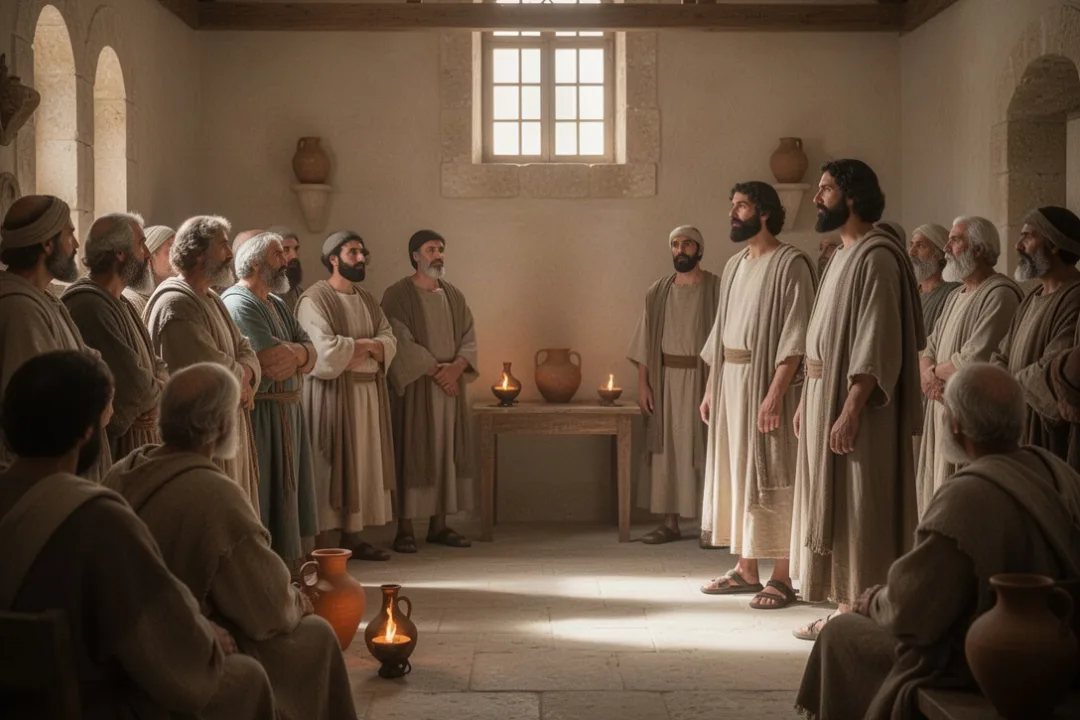
Acts 1 places the selection in Jerusalem after Jesus’ ascension and before the outpouring of the Holy Spirit at Pentecost. About 120 believers were gathered, and Peter addressed them as the group considered Judas’s place among the apostles.
Peter connected the vacancy to the biblical need for the apostolic group to continue. The believers then set out the qualifications, naming two men who had been with the disciples throughout Jesus’ ministry. After prayer, they cast lots, and Matthias was numbered with the Eleven.
The passage gives readers several details about Matthias’s identity and role:
He was already a committed disciple before the selection.
He had accompanied Jesus’ followers from the baptism of John to the ascension.
He was qualified to serve as a witness to the resurrection.
He was considered alongside Joseph Barsabbas, not treated as an outsider.
He became part of the group known as the Twelve after the lot was cast.
Acts does not record a speech from Matthias, a letter written by him, or a detailed account of his later missionary work. That silence should not be mistaken for evidence that he was unimportant. The passage presents his appointment as a legitimate act of the early church, even though the narrative later focuses on figures such as Peter, John, Stephen, Philip, and Paul.
What “apostle” means in Matthias’s case
The word apostle refers broadly to someone sent with authority, but the New Testament uses the term in more than one way. In Acts 1, the specific group in view is the Twelve: the close circle appointed to bear witness to Jesus and represent the restored people of God.
Matthias’s appointment therefore had a particular significance. The believers were not simply adding another church worker. They were restoring the number of the Twelve after Judas’s betrayal and death. Jesus had spoken of the Twelve in connection with the future renewal of Israel, as recorded in Matthew 19:28 and Luke 22:30. Acts presents the replacement as part of that continuing apostolic identity.
His role also shows that being an apostle in this setting involved more than being present at one meeting or hearing a single teaching. The stated qualification required sustained association with Jesus’ ministry. The new apostle needed to be able to testify about the events that formed the foundation of Christian preaching.
That does not mean every later use of “apostle” has exactly the same meaning. Paul called himself an apostle even though his encounter with the risen Christ came after Jesus’ earthly ministry. Barnabas is also associated with the title in Acts. The biblical accounts show that the term can describe different forms of being sent, while Acts 1 gives a specific standard for filling Judas’s place among the Twelve.
Why the apostles prayed and cast lots
The process in Acts 1 combines human responsibility with dependence on God. The disciples identified the biblical and practical qualifications, named suitable candidates, prayed, and then cast lots. The method was not portrayed as a game of chance or a substitute for discernment. They asked God to show which candidate had been chosen.
Lots appear in several parts of the Old Testament as a way of making decisions under God’s providence. The practice was also familiar in Jewish life. In Acts 1, the believers used it during a unique transition: Jesus had ascended, the Spirit had not yet come at Pentecost, and the community was restoring the group of Twelve.
Modern Christians often ask whether churches should copy this method. Acts 1 describes what the first believers did in this particular situation; it does not issue a universal command that every leadership decision must be settled by lots. Churches today usually use prayer, Scripture, character assessment, wise counsel, and community discernment.
The most important feature of the episode is not the mechanics of the lot. It is the community’s recognition that God knows the heart and that the apostolic mission belongs to God. Their prayer asked the Lord to make the right choice clear, rather than treating the decision as a contest between two personalities.
How Matthias differed from Joseph Barsabbas
Joseph Barsabbas, also called Justus, was not presented as unfaithful or unqualified. He was one of only two men considered suitable for the role. The text simply says that the lot fell to Matthias.
That detail gives the account a useful perspective on Christian service. A person may be genuinely qualified, faithful, and respected without being selected for a particular assignment. Joseph’s nonselection does not imply moral failure, and Matthias’s selection does not imply that he was more talented or more loved.
The passage also prevents readers from reducing ministry to visibility. Neither candidate had a prominent public profile in the surviving New Testament narrative. Their qualification rested on faithful presence and firsthand knowledge of Jesus’ ministry. The account values long-term discipleship even when the wider audience may not know a person’s name.
Matthias’s selection should therefore be read with humility. It was not a promotion based on self-promotion. It was a responsibility entrusted to a disciple whose years of following Jesus had prepared him to bear witness.
What the New Testament does not tell us about Matthias
After Acts 1, Matthias is not named again in the New Testament. The Bible does not tell us where he preached, which churches he visited, whether he wrote any documents, or how long he served among the apostles.
This lack of information limits what can be stated confidently. It is reasonable to say that Matthias became one of the Twelve and shared the apostolic witness of the early church. It is not reasonable to present a detailed itinerary or a definite account of his death as though Acts recorded it.
Several passages mention “the apostles” collectively after Matthias’s appointment, but they do not provide a personal biography of him. Later references to apostolic activity may include him, yet the text does not identify his individual actions. Careful study keeps the direct biblical evidence separate from later tradition.
The silence can also encourage a healthier understanding of faithful work. The New Testament records Matthias’s appointment but not a list of his accomplishments. His significance rests first on his calling and witness, not on the amount of surviving information about him.
What Christian tradition says about Matthias
Early Christian writers and later church traditions preserve accounts about Matthias, but they do not agree on every detail. Some traditions associate him with ministry in Judea, while others place his work in regions farther from Jerusalem. Accounts of his death also differ.
Some sources describe Matthias as dying by stoning and then being beheaded; others describe crucifixion or another form of execution. These traditions may reflect separate local memories, later developments, or confusion with another Christian figure. Because the New Testament does not settle the question, claims about the exact location and manner of his death should be labeled as traditional rather than certain.
Church calendars also do not share one universal date for commemorating Matthias. Different Christian communities observe his feast on different days. The variation reflects distinct liturgical traditions, not necessarily a disagreement about the central biblical account.
Tradition can still be valuable when handled carefully. It shows that Christians in different places remembered Matthias as a missionary and martyr. At the same time, tradition is not the same as Scripture, and a responsible account should not turn uncertain details into established facts.
Common mistakes when studying the apostle Matthias
Matthias’s brief appearance has led to several recurring misunderstandings. Keeping the biblical details and later traditions separate helps avoid them.
Confusing Matthias with Matthew: Matthias is the apostle chosen in Acts 1. Matthew is the tax collector and disciple named in the lists of the Twelve. Their names may sound similar in English, but they are different people.
Calling Matthias a replacement for Paul: Acts presents Matthias as the one chosen to take Judas’s place among the Twelve. Paul’s apostleship is described separately and does not make Matthias unnecessary.
Assuming the Bible gives his full biography: Acts 1 records his selection, not his entire ministry. Later details come from tradition and vary in reliability.
Treating the lot as ordinary gambling: The decision followed prayer and was made in a sacred communal setting. The passage describes reliance on God’s direction, not entertainment or personal profit.
Assuming Joseph Barsabbas was rejected for wrongdoing: Acts gives no such reason. He was one of the two qualified candidates.
Claiming that Matthias was unknown before Acts 1: The passage says he had accompanied Jesus’ followers throughout the ministry. He was not a random newcomer.
Ignoring the resurrection-witness requirement: His firsthand continuity with Jesus’ ministry was central to the stated qualification.
Study tip: Read Acts 1:12–26 first, then compare later traditions separately. Mark each statement as biblical evidence, a reasonable inference, or a traditional claim before using it in teaching or discussion.
What Matthias teaches about Christian leadership
The account emphasizes faithful preparation before public recognition. Matthias had apparently been following Jesus for a long period before his name became prominent in the story. His appointment did not create his discipleship; it revealed that his previous faithfulness had made him a suitable witness.
His story also highlights the value of continuity. The apostles needed someone who had seen the ministry of Jesus from its beginning through the ascension. Christian leadership is not only about communication skills or organizational ability. For this role, a person’s steady presence and direct knowledge mattered deeply.
The selection process involved the whole believing community, not only one individual acting privately. The group listened to Peter’s explanation, identified candidates, prayed, and participated in the decision. That pattern suggests that important leadership choices should receive careful communal attention rather than being driven by impulse.
Matthias also illustrates that service can be important even when the record is short. Many faithful people never become the main subject of a biblical book, a church history, or a public biography. Their work can still strengthen the community and preserve the message entrusted to them.
The best starting point is Acts 1:12–26, which contains the only direct account of his appointment. Read the surrounding chapters as well: Acts 1 explains the period between the ascension and Pentecost, while Acts 2 shows the Spirit empowering the gathered disciples.
Several cross-references help clarify the setting. The lists of the Twelve appear in Matthew 10, Mark 3, and Luke 6. Judas’s betrayal and death are described in the Gospels and discussed in Acts 1. Jesus’ teaching about the Twelve and their future role appears in Matthew 19:28 and Luke 22:30.
When reading, ask focused questions rather than trying to fill every silence:
What qualifications did Peter identify?
What does the passage say about Matthias directly?
Why was firsthand continuity with Jesus’ ministry important?
How did prayer shape the decision?
What does the text say about Joseph Barsabbas, and what does it leave unsaid?
Which later claims come from tradition rather than the New Testament?
It also helps to compare translations for terms such as “witness,” “numbered,” and “cast lots,” while remembering that no translation removes the central point. Matthias was chosen as a qualified witness and joined the apostolic group through a prayerful decision.
Why Matthias still matters to readers today
Matthias matters because his story connects private discipleship with public responsibility. He had been present and faithful before receiving a formal role. When the community needed a replacement, his prior commitment became the foundation for his service.
His account also protects readers from judging significance by how much information survives about someone. The New Testament gives Matthias only a few verses, yet those verses identify him as a genuine apostle. A brief record does not mean a minor calling.
Finally, Matthias represents the early church’s conviction that the mission of Jesus would continue after the ascension. The apostles were commissioned to bear witness, and the community took care to restore the group that would carry that witness forward. His selection is therefore both a personal calling and a sign of the church’s continuity.
Frequently asked questions
Was Matthias one of the original twelve disciples?
Matthias was not named in the Gospel lists of the original Twelve, but Acts 1 says he had followed Jesus’ ministry from John’s baptism through the ascension. After Judas Iscariot’s death, Matthias was chosen to join the remaining Eleven. In that sense, he became one of the Twelve after Jesus’ earthly ministry.
Is Matthias the same person as Matthew?
No. Matthias and Matthew are different people. Matthew was the tax collector who became one of Jesus’ named disciples in the Gospel accounts. Matthias was chosen in Acts 1 to replace Judas. Similar English names can cause confusion, but the biblical narratives distinguish them clearly.
Did Matthias write a book of the Bible?
No New Testament book is attributed to Matthias. Some later writings have been associated with his name, but their authorship and historical reliability are uncertain. The Bible’s direct account of Matthias focuses on his qualifications, selection, and addition to the apostolic group rather than on any writing ministry.
How did the apostle Matthias die?
The New Testament does not record Matthias’s death. Later Christian traditions give conflicting accounts, including different locations and methods of execution. Some describe stoning, while others mention crucifixion or another death. These reports may preserve old memories, but none can be confirmed with certainty from Scripture.











Leave a Reply