Philip the apostle: What the Bible tells us about him
Philip the apostle: What the Bible tells us about him
Philip the apostle was one of Jesus’ Twelve disciples, and the Gospel of John presents him as a direct, thoughtful witness who helped others meet Jesus.
He appears by name in all four New Testament lists of the apostles, although the fullest accounts of his words and actions come from John’s Gospel. Philip is not the same person as Philip the evangelist, a prominent figure in the book of Acts. Keeping those two men distinct helps make the biblical record clearer.
Who Philip the apostle was according to the New Testament
Philip came from Bethsaida, the Galilean town associated with Peter and Andrew, according to John 1:44. His name is Greek, which may reflect the cultural setting of Galilee, but the New Testament does not explain his family background, occupation, age, or education.
The Gospels identify Philip as one of Jesus’ chosen Twelve. Matthew 10:2–4, Mark 3:16–19, and Luke 6:13–16 include him in their lists, while Acts 1:13 names him among the apostles gathered in Jerusalem after Jesus’ ascension. In the lists, Philip appears after the leading groups of Peter, James, John, and Andrew, but the order does not establish a ranking.
Philip’s biblical profile is concentrated in a handful of scenes. These include his calling, his conversation with Nathanael, Jesus’ testing question before the feeding of the five thousand, the request from Greek visitors, and his exchange with Jesus at the Last Supper. Together, these moments show a disciple who responded to Jesus faithfully while still needing his understanding deepened.
Useful distinction: Philip the apostle belongs to the Twelve who followed Jesus during his earthly ministry. Philip the evangelist appears in Acts 6–8 and is described as one of the seven appointed to serve the Jerusalem church. The Bible does not identify them as the same man.
How Jesus called Philip to follow him
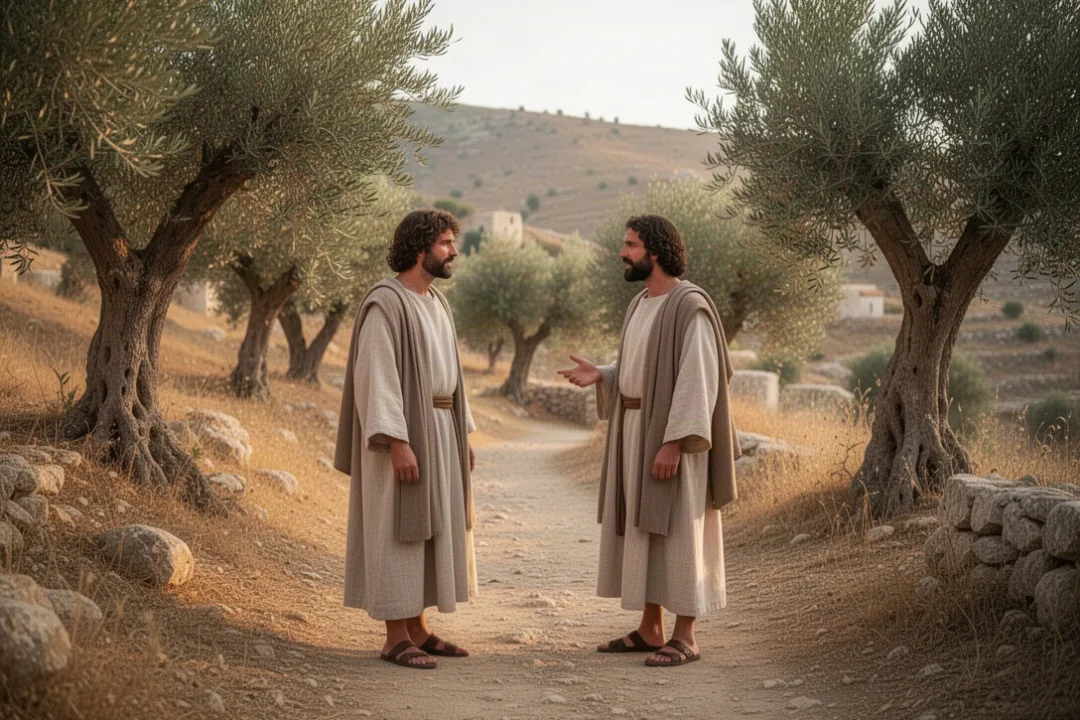
The clearest account of Philip’s calling is found in John 1:43–51. After Jesus decided to go to Galilee, he found Philip and told him to follow. The wording is brief, but the scene places Philip among the earliest disciples gathered around Jesus.
Philip then found Nathanael and told him that he had found the one Moses and the prophets wrote about: Jesus, the son of Joseph from Nazareth. Philip’s description draws on Israel’s Scriptures and shows that he understood Jesus in relation to the long-awaited hope of God’s people.
Nathanael responded with skepticism, asking whether anything good could come from Nazareth. Philip did not argue at length or try to win him through speculation. Instead, he gave a simple invitation: come and see. John’s account does not quote the invitation as a theological explanation; it presents it as Philip’s practical answer to doubt.
That exchange reveals an important feature of Philip’s witness. He was willing to speak about what he had found, but he also allowed Nathanael to encounter Jesus directly. His role was not to replace personal faith with a clever argument. He pointed another person toward Christ.
What Philip’s meeting with Nathanael shows
Philip’s conversation with Nathanael is sometimes treated as a minor episode, yet it gives the New Testament’s most recognizable picture of Philip. He is quick to share news about Jesus, familiar enough with Scripture to identify the hope being fulfilled, and patient enough to answer a doubtful response without hostility.
The passage also shows that Philip’s understanding was still developing. He described Jesus using language connected with Joseph and Nazareth, while the Gospel later presents Jesus’ identity in much greater depth. Philip had real insight, but he did not yet possess a complete understanding of who Jesus was.
Nathanael eventually made a strong confession about Jesus after speaking with him. John 1:49 records Nathanael’s response, but the passage does not say that Philip gave Nathanael every answer beforehand. Philip’s contribution was the invitation that brought Nathanael into that encounter.
What Philip did before the feeding of the five thousand
Philip’s next substantial appearance comes in John 6:1–15, shortly before Jesus feeds a large crowd. Jesus saw the crowd approaching and asked Philip where bread could be bought for the people. John explains that Jesus was testing Philip, because Jesus already knew what he intended to do.
Philip answered by calculating the cost. He said that even a large amount of bread would not provide enough for each person to receive a small portion. His response was practical and understandable. He looked at the number of people and the available resources, then concluded that the need exceeded what the disciples could supply.
Andrew then mentioned a boy with five barley loaves and two fish, while also pointing out how inadequate those provisions seemed for such a crowd. Jesus took the food, gave thanks, and distributed it. The miracle demonstrated that Jesus was not limited by the disciples’ calculations or by the apparent size of the available resources.
Philip’s role in this scene is not that of a faithless opponent. Jesus’ question exposed the limits of Philip’s perspective and prepared the setting for a sign. The disciple assessed the problem correctly from a human point of view, but he did not yet grasp what Jesus was about to do.
Why Philip’s question matters for reading the story
The Gospel of John often uses conversations to reveal a difference between ordinary human understanding and the deeper reality Jesus brings. Philip thought in terms of money, bread, and crowd size. Those details mattered, but they did not exhaust the situation because Jesus was present and acting.
This does not mean practical thinking is wrong. The disciples still had to gather the leftover pieces, and the Gospel records that twelve baskets were filled. Philip’s example suggests a more balanced lesson: careful assessment can identify a real need, but it should not become an assumption that God cannot provide beyond human capacity.
Philip noticed the scale of the need. He recognized that ordinary purchasing could not meet it.
His answer focused on available resources. He did not yet connect the problem with Jesus’ authority.
Jesus used the situation to teach the disciples. The question was part of their formation, not merely a request for information.
The sign redirected attention to Jesus. The final meaning was greater than the quantity of food.
What Philip did when Greek visitors sought Jesus
Philip appears again in John 12:20–22, when some Greeks came to Jerusalem for the Passover and wanted to see Jesus. They approached Philip, perhaps because of his Greek name, his connection with Bethsaida, or some other relationship that the text does not explain.
Philip told Andrew, and together they told Jesus. The passage does not record Philip personally bringing the visitors into a conversation with Jesus. It does show him acting as a point of contact: he received their request and brought it to another trusted disciple before the matter reached Jesus.
This brief episode occurs as Jesus speaks about his approaching death and glorification. The arrival of Gentile seekers anticipates the wider reach of Jesus’ mission, but the Gospel does not say that Philip understood all of that significance at the time.
Philip’s action here resembles his earlier interaction with Nathanael. In both cases, he helps connect people with Jesus. With Nathanael, he gave a direct invitation. With the Greek visitors, he carried their request to Andrew and then to Jesus. His ministry included bringing questions and seekers into the presence of Christ.
What Philip asked Jesus at the Last Supper
Philip’s most theologically significant words appear in John 14:8–11. During the Last Supper, Jesus had been teaching the disciples about his relationship with the Father and about the way to the Father. Philip replied by asking Jesus to show them the Father, saying that this would be enough for them.
Jesus answered that anyone who had seen him had seen the Father. He directed the disciples to trust the relationship between the Father and the Son, and to consider his words and works as evidence of that unity. The passage does not mean that Jesus and the Father are the same person; it presents Jesus as the unique revelation of the Father.
Philip’s request is sincere, but it also exposes a gap in his understanding. He wanted a further revelation, perhaps something immediate and unmistakable. Jesus explained that the disciples had already encountered the Father’s self-revelation through Jesus’ presence, teaching, and works.
How Philip’s question relates to the Gospel of John
John’s Gospel frequently presents a physical request that points toward a spiritual reality. People ask about bread, water, birth, a temple, or sight, while Jesus speaks about eternal life and divine revelation. Philip’s request follows this pattern: he asks to see the Father, while Jesus teaches that the Father is made known through the Son.
Philip should not be reduced to a negative example. His question gives Jesus an opportunity to state a central Christian belief: Jesus reveals the Father. The disciple’s uncertainty becomes part of the Gospel’s instruction for every later reader.
The exchange also shows that faithful disciples may ask questions that reveal incomplete understanding. Philip had walked with Jesus and witnessed his works, yet he still needed clarification. The New Testament does not hide that limitation. Instead, it shows Jesus responding by teaching rather than dismissing him.
Where Philip appears in the lists of the apostles
The apostle lists provide the basic framework for Philip’s place among the Twelve. Matthew, Mark, and Luke each list the apostles in a slightly different order, while Acts gives the names of the disciples present in Jerusalem after Jesus’ ascension. Philip is included in all four passages.
These lists also help distinguish Philip from other figures with similar names. The Twelve included Philip and Bartholomew, while Matthew and Mark also name James son of Alphaeus, Thaddaeus, Simon the Zealot, and Judas Iscariot. Luke uses the name Judas son of James for the disciple Matthew and Mark call Thaddaeus.
The Gospel of John never uses the name Bartholomew in its narrative, and the Synoptic Gospels never describe Philip and Nathanael together. For that reason, some Christians have suggested that Nathanael may be Bartholomew, but the New Testament does not explicitly state that identification. It should be presented as a possibility, not a certainty.
Philip the apostle and Philip the evangelist are different biblical figures
Acts 6:1–6 describes seven men chosen to help address a practical problem in the Jerusalem church. One of them was Philip. Later, Acts 8 presents him preaching in Samaria, explaining Scripture to an Ethiopian official, and continuing his ministry in coastal towns. Acts 21:8 calls him Philip the evangelist and identifies him as one of the seven.
The New Testament does not call this Philip one of the Twelve. The apostle Philip, by contrast, is identified as one of Jesus’ Twelve and appears in the apostolic lists. Because both men are named Philip, later readers can easily combine their stories, but the biblical descriptions support treating them as separate people.
Philip the evangelist had four unmarried daughters who prophesied, according to Acts 21:9. That detail belongs to the evangelist’s household, not to the apostle’s biography. Nothing in the New Testament supplies equivalent family information about Philip the apostle.
Reading tip: When a passage in Acts describes preaching in Samaria, meeting the Ethiopian official, or hosting Paul in Caesarea, it is referring to Philip the evangelist, not to the apostle Philip named in the Twelve.
What later Christian tradition says about Philip
The New Testament gives no detailed account of Philip’s later ministry, death, or burial. Later Christian writers and traditions associate him with missionary work in different regions and describe his death in different ways. Because these accounts are not consistent, they should be distinguished from the information provided directly by Scripture.
Some traditions connect Philip with Phrygia in Asia Minor, including Hierapolis. Ancient Christian sources also preserve accounts of martyrdom, but the details vary. Some versions describe crucifixion, while others include different forms of execution or burial. The evidence does not allow every traditional detail to be stated with confidence.
Churches that honor Philip may observe a feast day or preserve local traditions about his relics and ministry. Those practices can be historically and devotionally significant, but they are not the same kind of evidence as the Gospel accounts. A careful study should label them as later tradition rather than as established New Testament facts.
Practical ways to study Philip without common mistakes
Philip has a small biblical profile, so readers can learn more by comparing every relevant passage rather than relying on a single story. The following approach keeps the evidence clear and prevents details from one Philip being transferred to the other.
Read John 1:43–51 first. Notice the calling, Philip’s words to Nathanael, and the invitation to come and see.
Compare the apostle lists. Check Matthew 10:2–4, Mark 3:16–19, Luke 6:13–16, and Acts 1:13.
Study John 6:1–15. Ask what Philip sees in the feeding situation and what Jesus’ question reveals.
Read John 12:20–36. Observe how Philip responds when Greek visitors ask to see Jesus.
Read John 13–14 carefully. Philip’s question about seeing the Father belongs within Jesus’ teaching at the Last Supper.
Separate Acts 6–8 and 21 from the apostle’s story. Those passages describe Philip the evangelist, one of the seven.
Label later traditions accurately. Use phrases such as “later tradition holds” when discussing Philip’s mission or death beyond the New Testament.
Several common mistakes are easy to avoid:
Do not call Philip one of the Seventy. The New Testament names him among the Twelve. It does not place him in the separate group sent out in Luke 10.
Do not assume Nathanael is definitely Bartholomew. The connection is possible, but Scripture does not directly make it.
Do not assign Acts 8 to the apostle. The text identifies the preacher there as Philip the evangelist.
Do not treat every tradition as biography. The biblical record about Philip is limited, and later accounts differ.
Do not describe Philip as simply unbelieving. His questions show incomplete understanding, but he also followed Jesus and helped others approach him.
What Philip’s example can teach Christian readers
Philip’s story offers a grounded picture of discipleship. He did not begin with complete theological understanding, yet he responded to Jesus’ call and shared what he had learned. His first recorded instinct was to bring Nathanael to Jesus rather than keep the discovery to himself.
His questions also show that honest uncertainty can exist within committed faith. At the feeding, Philip focused on the practical impossibility of feeding the crowd. At the Last Supper, he asked for a clearer vision of the Father. In both cases, Jesus used Philip’s limited perspective as an opening for deeper instruction.
Philip also demonstrates the value of connecting people with Jesus in different ways. He invited Nathanael personally, listened to the Greek visitors, and brought their request to Andrew. Not every act of service looks like public preaching. Sometimes it involves answering a question, introducing a person to a trusted community, or directing attention to Christ.
The Gospel of John does not present Philip as a flawless hero or a failed disciple. It presents a real apostle: responsive, inquisitive, practical, and still growing. His recorded life points beyond his own personality to the identity of Jesus, who calls disciples, provides where they cannot, welcomes seekers, and makes the Father known.
Where to find every major New Testament reference to Philip
A short set of passages provides most of the reliable information about the apostle. Reading them in sequence makes his role easier to remember:
John 1:43–51: Jesus calls Philip, and Philip brings Nathanael to meet him.
Matthew 10:2–4: Philip appears in Jesus’ list of the Twelve.
Mark 3:16–19: Philip is named among the apostles appointed by Jesus.
Luke 6:13–16: Philip appears in Luke’s list of the Twelve.
John 6:1–15: Jesus tests Philip before feeding the large crowd.
John 12:20–22: Philip receives the request of Greek visitors who want to see Jesus.
John 14:1–11: Philip asks Jesus to show the disciples the Father.
Acts 1:13: Philip is named among the apostles gathered after Jesus’ ascension.
These references establish what can be said with confidence: Philip was a Galilean from Bethsaida, one of the Twelve, an early follower of Jesus, a person who brought others toward him, and a disciple whose questions became part of the Gospel’s teaching. Beyond those details, caution is appropriate.
Frequently asked questions
Was Philip the apostle one of the original twelve disciples?
Yes. Philip was one of the Twelve chosen by Jesus during his earthly ministry. He is named in the apostle lists in Matthew, Mark, Luke, and Acts. The New Testament also records several personal interactions involving him, especially in John’s Gospel, including his calling and his conversation with Jesus at the Last Supper.
Is Philip the apostle the same person as Philip in the book of Acts?
The biblical evidence indicates that they were different men. Philip the apostle belonged to the Twelve. Philip in Acts was one of the seven chosen to serve the Jerusalem church and is later called an evangelist. Acts describes his preaching ministry, but it does not identify him as one of the apostles.
What did Philip say to Nathanael?
Philip told Nathanael that he had found the person connected with Moses and the prophets, Jesus from Nazareth. When Nathanael questioned whether anything good could come from Nazareth, Philip answered with an invitation to meet Jesus personally. John 1:43–51 records the exchange and its outcome.
How did Philip die?
The New Testament does not describe Philip’s death. Later Christian traditions associate him with missionary work and martyrdom, often connecting him with Hierapolis in Phrygia, but the accounts differ about the circumstances. Those details should therefore be identified as tradition rather than as established biblical information.














Leave a Reply