St. Thomas the Apostle: His life, doubt, and legacy
St. Thomas the Apostle: His life, doubt, and legacy
St. Thomas the Apostle was one of the Twelve disciples of Jesus and is best known for asking to see physical evidence of the resurrection. The Gospel of John presents him not simply as a skeptic, but as a loyal and honest disciple whose encounter with the risen Christ led him to confess Jesus as “my Lord and my God”.
Thomas appears several times in the New Testament, especially in John’s Gospel. Later Christian tradition connects him with missionary work in India, where communities known as Thomas Christians have preserved his memory for centuries.
Thomas was one of the Twelve Apostles chosen by Jesus. The lists of the apostles in Matthew, Mark, and Luke include his name, while John’s Gospel gives him a more developed personality through several conversations and actions.
John identifies him by two names: Thomas and Didymus. Both names carry the meaning “twin,” although the New Testament does not tell us who his twin was. The name may have been a personal name in one language and a translation or equivalent in another.
The Bible gives no clear information about Thomas’s occupation, hometown, family, age, or appearance. Some later traditions supply additional details, but they are not equally reliable. The most secure knowledge about him comes from the Gospel accounts that place him alongside Jesus during the years of public ministry.
Thomas was not one of the three apostles who appear most often in the Gospels, such as Peter, James, and John. Even so, his brief appearances reveal a disciple who was serious, candid, and willing to act. His questions often expose what the other disciples may also have been thinking.
What Thomas did during Jesus’ ministry
Thomas’s first substantial appearance comes in the account of Lazarus’s death. Jesus told the disciples that he intended to return to Judea, even though religious leaders there had recently threatened him. The disciples were concerned about the danger.
According to John 11, Thomas responded by saying that the disciples should go with Jesus and be prepared to die with him. His statement has a sober edge, but it also shows devotion and courage. Thomas understood that following Jesus might carry real danger, and he was willing to face it rather than remain safely away.
Thomas appears again during Jesus’ teaching at the Last Supper. Jesus spoke about going to prepare a place for his followers and said that they knew the way to where he was going. Thomas answered that the disciples did not know where Jesus was going, so they could not know the way.
Jesus responded with the well-known teaching recorded in John 14. The point of the exchange is not that Thomas was foolish. His question gave Jesus an opportunity to explain that access to the Father is connected to Jesus’ person and mission, not merely to a map or set of instructions.
These scenes show why reducing Thomas to the label “doubting” misses much of his character. He asks direct questions when the meaning of Jesus’ words is unclear. He also shows a readiness to stand with Jesus when the situation becomes dangerous.
Why Thomas doubted the resurrection
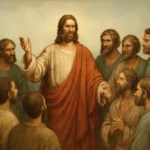
After Jesus’ crucifixion, the other disciples told Thomas that they had seen the risen Lord. Thomas was not present when Jesus first appeared to the gathered disciples, as described in John 20. He said that he would not accept their testimony unless he could see and touch the wounds left by the crucifixion.
His response was unusually specific. Thomas was not merely asking for a general sign that Jesus was alive; he wanted evidence that the risen Jesus was the same Jesus who had been crucified. His concern focused on the continuity between death and resurrection.
The Gospel does not say that Thomas rejected Jesus permanently or abandoned the community. It records a moment of resistance after an overwhelming tragedy. Thomas had seen Jesus die, and the other disciples’ report sounded impossible from a human point of view.
When Jesus appeared again, he addressed Thomas’s concerns directly. John 20 describes Jesus inviting him to examine the wounds. The passage does not record Thomas actually touching them. Instead, Thomas responds with a confession of faith and recognition: Jesus is his Lord and his God.
John 20:28 records Thomas recognizing the risen Jesus as both Lord and God.
Jesus then spoke about those who would believe without seeing him in the same physical way. This statement does not necessarily condemn every desire for evidence or every honest question. It speaks to later believers who would receive the Christian message through apostolic testimony rather than through a personal encounter like Thomas’s.
Important distinction: Thomas’s doubt is not the final description of his faith. In the Gospel of John, his questioning leads to one of the clearest confessions of Jesus’ divine identity.
What the story of “Doubting Thomas” actually teaches
The phrase “Doubting Thomas” is common, but it can create a misleading picture. Thomas was not the only disciple who struggled to believe the resurrection. The Gospel accounts describe uncertainty and confusion among the disciples more broadly.
Thomas’s story teaches that honest questions can exist alongside commitment. He had followed Jesus before the resurrection, spoken openly during difficult moments, and remained connected to the disciples after hearing their report. His doubt occurred within a relationship, not as a casual dismissal of everything Jesus had taught.
The account also emphasizes the physical reality of the resurrection. Jesus does not appear as a vague spirit or a symbol detached from his crucified body. The wounds remain part of his identity. For Christian belief, this matters because resurrection means that God raises the person who truly suffered and died.
Thomas’s confession also has a major theological significance. The Gospel of John begins by describing the Word as divine and ends this section with Thomas addressing the risen Jesus in divine terms. His words reinforce the Gospel’s claim about who Jesus is.
For readers who struggle with faith, Thomas offers a more balanced example than either blind confidence or permanent disbelief. He shows the value of bringing difficult questions into the community and allowing testimony, reflection, and encounter to reshape one’s understanding.
Thomas and the other resurrection appearances
The resurrection appearances are reported in several New Testament writings, with different details and emphases. John gives particular attention to Mary Magdalene, the gathered disciples, and Thomas. The other Gospels describe additional appearances and conversations.
In John’s account, Thomas becomes a representative of those who were not present at the first appearance to the disciples. His experience helps address a question faced by later Christians: how can someone believe in the risen Christ without having seen him directly?
The answer offered by the New Testament includes the witness of the apostles, the proclamation of the church, and faith in God’s action through Jesus. Thomas’s story stands at the meeting point between firsthand testimony and the faith of later generations.
The passage does not encourage believers to invent certainty where they have none. Instead, it presents a testimony that takes questions seriously while inviting trust. Thomas receives the evidence he asked for, and his response is not merely intellectual agreement but personal worship.
What happened to Thomas after the New Testament accounts
The New Testament does not provide a complete biography of Thomas after the resurrection. It names him among the disciples in Acts 1, where the apostles are gathered in Jerusalem after Jesus’ ascension. Beyond that, the biblical record becomes silent about his later travels and death.
Several early Christian writings and later traditions claim that Thomas traveled east as a missionary. The most influential tradition connects him with the Malabar Coast of southwestern India. Christians in Kerala and other parts of India have long identified themselves with Thomas’s mission.
These communities are often called Thomas Christians or Saint Thomas Christians. Their history includes several church traditions and periods of contact with churches from the Middle East and Europe. They do not all share exactly the same customs, liturgical traditions, or historical interpretations.
The traditional date of Thomas’s arrival in India is often placed in the first century, but historians discuss the evidence and the development of the tradition. Ancient trade routes between the Roman world and India make travel possible, yet possibility alone does not prove every detail of the later accounts.
A careful description separates what is firmly recorded in Scripture from what is preserved by church tradition. The Bible clearly presents Thomas as an apostle and witness to the risen Jesus. His Indian mission is an important and deeply rooted Christian tradition, though specific details should be described with appropriate care.
The Acts of Thomas and its limits as a historical source
The Acts of Thomas is an early Christian work associated with the apostle. It tells dramatic stories about his missionary activity, teachings, miracles, conflicts, and martyrdom. It is not part of the New Testament and is not treated as Scripture by most Christian traditions.
The work can still help readers understand how some Christians remembered Thomas and imagined the spread of the faith eastward. It belongs to the broad collection of early Christian literature that developed around apostolic figures.
Its stories should not be read in exactly the same way as the Gospel accounts. The Acts of Thomas contains theological themes, literary features, and legendary material. It may preserve older traditions, but scholars cannot automatically treat every scene as a verified event.
Later tradition says that Thomas was martyred near present-day Chennai, often associated with St. Thomas Mount and San Thome Basilica. These places are significant pilgrimage sites for many Christians. The precise historical details of his death remain less certain than the New Testament’s account of his role among the apostles.
Why Thomas matters to Indian Christian communities
For Thomas Christians, the apostle is more than a character in a biblical story. He represents an ancient Christian identity rooted in the belief that the gospel reached India through an apostolic missionary. This tradition shapes worship, family history, church customs, and local heritage.
Churches connected with St. Thomas can be found in Kerala and other parts of India, as well as among Indian Christian communities around the world. Their traditions may include Syriac-influenced liturgy, distinctive feast days, and historical memories that differ from those of Western churches.
St. Thomas also serves as a link between Christianity in India and the earliest Christian world. The tradition reflects the reality that Christianity spread through networks extending beyond the Roman Empire, including trade routes and communities connected to the Middle East.
Visitors to sites associated with Thomas should approach them as both religious and historical places. Local communities preserve the meaning of these sites through prayer, festivals, architecture, and oral tradition. The value of a pilgrimage does not depend on pretending that every historical question has been settled.
How different churches honor St. Thomas
Many Christian churches commemorate Thomas with a feast day. In Western Christianity, his feast is commonly observed on July 3. Some churches and calendars have used other dates or commemorations, particularly where local traditions follow different liturgical systems.
Thomas is often portrayed holding a square or builder’s rule, a spear, or a book. The builder’s tool connects with traditions about his work as a builder or architect, while the spear recalls the traditional account of his martyrdom. These symbols belong to Christian art and tradition rather than to explicit biblical descriptions.
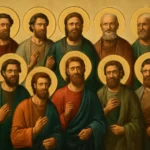
Artists also portray Thomas touching or examining Christ’s wounds. This image comes from John 20 and emphasizes the moment when doubt gives way to recognition. Other depictions show him among the apostles or traveling as a missionary.
Churches dedicated to Thomas appear in many countries. They can be especially significant in India, the Middle East, and communities formed by migration. The name “St. Thomas” may refer to the apostle himself, a church building, a school, a hospital, or a local parish under his patronage.
The passages about Thomas are short, but they reward careful reading. Instead of treating the story as a simple lesson about believing or doubting, pay attention to the setting, the words spoken, and the changes in Thomas’s understanding.
Read John 11:1–16 to see Thomas respond to the danger of returning to Judea.
Read John 14:1–7 to understand his direct question about Jesus’ destination and the way to the Father.
Read John 20:24–29 to follow the encounter with the risen Jesus and Thomas’s confession.
Compare the apostle lists in Matthew 10, Mark 3, Luke 6, and Acts 1.
Separate biblical statements from later tradition when researching Thomas’s travels, martyrdom, or occupation.
A useful reading practice is to ask what the passage says about Thomas before asking what it says about you. This prevents the character from becoming a symbol detached from the story. Thomas is a real disciple in the narrative, facing danger, confusion, grief, testimony, and renewed faith.
Common mistakes when researching St. Thomas
Calling him an unbeliever: Thomas was an apostle who followed Jesus and later made a strong confession of faith.
Assuming he touched the wounds: John records Jesus inviting him to do so, but it does not explicitly say that Thomas accepted the invitation physically.
Treating every tradition as biblical fact: The Bible does not describe all of Thomas’s later travels or his death.
Ignoring his courage: His statement in John 11 shows a willingness to face danger with Jesus.
Using “doubting” as an insult: The Gospel portrays his questions as part of a movement toward recognition.
Assuming all Thomas Christian communities are identical: They include different ecclesial traditions, histories, and practices.
Research tip: When a source describes Thomas’s mission in India, check whether it is citing Scripture, an early Christian text, a church tradition, or modern historical research. Those categories answer different questions.
What St. Thomas can teach about questions and faith
Thomas’s story is especially meaningful for people who want faith to engage with reality rather than avoid difficult evidence. He did not pretend that the crucifixion had not happened, and he did not accept a remarkable claim simply because it was comforting. His demand was connected to the wounds of Jesus.
At the same time, Thomas remained open to being corrected. Once he encountered the risen Christ, he did not cling to his earlier conclusion. His example combines intellectual honesty with the humility to change one’s mind.
The story also challenges communities to respond patiently to sincere questions. The other disciples had already received an appearance, but Thomas had not. Jesus did not treat his absence from the first gathering as proof that he could never believe.
For Christians, Thomas points toward a faith grounded in testimony about a historical person who suffered, died, and was proclaimed risen. For readers approaching the story from outside the faith, he provides a compelling portrait of a disciple who wrestled with an extraordinary claim rather than accepting an easy answer.
Where to find St. Thomas in the Bible
Thomas is named in each of the four New Testament lists of the apostles. These references establish his place among the Twelve but provide little personal detail. John’s Gospel supplies the main narrative material about him.
Matthew 10:2–4: Thomas appears in the list of the Twelve.
Mark 3:16–19: Thomas is named among Jesus’ chosen apostles.
Luke 6:13–16: Thomas appears in Luke’s list of the Twelve.
John 11:1–16: Thomas responds to Jesus’ decision to return to Judea.
John 14:1–7: Thomas asks how the disciples can know the way.
John 20:24–29: Thomas encounters the risen Jesus and makes his confession.
Acts 1:12–14: Thomas is listed among the disciples gathered after Jesus’ ascension.
These passages present a consistent outline: Thomas belonged to Jesus’ inner circle of apostles, struggled to accept the resurrection report he initially heard, and became a witness to the risen Christ. Later traditions add a broader missionary story, especially in connection with India.
Frequently asked questions
Was St. Thomas really the apostle who doubted Jesus’ resurrection?
Yes. John 20 identifies Thomas as the disciple who initially said he needed to see the marks of crucifixion before believing the other disciples’ report. The same passage shows that his doubt did not remain his final position. After Jesus appeared to him, Thomas recognized him and made a profound confession of faith.
Did St. Thomas travel to India?
Christian tradition strongly connects Thomas with India, particularly Kerala and the Malabar Coast. Thomas Christian communities preserve this apostolic memory, and ancient trade routes made such travel possible. However, the New Testament does not describe the journey, and historians distinguish between longstanding church tradition and details that can be independently established.
What is St. Thomas the patron saint of?
Thomas is commonly associated with architects, builders, surveyors, and people facing doubt or uncertainty. The connection with builders comes from traditions about his work and missionary activity, while the association with doubt comes from John’s resurrection account. Patronage can vary among denominations and local communities.
When is St. Thomas’s feast day?
Many Western Christian calendars observe the feast of St. Thomas the Apostle on July 3. Other churches may use different liturgical calendars or commemorative dates. Local customs can also shape how the feast is celebrated, especially in Indian communities with longstanding traditions connected to the apostle.











Leave a Reply