When someone asks, “Who was the first pope?” the short answer is Saint Peter. Catholic tradition identifies Peter, one of Jesus’ twelve apostles, as the first pope because Jesus entrusted him with a distinctive leadership role among the disciples and because Peter became a central leader of the early Church.
The fuller answer needs some historical context. Peter did not hold a papal office that looked exactly like the modern papacy, complete with the title, administrative structure, and worldwide jurisdiction familiar today. Those features developed over many centuries. Still, the Catholic Church regards Peter as the first Bishop of Rome and the first in the line of popes.
Peter was a Galilean fisherman who became one of Jesus’ closest disciples. The New Testament presents him as a prominent member of the apostolic group, often speaking on behalf of the others and taking part in several of the most significant events in Jesus’ ministry.
After Jesus’ death and resurrection, Peter appears as an important public leader of the first Christian communities. He preached in Jerusalem, helped guide the apostles, and played a major role in the Church’s movement beyond its original Jewish setting. Later Christian tradition connects Peter with Rome, where he is believed to have been martyred during the persecution of Christians under the Roman emperor Nero.
The Catholic understanding of Peter’s office rests especially on several passages in the New Testament:
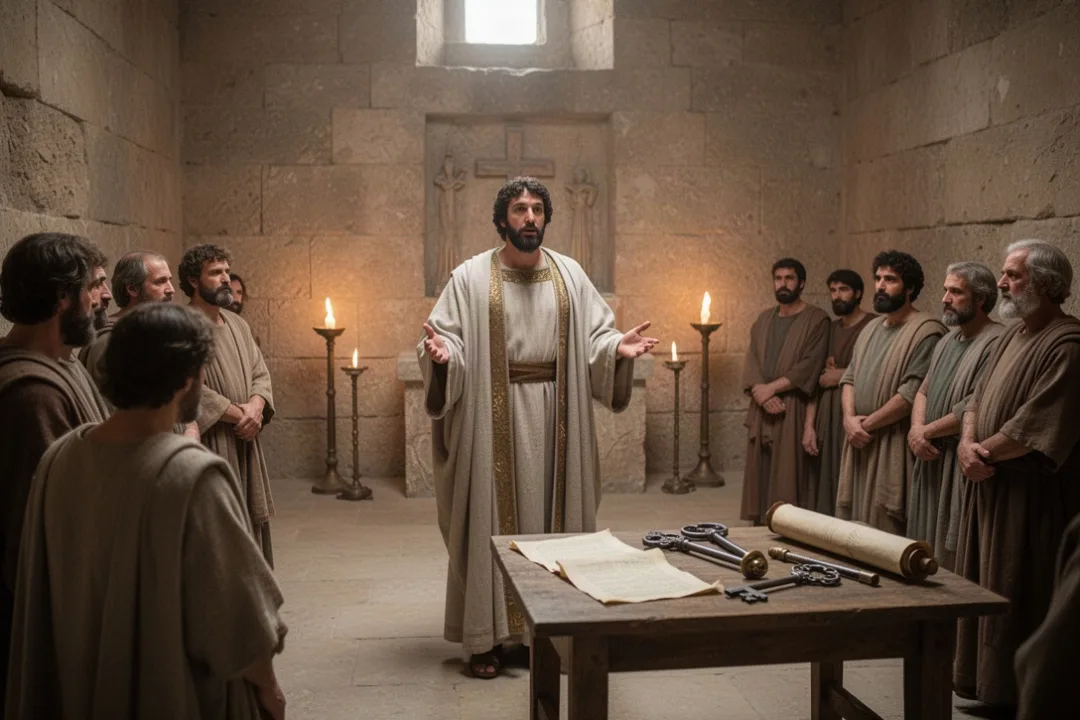
Matthew 16:13–20: Jesus gives Simon the name Peter and describes him as a rock associated with the building of the Church. The passage also refers to the “keys” of the kingdom and to the authority to bind and loose.
Luke 22:31–32: Jesus tells Peter to strengthen the other disciples after a period of testing.
John 21:15–19: The risen Jesus tells Peter to care for his followers, using the image of tending sheep.
Catholics interpret these passages together as evidence that Peter received a special responsibility to serve and strengthen the Church. They also believe that this responsibility continued through Peter’s successors in Rome, which is the basis for the papal succession.
Short answer: Saint Peter is traditionally considered the first pope because he was regarded as the first Bishop of Rome and the apostle entrusted with a special pastoral role among the disciples.
What “pope” meant in the early Christian period
The word pope comes from a term meaning “father.” In early Christianity, similar forms of this title could be used for respected bishops in different places. The word was not immediately an exclusive title for the bishop of Rome.
The early Church was organized around local communities led by bishops, assisted by priests and deacons. Bishops in major cities often had greater influence because of their location, the size of their Christian community, or the importance of their connection with the apostles. Rome gradually became especially prominent because it was the capital of the Roman Empire and because Christians believed that Peter and the apostle Paul had both preached and died there.
Peter’s role and the later office of the pope should therefore be distinguished carefully:
Peter was an apostle personally chosen by Jesus and a witness to the earliest events of Christianity.
The bishop of Rome was the local overseer of the Christian community in Rome.
The pope as universal pastor reflects a later understanding of the Roman bishop’s authority and relationship to Christians around the world.
These three descriptions overlap in Catholic tradition, but they are not identical in historical form. Peter’s leadership belongs to the first generation of Christianity, while the papacy as an established institution took shape over time.
How Peter became connected with Rome
The New Testament does not provide a complete biography of Peter’s travels or give a detailed account of his final years. It does, however, preserve evidence that Peter was a major leader in the Church’s earliest period. Later Christian writings and traditions strongly associate him with Rome.
By the late first and early second centuries, Christian memory connected Peter and Paul with the Roman Church. Both apostles were honored as martyrs, although they may have died in different ways. Peter is traditionally said to have been crucified, while Paul is associated with execution by beheading, a form of death sometimes connected with his Roman citizenship.
The belief that Peter was buried in Rome became central to the city’s Christian identity. Excavations beneath Saint Peter’s Basilica have revealed an ancient burial area and a tomb associated with Peter. The evidence has been studied extensively, but the precise identification of ancient remains involves historical and archaeological interpretation rather than a simple modern-style proof.
For Catholics, the connection is not based only on archaeology. It also rests on the continuous tradition of the Roman Church, the testimony of early Christian writers, and the belief that Peter’s special ministry continued through the bishops who followed him in Rome.
How the early Church chose and recognized its leaders
Peter did not receive his position through a modern election by cardinals. The first Christian communities recognized leaders through a combination of apostolic appointment, local community acceptance, spiritual reputation, and relationships with other churches.
After the apostles died, bishops became the principal leaders of local Christian communities. A bishop was normally understood to hold responsibility for teaching, worship, pastoral care, and preserving the faith received from the apostles. In Rome, the bishop’s connection with Peter and Paul gradually became a central part of his authority.
A simplified account of the development looks like this:
Jesus formed a community of disciples and gave the apostles a mission to teach and serve.
Peter and the other apostles led the earliest Christian communities after Jesus’ resurrection.
Local bishops emerged as stable leaders after the first generation of apostles passed away.
The Roman bishop gained increasing prominence because Rome was an important city and because Peter and Paul were linked to its Christian community.
The idea of apostolic succession developed, connecting later bishops with the teaching and ministry of the apostles.
The papacy took a more defined institutional form as the Roman bishop’s authority, responsibilities, and relationship with other churches developed.
This process explains why historians generally avoid describing Peter’s role as identical to that of a modern pope. The tradition identifies him as the first pope in a foundational sense, while the institution itself developed gradually rather than appearing fully formed at the beginning.
What the Catholic Church means by apostolic succession
Apostolic succession is the belief that the Church’s bishops continue the ministry entrusted by Christ to the apostles. In Catholic teaching, this succession is not merely a list of names. It includes the preservation of Christian teaching, sacramental ministry, and pastoral responsibility.
For the pope, apostolic succession has a specific Roman dimension. Catholics believe that the bishop of Rome succeeds Peter in the service of the universal Church. The pope is not considered a new apostle with a separate revelation. Instead, his role is understood as a continuation of Peter’s pastoral responsibility within the Church.
This distinction matters because the Catholic view of the papacy does not claim that every pope has Peter’s personality, personal holiness, or individual gifts. Popes have differed greatly in character and ability. The claim concerns the office and its service to the Church, not the automatic perfection of every person who occupies it.
Other Christian traditions accept some form of apostolic succession but do not necessarily accept the Catholic understanding of papal authority. Eastern Orthodox, Oriental Orthodox, Anglican, and other churches have their own views about bishops, councils, and the role of the Roman bishop. The question of Peter’s historical importance is therefore shared more broadly than the question of papal supremacy.
How the Roman bishop’s authority grew
The authority of the bishop of Rome expanded through several overlapping factors. Rome was the empire’s central city, and its Christian community was connected with two highly respected apostles, Peter and Paul. Roman bishops also became involved in disputes that affected churches beyond their immediate region.
Early Christian writers sometimes appealed to the Roman Church as a source of reliable teaching or as a respected point of reference. One frequently discussed example is a letter traditionally associated with Clement, the bishop of Rome, sent to the church in Corinth near the end of the first century. The letter addresses conflict in Corinth and shows that the Roman community was already willing to speak into a dispute outside its own city.
That evidence should not be overstated. Early Christians did not all describe Roman authority in the same way, and the relationship between Rome and other major churches changed over time. Bishops in Alexandria, Antioch, Constantinople, Jerusalem, and other centers also held significant influence.
Over the centuries, the Roman bishop’s role came to be described in increasingly universal terms. The development was shaped by theology, church councils, political circumstances, disputes over doctrine, relationships among patriarchates, and the practical need for recognized leadership. The modern papacy is the result of this long historical development built on the earlier memory of Peter.
Peter’s leadership in the New Testament
Peter’s prominence appears in several different ways in the New Testament. He is often named first among the apostles, although the order of names alone does not establish every later claim about his authority. He speaks during important moments, acts as a representative of the disciples, and is included in the smaller group present at particularly significant events.
Peter also has a deeply human story. The Gospel accounts describe his confidence, confusion, courage, and failure. He declares loyalty to Jesus but later denies knowing him during Jesus’ arrest. After the resurrection, the Gospel of John describes a personal restoration in which Peter is asked to care for Jesus’ followers.
That pattern is significant in Christian interpretation. Peter’s authority is not presented as a reward for flawless behavior. His ministry is connected with repentance, service, and dependence on Christ. Catholics therefore understand the pope’s office as a call to pastoral care rather than as a declaration that the pope is personally without error or weakness.
Peter’s significance comes from the responsibility entrusted to him and the service he was called to give, not from a claim that he was personally perfect.
Was Peter the first pope according to all Christians?
No. The answer depends on the Christian tradition being considered. The Roman Catholic Church officially identifies Peter as the first pope and teaches that the pope continues Peter’s ministry as Bishop of Rome.
Many Eastern Orthodox Christians honor Peter as a leading apostle and recognize the historical importance of Rome, but they generally do not accept the Catholic claim that the pope has universal jurisdiction over all Christians. Orthodox theology traditionally gives greater emphasis to the authority of bishops acting together in councils and to the distinct responsibilities of ancient Christian sees.
Many Protestant churches respect Peter’s role in the New Testament but reject the idea that a continuing papal office was established by Jesus. Some Protestant interpretations regard Peter as a leading apostle without treating him as the first pope. Others argue that the New Testament does not present a permanent office with the powers later associated with the papacy.
These differences do not erase the historical importance of Peter. They show that the question combines several issues:
What role did Peter have among the apostles?
Did Peter serve as the first Bishop of Rome?
Did Jesus establish a continuing office based in Rome?
What authority should later bishops of Rome possess?
The first two questions concern early Christian history. The third and fourth also involve theology and the interpretation of Church tradition.
How Peter differs from later popes
Peter lived during the apostolic age, when the Christian movement was still developing and its communities were spread across the eastern Mediterranean and beyond. Later popes operated within a more formal structure that included established dioceses, church law, official diplomatic relationships, and defined procedures for selecting a pope.
The contrast is especially clear in the way leaders were recognized. Peter was called by Jesus and commissioned within the circle of the apostles. Modern popes are elected by the College of Cardinals through a process governed by Church law. The modern pope also lives and works within institutions that developed long after Peter’s lifetime.
There are also differences in titles and responsibilities. Peter did not use the title “pope” in the later exclusive sense, did not preside over a global administrative system, and did not issue documents in the formats associated with modern papal teaching. His importance comes from his place at the foundation of the Church and from the Roman succession attributed to him.
At the same time, Catholics see continuity between Peter and later popes in several areas:
Teaching: preserving and explaining the faith received from the apostles.
Pastoral care: serving the unity and spiritual welfare of Christians.
Church leadership: helping guide the wider Christian community.
Connection with Rome: maintaining the ministry associated with Peter’s Roman service and martyrdom.
What historians can and cannot establish about Peter
Historians can study Peter through the New Testament, early Christian writings, archaeological discoveries, and the traditions preserved by churches. These sources support the view that Peter was a major leader of the earliest Christian movement and that he became strongly connected with Rome in Christian memory.
Some details remain uncertain. The surviving sources do not provide a complete timeline of Peter’s movements, the exact date of his arrival in Rome, or a full account of his years there. Early Christian testimony is valuable but was written in different settings and for different purposes.
Historical analysis also distinguishes between what a source says directly and what later communities inferred from it. For example, a source may show that Peter was respected as a leader without describing the later papal office. The belief that Peter was the first pope includes a theological interpretation of that leadership and its continuation.
For a careful answer: history can establish Peter’s central place among the apostles and his strong association with Rome; Catholic theology interprets that connection as the beginning of the papal office.
In Catholic lists of popes, Peter appears first and is followed by the bishops of Rome who are understood to have succeeded him. The early part of that list can be difficult to reconstruct because records from the first Christian centuries are incomplete, and different ancient sources sometimes preserve different details.
Tradition commonly identifies early Roman leaders after Peter, including Linus, Anacletus or Cletus, and Clement. Their exact order and dates have been discussed by historians because ancient evidence is limited and later lists do not always agree on every point.
This uncertainty does not change Peter’s place in Catholic tradition. It does show why early papal history should not be treated like a complete modern administrative record. The papal succession is a historical tradition supported by multiple kinds of evidence, but the earliest period contains gaps and questions.
The title “first pope” therefore has two layers of meaning:
Foundational meaning: Peter is regarded as the first person to receive the pastoral responsibility that Catholics believe continues in the papacy.
Institutional meaning: the fully developed office of the pope emerged later through the growth of the Roman Church and its authority.
Why Peter still matters to the modern papacy
Every pope is traditionally described as the successor of Saint Peter. That description links the pope’s role to service, unity, teaching, and pastoral responsibility. It also places the papacy within the wider story of the apostles and the first Christian communities.
In Catholic worship and teaching, Peter’s memory is preserved through the feasts of Saints Peter and Paul, the importance of Saint Peter’s Basilica, and the pope’s ministry as Bishop of Rome. The image of Peter with the keys is especially common because of the Gospel passage that connects him with the keys of the kingdom.
The symbolism is not meant to suggest that Peter owned the Church or that later popes replace Christ. Catholic teaching presents Christ as the head of the Church and the pope as a servant with a particular office. The pope’s authority is understood as subordinate to the faith he is charged to preserve.
That is why the question “Who was the first pope?” cannot be answered only with a name. Peter is the traditional answer, but understanding the answer requires recognizing the difference between the apostolic ministry of the first century and the historical institution that developed afterward.
How to explain the answer in one sentence
If you need a concise explanation, you can say: Saint Peter was the first pope according to Catholic tradition because he was regarded as the first Bishop of Rome and as the apostle given a special responsibility to lead and strengthen the Church. The papacy later developed into the formal office known today.
That wording answers the question accurately while leaving room for the historical distinction between Peter’s ministry and the later growth of papal structures. It also explains why Christians from different traditions may agree that Peter was a leading apostle while disagreeing about whether he should be called the first pope.
Frequently asked questions
Did Jesus directly call Peter the first pope?
The New Testament does not use the word “pope” for Peter or describe a modern papal office. Catholics interpret Jesus’ words and actions toward Peter, especially in Matthew 16, Luke 22, and John 21, as establishing a special pastoral role. They then understand Peter’s ministry in Rome and the succession of Roman bishops as the foundation of the papacy.
Was Peter definitely the first Bishop of Rome?
Catholic tradition holds that Peter served as the first Bishop of Rome and was martyred there. Historians generally accept that Peter was strongly associated with Rome in early Christian memory, but the surviving sources do not provide a complete record of his Roman ministry. Some details, including timing and chronology, remain uncertain.
Who succeeded Peter as pope?
Catholic tradition usually names Linus as Peter’s immediate successor, followed by Anacletus or Cletus and then Clement. Early records are incomplete, and ancient lists do not preserve every detail consistently. Because of those gaps, the earliest succession should be described as a longstanding tradition rather than a fully documented modern-style administrative record.
Why do some Christians reject Peter as the first pope?
Many Christians honor Peter as a leading apostle but do not believe Jesus established a continuing office with the authority later claimed by the pope. Eastern Orthodox Christians generally emphasize shared authority among bishops and councils, while many Protestants reject papal succession altogether. Their disagreement concerns the meaning and authority of the later papacy, not necessarily Peter’s importance.















Leave a Reply