Saint Paul: His life, letters, and lasting influence
Saint Paul: His life, letters, and lasting influence
Saint Paul was the early Christian missionary whose letters and preaching helped carry the message of Jesus from a Jewish movement in the eastern Mediterranean to communities across the Roman world. His life combined deep Jewish learning, a dramatic conversion experience, difficult missionary work, and a lasting influence on Christian belief.
Paul is also known by his Jewish name, Saul. The New Testament presents him as a Pharisee who initially opposed followers of Jesus, then became one of Christianity’s most active apostles. His letters address real communities facing arguments, ethical questions, persecution, and uncertainty, which is why they still feel connected to ordinary religious life.
Paul was born in Tarsus, a major city in the region of Cilicia, probably during the first decade of the first century. Acts describes him as a Jew, a Pharisee, and a Roman citizen. His letters also show that he was thoroughly formed by Israel’s Scriptures and traditions.
Paul’s Jewish identity was not a minor part of his story. He understood himself as a descendant of Israel, connected to the tribe of Benjamin, and educated within the Pharisaic tradition. He knew Hebrew Scripture deeply and interpreted the life, death, and resurrection of Jesus through that inherited religious framework.
According to Acts, Paul studied in Jerusalem under Gamaliel, a respected teacher associated with the Pharisees. Whether every detail of his early education can be independently confirmed, the portrait fits Paul’s letters, which reveal an able interpreter of Scripture and a careful thinker familiar with Jewish religious debate.
Before becoming a Christian missionary, Paul opposed the growing movement that proclaimed Jesus as the Messiah. Acts portrays him as approving or participating in the persecution of believers, including the period surrounding the death of Stephen. Paul himself refers to his earlier conduct in Galatians 1 and Philippians 3, describing his intense opposition to the church and his zeal for ancestral tradition.
A useful distinction: Paul did not abandon belief in the God of Israel when he became a follower of Jesus. He came to believe that God had acted decisively through Jesus’ death and resurrection and that this message fulfilled, reinterpreted, and extended Israel’s story.
What happened during Paul’s encounter with Jesus
The turning point in Paul’s life was an encounter with the risen Jesus. Acts describes the event three times, in Acts 9, 22, and 26, with differences in emphasis but the same basic movement: Paul was traveling to Damascus to oppose Jesus’ followers when a powerful revelation changed his direction.
In the Acts accounts, Paul saw a heavenly light and heard Jesus identify himself. Paul was temporarily unable to see, then was helped by a disciple named Ananias. Ananias prayed for him, Paul regained his sight, was baptized, and began proclaiming that Jesus was the Son of God and the Messiah.
Paul’s own letters mention the experience more briefly. In 1 Corinthians 15, he lists himself among those to whom the risen Christ appeared, describing himself as one who had been shown the risen Lord after the others. In Galatians 1, he says that God revealed his Son to him so he could announce the good news among the nations.
The word conversion can describe this change, but it needs care. Paul was not simply moving from one unrelated religion to another. He remained committed to the God of Israel and understood his calling as a new mission within the biblical story. His encounter changed his understanding of Jesus, the people of God, and the place of Gentiles in that community.
The Damascus experience did not make Paul’s life easy. The New Testament portrays him as facing suspicion from Christians who remembered his earlier persecution and hostility from some who rejected his new preaching. His authority was not automatically accepted; he repeatedly had to explain his calling and defend the message he taught.
How Paul became a missionary to the nations
Paul’s central mission was to announce Jesus among the Gentiles, meaning people who were not Jewish. He did not see Gentile inclusion as an optional expansion of Christianity. He argued that people could belong to the people of God through faith in Christ rather than by first adopting the full set of Jewish boundary markers.
Those boundary markers included practices such as circumcision, food regulations, and certain observances connected with Jewish identity. Paul respected the Jewish origins of the movement, but he resisted the idea that Gentile believers had to become Jews in order to follow Jesus.
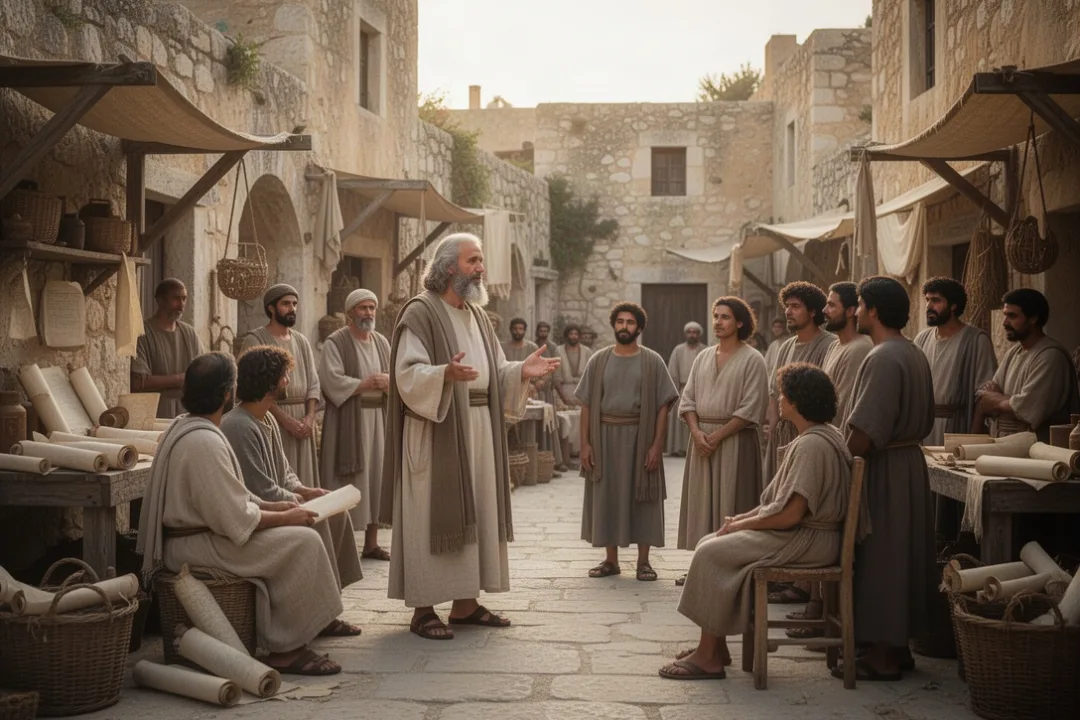
Acts presents Paul as working with other leaders and traveling through cities in Syria, Asia Minor, Macedonia, and Greece. His preaching often began in a synagogue, where he could speak to people who already knew Israel’s Scriptures. He then addressed Gentiles and others who were interested in the message about Jesus.
Paul’s work depended on local communities, not only public preaching. After teaching in a city, he helped organize believers into a congregation with worship, instruction, shared meals, mutual support, and recognized leaders. He later maintained contact through letters and personal representatives.
Paul did not work alone. Acts names companions such as Barnabas, Silas, Timothy, and Luke, while Paul’s letters mention many coworkers, including Priscilla and Aquila, Phoebe, Titus, Epaphroditus, and others. The missionary movement was therefore a network of people who hosted gatherings, carried messages, taught, traveled, raised funds, and cared for vulnerable members.
His journeys were physically demanding. Paul refers to beatings, imprisonment, shipwrecks, hunger, sleepless nights, and danger from hostile groups in 2 Corinthians 11. Acts also describes conflicts, public opposition, and legal trouble. These experiences help explain why his letters often combine theological argument with practical concern for endurance.
Why the conflict over Gentile believers mattered
The question of Gentile membership was one of the earliest and most serious disputes among Jesus’ followers. If Gentiles believed in Jesus, did they need circumcision and full observance of Jewish law? The answer affected meals, marriage, worship, social identity, and the basic definition of the Christian community.
Acts 15 describes a gathering in Jerusalem where apostles and elders discussed the issue. The account presents a decision that Gentile believers should not be required to take on the entire yoke of the Jewish law, while asking them to avoid certain practices associated with idolatry, blood, and sexual immorality.
Paul’s own account in Galatians 2 focuses on his disagreement with Peter at Antioch. Paul objected when Peter withdrew from eating with Gentile believers because of pressure from other Jewish Christians. For Paul, the shared table represented a central truth: those who trusted in Christ belonged together without being separated by ethnic or ritual status.
Paul did not treat every community in exactly the same way. In 1 Corinthians 9, he describes adapting his conduct in order to serve different people, while still placing limits around behavior that would harm others. In Romans 14, he urges believers with different food practices and special days to avoid contempt and judgment.
The heart of the dispute: Paul argued that belonging to Christ was not reserved for one ethnicity or dependent on adopting every Jewish identity marker. His teaching made the early movement more openly multinational, while also forcing it to work through difficult questions about tradition and shared life.
What Paul taught about Jesus and salvation
For Paul, the death and resurrection of Jesus were the center of the gospel. He did not present Jesus merely as a wise teacher or moral example. He proclaimed Jesus as the crucified and risen Lord through whom God was acting to restore humanity and reconcile people to himself.
Paul’s teaching about salvation uses several images. People are justified, or put in a right relationship with God, through faith rather than through boasting in works of the law. They are reconciled, released from sin’s power, transferred from an old way of life into a new one, and incorporated into the body of Christ.
These ideas appear together but are not identical. In Romans, Paul describes humanity as trapped in sin and unable to establish its own righteousness. In Galatians, he emphasizes that Gentiles receive the Spirit through faith in Christ rather than through adopting Jewish law. In 1 Corinthians, he focuses on the cross, which overturns human expectations about power and wisdom.
Paul also taught that believers share in a new life. Faith was not simply agreement with a set of propositions. It involved baptism, receiving the Holy Spirit, turning away from destructive behavior, caring for other believers, and learning to live according to love.
His understanding of the church was remarkably communal. In 1 Corinthians 12, he compares the community to a body with many parts. Different gifts and roles matter, but none gives a believer permission to despise another. A congregation is healthy when its members use their abilities for the common good rather than personal status.
Paul placed love above spiritual prestige. In 1 Corinthians 13, he describes love as patient, generous, humble, and enduring. The passage is often read at weddings, but its original setting is a divided church arguing about spiritual gifts and social standing. Paul’s point is that impressive religious abilities have no value when they are separated from love.
How Paul described the role of women and coworkers
Paul’s letters name many women as important participants in Christian communities. In Romans 16, he commends Phoebe as a deacon or servant of the church at Cenchreae and describes her as a benefactor to many. He also greets Priscilla, who with Aquila helped instruct Apollos, and Junia, whom he identifies as notable among the apostles.
Paul’s letters contain passages about women’s behavior in worship and household relationships that have been interpreted in different ways. Some readers understand these passages as restrictions on women’s public roles, while others connect them to specific local problems or later editorial contexts. The evidence requires careful reading rather than a single easy claim about Paul’s overall position.
His greetings also reveal how much missionary work depended on people who are less visible in the main narrative. Paul mentions hosts who opened their homes, messengers who traveled between churches, people who risked their lives for him, and believers who labored beside him. The movement grew through shared ministry, not through Paul’s work alone.
What Paul’s letters reveal about his communities
Seven letters are widely accepted by scholars as written by Paul: Romans, 1 and 2 Corinthians, Galatians, Philippians, 1 Thessalonians, and Philemon. Other New Testament letters are traditionally associated with him, but their authorship is debated. Ephesians, Colossians, 2 Thessalonians, and the Pastoral Epistles are often discussed separately because of differences in style, vocabulary, theology, or historical setting.
Paul’s letters are not abstract theological textbooks. They respond to recognizable situations. The Corinthians argue over leadership and spiritual gifts. The Galatians face pressure about circumcision and law observance. The Philippians endure opposition and experience internal disagreement. Philemon addresses the relationship between a slaveholder and Onesimus, a man connected with his household.
Romans is Paul’s most extended presentation of the gospel. It explores sin, faith, Israel’s story, Gentile inclusion, life in the Spirit, Christian ethics, and the relationship between Jewish and Gentile believers. Paul does not write as if he is addressing a community with no history; he repeatedly engages the tension between the two groups.
First Corinthians shows Paul answering questions about marriage, celibacy, food offered to idols, public worship, the Lord’s Supper, resurrection, and economic inequality. His criticism is often direct, but his goal is to reshape the church into a community where knowledge, freedom, and spiritual gifts are governed by love.
Philippians offers a close view of Paul’s imprisonment, friendship, and humility. It includes a poetic passage about Christ’s self-emptying and exaltation in Philippians 2. Paul encourages the church to reject rivalry and empty ambition, using Jesus’ example to define greatness through service.
Philemon is short but socially significant. Paul appeals to Philemon regarding Onesimus, whom Paul calls a beloved brother. The letter does not provide a modern legal argument about slavery, and interpreters disagree about how far Paul’s appeal reaches. It does, however, place a person’s relationship within the Christian community under the pressure of transformed kinship and shared faith.
How to read Paul without common misunderstandings
Paul can be difficult because his letters assume knowledge of local disputes that modern readers do not possess. He may move quickly from Scripture to argument, use technical religious language, or answer a question that is only indirectly visible. Reading each passage within its letter usually produces a fairer interpretation than isolating a single sentence.
These practical habits can help:
Identify the audience: Ask who received the letter and what problem or question appears to have prompted it.
Read the whole section: A sentence about law, freedom, women, marriage, or spiritual gifts may change meaning when read with the surrounding argument.
Separate Paul’s voice from an opponent’s: In Romans and 1 Corinthians, Paul sometimes states a position before challenging it.
Notice the community setting: Paul usually discusses personal behavior in relation to worship, shared meals, economic fairness, or the health of the congregation.
Compare related passages: Romans, Galatians, and 1 Corinthians often illuminate different aspects of the same concerns.
Distinguish certainty from debate: The authorship and interpretation of some New Testament letters remain subjects of serious scholarly discussion.
Several common mistakes can distort Paul’s message:
Calling him the founder of Christianity: Paul was a major apostle and interpreter of Jesus, but the movement began with Jesus and his first followers.
Portraying him as anti-Jewish: Paul argued fiercely about Jewish law and Gentile inclusion, yet he remained shaped by Israel’s Scriptures and grieved over the rejection of the gospel by many of his fellow Israelites.
Reducing him to a rule-maker: His ethical instructions grow from larger themes of grace, the Spirit, resurrection, freedom, and love.
Treating every letter attributed to him as equally certain: Traditional attribution and modern authorship analysis are not always the same.
Reading the letters as a biography: They provide valuable personal details, but Acts supplies much of the narrative framework, and the two sources emphasize different aspects of Paul’s life.
How Paul’s imprisonment and death are understood
Paul’s letters refer repeatedly to imprisonment, and Acts ends with him under house arrest in Rome, preaching and receiving visitors. Acts does not describe his execution or provide a final scene of death. The ending leaves Paul teaching while awaiting the outcome of his appeal or legal situation.
Early Christian tradition connects Paul’s death with Rome, usually during the persecution associated with Emperor Nero. Because Paul was considered a Roman citizen in Acts, later tradition commonly says that he was beheaded rather than crucified. The exact date and circumstances are not known with certainty.
Many historians place his death sometime in the 60s, often around the period of Nero’s persecution, but the evidence does not establish every detail. The strongest historical point is that Paul likely died as a martyr after a period of missionary activity, imprisonment, and public conflict.
Rome became closely associated with both Paul and Peter. The Basilica of Saint Paul Outside the Walls in Rome is traditionally linked to Paul’s burial place and preserves a long history of devotion to him. Such traditions matter to Christian communities, while the historical details should be stated with appropriate caution.
Why Saint Paul still matters to Christians
Paul continues to shape Christian worship, preaching, theology, ethics, and spiritual practice. His letters are read in churches across denominations because they address enduring questions: How are people reconciled to God? What does faith look like in daily life? How should communities handle disagreement? What does love require when freedom and conscience collide?
His teaching on the body of Christ supports a vision of the church as a connected community rather than an audience gathered around a leader. His emphasis on gifts encourages participation, while his warnings against pride challenge communities that measure spiritual worth by influence, knowledge, wealth, or public recognition.
Paul also gives Christian readers a model of perseverance that is more complex than simple confidence. He writes about weakness, fear, hardship, and disappointment alongside conviction. In 2 Corinthians, he argues that divine strength can be seen through human weakness. That theme has offered comfort to people who feel limited, rejected, or unable to meet ideal standards of religious performance.
His letters have also generated serious debate. Readers have wrestled with Paul’s teaching about government, marriage, sexuality, slavery, women, Jewish-Christian relations, and the end times. Responsible interpretation does not avoid these difficult passages or pretend that every question has one uncontested answer. It examines historical context while asking how Paul’s central commitments to faith, justice, holiness, freedom, and love fit together.
To begin reading Paul, start with Philippians for its personal tone, then read Galatians for the dispute over Gentile identity, 1 Corinthians for community life, and Romans for his broadest theological argument. Reading one letter at a time makes it easier to follow the situation, vocabulary, and emotional movement.
Saint Paul’s importance rests not only on how many churches he visited or letters he wrote. It rests on the way he connected the story of Jesus with the inclusion of diverse peoples, the formation of local communities, and a vision of faith expressed through love. His work helped shape Christianity at a decisive moment, and his arguments continue to challenge readers to consider what a unified community can look like across deep social and religious differences.
Frequently asked questions
Was Saint Paul one of Jesus’ original twelve apostles?
No. Paul was not one of the Twelve who followed Jesus during his earthly ministry. He became an apostle through his post-resurrection encounter with Jesus and understood his mission as a calling to announce the gospel, especially among Gentiles. Early Christians debated his authority, but his letters show that he regarded his apostolic commission as genuine and central to his work.
Why does Paul have two names, Saul and Paul?
Saul was his Jewish name, while Paul was the Roman name associated with him in the New Testament. People in the eastern Roman world could use more than one name across Jewish, Greek, and Roman settings. Acts begins referring to him as Paul around the time of his mission to Cyprus, but the text does not describe this as a formal name change caused by his conversion.
Did Saint Paul write all the letters attributed to him?
Christian tradition associates thirteen New Testament letters with Paul, but authorship is not equally certain for all of them. Seven are broadly accepted as authentic Pauline letters. Other writings may come from later followers who used Paul’s name, teaching, and authority. Scholars compare vocabulary, style, theology, historical references, and the circumstances assumed by each letter.
What is the best Pauline letter to read first?
Philippians is often a manageable starting point because it is relatively concise and personal. It discusses joy, humility, suffering, friendship, and life in Christ. Galatians is useful for understanding Paul’s argument about faith and Gentile inclusion, while Romans offers a fuller theological presentation but requires slower reading because its argument is longer and more complex.















Leave a Reply