Acts of the Apostles summary: key events and themes
Acts of the Apostles summary: key events and themes
The Acts of the Apostles tells how Jesus’ followers began proclaiming his message after his ascension. It follows the church’s growth from Jerusalem to Rome, highlighting the work of the Holy Spirit, the apostles’ preaching, persecution, and the inclusion of Gentiles.
The first half focuses mainly on Peter and the Jerusalem church. The second half follows Paul as he travels through the eastern Roman Empire and eventually reaches Rome as a prisoner. Acts ends with Paul preaching openly under house arrest, showing that the Christian message continues to spread despite opposition.
Acts is the second volume traditionally attributed to Luke, following the Gospel of Luke. The Gospel describes Jesus’ ministry, death, resurrection, and ascension; Acts begins with the disciples waiting in Jerusalem for the promised power of the Holy Spirit.
The book covers a period of major transition. Jesus is no longer physically present with the disciples, the apostles take responsibility for public witness, and a small Jewish movement becomes a community that welcomes people from many nations. The story moves geographically and culturally from the Jewish center of Jerusalem toward the Gentile capital of Rome.
Luke presents this growth as guided by God’s purpose, not merely by human planning. The believers preach, organize local communities, endure threats, and make difficult decisions about Gentile converts. At several points, the Holy Spirit directs the mission, gives courage to witnesses, and confirms that the message is reaching new groups.
The central movement of Acts: Jesus’ followers begin in Jerusalem, cross ethnic and religious boundaries, and carry the gospel outward until it reaches the heart of the Roman world.
The book is not a complete biography of every apostle or a full history of every early Christian congregation. Instead, it selects key events that demonstrate how the church expanded and how its leaders responded to conflict, persecution, cultural differences, and questions of identity.
Chapters 1–7: The church is established in Jerusalem.
Chapters 8–12: The message spreads to Samaria, the coast, and Gentile households.
Chapters 13–20: Paul undertakes missionary journeys and churches develop across the eastern Mediterranean.
Chapters 21–28: Paul is arrested, defends his faith, and travels to Rome.
How the Holy Spirit forms the church in Jerusalem
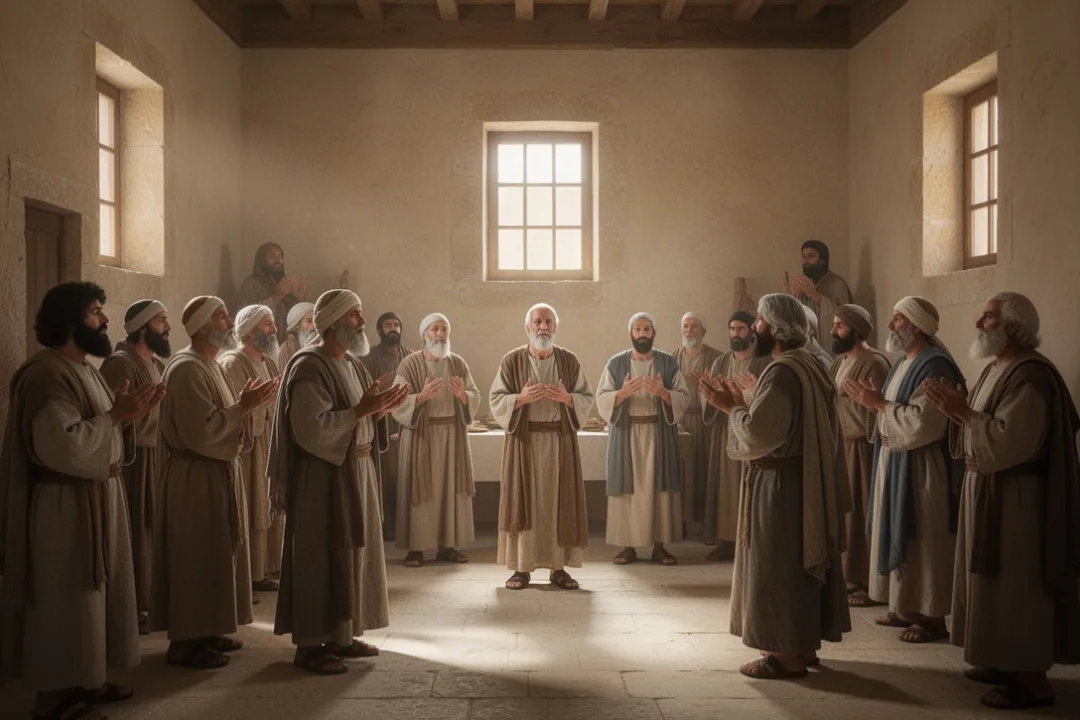
Acts opens after Jesus has risen from the dead. He instructs the apostles to remain in Jerusalem until they receive power from the Holy Spirit, and he identifies their future witness as extending from Jerusalem outward to distant regions. After Jesus ascends, the disciples return to the city, pray together, and choose Matthias to join the Twelve in place of Judas Iscariot.
At the Jewish festival of Pentecost, the Holy Spirit comes upon the gathered believers. They speak in languages understood by visitors from different regions, and Peter explains the event as part of God’s promised work. His speech calls people to turn toward Jesus, and many are baptized. This event marks the public beginning of the church’s mission.
The first believers share meals, prayer, teaching, and practical resources. Their community includes people who sell property or possessions to help those in need, although Acts also shows that participation is expected to be honest rather than performative. The fellowship is marked by public worship, mutual care, and a strong sense that the resurrection has changed the meaning of their lives.
Peter and John soon become prominent witnesses in Jerusalem. After healing a man who cannot walk, Peter speaks to a crowd at the temple and attributes the healing to Jesus rather than to his own power. The apostles are questioned by religious authorities, ordered to stop teaching, and later imprisoned, but they continue to proclaim what they believe they have seen and heard.
Opposition becomes more severe as the apostles’ influence grows. The high priest and other leaders challenge them, while a respected teacher named Gamaliel advises caution. His argument is that movements created only by human effort will fail, whereas a work truly originating with God cannot be easily stopped.
Acts also records internal tensions within the growing community. Greek-speaking Jewish believers complain that their widows are being overlooked in the distribution of food. The apostles respond by appointing seven respected men to manage this responsibility, allowing the apostles to remain focused on prayer and teaching. This decision shows that spiritual mission and practical administration both matter in a healthy community.
One of the seven, Stephen, becomes a powerful preacher. His speech reviews Israel’s history and argues that God’s work cannot be confined to one location or controlled by one group. His opponents accuse him of speaking against Moses and the temple, and he is stoned after declaring that he sees Jesus in a position of heavenly authority.
Stephen’s death begins a broad persecution of believers in Jerusalem. Rather than ending the movement, the persecution forces many disciples into other areas. Their displacement helps carry the message beyond the city, creating the pattern that repeatedly appears throughout Acts: opposition causes suffering, but it also contributes to wider expansion.
How the message reaches Samaritans and Gentiles
Philip, another of the seven, travels to Samaria and proclaims Jesus there. Many Samaritans respond positively, and Peter and John visit to confirm the development. The event matters because Jews and Samaritans had a long history of hostility, yet Acts presents the Spirit’s work as crossing that social and religious boundary.
Philip then encounters an Ethiopian official traveling home from Jerusalem. The man is reading from Isaiah and asks Philip for help understanding the passage. Philip explains how it relates to Jesus, and the official requests baptism. This meeting shows the mission reaching someone who is both geographically distant and socially distinct from the Jerusalem believers.
Acts next introduces Saul, a zealous opponent of the church. He is traveling to Damascus to arrest believers when he experiences a revelation of the risen Jesus. Blinded temporarily, Saul is led into the city, where a disciple named Ananias prays for him. Saul regains his sight, is baptized, and soon begins proclaiming the faith he had previously tried to destroy.
Saul later becomes known by his Roman name, Paul, and takes a leading role in the mission to Gentiles. His conversion does not erase the seriousness of his earlier actions; Acts emphasizes that the church is initially cautious about trusting him. Barnabas helps introduce him to the apostles, and Paul’s new preaching brings both amazement and danger.
Peter’s ministry also expands beyond Jerusalem. He heals Aeneas in Lydda and raises Tabitha, also called Dorcas, in Joppa. These episodes increase the number of people who hear the message, but the most significant development occurs when Peter is summoned to the home of Cornelius.
Cornelius is a Roman centurion and a Gentile who reveres God. Through visions, both Cornelius and Peter are directed toward their meeting. Peter initially struggles with the idea of entering a Gentile home, but he comes to understand that God does not show favoritism based on ethnic identity. While Peter is speaking, the Holy Spirit comes upon Cornelius and the others with him, and they are baptized.
This event creates a major question for the early church: must Gentiles become Jews and follow the full requirements of Jewish religious practice before becoming Christians? Peter reports what happened to the Jerusalem believers, and the church recognizes that God has granted repentance and life to Gentiles as well.
The church in Antioch becomes especially important. Jewish and Gentile believers worship together there, and the disciples are first called Christians in that city. Antioch serves as a missionary base and demonstrates the increasingly international character of the movement.
A turning point in Acts: Cornelius’s conversion shows that Gentiles receive the Holy Spirit without first becoming Jews. The church must now decide how a diverse community can share one faith.
How Paul’s missionary journeys build new churches
Paul and Barnabas are sent from Antioch after the church prays and fasts. Their first journey takes them through Cyprus and parts of Asia Minor. They preach in synagogues and public settings, speak with Gentiles, and face resistance from some local leaders. In several cities, people welcome the message, while in others Paul and Barnabas are expelled or attacked.
Their preaching follows a recurring pattern. They often begin with Jewish communities familiar with Israel’s Scriptures, then address Gentiles when opposition develops or when non-Jews show interest. The missionaries establish groups of believers, appoint local leaders, and return their attention to the need for perseverance amid hardship.
At Lystra, the crowd mistakes Paul and Barnabas for Greek gods after Paul heals a man. The missionaries reject the worship and insist that the people turn from idols to the living God. Soon afterward, opponents persuade the crowd to attack Paul, who survives and continues the mission.
The dispute over Gentile believers becomes unavoidable when some teachers insist that Gentile converts must be circumcised and keep the law of Moses. Church leaders gather in Jerusalem for what is often called the Jerusalem Council. Peter recalls Cornelius’s conversion, Paul and Barnabas describe God’s work among the nations, and James offers a decision intended to protect fellowship without placing the entire law upon Gentile converts.
The council’s message asks Gentile believers to avoid practices especially offensive to Jewish Christians, including food associated with idolatry, blood, meat from strangled animals, and sexual immorality. The decision does not remove every cultural difference, but it establishes that Gentiles belong to the people of God through faith and God’s grace rather than by adopting the complete Jewish law.
Paul later begins another journey with Silas. After a disagreement, Barnabas travels separately with Mark, while Paul chooses Silas as his companion. The separation is painful, but the mission continues through multiple teams. Acts presents this as an example of how human conflict can exist alongside ongoing ministry.
In Philippi, Paul and Silas meet Lydia, a merchant from Thyatira who becomes a believer and offers hospitality. They also encounter a slave girl whose owners profit from her fortune-telling. After Paul frees her from the spirit controlling her, her owners provoke a legal complaint because their income has disappeared. Paul and Silas are beaten and imprisoned, yet an earthquake opens the prison doors. The jailer and his household then hear the message and are baptized.
Paul’s work continues in Thessalonica, Berea, Athens, and Corinth. In Thessalonica, some people accept his teaching while others create unrest. The Bereans are praised for examining the Scriptures carefully. In Athens, Paul speaks at the Areopagus and addresses an audience shaped by Greek religious ideas, using their interest in an unknown deity as a starting point for explaining the Creator and the resurrection.
Corinth becomes one of Paul’s longest and most significant periods of ministry. He works with Aquila and Priscilla, supports himself through trade, and teaches in the city for an extended time. The local population is culturally mixed, and the church faces the same kind of social tensions that appear elsewhere in Acts.
On a later journey, Paul spends substantial time in Ephesus. His teaching influences many people, and some who practiced magic publicly destroy their scrolls. The growing Christian movement threatens the business of craftsmen who make silver shrines connected with the goddess Artemis. A large disturbance follows, showing that religious conversion can have economic and civic consequences.
Paul and his coworkers preach in synagogues, marketplaces, homes, and public meeting places.
New believers gather in local communities rather than remaining dependent on Jerusalem.
Leaders face resistance from religious authorities, civic officials, business interests, and hostile crowds.
Missionary teams adapt their message to Jewish, Greek, Roman, urban, rural, wealthy, and enslaved audiences.
Churches remain connected through visits, letters, messengers, and shared concern for one another.
Why Paul’s arrest and journey to Rome matter
Paul eventually returns to Jerusalem despite warnings that trouble awaits him. He meets with church leaders and participates in temple-related observance to counter rumors that he teaches Jews to abandon Moses. Even so, some opponents accuse him of bringing a Gentile into the temple, and a riot begins.
Roman soldiers rescue Paul from the crowd and take him into custody. His arrest becomes the means by which he addresses several audiences, including the Jerusalem crowd, the Jewish council, the Roman governor Felix, the governor Festus, and King Agrippa. Paul repeatedly explains his Jewish background, his encounter with Jesus, and his commission to preach to Gentiles.
Because Paul is a Roman citizen, he appeals to the emperor. This appeal sends him by sea toward Rome, where the journey becomes dangerous. The ship encounters severe weather, and Paul warns that the voyage is at risk. A storm eventually wrecks the vessel near Malta, but everyone survives after following Paul’s guidance.
On Malta, Paul heals the father of the island’s leading official and helps other sick people. After spending time there, he travels onward to Rome. These events continue a pattern established earlier: Paul’s imprisonment does not silence his witness, and even hardship creates opportunities to serve and speak about his faith.
In Rome, Paul is allowed to live under guard in a rented house. He calls local Jewish leaders to explain why he has been imprisoned and then welcomes visitors. For two years, he teaches about the kingdom of God and Jesus, receiving people openly and without being prevented from preaching.
The ending is deliberately open. Acts does not describe Paul’s trial, release, death, or the later history of the Roman church. Its final image is a missionary speaking freely in the imperial capital. The book’s movement from Jerusalem to Rome suggests that the gospel has reached a major center, while the open ending leaves the mission continuing beyond the pages of the book.
What the main themes of Acts mean
The Holy Spirit directs the mission. The Spirit empowers preaching, inspires courage, guides decisions, and confirms the inclusion of new groups. Acts does not portray the church as expanding only because its leaders are persuasive or strategic. Human effort matters, but the narrative repeatedly presents God as the primary actor behind the mission.
Witness requires courage. Peter, John, Stephen, Paul, and many unnamed believers face imprisonment, public hostility, physical violence, and social exclusion. Their witness is not described as the absence of fear; it is the decision to continue speaking and serving despite real danger.
The church crosses boundaries. The movement expands from Galilean disciples to Samaritans, an Ethiopian official, Roman soldiers, Greek-speaking residents, women such as Lydia, and people from many cities. Acts portrays unity as something that must be worked out through conversation, hospitality, shared worship, and wise decisions.
Prayer and practical care belong together. The believers pray before major decisions, gather for worship, and ask for boldness. At the same time, they distribute resources, appoint administrators, welcome travelers, support missionaries, and care for people in distress. Acts presents spiritual devotion and concrete responsibility as connected rather than competing priorities.
God can work through setbacks. Persecution scatters believers, imprisonment creates new audiences, disagreements lead to separate missionary teams, and shipwreck does not stop Paul’s journey. The story does not minimize suffering, but it shows that opposition does not have the final word over the church’s witness.
The message is for every nation. The geographic progression from Jerusalem to Rome represents more than travel. It signals a widening community in which ethnicity, language, geography, social rank, and citizenship do not determine who may hear the gospel or receive the Holy Spirit.
For readers seeking the basic storyline, Acts can be remembered as the account of a movement that begins with the Spirit’s arrival, grows through the apostles’ witness, resolves a major dispute about Gentile inclusion, and reaches Rome through Paul’s determined ministry. Its final scene keeps the mission open, inviting readers to see the church’s witness as continuing beyond the events Luke records.
Frequently asked questions
Who wrote the Acts of the Apostles?
Acts is traditionally attributed to Luke, the same author associated with the Gospel of Luke. The two books are addressed to the same individual, Theophilus, and Acts begins by referring back to the earlier account of Jesus’ life and ministry. The author writes as a careful narrator who selects speeches, journeys, conflicts, and miracles to explain the church’s expansion.
What is the main message of Acts?
The central message is that the risen Jesus continues his work through the Holy Spirit and his witnesses. The gospel moves from Jerusalem to the wider Roman world, reaching both Jews and Gentiles. Acts also emphasizes courage under persecution, the importance of Christian unity, and God’s ability to use ordinary people and difficult circumstances to advance the mission.
Why is Paul so important in Acts?
Paul becomes the book’s leading missionary figure after his conversion from persecutor to apostle. He establishes or strengthens churches across several Roman provinces, explains the faith to diverse audiences, and argues that Gentiles can belong to the church without becoming Jews. His arrest and voyage to Rome also give Acts its final geographical movement and open-ended ending.
Does Acts tell what happened to the apostles after Rome?
No. Acts ends while Paul is living under guard in Rome and preaching to visitors. It does not record his eventual trial, death, or the later ministries of most apostles. Other early Christian traditions discuss some of these subjects, but they are outside the narrative preserved in Acts and should not be presented as details supplied by the book itself.












Leave a Reply