When you are waiting for an answer, a deadline, or a change you cannot control, you may wonder whether waiting means nothing is happening. Acts 1:1-7 speaks directly to that tension. The disciples have seen the risen Jesus, but they still do not know what comes next. Jesus tells them to remain in Jerusalem, trust the Father’s promise of the Holy Spirit, and stop trying to determine the timetable for God’s kingdom.
The passage is not mainly a prediction chart or a formula for identifying the end of the age. It is a carefully placed transition between Jesus’ earthly ministry and the church’s Spirit-empowered witness. Acts 1:1-7 teaches that resurrection faith leads to patient obedience: believers receive what God has promised, wait for God’s provision, and leave the timing of God’s purposes in God’s hands.
Acts begins as the continuation of a previous account written for a person named Theophilus. The opening recalls the author’s earlier work, the Gospel of Luke, which described what Jesus began to do and teach. That wording matters because Acts presents the risen Jesus as continuing his work through the Holy Spirit and his people.
Luke’s Gospel ends with Jesus’ death, resurrection, and instructions to his followers. Acts opens after the resurrection and shows the disciples receiving further direction before Jesus’ ascension. The two books belong together: the Gospel presents Jesus’ ministry, while Acts shows how that ministry continues as the message spreads from Jerusalem outward.
Acts 1:1-7 covers several connected events and ideas:
Jesus is alive after his suffering and gives convincing evidence of his resurrection.
He spends a period of time teaching the apostles about God’s kingdom.
He commands them not to leave Jerusalem but to wait for the Father’s promised gift.
He contrasts John’s water baptism with the coming baptism of the Holy Spirit.
The apostles ask whether the kingdom will be restored to Israel immediately.
Jesus tells them that the Father has kept the times and seasons under his own authority.
These points move from what God has already done to what God is about to do. The resurrection establishes the truth of Jesus’ identity and message. The promised Spirit supplies the power for the next stage. The unanswered timetable reminds the disciples that they are called to faithful participation, not control over every detail.
Acts 1:1-7 explained step by step
1. The opening links Acts with Luke’s Gospel
Acts 1:1 addresses Theophilus and refers to the earlier account. The author does not treat Acts as an isolated story. He assumes that the reader knows the Gospel’s account of Jesus’ birth, teaching, death, resurrection, and commission to his followers.
The phrase about what Jesus “began” to do and teach suggests that his work did not end when he returned to the Father. His earthly ministry was the beginning of a larger work. In Acts, Jesus acts through the Holy Spirit, the apostles, and the growing community of believers. The human witnesses are active, but Jesus remains the central actor behind the mission.
This connection also gives Acts a clear foundation. The church does not invent a new message after Easter. Its preaching grows out of Jesus’ life, death, resurrection, and teaching. The events that follow are meant to be understood as the continuation of God’s saving work already revealed in the Gospel.
2. Jesus gives instructions through the Holy Spirit
Acts 1:2 says that Jesus gave commands to the apostles through the Holy Spirit before his ascension. This description emphasizes the unity of Jesus’ ministry with the Spirit’s work. The Spirit is not introduced only after Jesus leaves; the Spirit is already connected with Jesus’ teaching and mission.
The apostles are also described as chosen. Their role is not based simply on personal ambition, political influence, or public speaking ability. They are appointed witnesses who have been prepared to testify about Jesus. That calling gives weight to their testimony, but it also places responsibility on them to obey the instructions they receive.
For Christian readers, this offers a useful correction. A person may have genuine knowledge, strong convictions, or an important assignment, yet still need to receive direction and wait for God’s provision. Calling does not remove the need for dependence. The apostles are chosen before they are empowered, and they are instructed before they are sent.
3. The resurrection is presented as a real, sustained reality
Acts 1:3 says Jesus presented himself alive after his suffering and gave many convincing proofs. He appeared to the apostles over a period of time and spoke about God’s kingdom. The passage therefore treats the resurrection as the basis for the church’s message, not as a private feeling that appeared among the disciples.
The apostles had lived through Jesus’ execution and then encountered him alive. Their faith was shaped by repeated instruction and personal witness. Luke does not provide every detail of those appearances here, but he stresses that the risen Jesus continued to teach them.
That teaching focused on the kingdom of God. The kingdom means God’s rule and saving authority, not merely a geographic territory. Jesus’ resurrection confirms that God’s reign is breaking into human history, while the rest of Acts shows that the announcement of this reign will reach many peoples and places.
Key idea: Acts does not begin with the disciples’ strategy. It begins with the risen Jesus, who establishes the truth of the resurrection and teaches his followers how to wait, receive, and witness.
4. Jesus tells the disciples to wait in Jerusalem
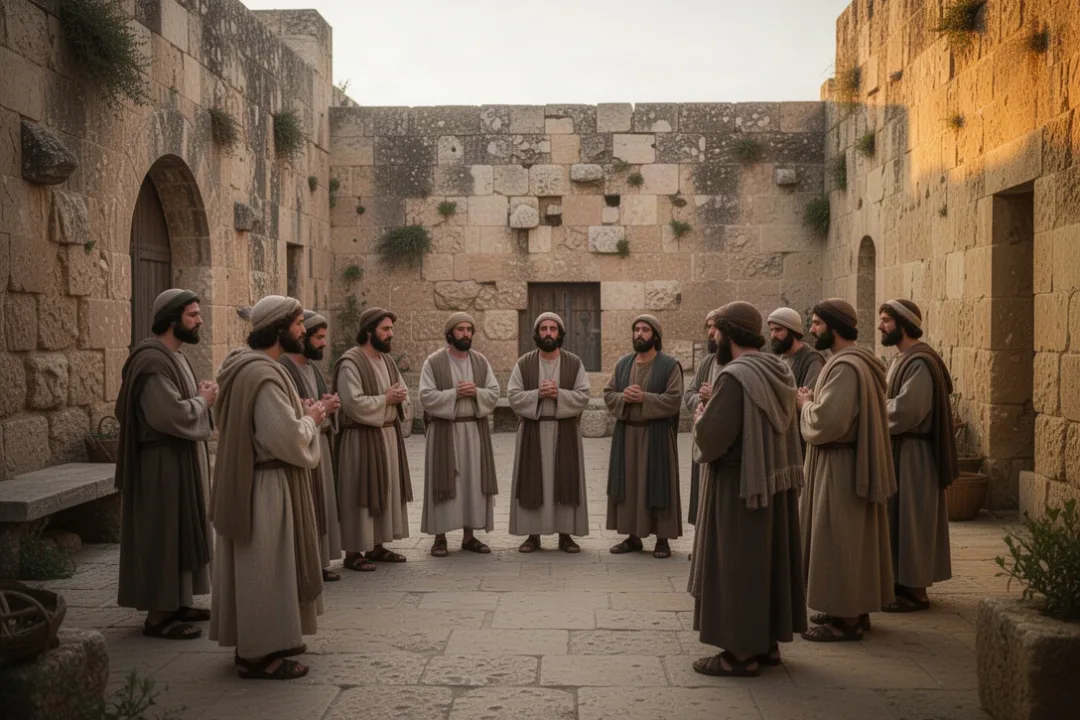
In Acts 1:4, Jesus tells the apostles not to depart from Jerusalem. Instead, they are to wait for the promise of the Father. The instruction may have seemed unusual because the disciples had already received a mission. Yet a mission from God requires more than enthusiasm; it requires the power God has promised.
Jerusalem is significant because it is where Jesus was rejected and executed, but it is also where the next stage of God’s work will begin. The disciples are not told to escape a difficult location or create their own starting point. They are told to remain where Jesus directs them until the promised gift arrives.
Waiting here is active obedience, not passive indecision. The disciples know what they are supposed to do next: stay together, remain alert to God’s promise, and prepare to serve as witnesses. They do not know the full schedule, but they do know the next command.
That distinction can help when you face an uncertain season. You may not know when circumstances will change, but you may know what faithfulness looks like today. Waiting becomes meaningful when it is shaped by a clear instruction, rather than by fear, avoidance, or endless speculation.
5. The Holy Spirit is the promised source of power
Jesus reminds the disciples that John baptized with water, but they will be baptized with the Holy Spirit soon. The comparison links the coming event with John the Baptist’s earlier announcement that someone greater would bring a deeper work of God’s Spirit.
Water baptism is an outward act associated with repentance and entrance into the community gathered around God’s message. The baptism of the Holy Spirit points to God’s direct empowering presence. In Acts, the Spirit gives the disciples courage, understanding, unity, and ability to bear witness in ways they could not produce through natural strength alone.
The exact timing is described as near, but the disciples are not given a detailed schedule. They are told enough to obey: the promise is certain, and it is coming soon. Their task is not to manufacture spiritual power or begin the mission without it.
Several practical lessons follow:
God’s work depends on God’s power. Skill, planning, and effort have value, but they cannot replace the Spirit’s work.
Preparation includes receptivity. The disciples must be willing to wait and receive before they can serve effectively.
Spiritual power has a purpose. In Acts, the Spirit equips people to testify about Jesus, not merely to seek private experiences.
God keeps promises in his own way. The disciples are responsible for obedience, not for forcing the fulfillment.
Why the apostles ask about restoring the kingdom
Acts 1:6 records the disciples asking Jesus whether he will restore the kingdom to Israel at that time. Their question reflects their hope that God will renew his people and fulfill the promises associated with Israel’s kingdom. It also shows that they are still trying to understand how Jesus’ resurrection, the kingdom, and the future fit together.
The question is not necessarily foolish or unrelated to Jesus’ teaching. Jesus has been speaking about God’s kingdom, so the disciples naturally ask about its visible restoration. Their difficulty lies partly in their desire to know the schedule and perhaps in their expectation that the restoration will take place in a form they can immediately recognize.
The text does not require readers to mock the apostles for asking. They have understood something true—that God’s kingdom matters—but they do not yet understand the scope and timing of the mission. The answer they receive redirects their attention without treating their hope as meaningless.
Jesus does not tell them to abandon concern for God’s reign. Instead, he shows that their responsibility is not to possess the calendar. Their concern should move from “When will this happen?” to “How should we obey while we wait?”
What Jesus means by “times and seasons”
In Acts 1:7, Jesus says that it is not for the disciples to know the times or seasons the Father has established by his own authority. The wording emphasizes both God’s authority and the disciples’ limits. God has not surrendered control of history to human prediction.
“Times” can suggest appointed periods, while “seasons” can suggest the particular phases or occasions within God’s plan. Together, the terms communicate that the Father governs the unfolding of events. Jesus does not give the disciples a code for calculating the kingdom’s timetable.
This does not mean that Christians should never study biblical prophecy or think about the future. It does mean that speculation must not replace obedience. A person can spend so much energy identifying dates, interpreting headlines, or debating sequences that the actual task of faithful witness receives little attention.
The warning has two sides. First, do not claim certainty where Jesus has left the timing with the Father. Second, do not use uncertainty as an excuse for indifference. The disciples are not given the schedule, but they are given a mission and the promise of the Spirit.
Practical boundary: Trusting God’s timing means refusing to set dates or make confident predictions that Jesus has not authorized. It does not mean ignoring the future; it means letting hope produce faithful action rather than speculation.
How Acts 1:1-7 connects waiting with mission
The passage holds together two ideas that people often separate: waiting on God and participating in God’s work. The disciples must wait before they go, but the waiting is not the destination. They are being prepared for witness.
Jesus’ instruction also protects the disciples from relying on their own resources. They have seen the risen Lord, but even that extraordinary experience does not mean they can fulfill the mission without the Holy Spirit. The church will grow through divine empowerment, not merely through human organization.
This pattern appears in many forms of Christian service. Someone may understand a responsibility but still need patience, training, wisdom, or courage before acting. A congregation may have a worthy goal but need to seek God’s direction rather than rush forward because activity feels more productive than prayer.
Waiting should not be confused with avoiding responsibility. A useful question is: What has God already made clear, and what remains outside my control? Acts 1:1-7 encourages you to obey the first category and entrust the second to God.
What Acts 1:1-7 teaches about the kingdom of God
The kingdom remains central from Jesus’ ministry in Luke through the opening of Acts. It refers to God’s active rule, his saving purpose, and the restoration he brings through the Messiah. The resurrection shows that Jesus is not defeated by death, and the Spirit’s coming shows that God’s reign is advancing through witness.
At the same time, the passage does not present the kingdom as fully visible in every respect. The disciples still ask about restoration, and Jesus still speaks about a future timetable known to the Father. Acts therefore holds together present and future dimensions of the kingdom.
God’s reign is already being announced and experienced through the risen Christ and the Spirit-formed community. Yet believers still wait for the complete fulfillment of God’s promises. This combination gives Christian hope a steady shape: confidence that God is acting now, along with patience about what has not yet been completed.
The kingdom also becomes larger than the disciples initially imagine. Their question focuses on Israel, but the mission that follows reaches across ethnic, geographic, and cultural boundaries. The risen Jesus does not discard Israel’s story; he brings God’s saving purpose outward so that people from many nations can hear and respond.
Common misunderstandings of Acts 1:1-7
“The disciples were wrong to care about the kingdom”
The passage does not say that concern for the kingdom is wrong. Jesus himself teaches about the kingdom, and the disciples are right to understand that it is central to God’s plan. Their mistake is assuming that they should know or control the timetable.
The proper response is not to become indifferent to God’s future. It is to let future hope strengthen present faithfulness. The kingdom matters, but the Father’s schedule remains the Father’s authority.
“Waiting means doing nothing”
The disciples are told to wait for the Spirit, but Acts quickly shows them praying, gathering, and preparing for the work ahead. Biblical waiting involves trust, attention, and readiness. It is different from laziness or resignation.
When you are waiting for direction, the faithful response may include prayer, learning, serving in responsibilities already clear, and staying connected to other believers. You do not need complete knowledge of the future to take the next obedient step.
“The passage gives a method for predicting the end”
Acts 1:7 points in the opposite direction. Jesus places the times and seasons under the Father’s authority and refuses to give the disciples control over that knowledge. Attempts to turn the passage into a prediction system move beyond what it says.
The text directs attention toward witness, dependence, and trust. It reminds readers that knowing God’s plan is not the same as knowing every date or sequence within it.
“The Holy Spirit is only for a select few”
In Acts, the apostles have a distinctive role as witnesses of Jesus’ resurrection, but the Spirit’s work expands through the wider community of believers. The Spirit equips God’s people for witness and service according to God’s purpose.
This does not mean every believer has the same task or experience. It does mean that Christian mission cannot be reduced to the talent of a small leadership group. The church depends on God’s presence among his people.
How to apply Acts 1:1-7 in daily life
The passage offers a practical pattern for decisions, uncertainty, and spiritual service. Begin with what is clear rather than demanding information that God has not promised to provide.
Remember what God has already done. The disciples’ confidence begins with the risen Jesus, not with their ability to predict the future.
Identify the next clear instruction. Do not wait for a complete life plan before obeying a responsibility that is already evident.
Ask for God’s power. Seek the Holy Spirit’s wisdom and strength instead of treating personal ability as sufficient.
Accept the limits of your knowledge. Some times and seasons belong to the Father’s authority rather than to your investigation.
Turn uncertainty toward faithful witness. Use the present season to speak and live in a way that points to Jesus.
Stay connected to the community. The apostles wait together, reminding readers that Christian faith is not designed to be lived in isolation.
These steps are especially relevant when you are making a major decision, enduring a delay, or feeling pressure to predict what comes next. Acts 1:1-7 does not promise that every question will receive an immediate answer. It offers something more stable: the risen Christ, the Father’s promise, and a clear call to trust.
Questions to ask when you are in a waiting season
You can use the passage as a framework for honest reflection without forcing it to answer questions it does not address. Consider asking:
What has God already made clear through Scripture, wise counsel, and responsible circumstances?
Am I waiting because I am obeying a clear direction, or because fear is keeping me from action?
Have I confused the desire for certainty with the need for faithfulness?
Am I seeking the Holy Spirit’s help, or relying only on planning and personal strength?
How can I serve or bear witness during this season instead of treating it as wasted time?
Have predictions about the future distracted me from responsibilities in the present?
These questions preserve the balance found in Acts 1:1-7. They take God’s promises seriously while respecting the limits Jesus gives. They also keep waiting connected to mission rather than turning it into a private exercise in anxiety.
The central message of Acts 1:1-7
Acts 1:1-7 begins with the risen Jesus and ends with the Father’s authority over time. Between those points, the disciples receive a promise and a command: wait for the Holy Spirit, then serve as witnesses. The passage presents Christian mission as a response to God’s prior action.
Its message can be expressed in four statements: Jesus is truly risen; God keeps his promise to empower his people; the kingdom is central to the Christian hope; and the timing of God’s purposes belongs to the Father. Those truths work together rather than competing with one another.
If you are facing uncertainty, the passage does not require you to pretend that every question has been answered. It calls you to place unanswered timing in God’s hands while faithfully responding to what has been revealed. The disciples do not receive a calendar, but they do receive Christ’s teaching, the Spirit’s promise, and a mission that gives their waiting purpose.
Frequently asked questions
What is the main meaning of Acts 1:1-7?
Acts 1:1-7 explains that the risen Jesus prepared his apostles for their mission by teaching about God’s kingdom and promising the Holy Spirit. It also establishes a boundary around future knowledge: the Father controls the timing of kingdom events. Believers are therefore called to trust God’s promise, wait obediently for his power, and serve faithfully without trying to control or predict the timetable.
Why did Jesus tell the disciples to wait in Jerusalem?
The disciples needed the Holy Spirit before beginning their public witness. Their assignment could not be completed through courage, organization, or personal conviction alone. Jerusalem was the place Jesus designated as the starting point for the next stage of the mission. Their waiting demonstrated obedience and dependence, while also preparing them to receive the power God had promised.
Does Acts 1:7 say Christians should not study prophecy?
Acts 1:7 does not forbid thoughtful study of biblical prophecy. It does reject claims of control or certainty over dates and seasons that the Father has kept within his authority. Prophecy should encourage hope, holiness, and faithful service rather than speculation. Any interpretation that produces confident date-setting goes beyond the restraint Jesus teaches in this passage.
What does Acts 1:1-7 teach about waiting on God?
The passage presents waiting as active trust rather than inactivity. The apostles remain where Jesus instructed them, stay attentive to the promise of the Spirit, and prepare for their witness. For Christians today, waiting can include prayer, wise preparation, service, and community. You may not know the full timeline, but you can still obey the responsibilities God has already made clear.















Leave a Reply