Saint Lorenzo Ruiz was the first Filipino to be canonized by the Catholic Church. A husband, father, lay Dominican, and native of Manila, he was martyred in Japan in 1637 after refusing to renounce his Christian faith.
His story brings together the history of the Philippines, the Dominican missionary movement, and the severe persecution of Christians in early seventeenth-century Japan. Lorenzo was not a priest or professional missionary. He was an ordinary working man whose faith was tested far from home, under circumstances he never expected.
Lorenzo Ruiz was born in Manila around 1594, during the period of Spanish rule in the Philippines. His father was Chinese and his mother was Filipino, making Lorenzo part of the mixed Chinese-Filipino community that played an important role in Manila’s early history.
He grew up in the area now associated with Binondo, Manila’s historic Chinese-Filipino district. The community was shaped by trade, family networks, Catholic institutions, and cultural connections across Asia. Lorenzo’s background gave him an experience of Christianity that was Filipino, Chinese, and deeply connected to the wider Catholic world.
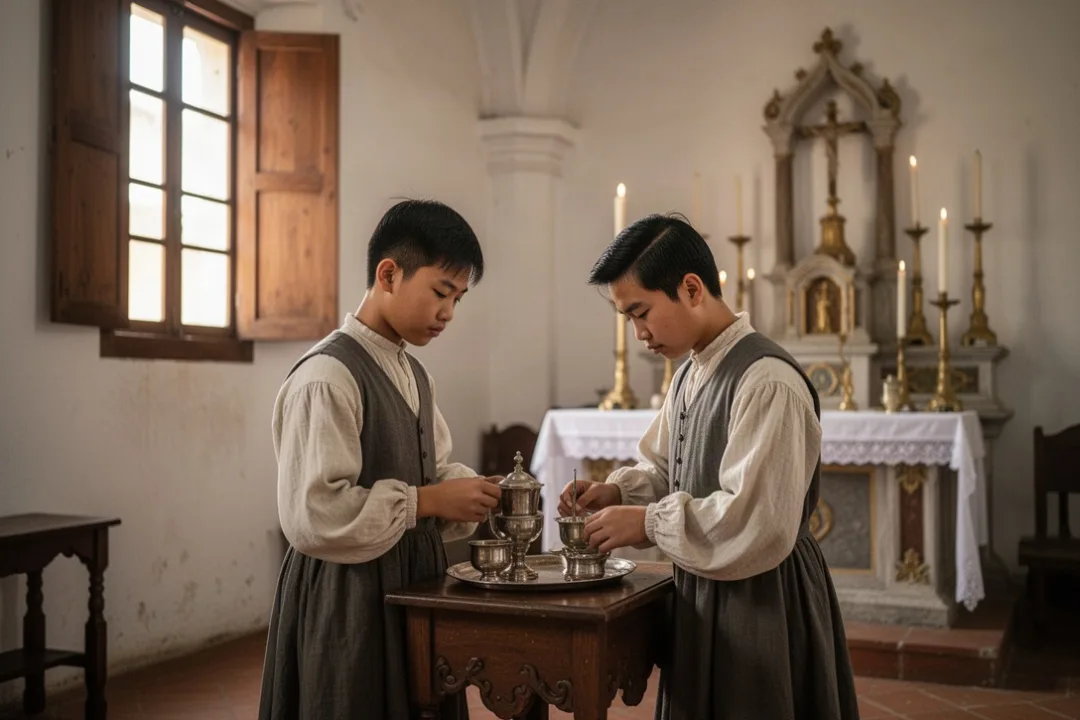
As a young man, Lorenzo served at the church of Binondo as a sacristan. This work involved preparing the church for worship and assisting with practical duties surrounding the liturgy. He also became a member of the Confraternity of the Most Holy Rosary, a Dominican-affiliated devotional group.
These details matter because Lorenzo’s path to sainthood did not begin with public leadership or a position of authority. His formation took place through family life, parish service, prayer, and community. He represents the many lay Catholics whose religious commitment is expressed through work, marriage, service, and daily responsibilities.
His marriage, work, and family in Manila
Lorenzo married a woman named Rosario, and the couple had children. Historical accounts identify him as a family man rather than a celibate religious or ordained minister. His life before martyrdom included the ordinary obligations of providing for a household and raising a family.
He worked as a clerk and was known for his ability to read and write. In Manila’s commercial and religious environment, those skills were useful. His work connected him to institutions and people who depended on accurate records, correspondence, and administrative service.
The fact that Lorenzo was married and had children is central to the way many Catholics understand his witness. His holiness was not separated from family responsibilities. He was a layperson with a profession and dependents, and his final decision was made with the knowledge that it could cost him his life and remove him from his family.
Accounts of his life also connect him with the Dominican community in Manila. He was familiar with Dominican priests and brothers through parish service and the Rosary confraternity. That relationship later became decisive when he left the Philippines with a group of missionaries traveling toward Japan.
A useful distinction: Lorenzo Ruiz was a lay Catholic, not a priest. His sainthood highlights the possibility of profound Christian witness through family life, employment, parish service, and personal courage.
Why Lorenzo Ruiz left the Philippines
In 1636, Lorenzo joined a group connected with the Dominican mission to Japan. The reason for his departure is linked to a serious accusation in Manila. Historical accounts state that he was suspected of involvement in the killing of a Spaniard, although the surviving record does not provide a complete modern-style account of the case.
Lorenzo maintained his innocence. Fearing arrest and believing that he could not receive a fair hearing, he sought safety with the Dominican missionaries. He boarded a ship with them, expecting to leave the Philippines and travel through Asia.
The group included Dominican missionaries and other companions. Among the best-known were Dominic Ibáñez de Erquicia, Antonio Gonzalez, Guillaume Courtet, and Miguel de Aozaraza. A Japanese layman named Lazaro is also traditionally included among the martyrs.
The voyage did not lead Lorenzo to a place of refuge. Instead, the group eventually reached regions connected with the Japanese mission. By that time, Japan had imposed severe restrictions on Christianity. Missionaries were being arrested, and Japanese Christians faced punishment for practicing their faith.
Lorenzo’s decision to travel with the group therefore changed the direction of his life. A man seeking protection from an accusation in Manila became part of a mission that exposed him to imprisonment, interrogation, torture, and execution.
Christian persecution in seventeenth-century Japan
Christianity had reached Japan through missionaries during the sixteenth century, and communities of Japanese Christians had formed in several areas. Political authorities later came to regard the religion as a threat to social control and national stability. The result was an increasingly organized persecution.
Authorities attempted to identify Christians and force them to renounce their faith. Some people were ordered to step on a Christian image as a public sign of apostasy. Others were imprisoned, tortured, or killed. Missionaries who entered Japan secretly faced especially severe penalties.
By the time Lorenzo arrived, the Christian mission was operating under extreme danger. Public worship was largely impossible, and the missionaries depended on secrecy, local contacts, and personal courage. The danger affected both foreign missionaries and Japanese believers who had accepted Christianity at great personal cost.
The Dominican missionaries with Lorenzo continued their ministry despite these conditions. Their work included preaching, hearing confessions, celebrating the sacraments when possible, and supporting persecuted Christians. Lorenzo, as a lay companion, shared the group’s hardships and eventually its fate.
His story should not be separated from the Japanese Christians who also suffered. Lorenzo is often remembered as a Filipino martyr, but the broader group represented a multinational Church. Filipinos, Spaniards, Frenchmen, Japanese Christians, and people from other backgrounds were connected by the same mission.
What happened to Lorenzo Ruiz before his death
Lorenzo and his companions were arrested and brought before officials. He was questioned about his Christian faith and urged to abandon it. The authorities wanted a public renunciation, not merely a private change of opinion.
According to the traditional accounts, Lorenzo refused to deny Christianity. The most famous statement attributed to him expresses his willingness to die for God rather than abandon his faith. Because translations and historical retellings vary, the exact wording should be treated cautiously; the central meaning is clear: he chose fidelity over survival.
The prisoners endured imprisonment and torture over an extended period. The aim was often to break their resistance without immediately killing them. Such treatment placed pressure on the body, the mind, and the prisoner’s concern for family members and fellow captives.
Lorenzo’s family remained in Manila while he was imprisoned in Japan. That distance adds a painful dimension to his story. He was not an isolated religious figure free from personal attachments. He was a husband and father who faced death knowing that his family would lose him.
The Church’s understanding of martyrdom does not require a person to seek suffering recklessly. In Lorenzo’s case, the witness came through refusing to renounce the faith when authorities gave him that choice under threat of death. His courage was shown in a specific historical situation, not in a desire for suffering itself.
How Saint Lorenzo Ruiz was martyred
Lorenzo and several companions were taken to Nishizaka Hill in Nagasaki, a place associated with the execution of Christian martyrs. There, they were subjected to the form of torture and execution known as the pit, or tsurushi.
The condemned person was suspended upside down with the head lowered into a pit. Restraints were used to prevent an immediate fall, while pressure and injury caused prolonged suffering. The method was intended to force prisoners to recant their faith.
Lorenzo died in Nagasaki in 1637. Accounts commonly place his death on September 29, while the Church celebrates his liturgical memorial on September 28 together with the Dominican martyrs of Japan. The difference reflects the distinction between a historical date and a liturgical calendar date.
He was about forty years old. His death ended a short period of travel and imprisonment, but it transformed the meaning of his life for later generations. A man remembered in Manila for parish service and family life became known across the Philippines as a witness to steadfast faith.
The companions who died with him are also honored. Their witness reminds Catholics that Lorenzo’s martyrdom belonged to a group, not only to one individual. Each person faced the same pressure to abandon Christianity, and each was remembered as part of the Church’s suffering in Japan.
For centuries, Lorenzo was honored through local devotion and historical memory. Formal recognition by the Catholic Church came in the twentieth century, when his life and martyrdom were examined through the Church’s canonical procedures.
Pope John Paul II beatified Lorenzo Ruiz in Manila on February 18, 1981. The event was especially significant because it took place in the Philippines, allowing Filipino Catholics to celebrate the recognition of their countryman in his homeland. It was also remembered as the first beatification performed outside Rome.
Lorenzo was canonized by Pope John Paul II on October 18, 1987, in Rome. Canonization formally recognizes a person as a saint for the universal Catholic Church and permits public veneration throughout the Church. Lorenzo thus became the first Filipino canonized saint.
His canonization was not simply a source of national pride. It also confirmed that sanctity is not limited by nationality, social status, or clerical office. Lorenzo’s life included Chinese-Filipino heritage, marriage, parenthood, lay employment, parish service, migration, and martyrdom.
The canonization also placed Filipino Catholic history within the wider story of the Church in Asia. The Philippines has a long Catholic tradition, but Lorenzo’s recognition drew attention to the ways Filipino faith was shaped by local communities and by connections with other Asian countries.
What Saint Lorenzo Ruiz means to Filipino Catholics
For many Filipino Catholics, Lorenzo is a figure of faithfulness under pressure. His story speaks to people who have left home for work, faced prejudice because of their background, carried family responsibilities, or tried to remain faithful in unfamiliar surroundings.
He is also a symbol of the Filipino Catholic presence beyond the Philippines. Filipino migrants and overseas workers often live far from relatives and familiar churches. Lorenzo’s own journey away from Manila ended in suffering, but his memory has traveled with Filipino communities around the world.
His Chinese-Filipino heritage gives his story another layer of meaning. Lorenzo does not fit a narrow image of Filipino identity. His life reflects the cultural mixing that has long existed in Manila and shows how the Catholic Church includes people whose families and histories cross national and ethnic boundaries.
Many Catholics also turn to him when they need courage in difficult circumstances. Prayer to a saint is not the same as treating the saint as a replacement for God. In Catholic practice, saints are asked to intercede with God and to serve as examples of faithful living.
Lorenzo is commonly associated with altar servers, Filipino youth, migrants, and lay Catholics. These associations arise from different parts of his life: his service at the church, his youth and family background, his journey away from home, and his lay status.
How Catholics observe his feast day
Saint Lorenzo Ruiz’s feast day is observed on September 28. In parishes and Filipino Catholic communities, the day may be marked with Masses, novenas, processions, devotional prayers, educational programs, or celebrations connected with Filipino heritage.
A parish may focus on his martyrdom, while a Filipino community may also emphasize family, migration, cultural identity, and service. These themes can be held together because Lorenzo’s faith was expressed in both ordinary life and extraordinary trial.
Common ways to observe his feast include:
Attend Mass or participate in a parish liturgy dedicated to Saint Lorenzo Ruiz.
Read a reliable account of his life and the history of Christian persecution in Japan.
Pray for families separated by migration, work, imprisonment, or conflict.
Support parish service, catechesis, or ministries involving altar servers and young people.
Reflect on one area where fear or social pressure makes faithful action difficult.
Learn about the Filipino and Japanese communities connected with his story.
A novena to Saint Lorenzo Ruiz may be prayed before his feast or at another time of need. Catholic devotional practice differs from parish to parish, so the wording of a novena may vary. The purpose is generally to ask for his intercession while seeking a deeper commitment to God, family, and neighbor.
Practical tips and common mistakes when learning about him
Lorenzo Ruiz’s story is often retold in short devotional biographies. These can be helpful, but simplified versions sometimes blur dates, occupations, companions, or the difference between historical evidence and later tradition.
Do not call him a priest. Lorenzo was a layman, husband, father, and church worker.
Use the feast date carefully. His liturgical memorial is September 28, while historical accounts commonly place his death on September 29, 1637.
Remember his companions. He was part of a group of martyrs connected with the Dominican mission in Japan.
Avoid reducing his story to nationalism. He was Filipino, but his martyrdom also involved Japanese Christians and missionaries from several backgrounds.
Be cautious with exact quotations. His reported words have appeared in different translations and retellings.
Do not portray martyrdom as reckless suffering. His witness concerned steadfastness when pressured to deny his faith.
Include his family life. Marriage, parenthood, employment, and parish service are essential parts of his identity.
Distinguish devotion from historical proof. A prayer or popular title may express religious affection without supplying a precise historical detail.
When teaching children or preparing a parish presentation, begin with the basic facts: Manila, lay Catholic, married, Dominican-associated, missionary journey to Japan, martyrdom in Nagasaki, and first Filipino canonized saint. Then add the more difficult historical details, including the accusation that led him to leave Manila and the conditions of persecution in Japan.
For a respectful presentation: Describe Lorenzo’s courage without romanticizing torture. The point of his witness is the value he placed on truth and faith, not the suffering inflicted on him.
Prayers and reflections inspired by Saint Lorenzo Ruiz
A prayer associated with Lorenzo can ask for steadfastness, wisdom, and protection for families. It can also ask for the grace to act honestly when a person’s reputation, career, safety, or relationships are under pressure.
His life invites reflection on several questions. How do you serve your community when your work is unnoticed? How do you remain truthful when you are accused? How do you balance responsibility to your family with responsibility to conscience? How can faith remain active when you are far from home?
Christian reflection on Lorenzo also connects with the New Testament’s teaching about faithful witness. Passages such as Matthew 5:10–12, Acts 7, and Revelation 2:10 address perseverance amid opposition, but they should be read as theological reflection rather than as direct predictions about Lorenzo’s life.
A simple personal prayer might ask God to help you follow Lorenzo’s example in ways appropriate to your own situation: by telling the truth, refusing cruelty, serving your parish, protecting vulnerable people, and remaining faithful without seeking conflict.
Where Saint Lorenzo Ruiz is remembered today
Devotion to Lorenzo is especially strong in the Philippines, where churches, schools, organizations, and communities bear his name. The Binondo church in Manila is closely connected with his early life and remains an important place for remembering his Filipino roots.
His name also appears in Filipino Catholic communities outside the Philippines. Parishes and organizations dedicated to him often serve as places where migrants preserve religious traditions, celebrate Filipino identity, and support one another through life far from home.
In Nagasaki, the site of Nishizaka Hill connects visitors with the history of the martyrs of Japan. Remembering Lorenzo there places his Filipino story within the geography of the Japanese Christian community that endured persecution.
The lasting value of his example lies in the combination of traits that can be easy to separate: he was a family man and a martyr, a Filipino and a member of an international mission, a worker and a person of deep prayer, an ordinary layperson and the first Filipino recognized as a saint for the universal Church.
Frequently asked questions
Was Saint Lorenzo Ruiz a Filipino priest?
No. Lorenzo Ruiz was a Filipino lay Catholic. He was married, had children, worked as a clerk, served as a sacristan, and belonged to a Dominican Rosary confraternity. He traveled with Dominican missionaries but was not ordained. His example is especially significant because it shows how laypeople can live a profound Christian vocation through family life, work, parish service, and courageous moral decisions.
Why is Saint Lorenzo Ruiz associated with Japan?
Lorenzo traveled from Manila with Dominican missionaries during a period when Christianity was being severely persecuted in Japan. He was arrested with his companions, interrogated, tortured, and eventually executed at Nishizaka Hill in Nagasaki. Although he was Filipino, his martyrdom is part of the wider history of Japanese Christians and international missionaries who suffered during that persecution.
When is Saint Lorenzo Ruiz’s feast day?
The Catholic Church celebrates Saint Lorenzo Ruiz’s memorial on September 28, together with the Dominican martyrs of Japan. Historical accounts commonly place his death on September 29, 1637. The two dates are not necessarily contradictory because a saint’s liturgical memorial does not always fall on the exact anniversary of death.
What can families learn from Saint Lorenzo Ruiz?
Families can see in Lorenzo a model of faith lived through ordinary responsibilities. He was a husband and father who served his church and worked for his household before facing martyrdom. His story encourages families to value truthfulness, prayer, service, cultural heritage, and compassion for people separated from loved ones by migration or difficult circumstances.













Leave a Reply