Saint Oliver Plunkett: life, martyrdom, and legacy
Saint Oliver Plunkett: life, martyrdom, and legacy
Saint Oliver Plunkett was an Irish Catholic archbishop who was executed for treason in 1681 after defending the faith during a period of severe persecution. Remembered as a martyr, pastor, and advocate for peace, he remains one of Ireland’s best-known saints.
Oliver Plunkett was born in 1625 at Loughcrew, County Meath, into a prominent Catholic family. He grew up when Catholics in Ireland faced political restrictions, loss of property, and limits on public religious life. Those conditions shaped his vocation and later made his ministry unusually dangerous.
Plunkett traveled to Rome for education and was ordained a priest there in 1654. Because religious persecution made it difficult for many Catholic institutions to operate openly in Ireland, he remained in Rome for many years, teaching and working for the Church. His experience gave him a strong grounding in theology, administration, and pastoral care.
In 1669, Pope Clement IX appointed him Archbishop of Armagh, the senior Catholic archbishop in Ireland. Plunkett returned to a country where churches and schools had been disrupted, clergy were vulnerable to arrest, and many Catholics practiced their religion quietly or in secret.
He spent the next decade rebuilding Catholic life in northern Ireland. His work included confirming Catholics, ordaining priests, repairing church discipline, encouraging education, and attempting to settle disputes among clergy. His ministry was not limited to defending Catholics against outside pressure; he also expected high standards from the people and priests he served.
The central fact: Plunkett was condemned for treason, but the charge arose from false testimony and religious persecution rather than a proven military conspiracy.
The historical setting that shaped Plunkett’s ministry
Seventeenth-century Ireland was marked by conflict among religious, political, and national groups. The English Crown and Protestant authorities feared Catholic political influence, especially after wars, rebellions, and changes of government. Catholics, meanwhile, faced laws and policies that restricted worship, property ownership, education, and public office.
The situation changed over time, and enforcement was not always uniform. Some Catholic communities worshiped with relative freedom in certain periods, while other periods brought arrests, expulsions, or pressure on clergy to leave the country. By the time Plunkett became archbishop, the Catholic Church was recovering from years of instability.
Plunkett’s return was therefore both an honor and a demanding assignment. He inherited a scattered network of priests and communities. Some Catholics had grown accustomed to secrecy, while others were discouraged by internal divisions and the loss of church buildings.
The political climate became more dangerous after the alleged “Popish Plot” in England. Titus Oates claimed that Catholics were planning to assassinate King Charles II. The allegations were false, but they produced widespread fear, anti-Catholic agitation, and prosecutions. Plunkett eventually became one of the most prominent Catholic targets.
How Saint Oliver Plunkett served as archbishop
Plunkett’s ministry can be understood through several connected responsibilities. He was not simply a public symbol of Catholic resistance. He was a bishop trying to restore ordinary religious life under extraordinary conditions.
He visited Catholic communities. Plunkett traveled extensively through the Archdiocese of Armagh, often using discreet arrangements because priests and bishops could be arrested. These visits allowed him to celebrate the sacraments, preach, confirm children and adults, and learn about local needs.
He strengthened priestly discipline. He addressed disputes among clergy and insisted that priests live according to their responsibilities. His reforms could create tension, particularly when local customs or personal rivalries conflicted with his expectations.
He supported Catholic education. Plunkett understood that the survival of the faith depended on trained clergy and informed families. He encouraged religious instruction and worked to improve the preparation of priests.
He defended the unity of the Church. As archbishop, he dealt with disagreements over authority, jurisdiction, and pastoral practice. His correspondence shows concern for order as well as compassion for Catholics living under pressure.
He sought peaceful coexistence. Plunkett did not promote armed rebellion. He urged Catholics to remain faithful while avoiding actions that could endanger communities or give opponents an excuse for further persecution.
These duties demanded persistence. A bishop could not always work from a permanent church building or public residence. Plunkett often depended on trusted families and priests for shelter, communication, and the organization of religious services.
Why Plunkett faced opposition inside the Church
Plunkett’s difficulties did not come only from government officials. He also encountered resistance from some clergy and religious figures. Conflicts over authority, money, pastoral boundaries, and personal conduct were common in a Church rebuilding after disruption.
His approach was direct. He criticized priests whom he believed were neglecting their duties or causing scandal. He also challenged clergy who resisted his authority as archbishop. Those confrontations later helped his enemies present him as a divisive figure, even though the disputes were primarily internal Church matters.
Several opponents supplied information or accusations against him. Some accusations involved claims that he had supported rebellion or coordinated with foreign powers. The allegations became more dangerous as anti-Catholic fear spread through England and Ireland.
Plunkett’s letters and reported conduct point in the opposite direction. He worked to keep Catholics peaceful and insisted that the Church’s mission was religious, not military. He also warned against actions that would expose vulnerable people to retaliation.
The accusations and arrest of Saint Oliver Plunkett
By the late 1670s, the authorities were looking for evidence against Catholic leaders. Plunkett was accused of plotting a French invasion, raising an army, and planning attacks on Protestants. These charges placed him within the wider atmosphere created by the Popish Plot.
He was arrested in Ireland in 1679. The legal process was deeply flawed. Witnesses gave statements against him, but some had personal motives and questionable credibility. The prosecution eventually relied heavily on testimony from people who were hostile to Plunkett and whose accounts were inconsistent.
Plunkett spent a period in prison in Dublin and was later transferred to England. The authorities believed that a trial in Ireland would be difficult because local witnesses might expose the weakness of the case. Moving him to England removed him from many people who could have testified on his behalf.
He was first tried in Dundalk, but the proceedings did not produce a conviction. The prosecution then pursued a new trial in London. Plunkett was held in Newgate Prison, where he faced poor conditions while awaiting judgment.
Why the trial matters: Plunkett’s case demonstrates how a treason prosecution can be manipulated when political fear, unreliable witnesses, and religious prejudice outweigh the demand for credible evidence.
What happened at Plunkett’s trial
Plunkett’s English trial took place at Westminster Hall in 1681. He was charged with conspiring against the king and with attempting to bring a French force into Ireland. He denied the accusations and maintained that he had never planned violence or rebellion.
The prosecution’s case depended on testimony from individuals who had reason to resent him. Two central witnesses, John MacMoyer and John MacEagle, did not appear to provide reliable evidence in a way that would meet modern expectations of a fair trial. Their statements were treated as sufficient by the court, despite serious concerns about credibility.
Plunkett’s defense was also weakened by the circumstances. He had difficulty obtaining witnesses from Ireland, and the legal process moved forward despite the problems surrounding the testimony. The jury convicted him of high treason.
He was sentenced to the traditional punishment for treason: hanging, drawing, and quartering. Charles II later commuted the sentence in part, allowing Plunkett to be executed by hanging before his body was dismembered. Even so, the punishment remained deliberately brutal.
Plunkett’s trial is now widely regarded as a miscarriage of justice. The record reflects a prosecution shaped by a broader campaign against Catholics rather than a genuine demonstration that he had taken part in an armed conspiracy.
How Saint Oliver Plunkett died at Tyburn
Oliver Plunkett was executed at Tyburn in London on July 1, 1681. He was the last Catholic bishop to be executed in England during the Reformation-era persecution of Catholics, and he is commonly described as the last Catholic martyr executed in England.
Accounts of his final hours emphasize his calmness, prayer, and forgiveness. He denied the charges to the end but did not use his final moments to encourage hatred. Instead, he prayed for those involved in his condemnation and for the people he had served.
His death followed a punishment intended to terrify the public. Yet the manner in which he faced execution became part of his witness. For Catholics, he represented faithfulness under coercion. For later observers, his case also exposed the dangers of state power being used against a religious minority.
Plunkett’s last public statements are often remembered for their themes of forgiveness and peace. Because historical versions of these statements differ, it is best to focus on the consistent picture: he rejected violence, affirmed his faith, and refused to answer injustice with personal hatred.
How the Catholic Church recognized Saint Oliver Plunkett
After his execution, devotion to Plunkett continued among Irish Catholics and others who knew the story of his death. His remains were divided and moved among several locations, as was common with saints and martyrs whose relics were preserved by different communities.
The Church formally declared him a martyr and beatified him in 1920. Pope Paul VI canonized him in 1975. His canonization made him the first new Irish saint recognized by the Catholic Church in several centuries.
His feast day is July 1. It is observed especially in Ireland and by communities connected with Irish Catholic history. Liturgical celebrations may include Masses, processions, prayer services, talks about religious freedom, and visits to places associated with his life.
The title “martyr” does not mean that Plunkett sought death or welcomed political conflict. In Catholic usage, it refers to a person who is killed because of fidelity to the Christian faith. Plunkett’s martyrdom is linked to his identity as a Catholic bishop and to the anti-Catholic setting of his prosecution.
Where Saint Oliver Plunkett’s relics are honored
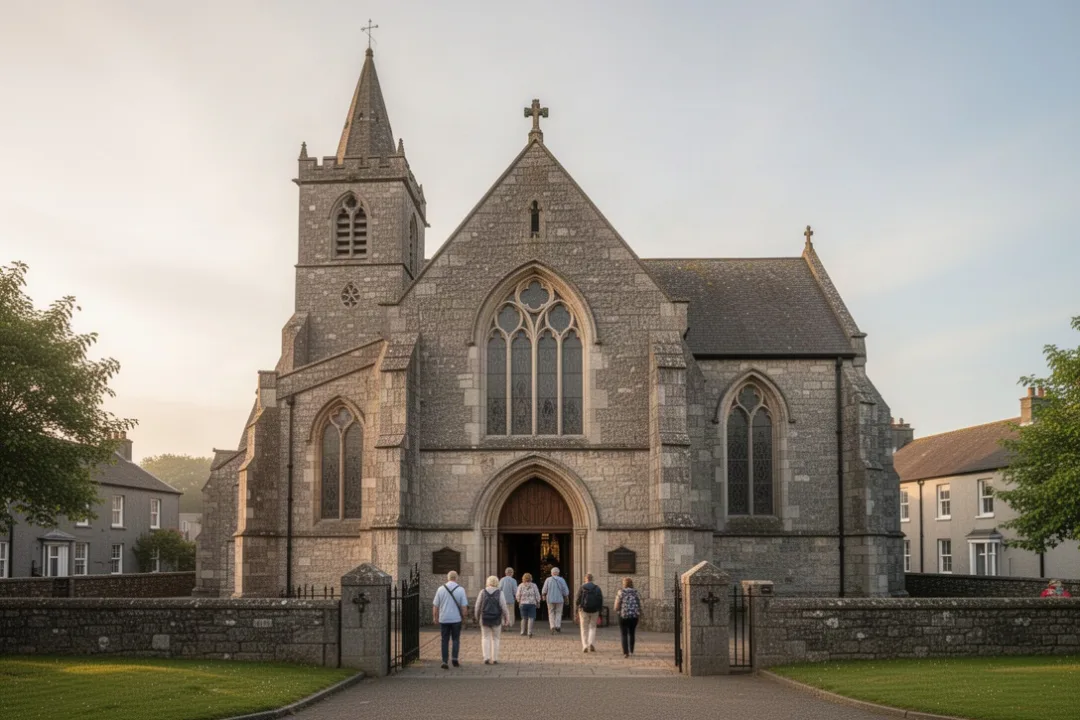
Saint Oliver’s head is preserved and venerated at St. Peter’s Church in Drogheda, County Louth. The shrine has become one of the most important places associated with his memory. Pilgrims visit to pray, learn about his life, and honor his witness.
Other relics are held in different locations, including places connected with his execution and with the communities that preserved parts of his remains. The distribution of relics reflects the complicated history following his death rather than a single burial site.
A visit to the Drogheda shrine can be approached in several ways:
Attend a liturgy or scheduled prayer service if one is available.
Read the displays explaining Plunkett’s ministry, trial, and death.
Spend time in quiet prayer before the relic.
Consider how religious persecution affected ordinary families, clergy, and children.
Pray for peace between communities divided by religion or politics.
The shrine’s value is not limited to the relic itself. It also preserves the memory of a period when Catholic worship had to be organized under pressure and when public religious identity could carry serious personal risk.
What Saint Oliver Plunkett means to Catholics today
Plunkett is often invoked as a patron of peace, reconciliation, religious freedom, and courageous leadership. His example speaks to people who must remain faithful without becoming consumed by anger toward opponents.
His life also presents a demanding model of pastoral responsibility. He did not treat persecution as an excuse to ignore problems within the Church. He corrected misconduct, addressed division, and asked priests and laypeople to take their responsibilities seriously.
For communities dealing with historical conflict, Plunkett’s story has a special significance. He belonged to one religious tradition, but his remembered response to violence was not revenge. His willingness to forgive does not erase the injustice he suffered; rather, it shows that reconciliation can acknowledge wrongdoing without reproducing hatred.
His witness can be applied to several situations:
Religious minorities: remain faithful while seeking lawful and peaceful ways to practice and protect religious life.
Church leaders: combine courage in public matters with honesty about internal failures.
Families: pass on religious identity through prayer, education, and service rather than fear alone.
People facing false accusations: seek truth and due process while resisting the temptation to dehumanize opponents.
Communities divided by history: remember injustice accurately while making room for forgiveness and peaceful cooperation.
Prayers and devotional practices associated with his feast
There is no single prayer required for devotion to Saint Oliver Plunkett. Catholics may ask for his intercession in ordinary personal prayer, during Mass, or through a novena. The intention may concern courage, protection from persecution, reconciliation, or wisdom for religious and civic leaders.
A simple devotional practice can include reading a short account of his life, reflecting on his commitment to peaceful service, and praying for people who suffer because of their beliefs. You might also pray for those who have been falsely accused or denied a fair hearing.
Families and parish groups can mark July 1 by discussing religious freedom and the responsibilities that accompany it. A useful approach is to connect Plunkett’s history with practical acts of peace, such as visiting someone who is isolated, supporting a persecuted community, or resolving a long-standing disagreement.
Devotion should not turn his story into a political slogan. The strongest reading of Plunkett’s witness keeps together truth, justice, forgiveness, and nonviolence. His life challenges people to defend conscience without treating opponents as enemies who can never change.
Why Saint Oliver Plunkett’s story still matters
Saint Oliver Plunkett’s story matters because it joins personal holiness to public injustice. He was not killed in a battlefield or during an act of rebellion. He was killed after a legal process that used treason charges to target a Catholic leader during a period of intense fear.
His example encourages careful attention to evidence. The false accusations against him remind us that courts and governments can fail when prejudice is allowed to replace proof. Religious identity, political suspicion, and public panic can create conditions in which an innocent person is treated as dangerous before the facts are tested.
His ministry also shows that courage is usually expressed through repeated duties rather than one dramatic moment. He traveled, taught, corrected clergy, celebrated the sacraments, encouraged families, and maintained Catholic life in difficult circumstances. These ordinary acts prepared the ground for the extraordinary courage of his final days.
For Catholics, Plunkett remains a saint because he combined fidelity with charity. For anyone studying history, he offers a clear example of how persecution affects institutions, families, and individual conscience. His memorial invites both prayer and serious reflection on justice, religious liberty, and the work of reconciliation.
Questions to consider when learning about Saint Oliver Plunkett
Plunkett’s life can be remembered through more than dates and titles. Ask what enabled a religious community to survive when its leaders were threatened. Ask how reliable testimony should be tested before a person is condemned. Ask how someone can oppose injustice without allowing resentment to define his character.
Those questions make his story relevant beyond Irish Catholic history. They concern every society that values freedom of conscience, fair trials, responsible leadership, and peaceful relations between religious communities.
Frequently asked questions
When is Saint Oliver Plunkett’s feast day?
Saint Oliver Plunkett’s feast day is July 1, the date associated with his execution at Tyburn in 1681. Catholics, especially in Ireland and communities with Irish connections, may mark the day with Mass, prayer, pilgrimages, or educational events about his ministry and martyrdom.
Where can visitors see Saint Oliver Plunkett’s head?
Saint Oliver Plunkett’s head is preserved at St. Peter’s Church in Drogheda, County Louth, Ireland. The church is a major pilgrimage site dedicated to his memory and presents information about his life, trial, execution, and continuing importance to Irish Catholics.
Was Saint Oliver Plunkett involved in an armed rebellion?
No credible evidence established that Plunkett planned an armed rebellion, invasion, or attack on Protestants. He consistently denied the charges and promoted peaceful religious ministry. His conviction was based on unreliable testimony during an intensely anti-Catholic political climate and is widely regarded as a miscarriage of justice.
When was Saint Oliver Plunkett canonized?
Pope Paul VI canonized Oliver Plunkett in 1975. He had previously been beatified in 1920. His canonization recognized him as a Catholic martyr and made him the first new Irish saint formally canonized in several centuries.










Leave a Reply