Saint Josaphat, also known as Josaphat Kuntsevych, was a Ruthenian Byzantine-rite bishop and martyr who worked for unity between Christians of the Eastern and Western traditions. He was killed in 1623 during religious and political conflict in the Polish-Lithuanian Commonwealth and was canonized by Pope Pius IX in 1867.
His story is closely connected with the Union of Brest, the Eastern Catholic tradition, and the difficult history of Christian communities in what is now Ukraine and Belarus. Catholics honor him as a saint on November 12, remembering both his pastoral work and his death while defending the church union he believed could preserve Eastern Christian traditions in communion with Rome.
Saint Josaphat was born around 1580 in Volodymyr-Volynskyi, a city in the Ruthenian lands of the Polish-Lithuanian Commonwealth. The exact details of his early life are not all certain, but he grew up in an Eastern Christian environment shaped by the Byzantine liturgical tradition. His baptismal name was probably Ivan, while “Josaphat” became his religious name later.
As a young man, he moved to Vilnius, where he trained for a career in business. Instead, he became increasingly drawn to prayer, Scripture, church history, and the renewal of Christian life. He entered the Order of Saint Basil the Great, a monastery-based community that served Eastern Christians while retaining their Byzantine worship, spirituality, and customs.
Josaphat did not become a Western-style bishop who replaced Eastern practices with Latin ones. His work centered on strengthening the Eastern Christian community through Byzantine liturgy, disciplined clergy, monastic reform, and teaching. He believed that Eastern Christians could remain faithful to their own heritage while also being in full communion with the pope.
That belief placed him in the middle of a serious dispute. Some Ruthenian Christians supported communion with Rome, while others rejected it and defended an Orthodox ecclesial structure. The disagreement involved theology, but it also reflected competition among bishops, political loyalties, ethnic identity, local customs, and the influence of powerful governments.
Essential distinction: Saint Josaphat was not trying to erase Byzantine Christianity. He supported communion with Rome while defending the Eastern rite, its liturgy, its spiritual tradition, and the legitimate customs of its clergy and people.
His importance today comes from this combination of identity and mission. Josaphat represents a form of Christian unity that does not require every community to worship in the same way. He also offers a historical example of how a commitment to church unity can become entangled with political conflict, local resistance, and human suffering.
Saint Josaphat’s early life and monastic vocation
Josaphat’s early adulthood coincided with a period of change among Ruthenian Christians. Church leaders and political authorities were debating how Eastern Christian communities should relate to Rome, Constantinople, and the governments that ruled their territory. The religious landscape was not divided into simple, isolated groups; people often lived with overlapping loyalties tied to parish, language, family, region, and ruler.
In Vilnius, Josaphat encountered the Ruthenian Church and the monastic movement that would shape his life. He joined the monastery associated with the Holy Trinity in Vilnius, where he took on the religious name Josaphat. The monastery became an important center for his study, preaching, prayer, and efforts to renew religious discipline.
His spirituality emphasized frequent prayer, fasting, repentance, service to the poor, and careful instruction in the faith. Accounts of his life describe him as an austere monk who practiced self-denial, but his public ministry also involved practical responsibilities. He worked to improve the formation of clergy and encouraged bishops and priests to live in ways consistent with their pastoral responsibilities.
Josaphat belonged to a tradition in which monastic life was not separated from service to the wider church. The monastery provided a setting for liturgical prayer and theological study, but it also supplied clergy, teachers, preachers, and administrators. His later leadership grew from that monastic foundation rather than from a desire for political influence.
The union between some Ruthenian bishops and the Catholic Church was formally connected with the Union of Brest in 1596. The union recognized the pope’s authority while allowing the Ruthenian church to retain its Byzantine rite and much of its established discipline. Josaphat became one of the strongest advocates for implementing this union in local church life.
Support for the union was never universal. Some bishops and faithful accepted it, while others believed it compromised Eastern Christian independence or had been shaped too strongly by political pressure. The resulting division was especially painful because communities that shared language, customs, and liturgical heritage could find themselves under rival bishops and competing institutions.
Josaphat’s position was firm, but his work was not simply a campaign of abstract theology. He wanted the union to produce visible changes in preaching, sacramental life, clerical conduct, and parish organization. He also wanted Catholics of the Byzantine tradition to understand that communion with Rome did not make them culturally Latin.
What the Union of Brest meant
The Union of Brest was an agreement by several Ruthenian bishops to enter or restore communion with the Catholic Church while preserving the Byzantine liturgical tradition. Their communities continued to use Eastern forms of worship, church Slavonic in many settings, married parish clergy according to Eastern discipline, and distinctive theological and spiritual customs.
The agreement did not immediately create peace. Some Orthodox Christians rejected it, and some Catholic leaders did not always respect the Eastern customs that the union was supposed to preserve. As a result, the word “union” could mean different things to different people: a theological relationship, a political alignment, a local power struggle, or a threat to inherited religious identity.
That historical background helps explain why Josaphat’s preaching provoked both admiration and anger. To supporters, he was defending a legitimate union and protecting the Eastern church from decline. To opponents, he could appear to be enforcing an unwanted arrangement connected to foreign authority. Modern readers should avoid reducing the conflict to a simple disagreement between good and bad individuals.
His work as a bishop and reformer
Josaphat was ordained a priest and later became abbot of the monastery in Vilnius. His reputation for learning, discipline, and commitment to church renewal led to his appointment as bishop of Vitebsk and then archbishop of Polotsk. These positions gave him responsibility for communities where the union with Rome remained contested.
As a bishop, he focused on clergy formation and the quality of parish life. He challenged priests who neglected their duties, treated church offices as sources of personal income, or failed to teach the people entrusted to them. He also encouraged preaching and catechesis so that the faithful would understand the meaning of their worship rather than simply inherit religious practices without instruction.
His reforms extended to church property and administration. Bishops and monasteries controlled land, buildings, and other resources, and disputes over these assets often intensified the religious conflict. Josaphat tried to strengthen Catholic administration in the areas under his authority, but attempts to enforce a bishop’s jurisdiction could be viewed by opponents as an attack on their community.
He also worked to renew monasteries. The Basilian order had an important role in preserving and developing Eastern Catholic life, and Josaphat regarded disciplined monastic communities as essential to the church’s future. Monks could serve as teachers, confessors, preachers, writers, and parish clergy, helping communities maintain their spiritual and intellectual life.
His ministry was not limited to institutional reform. He was known for personal austerity and direct pastoral contact. He preached, heard confessions, visited people, and attended to those in need. His supporters remembered him as a bishop who lived simply and accepted hardship rather than using ecclesiastical office for comfort or status.
At the same time, his methods must be understood within the limitations of his period. Religious leaders in the early modern Commonwealth often operated with the support or opposition of local nobles and state authorities. Church jurisdiction was connected to property, legal rights, and public order. Even a reform intended to strengthen spiritual life could have immediate consequences for who controlled a parish, monastery, or cathedral.
Historical caution: Josaphat’s reputation as a martyr does not mean that every policy associated with the church union was peaceful or universally accepted. His life should be honored alongside an honest recognition of the pressure, coercion, and political conflict surrounding religious divisions in his time.
His pastoral goals can be summarized in several connected priorities:
Preserve Byzantine worship within communion with Rome.
Improve the education and conduct of clergy.
Strengthen monastic life and religious discipline.
Teach the faithful through preaching and catechesis.
Defend church unity as he understood it.
These priorities help explain why Josaphat became influential so quickly. He was not only a controversial church politician. He was also a religious reformer who believed that unity required serious spiritual renewal, clear teaching, and responsible leadership.
How Saint Josaphat died as a martyr
Opposition to Josaphat intensified in the years after he became archbishop of Polotsk. Some Orthodox leaders and communities rejected his jurisdiction, while local political figures sometimes supported competing ecclesiastical structures. In areas where both sides claimed authority, ordinary religious practice could become a public sign of allegiance.
The city of Vitebsk became a particularly dangerous place. Josaphat traveled there in 1623 to address resistance to his authority and to seek reconciliation. He understood that the situation was tense, but he continued his pastoral work rather than abandoning the community.
On November 12, 1623, a group opposed to the union entered the archbishop’s residence. Josaphat was attacked and killed. Historical accounts describe a violent assault involving several weapons, after which his body was thrown into the Dvina River. He was about forty years old.
His death shocked supporters and drew attention across the Commonwealth. The killing was not an isolated theological argument; it was the result of a broader struggle involving ecclesiastical authority, social divisions, and political loyalties. Those responsible were punished by the authorities, although the exact legal treatment varied among the people involved.
For Catholics, Josaphat’s death was a martyrdom for church unity. That phrase refers to his willingness to accept death rather than abandon the communion and pastoral responsibilities he believed were true. It does not mean that every later interpretation of the conflict is equally reliable or that his opponents can be understood only through hostile descriptions written by his supporters.
The Christian meaning of martyrdom is centered on faithful witness, not on glorifying violence. Josaphat did not become a model because violence was done in his name. He became a martyr because he remained committed to his religious vocation in the face of threats and ultimately died during a mission of pastoral leadership.
Why his martyrdom remains complicated
Different Christian communities remember the events of 1623 from different perspectives. Eastern Catholics see Josaphat as a defender of their church and a witness to unity. Many Orthodox Christians have remembered the union associated with him as a painful period of pressure and division. The historical record includes genuine religious conviction on multiple sides, along with political interests and acts of coercion.
A responsible account therefore holds two truths together. Josaphat’s courage and sincerity can be honored, while the suffering caused by religious conflict must also be acknowledged. Admiration for a saint does not require ignoring the wounds left by the institutions and policies connected with his mission.
This balanced approach is especially useful when discussing saints whose lives unfolded during periods of division. Historical sanctity is not the same as political perfection. Josaphat’s witness can encourage a desire for unity, but it should not be used to excuse contempt for other Christians or to repeat old polemics without examination.
Canonization, feast day, and symbols
After his death, devotion to Josaphat spread among Catholics, particularly in Eastern Catholic communities. His remains were moved more than once because of changing political and religious conditions. They eventually came to be associated with the Saint Peter’s Basilica in Rome, where his tomb is honored.
Josaphat was beatified by Pope Urban VIII in 1643, about two decades after his death. He was canonized by Pope Pius IX in 1867. He is commonly described as the first Eastern Catholic saint formally canonized by Rome, a distinction that reflects the importance of his recognition for churches using Eastern rites in communion with the Catholic Church.
His feast day is November 12. In Catholic worship, a feast day is more than a historical anniversary. It is a day for liturgical prayer, reflection on a saint’s witness, and asking how the saint’s virtues can be lived in the present. For Josaphat, the central themes are fidelity, pastoral courage, prayer, reform, and the pursuit of Christian unity.
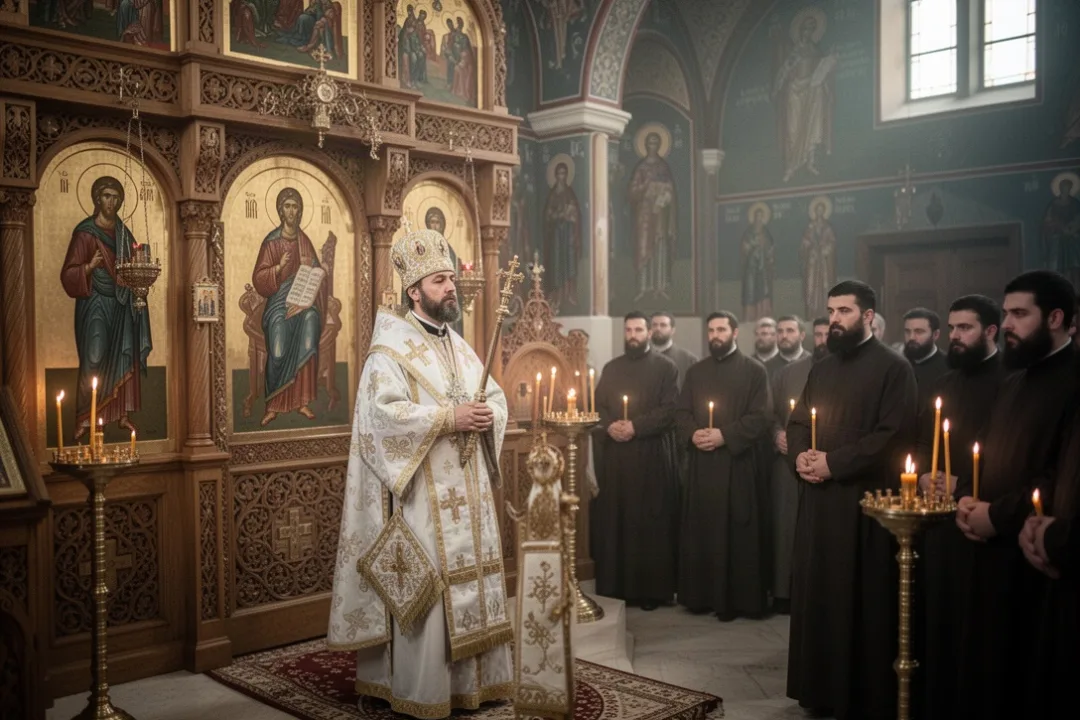
Art commonly depicts him wearing the vestments of a Byzantine bishop. He may hold a cross, a pastoral staff, or a symbol connected with his martyrdom. Images of him generally emphasize his role as an Eastern Catholic archbishop rather than portraying him as a Latin cleric.
Common themes associated with Saint Josaphat include:
Christian unity: a desire for communion among divided Christians.
Eastern Catholic identity: fidelity to Byzantine worship within Catholic communion.
Pastoral responsibility: care for clergy, parishes, and the poor.
Monastic discipline: prayer, fasting, study, and service.
Martyrdom: steadfast witness under threat and persecution.
People may ask Saint Josaphat’s intercession for church unity, reconciliation among Christians, faithful leadership, courage during persecution, and renewal within religious communities. Such devotion does not require treating him as a substitute for direct action. Prayer for unity is most credible when joined with humility, truthful history, patient listening, and respect for people from other traditions.
Saint Josaphat’s legacy for Christians today
Saint Josaphat remains especially significant for Eastern Catholics, including communities shaped by the Ruthenian, Ukrainian, and Belarusian religious heritage. His life reminds these churches that communion with Rome can exist alongside Eastern liturgy, theology, canon law, music, architecture, and spiritual practice.
His legacy also reaches beyond his own church. Christians divided by history can recognize in his story both the longing for unity and the damage caused when religious disagreement becomes tied to power. His example invites believers to seek unity without demanding cultural uniformity or dismissing the identity of communities that have suffered during past conflicts.
For Catholic communities, his life raises practical questions about how unity should be pursued. Unity is not simply a statement that everyone belongs together. It depends on trust, mutual recognition, honest teaching, and respect for legitimate differences. The history of the Union of Brest shows what can happen when those foundations are weak or when church structures become tools in political struggles.
His example can also be read as a call to reform within the church. Josaphat’s work among clergy and monasteries reflects a conviction that institutional renewal begins with personal conversion. Better structures matter, but they cannot replace prayer, integrity, education, and a sincere concern for the people whom leaders serve.
At the personal level, his witness may speak to anyone trying to remain faithful during conflict. He faced criticism from people who regarded his mission as harmful, while his supporters saw him as courageous and loyal. His life does not promise that faithful action will receive immediate approval. It does show the value of acting from settled conviction while resisting hatred toward opponents.
A thoughtful way to remember Saint Josaphat is to combine devotion with historical care:
Learn the Eastern Catholic tradition rather than viewing it only through Western categories.
Study the Union of Brest with attention to both its stated aims and its contested consequences.
Pray for Christian unity without treating other Christians as enemies.
Support honest dialogue between Catholic and Orthodox communities.
Practice pastoral responsibility through service, teaching, and care for those who are vulnerable.
Saint Josaphat’s story is therefore more than the account of one bishop who died violently. It is a window into the history of Eastern Christianity, the meaning of communion across traditions, and the risks that arise when religious identity becomes inseparable from political authority.
His feast day can be observed with Byzantine or Roman Catholic prayer, readings about Christian unity, and reflection on the responsibilities of church leaders. The most faithful tribute is not to repeat old hostilities, but to seek the unity he desired through truth, charity, and respect for the traditions of other Christians.
Frequently asked questions
Was Saint Josaphat Catholic or Orthodox?
Saint Josaphat was an Eastern Catholic bishop. He belonged to the Byzantine Christian tradition and supported communion with the pope after the Union of Brest. His identity was therefore both Eastern in worship and spirituality and Catholic in ecclesial communion. His life unfolded during a period when Catholic and Orthodox communities in the Ruthenian lands were sharply divided.
What is Saint Josaphat the patron saint of?
Saint Josaphat is especially associated with Christian unity, Eastern Catholics, and people seeking reconciliation among divided churches. He is also remembered as a patron and intercessor for bishops, clergy, religious communities, and those facing opposition because of their faith. Different communities may emphasize particular aspects of his patronage.
Where are Saint Josaphat’s relics?
Saint Josaphat’s relics are honored at Saint Peter’s Basilica in Rome. His remains were moved during periods of political and religious upheaval before being brought to Rome. The tomb reflects his importance to the Catholic Church and especially to Eastern Catholics, who continue to honor him as a Byzantine-rite bishop and martyr.
Why is Saint Josaphat controversial?
The controversy comes from the religious and political conflict surrounding the Union of Brest. Supporters viewed him as defending legitimate communion with Rome and Eastern Christian traditions, while opponents saw the union as pressured or harmful to Orthodox communities. Respectful study recognizes both his sincere commitment and the real suffering caused by the broader conflict.













Leave a Reply