Saint Henry usually refers to Saint Henry of Finland, a 12th-century bishop associated with the beginnings of Christianity in Finland. He is traditionally remembered as a missionary bishop from England who worked in Finland alongside King Eric of Sweden and died as a martyr around 1156.
His feast day is January 19, and he is honored as the patron saint of Finland. Some details of his life come from medieval tradition rather than securely documented contemporary records, so his story combines historical evidence, church memory, and later legend.
Saint Henry is known in Latin as Henricus and in Finnish as Pyhä Henrik. Christian tradition identifies him as a bishop connected with Uppsala in Sweden who traveled east across the Baltic region to preach and organize the Christian community in Finland.
The surviving evidence does not provide a complete biography. His exact birthplace, education, date of arrival in Finland, and time as bishop remain uncertain. Later accounts describe him as an English-born churchman, but historians treat some details cautiously because the main written narratives were produced after the period in which he lived.
Henry’s importance comes less from a large collection of personal writings than from his place in the early Christian history of Finland. He represents the period when Christianity was becoming established among communities that had long followed local religious traditions and maintained connections throughout the Baltic and Scandinavian world.
The medieval church in Finland was not created by one person working alone. Missionaries, local converts, Swedish rulers, clergy, and communities all played different roles. Henry became the figure most closely associated with this process because tradition remembers him as a bishop who traveled, preached, administered the sacraments, and died while serving the people he had come to evangelize.
Historical caution: The broad tradition of Saint Henry’s mission and martyrdom is well established in Finnish Christian memory, but the precise dates and details of his life are not known with complete certainty.
Saint Henry’s mission in Finland
Saint Henry’s mission is traditionally placed in the 1150s, during a period when Sweden was extending political and ecclesiastical influence across the eastern Baltic. According to church tradition, King Eric of Sweden led a campaign to Finland, and Henry accompanied him as a bishop or missionary organizer.
Medieval sources and later tradition connect the mission with the introduction of Latin Christianity in parts of Finland. Henry’s work would have involved more than public preaching. A bishop serving a developing Christian community would also teach the faith, celebrate worship, baptize converts, guide clergy, settle religious questions, and help establish lasting church structures.
The phrase “conversion of Finland” can be misleading if it suggests that an entire population became Christian at one moment. Christianity arrived through gradual contact and regional change. Trade, marriage, travel, political alliances, missionary visits, and local decisions all contributed to the spread of Christian practices over time.
Some Finnish communities may have encountered Christianity before Henry, through contact with Sweden, Novgorod, Scandinavia, or traveling merchants. His significance lies in the traditional claim that he helped give the Christian presence a more organized form rather than being the first Christian anyone in Finland had ever encountered.
Henry’s mission also took place in a region where political and religious motives could overlap. Medieval rulers sometimes supported missionary activity because Christianity strengthened ties with other Christian kingdoms and church institutions. That does not erase the religious purpose of Henry’s preaching, but it explains why accounts of his work often appear alongside stories of royal power and military expeditions.
There is no surviving contemporary biography that answers every question about Henry. The principal narratives were written later, and they reflect the devotional purpose of medieval hagiography: presenting a holy person as a model of faith, pastoral courage, and sacrifice.
That does not mean the entire tradition is fictional. A later source can preserve older memories, even when it also contains symbolic or legendary elements. Historians compare the written accounts with church dedications, liturgical calendars, archaeological evidence, and regional history to assess what may be securely known.
The most cautious account is that a bishop named Henry was associated with the Christian mission in Finland and was remembered as a martyr. His exact relationship to Uppsala, King Eric, and particular locations remains a subject of historical discussion.
How Saint Henry died according to tradition
The traditional account says that Henry was killed after the royal expedition had ended. A man named Lalli is identified as his attacker. In the story, Henry encountered Lalli after an incident involving payment or property, and a conflict followed in which the bishop was murdered.
Later versions say that Henry’s body was buried at Köyliö, an island or area associated with the event in southwestern Finland. The legend then describes the discovery of a ring or other sign connected with the bishop’s body. These details belong to the devotional tradition and should not be treated as independently verified facts.
Medieval martyr stories often use recognizable patterns. A holy person travels among the people, faces hostility, refuses to abandon his calling, and dies because of it. The account of Henry’s death presents him as a pastoral martyr: a bishop who remains responsible for his community even when doing so places him in danger.
The story also helped explain how a local landscape became connected with Christian memory. Places linked to the saint’s death, burial, or relics could become pilgrimage destinations. Through worship and repeated retelling, a particular region acquired a sacred identity that remains part of Finnish cultural history.
Remember the distinction: Saint Henry’s martyrdom is central to the church’s traditional devotion, while the exact circumstances involving Lalli and Köyliö come from later accounts and cannot all be confirmed as historical detail.
The story of Lalli in Finnish tradition
Lalli became one of the best-known figures in Finnish medieval legend. He is commonly portrayed as a local landowner or farmer who killed Henry and later suffered punishment or misfortune. In many versions, the story carries a moral contrast between the bishop’s religious mission and the attacker’s violence.
The legend changed as it passed through manuscripts, sermons, art, schoolbooks, and popular storytelling. Some retellings present Lalli as a straightforward villain; others have encouraged discussion about local resistance, social conflict, or the way medieval history was interpreted by later generations.
For that reason, Lalli is best understood as both a character in the martyr story and a figure in Finnish cultural memory. The tale says something about how communities remember the arrival of Christianity, the authority of bishops, and the tension between outside institutions and local life.
The feast of Saint Henry is celebrated on January 19. In Finland, the day has particular importance because Henry is regarded as the country’s patron saint. The liturgical observance belongs to the wider Christian tradition of honoring saints on the date associated with their death, which is understood as their entrance into eternal life.
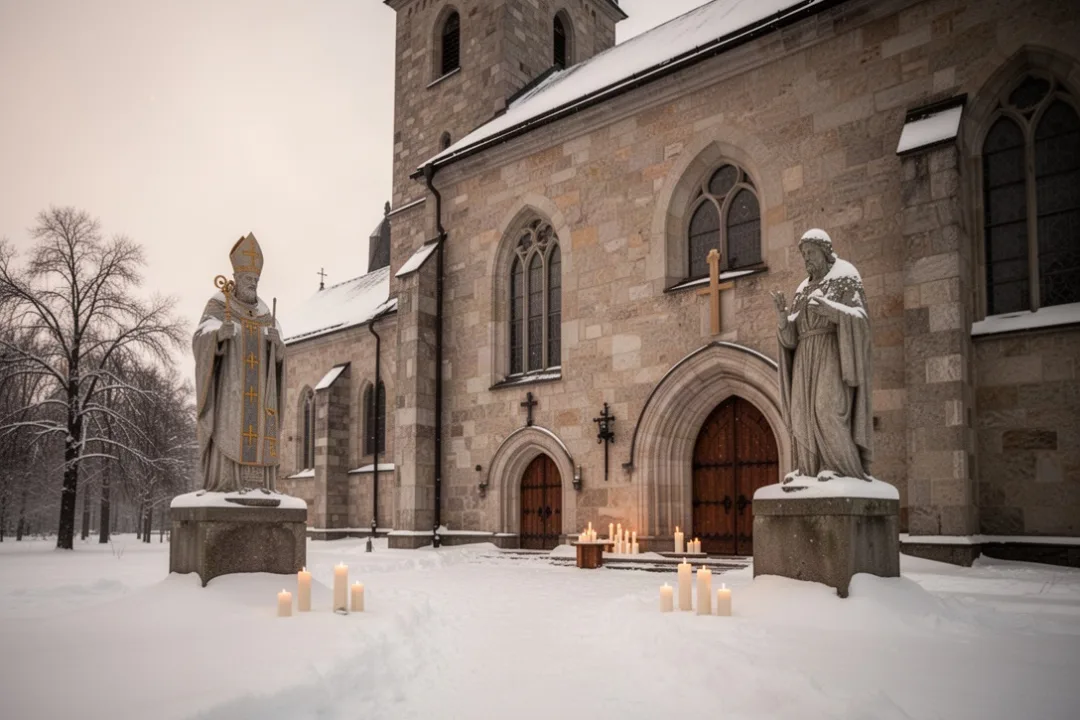
Saint Henry is commonly shown in bishop’s vestments, often carrying a crozier or appearing with a mitre. Artistic representations may also include a book, signifying his teaching and preaching, or a palm, symbolizing martyrdom.
Images connected with the Finnish legend may show Henry standing over or near Lalli. In some artwork, the bishop’s severed head or a particular scene from the martyr story appears as a visual reference to the saint’s death. These images can be striking, but their purpose is not simply to illustrate violence. They identify Henry as someone who accepted danger in the service of his faith.
Churches dedicated to Saint Henry can be found in Finland and elsewhere. A dedication to a saint often indicates that a community wants to place its worship under that person’s spiritual example. In Henry’s case, the dedication also points to the historical memory of Christianity’s early institutional presence in Finland.
Feast day: January 19.
Patronage: Finland and the Finnish Church.
Traditional role: missionary bishop and martyr.
Common symbols: bishop’s clothing, crozier, book, and martyr’s palm.
Important places: Turku and Köyliö are especially associated with his memory.
Why Saint Henry matters in Finland
Saint Henry is important not only as a religious figure but also as a symbol of Finland’s medieval Christian heritage. His story links Finnish history with Sweden, the Latin Church, the Baltic region, and the wider European network of medieval Christianity.
Turku became especially significant in the development of the Finnish church. Tradition and later church history associate Saint Henry with the diocese connected with Turku, although the exact organization of the early diocese developed over time. The cathedral in Turku became a major center of Finnish religious life and is strongly associated with Henry’s memory.
Relics have also shaped devotion to the saint. Relics are physical remains or objects associated with a holy person, and medieval churches often treated them as visible connections between the worshiping community and the saint. Accounts of Henry’s relics have changed over time, and their history reflects periods of war, movement, religious reform, and changing church practice.
During the Protestant Reformation, Catholic forms of saint veneration were reduced or reshaped in Finland. Even so, Henry did not disappear from the country’s historical memory. He continued to appear in art, place names, literature, church history, and discussions of Finland’s medieval past.
His story can be meaningful to people in different ways. For Catholics and other Christians, he is a model of missionary service and faithful endurance. For historians, he is a window into the formation of medieval institutions. For many Finns, he is part of the cultural story of how Christianity became rooted in the country.
Religious meaning for Christians today
Saint Henry’s example emphasizes that missionary work is not limited to speaking publicly about belief. It includes education, care for communities, worship, patience, and a willingness to serve people over a long period. His traditional role as a bishop highlights the responsibility of building structures that allow faith to continue after one preacher is gone.
His martyrdom also raises a careful question about courage. Christian devotion does not require seeking danger or treating conflict as proof of holiness. Henry is honored because tradition presents him as remaining faithful to his vocation, not because suffering itself is considered desirable.
For someone praying with Saint Henry’s example, several themes may be especially relevant:
Perseverance: continuing meaningful service when results are slow.
Pastoral care: helping a community grow in understanding and compassion.
Respectful evangelization: sharing religious conviction without ignoring local people or their history.
Reconciliation: remembering that the history of conversion can include both sincere faith and political tension.
Hope under pressure: remaining grounded in one’s beliefs without glorifying violence.
How Saint Henry is remembered today
Saint Henry’s memory survives through feast-day liturgies, churches, artwork, historical sites, and pilgrimage traditions. The annual observance on January 19 gives churches an opportunity to pray for Finland, remember the country’s Christian heritage, and reflect on the responsibilities that come with religious leadership.
Some people visit places associated with Henry, particularly sites connected with Turku or the traditional account of his death at Köyliö. A pilgrimage does not have to be a long journey or a formal religious event. It can involve visiting a church, learning about a local tradition, or setting aside time for prayer and reflection.
Schools and cultural institutions may approach Henry differently from churches. They may present him as a figure from the medieval period, examine the reliability of the sources, or discuss how legends influence national identity. These approaches can complement religious devotion when they distinguish clearly between historical evidence and sacred tradition.
Saint Henry’s story also invites a broader reflection on how Christianity spread in northern Europe. Conversion was not a single event with a simple beginning and end. It was a long process shaped by local communities, international connections, political authority, religious conviction, and the creation of new institutions.
That complexity does not make Henry’s legacy less meaningful. It makes the tradition more understandable. He can be honored as a saint while his biography is studied with care, his legends are identified as legends, and the people who lived in Finland before and during Christianization are remembered as active participants in history rather than passive figures in someone else’s story.
For a Christian seeking Saint Henry’s intercession, a simple observance might include attending Mass or another church service on January 19, reading about the early church in Finland, praying for church leaders, or asking for the patience to serve a community faithfully. The central image remains clear: a bishop remembered for bringing Christian teaching to Finland and for dying in the course of that mission.
Frequently asked questions
Was Saint Henry a real historical person?
Most historians accept that a bishop named Henry was connected with the early Christian mission in Finland, but the surviving evidence is limited and comes largely from later sources. His exact dates, background, and activities cannot be established in every detail. The broad memory of Henry as a missionary bishop and martyr is stronger than the individual details found in later legends.
Is Saint Henry the same person as King Henry?
No. Saint Henry of Finland is traditionally identified as a bishop and missionary. King Henry usually refers to a different saint, such as Henry II, the Holy Roman Emperor, who lived in Germany and died in 1024. Several saints have the name Henry, so the country, title, and feast-day context help distinguish them.
Where is Saint Henry believed to have been killed?
Tradition places his death in the Köyliö area of southwestern Finland. The story says that a man named Lalli killed the bishop after Henry’s missionary work. Köyliö remains associated with the saint, although the precise historical circumstances of the death and the details of the later legend cannot be verified with complete certainty.
How can someone observe Saint Henry’s feast day?
Saint Henry’s feast day is January 19. You might attend a church service, pray for Finland and Christian communities, visit a church connected with his memory, or read about medieval Finnish history. A thoughtful observance can hold religious devotion and historical awareness together by honoring Henry’s traditional witness while recognizing the limits of the surviving evidence.















Leave a Reply