Saint Olaf: Norway’s king, martyr, and patron saint
Saint Olaf: Norway’s king, martyr, and patron saint
Who was Saint Olaf, and why do churches, place names, and festivals across Scandinavia still bear his name? Saint Olaf was Olaf II Haraldsson, a medieval Norwegian king who helped establish Christianity as a public faith in Norway. He died in battle at Stiklestad in 1030 and was honored as a saint soon afterward.
His story combines political ambition, religious change, military conflict, and centuries of devotion. Olaf was not simply a peaceful missionary or a flawless ruler. He was a warrior king who used laws, alliances, and force to strengthen royal authority and Christian practice. His death transformed him into Norway’s national saint and made his shrine at Nidaros, present-day Trondheim, one of northern Europe’s important medieval pilgrimage destinations.
Saint Olaf was born around 995, although the exact year is uncertain. His family belonged to the Norwegian royal dynasty, and he grew up during a period when Scandinavian rulers competed for control of Norway and the wider North Sea world. Christianity was spreading, but older Norse religious customs remained influential, especially outside the major trading centers and royal households.
As a young man, Olaf traveled and fought in different parts of Europe. Medieval sources describe campaigns in the Baltic region, England, and France, though some details are difficult to confirm. These experiences exposed him to Christian kingdoms and gave him the military reputation and political connections he later used in Norway.
Olaf returned to Norway in 1015 and claimed the kingship. He worked to bring more of the country under a single royal administration, challenge local rulers, and promote Christian laws. His authority was never complete. Powerful regional leaders resisted him, and foreign pressure from King Cnut of Denmark and England eventually made his position more vulnerable.
The short answer: Saint Olaf was Olaf II Haraldsson, king of Norway from 1015 to 1028. He became a saint after dying at Stiklestad in 1030, and his cult helped make Nidaros a major center of medieval Christianity.
How Olaf II became known as Saint Olaf
Olaf’s sainthood followed a pattern familiar in medieval Europe: a ruler died violently, people reported miracles or extraordinary signs, and local religious leaders recognized a growing cult around his memory. According to the tradition, Olaf’s body was examined after his death and found to show signs associated with holiness. His former ally and bishop, Bishop Grimkell, is often connected with the early recognition of Olaf as a saint.
Olaf’s cult developed quickly after 1030. His son, Magnus the Good, became king and supported his father’s memory as part of the restoration of the Norwegian dynasty. By the eleventh century, churches and communities were invoking Olaf as a holy protector. His sainthood was not based on a simple modern-style canonization process. Instead, recognition grew through local veneration, episcopal approval, royal support, reported miracles, and the establishment of a shrine.
Medieval Christians understood sainthood through more than a person’s private character. A saint could be a martyr, a miracle worker, a defender of the faith, or a ruler whose death came to be interpreted as part of God’s providence. Olaf was remembered especially as a martyr king and as the Christian ruler who had helped shape Norway’s religious order.
Saint Olaf’s life and reign, step by step
He was born into Norway’s royal family. Olaf inherited a claim to kingship during a period when Norway was divided among local rulers and influenced by Danish power.
He gained experience as a Viking-age warrior. His early campaigns gave him military skill, wealth, and contacts beyond Scandinavia.
He returned to Norway in 1015. Olaf gathered supporters, defeated rival forces, and was accepted as king in much of the country.
He strengthened royal government. He appointed officials, challenged independent chieftains, and sought greater control over law and taxation.
He promoted Christianity. Churches, bishops, Christian customs, and laws received royal backing, although conversion was uneven and sometimes coercive.
He lost power to Cnut. Opposition from Norwegian elites combined with Danish military pressure, forcing Olaf into exile in 1028.
He returned and died at Stiklestad. Olaf attempted to regain his kingdom but was defeated and killed on July 29, 1030.
His memory became a source of political and religious unity. After his death, his son’s government and the church promoted Olaf’s cult across Norway.
How Saint Olaf helped Christianize Norway
It would be misleading to say that Olaf single-handedly converted Norway. Christianization had begun before his reign through contacts with England, Germany, and other Christian areas. Earlier rulers, including Olaf Tryggvason and Olaf’s great-grandfather Harald Bluetooth’s Danish dynasty, also played major roles in the religious changes taking place across Scandinavia.
Olaf’s contribution was to connect Christian belief with royal law and national administration. He supported bishops and priests, encouraged church building, and made Christian practices part of the laws enforced by royal authority. The result was not an instant change in personal belief. Many communities blended older customs with Christian worship for generations, and resistance to Olaf’s policies was often as political as it was religious.
Medieval conversion could affect inheritance, marriage, burial, festivals, oaths, and public authority. A king who required Christian observance was also changing how communities organized their lives. Olaf’s opponents could therefore resist him because they disliked both his religious policies and his attempts to limit the power of local rulers.
Later tradition sometimes presents Olaf as a straightforward champion who brought Christianity to a resistant people. Historians generally describe a more complicated process. Christianization was gradual, involved many leaders and communities, and unfolded alongside the growth of a more centralized Norwegian kingdom.
Why Olaf was exiled before the Battle of Stiklestad
Olaf’s political program created enemies. He tried to replace or control regional chieftains, enforce royal decisions, and collect resources more consistently. These actions threatened established privileges. His religious policies intensified the conflict because they challenged traditional leaders who held both political and sacred authority in their communities.
At the same time, Cnut the Great was expanding Danish influence in Norway. Cnut supported Norwegian nobles who opposed Olaf and placed his own political network in a strong position. Olaf fled Norway in 1028 and spent part of his exile in Kievan Rus, where he was connected with the court of Yaroslav the Wise and his wife, Ingigerd.
Olaf returned in 1030 with the hope of recovering the throne. He gathered an army and moved through central Norway. His opponents, including regional leaders who had grown stronger during his absence, met him at Stiklestad near Verdal.
The Battle of Stiklestad took place on July 29, 1030. Olaf was killed, traditionally by several wounds, including an injury to the leg, stomach, and neck. The exact details come from later accounts and must be treated with care, but the battle itself and Olaf’s death are central to the historical tradition.
What happened at Stiklestad after Olaf’s death
Olaf’s death did not end his influence. According to the tradition, his body was taken to Nidaros, where it was buried. Reports of miracles soon surrounded his grave. The church and royal government recognized the site as sacred, and Nidaros became associated with Saint Olaf’s shrine.
The political situation also changed. Cnut’s authority in Norway weakened, and Olaf’s young son Magnus eventually became king. Magnus’s rule helped restore the dynasty connected with Olaf. Supporting Olaf’s sainthood therefore served both a religious purpose and a political one: the dead king could be presented as the rightful Christian ruler whose kingdom had been unjustly taken from him.
This does not mean that the cult was merely a political invention. Medieval devotion often developed through the interaction of popular belief, political memory, local worship, and church recognition. Olaf’s cult became durable because different groups found meaning in him: kings saw a dynastic predecessor, clergy saw a Christian patron, pilgrims sought healing, and ordinary worshipers honored a holy protector.
Why Nidaros became Saint Olaf’s major shrine
Nidaros, now Trondheim, became the center of Olaf’s cult. The city grew around the Nidelva River and developed into an important religious and political site. The cathedral built there became associated with Olaf’s shrine and with the wider Christian identity of Norway.
During the Middle Ages, pilgrims traveled to Nidaros from across Scandinavia and from other parts of northern Europe. Pilgrimage could express repentance, gratitude, devotion, or a request for healing. Travelers also encountered inns, churches, roads, and local traditions shaped by the flow of people heading toward the shrine.
The cathedral’s significance extended beyond Olaf himself. Nidaros became the seat of an archbishop and a center for church administration in Norway. The shrine connected Norwegian Christianity to international pilgrimage culture while also giving the kingdom a distinct patron saint.
Many medieval shrines were damaged or dismantled during the Protestant Reformation. Saint Olaf’s shrine did not retain its medieval role in the same way after religious changes in Norway. Even so, Nidaros Cathedral remains strongly linked with Olaf, and his memory continues to shape the city’s religious and cultural identity.
What Saint Olaf represents in Christian tradition
Saint Olaf is most often understood as a symbol of Christian kingship, national unity, and martyrdom. His story presents a ruler who tried to place Christian law at the center of public life, lost his throne, and died while attempting to recover it. For medieval audiences, that combination made his death meaningful as both a political sacrifice and a religious witness.
His symbolism is not limited to idealized royal authority. Olaf also represents the tension between faith and power. He used force in a violent age, and the changes associated with him were not always peaceful. His story can therefore be read as a record of how religion, law, state-building, and cultural change affected one another.
For many worshipers, Saint Olaf’s importance is personal rather than political. He may be invoked as a protector of Norway, a patron of travelers, or an example of repentance and perseverance. Local traditions differ, and not every title associated with him has the same historical status.
Saint Olaf’s legacy is best understood as both religious and historical: he became holy in memory, while his reign helped shape the institutions of medieval Norway.
How Saint Olaf appears in art and church imagery
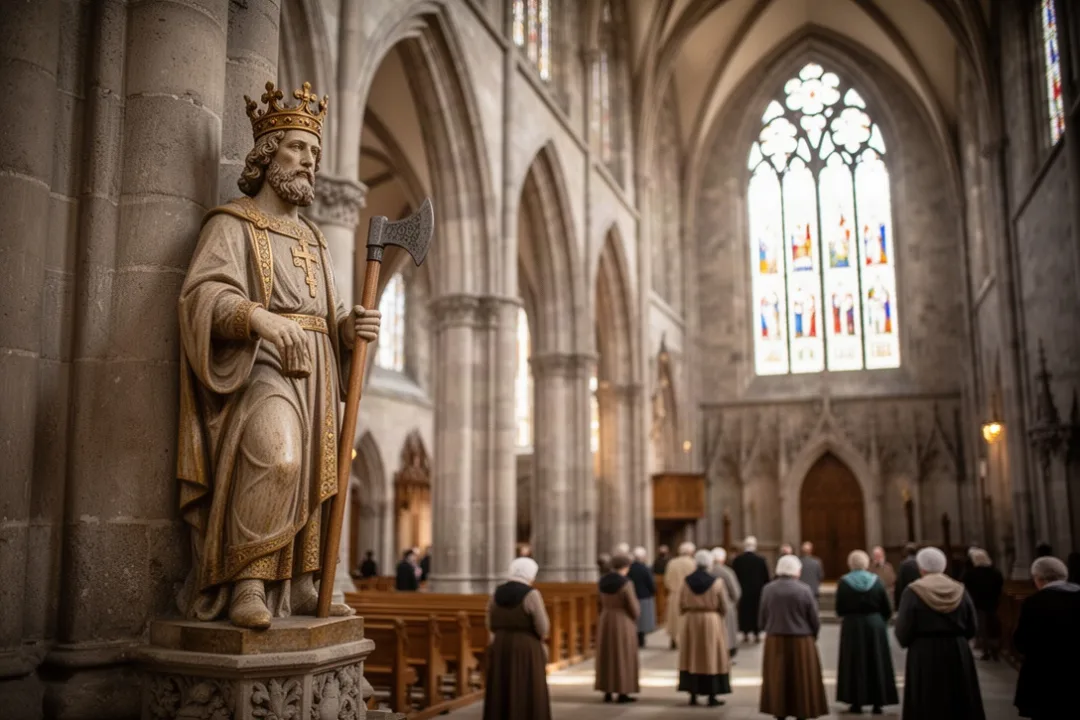
Artists often portray Saint Olaf as a crowned king holding an axe. The axe refers to his royal and military identity and is especially associated with the weapon used in traditional accounts of his death. In many images, he stands on or beside a defeated figure, often understood as a pagan symbol, a demon, or a personification of disorder.
A crown: showing that he was a king as well as a saint.
An axe: recalling his martyrdom and warrior identity.
A cross or book: representing Christian teaching, law, or the church.
A royal cloak: emphasizing his place in Norway’s political history.
A figure beneath his feet: often symbolizing defeated paganism, evil, or rebellion.
A halo: identifying him as a saint in devotional art.
Artistic details vary by region and period. A medieval sculpture may emphasize Olaf’s authority, while a modern painting may focus on his spiritual transformation or national symbolism. The axe is the most recognizable attribute, but viewers should avoid assuming that every crowned figure holding an axe is Saint Olaf without additional clues.
Saint Olaf’s feast day and Olsok celebrations
Saint Olaf’s feast day is July 29, the date traditionally associated with his death at Stiklestad. In Norway, the celebration is called Olsok, a name derived from Olaf’s feast. Olsok has religious, historical, and cultural dimensions, and observances vary from one community to another.
Some celebrations include church services, processions, concerts, lectures, historical reenactments, or outdoor gatherings. Stiklestad is especially associated with events that explore Olaf’s life and the political and religious changes of the Viking Age. Nidaros Cathedral also remains an important location for worship and remembrance connected with him.
The feast day is not only a commemoration of a dead king. It can also prompt reflection on how Norway became a Christian kingdom, how medieval communities handled conflict, and how later generations shaped their understanding of the past. In that sense, Olsok brings together religious observance and historical memory.
Where Saint Olaf is honored outside Norway
Saint Olaf’s influence spread well beyond Norway. Churches dedicated to him can be found across Scandinavia, especially in Sweden, Denmark, and Finland, as well as in places connected to medieval trade and pilgrimage. Dedications also appear in parts of the British Isles and elsewhere in Europe.
These churches reflect several kinds of connection. Some were founded by Scandinavian communities, some served travelers, and others were linked to medieval royal or ecclesiastical networks. Olaf’s cult traveled along the same routes that carried merchants, clergy, soldiers, and pilgrims around the North Sea and Baltic regions.
In England, churches and place names associated with Saint Olaf reflect the close political and religious ties between England and Scandinavia during the Viking Age and the centuries that followed. London’s St Olave’s Church is one well-known example, although the history of each dedication should be examined separately rather than assumed to follow a single pattern.
Outside Scandinavia, his name may appear in different forms, including Olaf, Olav, Olaus, and Olave. These variations can help you identify churches, streets, schools, and historical records connected with the same saint.
What the medieval sources say about Saint Olaf
Information about Olaf comes from several kinds of evidence, and they do not all have the same purpose. Contemporary or near-contemporary poetry, foreign chronicles, church records, and later Icelandic sagas each preserve different parts of his story. Some sources focus on battles and genealogy, while others emphasize miracles and moral lessons.
The Heimskringla, associated with the Icelandic historian Snorri Sturluson, contains one of the best-known narratives of Olaf’s life. It was written generations after Olaf’s death, so it preserves older traditions but also reflects the interests and storytelling conventions of a later period. The saga is valuable evidence, but it should not be read as a modern biography.
Historians compare narrative sources with archaeology, place names, church history, and records from neighboring kingdoms. This approach helps distinguish likely historical events from details that may have developed through legend. The broad outline of Olaf’s career is more secure than every speech, omen, miracle, or battlefield detail attributed to him.
A careful view can respect the religious meaning of the stories without treating every element as independently verified. For believers, miracles may remain part of devotion. For historical study, they also show how medieval communities understood holiness and remembered a controversial king.
How Saint Olaf differs from other Scandinavian Olafs
Several Scandinavian rulers were named Olaf, which can cause confusion. Saint Olaf generally refers to Olaf II Haraldsson, the Norwegian king who died in 1030. He is different from Olaf Tryggvason, another Norwegian king associated with the earlier Christianization of Norway, and from Olaf the Holy’s later namesakes.
When you see the name Olav den hellige in Norwegian, Olof den helige in Swedish contexts, or Olavus in Latin records, the reference is usually to Olaf II. English-language sources may use Olaf the Holy, Olaf the Saint, or simply Saint Olaf.
Checking the date, kingdom, and associated location can prevent mistakes. A reference to Stiklestad, Nidaros, Olsok, or July 29 almost certainly concerns Olaf II. A reference to the conversion of Iceland or an earlier Norwegian reign may involve another ruler named Olaf.
How to recognize Saint Olaf’s legacy today
You can encounter Saint Olaf’s legacy in more places than religious art. Look for his name in Norwegian festivals, cathedral history, historical novels, local church dedications, museum exhibitions, and Scandinavian family or place names. In some communities, the connection is primarily devotional; in others, it is cultural and historical.
If you are visiting a church or museum connected with Saint Olaf, these questions can help you read the setting:
Is the building dedicated to Olaf, or does it contain a later image of him?
Does the artwork show the axe, crown, cross, or defeated figure associated with him?
Is the site connected with a pilgrimage route, medieval trade, or Scandinavian settlement?
Does the local tradition emphasize Olaf as king, martyr, missionary, protector, or national saint?
Are the stories based on medieval sources, later legends, or modern historical interpretation?
These questions matter because Saint Olaf’s image has changed over time. Medieval worshipers may have approached him as a miracle-working protector, while modern Norwegians may also see him as a symbol of national history. Both perspectives can exist together, provided the differences are recognized.
For a reliable identification: look for the combination of a crowned king, an axe, and a connection with Norway, Nidaros, or July 29. Those clues usually point to Olaf II Haraldsson, Saint Olaf.
Why Saint Olaf still matters
Saint Olaf remains significant because his life stands at the meeting point of several major changes in northern Europe. His reign belongs to the period when Viking-age kingdoms were becoming more centralized, Christian institutions were expanding, and old political structures were being challenged.
He is remembered as a saint because of what happened after his death, but his historical importance also comes from his life as a ruler. Olaf helped connect Christian law, royal power, and Norwegian identity in ways that shaped the kingdom for centuries. His opponents, policies, and failures are as important to understanding him as the later stories of miracles.
Whether you encounter him in a cathedral, a medieval saga, a July 29 festival, or a carved figure holding an axe, Saint Olaf represents more than a single moment of conversion. He is a figure through whom generations have considered holiness, kingship, violence, national memory, and the long process by which a society changes its religious identity.
Frequently asked questions
Was Saint Olaf a real historical person?
Yes. Saint Olaf was Olaf II Haraldsson, a Norwegian king who lived around 995 to 1030. His reign and death are recorded in Scandinavian and foreign sources, although later sagas add speeches, miracles, and dramatic details that cannot all be verified. Historians generally agree on the main outline of his career, including his kingship, exile, return, and death at Stiklestad.
Why is Saint Olaf called a martyr?
Olaf is called a martyr because he died during an armed attempt to regain his kingdom after supporting Christian rule and church institutions. Medieval tradition interpreted his death at Stiklestad as a holy sacrifice. The title reflects religious memory rather than a claim that he was killed while peacefully preaching. His life also included warfare and political conflict.
What is Saint Olaf the patron saint of?
Saint Olaf is chiefly regarded as the patron saint of Norway. He is also associated with kingship, Christian rulers, travelers, and communities connected with Scandinavia. Specific patronage titles vary by place and tradition. His strongest and most consistent association is with Norway, Nidaros, Norwegian Christianity, and the feast known as Olsok.
Where can you see Saint Olaf’s shrine?
Saint Olaf’s medieval shrine was located at Nidaros, now Trondheim, Norway, in the cathedral associated with his cult. Religious changes later disrupted the medieval shrine and pilgrimage tradition, so visitors should not expect it to survive in its original form. Nidaros Cathedral, however, remains the central place for understanding Olaf’s worship and historical legacy.













Leave a Reply