The King James Bible first came out in 1611. King James I commissioned the translation in 1604, and the first printed edition appeared in England seven years later.
The 1611 publication is commonly called the King James Version (KJV), although that name became widely used later. It was also known at first as the Authorized Version, reflecting its connection with the English king and the Church of England.
What happened before the King James Bible was published?
English-speaking Christians already had several Bible translations before 1611. The most influential was the Bishops’ Bible, which had been authorized for use in the Church of England. The Geneva Bible was also widely read, especially among English Protestants and the communities that settled in North America.
Earlier translations shaped the vocabulary and style of the King James Bible. The translators did not start with an entirely blank page. They compared earlier English Bibles with Hebrew and Greek manuscripts, consulted ancient translations, and considered the established wording familiar to English readers.
The KJV therefore belongs to a long history of English Bible translation. Its importance came not only from the quality of its language, but also from its official sponsorship, its use in churches, and the lasting influence of its printed text.
When was the King James translation project started?
King James I authorized the new translation project in 1604. The decision followed a meeting at Hampton Court Palace, where religious leaders discussed concerns about the Church of England and the need for a revised English Bible.
The king supported a new translation that could be used across the English church. A common version was intended to reduce disagreements caused by competing translations and to provide a text suitable for public worship.
The project took several years because the translators had to compare biblical languages, earlier English versions, and a wide range of interpretive choices. They also needed to review one another’s work before the final text could be prepared for printing.
How was the King James Bible produced?
The translation was assigned to several groups of scholars rather than one individual. Traditional accounts identify 47 translators, although the surviving historical record does not document every participant with complete certainty.
The scholars worked in committees associated with Westminster, Cambridge, and Oxford. Different groups handled different portions of the Bible, then circulated their work for further review. The process was designed to encourage careful comparison and consistency.
The translators worked from the biblical languages. For the Old Testament, they relied primarily on the Hebrew text, while the New Testament was translated mainly from Greek. They also consulted earlier versions and reference materials available to scholars in the early seventeenth century.
The project followed formal guidelines. These encouraged the translators to retain familiar church language, use the Bishops’ Bible as a starting point where appropriate, and preserve traditional names and terminology. The goal was a readable and dignified Bible for public use, not a completely novel paraphrase.
The main stages from commission to publication
1604: King James I approved the plan for a new English Bible.
Early 1600s: Committees of scholars translated assigned books and passages.
Review period: The committee work was compared, revised, and checked by other scholars.
Preparation for printing: The completed text was assembled and sent to the printer.
1611: The first edition was printed in London.
This timeline explains why the answer is usually given as 1611, while 1604 is also significant. The earlier date marks the beginning of the translation effort; the later date marks the arrival of the printed Bible.
The short answer: The King James Bible was commissioned in 1604 and first published in 1611. If someone asks when it “came out,” 1611 is the standard answer.
What was the first edition of the King James Bible called?
The first edition did not simply carry the modern title “King James Version.” Its title page described it as a Bible that had been newly translated from the original tongues and compared with earlier translations. It was appointed for use in churches under the authority of King James.
The term Authorized Version became associated with the book because of its intended status in the Church of England. “King James Version” became the more familiar name later, especially as readers identified the translation with the monarch who sponsored it.
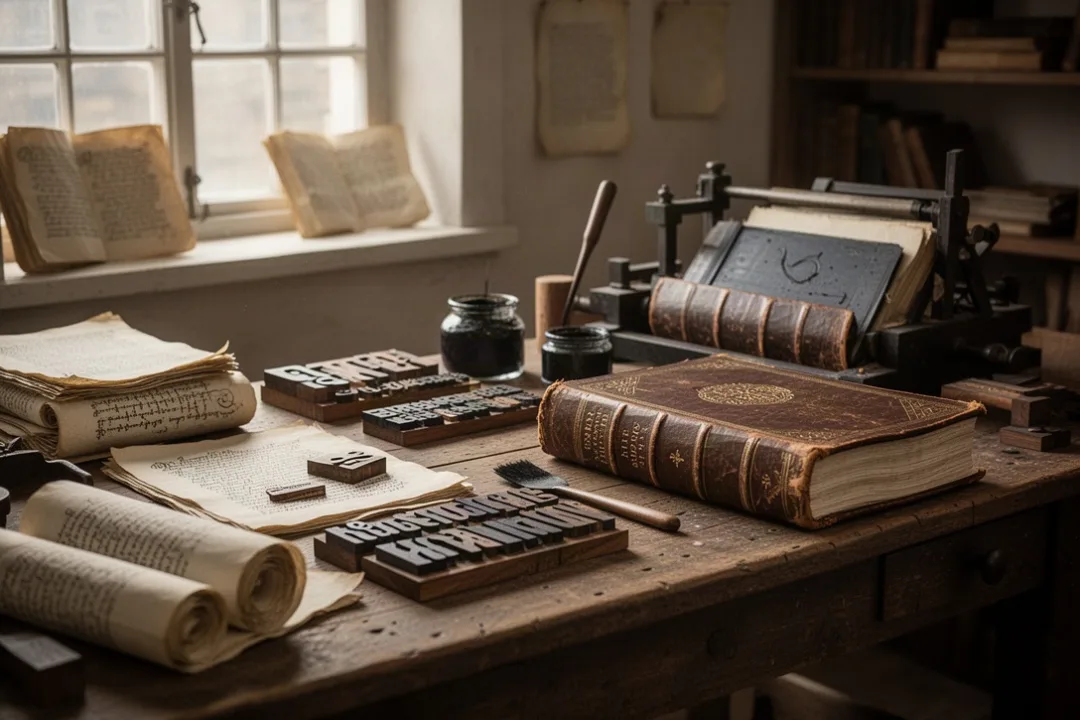
The first edition was a large, formal book intended primarily for church use. It was not originally designed as an inexpensive personal Bible in the way many modern editions are. Printing such a volume required substantial labor, paper, and financial investment.
Why did the King James Bible become so influential?
The KJV gained influence through a combination of church use, printing, education, and literary style. Its use in Anglican worship gave it an important institutional position, even though other English translations continued to circulate.
Its language also helped it endure. The translators used a formal style with balanced phrases, repeated patterns, and vocabulary that sounded suitable for reading aloud. Much of its wording became familiar through sermons, memorization, religious writing, and family reading.
The KJV’s influence extended beyond church life. Its phrasing affected English literature, public speech, poetry, and common expressions. Readers often recognize its cadence even when they cannot identify the exact passage or explain its meaning.
Popularity did not happen instantly or exclusively in 1611. The translation competed with the Geneva Bible and other versions for many years. Its position grew gradually as it became more established in churches, schools, homes, and publishing.
Was the King James Bible immediately accepted everywhere?
No. The first edition did not instantly replace every earlier English Bible. Different religious communities had strong preferences, and many readers continued using the Geneva Bible or other translations.
The KJV also appeared during a period of religious and political disagreement. A translation associated with the English monarchy and the established church was not equally attractive to every Protestant group. Acceptance depended on denomination, location, and the reader’s view of church authority.
Over time, however, the KJV became increasingly prominent in England. Its official connection to the Church of England, its polished public style, and the steady growth of its printing helped it become the dominant English Bible for many readers.
In colonial America, the situation was more varied. The Geneva Bible remained important among some Puritan and Separatist communities, while the King James Bible gradually became more common. Its later American influence was substantial, but it should not be assumed that every early English-speaking colonist used it from the beginning.
What changed after the 1611 edition?
The 1611 Bible was not the final form of the text most modern readers recognize. Printers and editors issued later editions to correct errors, improve consistency, adjust spelling, and revise punctuation. Some changes were minor, while others affected familiar wording.
Two important early revision points came in 1629 and 1638, when Cambridge scholars produced revised editions. These revisions addressed printing mistakes and other textual issues that had appeared in early copies.
Further changes were made in the eighteenth century. A 1762 Cambridge edition and a particularly influential 1769 Oxford edition, prepared by Benjamin Blayney, helped standardize spelling, punctuation, capitalization, and some wording.
When people quote the KJV today, they often use a form based more closely on later standardized editions than on the exact 1611 printing. This distinction matters because the original edition used spelling and typography that can look unfamiliar to modern readers.
How the 1611 text differs from later KJV editions
Spelling: Early forms included letters and spellings that later editions modernized.
Punctuation: Later editors adjusted punctuation to make sentences easier to read.
Capitalization: Early capitalization practices differed from modern publishing conventions.
Printing errors: Some early copies contained mistakes that later editions corrected.
Word choices: A small number of passages changed during revision and standardization.
These changes do not mean that the KJV suddenly became a different translation in every edition. They show that the text was transmitted through ordinary printing and editorial processes. The familiar modern KJV is the result of several centuries of revision after the first publication.
What did “authorized” mean in the Authorized Version?
The label Authorized Version suggests a simple official approval, but the historical situation was more complicated. The Bible was produced under royal sponsorship and intended for use in the Church of England, yet the precise nature of its formal authorization is not identical to a modern government licensing process.
The translation was closely connected with the church’s established structures and received strong institutional support. That support helped it gain a prominent place in worship and public life.
Readers should also avoid assuming that “authorized” means every English church immediately stopped using all other translations. Competing Bibles remained available, and the KJV’s dominance developed over time rather than appearing fully formed in 1611.
Did King James personally translate the Bible?
No. King James did not translate the Bible himself. He approved and supported the project, but the translation was carried out by committees of scholars.
The translators included clergy and academics experienced in biblical languages and theology. Their work was collaborative, with passages reviewed and revised through multiple stages rather than written by one royal author.
The king’s role was therefore one of patronage and authorization. His involvement helped launch the project and gave it public authority, but the wording of the translation came from the scholars and editors responsible for the work.
What sources did the translators use?
The translators examined the biblical languages and compared earlier English translations. Their Old Testament work drew on the Hebrew textual tradition available to scholars at the time, while their New Testament work used the Greek manuscripts and printed editions then in circulation.
For the New Testament, the translators were influenced by the Greek textual tradition commonly associated with the Textus Receptus. They also considered earlier English Bibles, including the Bishops’ Bible, the Geneva Bible, and the work of William Tyndale.
Tyndale’s influence was especially significant because much of the KJV’s memorable English style stands in a broader tradition shaped by his translation work. The King James translators revised and reworked earlier language rather than creating every phrase independently.
That history helps explain why the KJV can sound both traditional and carefully crafted. It represents a major editorial and translation achievement, but it also preserves centuries of English biblical vocabulary.
How should you date a King James Bible you own?
A Bible labeled “King James Version” may have been printed long after 1611. The year 1611 identifies the first publication of the translation, not the printing date of every KJV edition.
To date a particular copy, check the title page, copyright page, publisher information, and any introduction or historical note. A family Bible may contain a KJV text while having been printed in the nineteenth, twentieth, or twenty-first century.
Older copies can be difficult to date because title pages may be missing, reprints may reproduce an earlier title page, and bindings may have been replaced. A bookseller, librarian, rare-book specialist, or experienced archivist may be able to identify the edition more accurately.
Questions to ask when identifying an older copy
Does the book have an original title page?
What publication year and printer or publisher are listed?
Does the spelling match early modern English or later standardized editions?
Are there notes identifying a Cambridge, Oxford, or other revision?
Does the binding appear original, or may the pages have been rebound?
The physical age of the book and the historical age of the translation are separate questions. A modern paperback can contain the KJV translation first published in 1611, while an old-looking book may be a later reprint.
Why do some people call it the 1611 King James Bible?
The phrase 1611 King James Bible usually means either the first edition or a modern edition that attempts to preserve its early wording and presentation. Publishers sometimes use the date to distinguish an edition from later standardized forms.
However, not every Bible described as a “1611 KJV” reproduces the original printing exactly. Some modern editions retain traditional wording while updating spelling, punctuation, or typography. Others reproduce an early edition more closely.
If exact historical wording matters, examine the publisher’s description. Ask whether the edition reproduces the 1611 text, the 1769 text, or another revision. The label alone may not provide enough information.
For careful comparison: “First published in 1611” describes the origin of the translation, while “1611 edition” may refer to a specific historical printing or a modern reproduction. Check the edition details before assuming the texts are identical.
How does the King James Bible compare with modern English versions?
The KJV uses vocabulary and grammar associated with early modern English. Some words that sound familiar now had different meanings in the seventeenth century, and pronouns such as thee, thou, and ye reflected distinctions that modern standard English usually does not preserve.
Modern translations generally use more current vocabulary and sentence structure. They may also rely on a broader range of manuscripts and modern methods of textual and linguistic study. That does not make the KJV irrelevant; it means readers should understand its historical setting and language.
When reading the KJV, a Bible dictionary, study Bible, or trusted language guide can clarify unfamiliar terms. Comparing a passage with a modern translation can also reveal the meaning without requiring you to abandon the style of the older version.
The choice between translations depends on your purpose. Some readers value the KJV’s traditional language, literary influence, or role in their church. Others prefer a modern version for everyday comprehension. The publication date alone does not determine which translation will serve you best.
Why the date 1611 still matters
The year 1611 marks a turning point in English religious and literary history. It identifies the first appearance of a translation that eventually shaped worship, writing, education, and public language across the English-speaking world.
The date also prevents a common misunderstanding. The King James Bible was not written by the king, did not appear immediately after the English Reformation, and did not remain unchanged from its first printing. It was the product of a long translation tradition, a committee-based project begun in 1604, and later editorial revisions.
So the clearest answer is this: the King James Bible came out in 1611, after seven years of preparation. Its familiar modern form reflects not only that first edition, but also centuries of correction, standardization, and continued use.
Frequently asked questions
Was the King James Bible published in 1611 or 1604?
It was published in 1611. The year 1604 marks the beginning of the project, when King James I approved the plan for a new English translation. Scholars then worked for several years before the completed Bible was printed. Therefore, 1604 is the commissioning date, while 1611 is the publication date most people mean.
Is the King James Bible the oldest English Bible?
No. Several English Bible translations existed before it, including versions connected with John Wycliffe, William Tyndale, the Geneva Bible, and the Bishops’ Bible. The King James Bible drew on this earlier tradition. Its lasting influence came from its scholarship, style, church use, and broad circulation rather than from being the first English Bible.
Did the original 1611 Bible look like modern King James Bibles?
Not exactly. The first edition used early modern spelling, punctuation, capitalization, and typography. Later editions corrected printing errors and standardized the language. Many KJV editions sold today reflect later revisions, especially the influential 1769 form, rather than reproducing every feature of the original 1611 printing.
Who translated the King James Bible?
Committees of English scholars translated and reviewed the text. They worked in groups associated with Westminster, Cambridge, and Oxford and consulted Hebrew and Greek texts along with earlier English Bibles. King James authorized and supported the project, but he did not translate the Bible personally.














Leave a Reply