St. Stephen of Hungary: Life, legacy, and feast day
St. Stephen of Hungary: Life, legacy, and feast day
St. Stephen of Hungary was the first king of Hungary and the ruler who firmly established the Magyar kingdom as a Christian state in Europe. He is remembered for organizing Hungary’s government and Church, defending its independence, and guiding its people through a difficult transition from tribal rule to a centralized Christian monarchy.
Stephen is honored as a saint in the Catholic Church, with his feast day observed on August 20. In Hungary, that date is also a major national holiday. His story includes religious conviction, political reform, military conflict, and the hard choices involved in building a new kingdom.
Stephen was born around the late 10th century to Géza, grand prince of the Magyars, and Sarolt. His birth name was Vajk, but he later received the Christian name Stephen, probably when he was baptized as part of his family’s movement toward Christianity.
He became ruler after Géza’s death, during a period when Hungary’s future was uncertain. Some leaders favored the older succession customs and traditional pagan religious practices, while Stephen promoted hereditary kingship and Christianity. His reign, generally dated from around 997 to 1038, shaped the political and religious identity of medieval Hungary.
Stephen’s importance does not rest only on his personal piety. He created institutions that could survive beyond one ruler: royal counties, courts, churches, dioceses, monasteries, and laws. His work gave Hungary a durable place among the Christian kingdoms of Europe.
At a glance: St. Stephen of Hungary was a medieval king, state builder, and Christian ruler. His feast day is August 20, and his most lasting achievement was the creation of a centralized Hungarian kingdom connected to Western Christian Europe.
How Stephen became king and secured the Hungarian throne
Géza had already begun encouraging Christianity and strengthening central authority, but he did not complete the transformation. After his death, Stephen faced a serious challenge from Koppány, a powerful relative who claimed the right to rule under older Magyar succession customs.
Koppány’s claim was not simply a family disagreement. It represented a different political model. Traditional succession could allow power to pass to an older male relative rather than directly from father to son. Stephen’s claim, by contrast, supported a more familiar European pattern of hereditary monarchy centered on Géza’s chosen heir.
The conflict ended with Stephen’s victory near Veszprém. Koppány was killed, and Stephen’s success made it possible for him to impose royal authority over a larger part of the country. The battle also showed that Christian kingship would be backed by military power, not only preaching or ceremony.
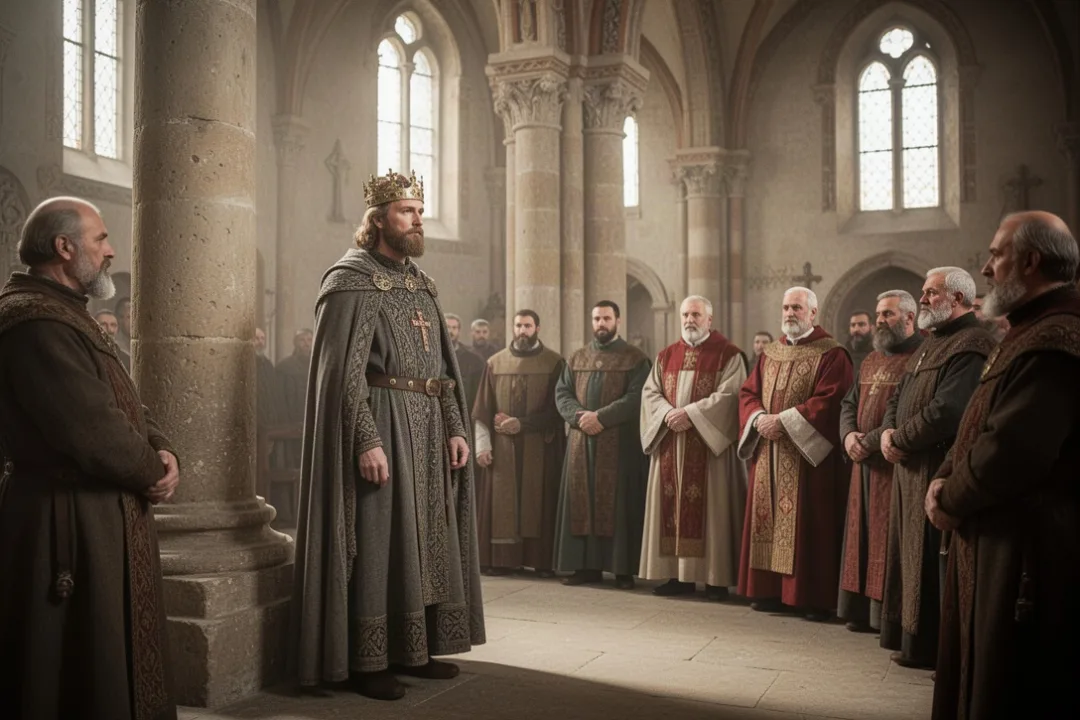
Stephen’s position became stronger when he received a royal crown and recognition connected with the papacy and the German Christian world. Historians debate some details of the coronation, including its precise date and the identity of the crown used. It is commonly placed around the turn of the millennium, in 1000 or 1001.
Stephen’s rise can be understood through five major developments
Family conversion: Géza’s household moved toward Christianity, giving Stephen access to Christian teachers and political connections.
Military victory: Stephen defeated Koppány and overcame a major challenge to his succession.
Royal recognition: His kingship gained legitimacy within the Christian political order of Europe.
Institution building: He organized counties, royal administration, churches, monasteries, and dioceses.
Religious consolidation: He promoted baptism, church attendance, Christian marriage, Sunday observance, and support for clergy.
These developments were connected. Stephen could not build churches securely without royal authority, and he could not maintain royal authority across the kingdom without a network of local officials, priests, and fortified centers.
How Stephen organized medieval Hungary
One of Stephen’s most important reforms was the creation of a stronger royal administration. The kingdom was divided into royal counties, often centered on a fortified settlement. Officials appointed by the king represented royal power, collected revenues, administered justice, and helped organize military service.
This system reduced the independence of local tribal leaders. Instead of relying only on personal alliances, Stephen built a government that connected distant regions to the crown. The county structure changed over time, but it became one of the central foundations of Hungarian statehood.
Stephen also supported the development of towns, churches, and monasteries. Religious houses were places of worship, learning, record keeping, and economic activity. They helped spread literacy and provided trained clergy and administrators for the emerging kingdom.
His laws addressed both public order and Christian practice. They dealt with matters such as theft, property, church obligations, marriage, the protection of churches, and the observance of religious days. Medieval law was often severe by modern standards, and Stephen’s code included harsh penalties. Its purpose was to replace older customs with a uniform royal and Christian order.
Royal authority: Local officials served the crown and helped enforce the king’s decisions.
Church support: Communities were expected to maintain churches and provide for clergy.
Christian observance: Sunday worship and major religious festivals received legal protection.
Social order: The laws addressed violence, theft, property disputes, and obligations between people of different status.
Political stability: Central rules reduced the room for independent regional power centers.
Why Christianity mattered so much to Stephen
Stephen’s Christianity was both a personal faith and the basis for his political program. He understood that a Christian kingdom needed more than a baptized ruler. It needed churches, bishops, priests, religious education, Christian rituals, and laws that reflected Christian teaching.
He established or supported important ecclesiastical centers, including the archbishopric at Esztergom and other diocesan structures. These institutions connected Hungary to the wider Latin Christian Church while allowing the kingdom to develop its own religious administration.
Missionaries and clergy came from different parts of Europe. Stephen’s marriage to Gisela of Bavaria, a member of the German ruling family, also strengthened ties with the Christian West. Gisela is traditionally associated with religious foundations and is venerated as a blessed figure.
Christianization was not always peaceful or voluntary. Stephen used royal authority and legal penalties to suppress practices he considered incompatible with Christianity. Some communities likely adopted the new religion gradually, while others resisted. The process combined teaching, patronage, political pressure, and force.
Historical perspective: Stephen’s Christianization should be understood in its medieval setting. It helped create common institutions and international legitimacy, but it also involved coercion and the suppression of older religious customs.
Stephen’s wars and the defense of the kingdom
Stephen had to defend his authority within Hungary and against external threats. His reign included conflicts with neighboring rulers and regional powers that opposed the growing strength of the Hungarian crown.
One important conflict involved Conrad II, Holy Roman Emperor, who invaded Hungary in the early 11th century. Stephen’s forces resisted successfully, helping preserve the kingdom’s independence. The result strengthened Stephen’s standing as a ruler capable of defending the country rather than merely receiving foreign protection.
Stephen also pursued campaigns against groups and territories that had not accepted his rule. These actions expanded or consolidated the kingdom, though the details differ across medieval sources and later traditions. His military policy was closely tied to state building: control of territory made taxation, law enforcement, church organization, and royal administration possible.
His reign therefore cannot be described only as a peaceful conversion project. Stephen was a king in a contested region, and the institutions he created were supported by armies, fortifications, and the threat of punishment.
What Stephen’s laws reveal about his rule
Stephen’s legal tradition survives through medieval texts associated with him, although the transmission of those texts is complex. The laws show a ruler concerned with making Christian norms part of everyday public life, not leaving religion as a private matter for the royal household.
They encouraged the building and maintenance of churches. They also addressed the responsibilities of communities, landowners, clergy, and the king’s officials. A person’s social rank affected legal penalties, reflecting the hierarchical structure of medieval society.
Several themes appear repeatedly in accounts of Stephen’s legislation:
Protection of church property: Religious institutions were given legal standing and material support.
Sunday and feast-day observance: People were expected to attend worship and limit ordinary labor on important religious days.
Marriage and family order: Christian marriage customs received royal backing.
Royal justice: Theft, violence, and disobedience could bring severe punishment.
Support for the poor: Christian charity and hospitality formed part of the king’s ideal of good rule.
These laws were not a modern constitution, and they did not create equality before the law in the contemporary sense. They were tools for governing a stratified society while establishing the moral and institutional expectations of a Christian monarchy.
Stephen as a Christian king and father
Stephen’s son Emeric, also called Imre, was prepared to inherit the kingdom. A work known as the Admonitions is traditionally connected with Stephen’s guidance to his son. It presents ideals for a Christian ruler, including respect for the Church, mercy, patience, fairness, and care for foreigners and guests.
The text is especially known for its emphasis on the value of welcoming people from different lands. A kingdom with multiple peoples and customs, it suggests, can be strengthened by variety when that variety is governed by a shared Christian order.
Emeric died before Stephen, probably in a hunting accident. His death created a succession crisis because Stephen no longer had a surviving son ready to inherit. The king’s later years were affected by disputes among relatives and competing claims to the throne.
Stephen died in 1038. After his death, Hungary experienced political instability, and his succession plans did not immediately produce a smooth transfer of power. Even so, the institutions he built proved strong enough for the kingdom to survive the crisis and retain its Christian identity.
Why St. Stephen was canonized
Stephen was canonized in 1083, during the reign of King Ladislaus I of Hungary. His elevation to sainthood occurred alongside the recognition of other important Hungarian Christian figures, including his son Emeric and Bishop Gerard, who had been killed during a period of political and religious conflict.
The canonization reflected more than stories of personal holiness. Stephen was viewed as the founder of the Christian kingdom and as the ruler responsible for bringing Hungary into the community of European Christian states. His public achievements and religious reputation reinforced each other.
His cult developed around several relics and places associated with his life. The most famous is the Holy Right, traditionally identified as Stephen’s preserved right hand. It became an important object of devotion and remains connected with Hungarian religious and national ceremonies.
The Basilica of St. Stephen in Budapest is named for him, and many churches throughout Hungary and neighboring regions honor his memory. His image appears in religious art as a crowned king, often holding a cross, a church, or an orb.
What the Holy Crown of Hungary means
Stephen is closely associated with the Holy Crown of Hungary, one of the country’s most important historical symbols. Tradition connects the crown with his coronation and with the legitimacy of Hungarian kingship.
The crown now known as the Holy Crown is a medieval object with a complicated history. Scholars do not treat every traditional claim about its origin as certain, and the current crown may not be identical to the object used at Stephen’s coronation. Its parts and history have been studied extensively, and the exact chronology remains a matter of historical discussion.
That uncertainty does not lessen its importance. Over centuries, the crown came to represent the continuity of the Hungarian state. It symbolized not simply the personal power of a king, but the idea that the kingdom itself possessed a lasting legal and sacred identity.
When and how St. Stephen of Hungary is celebrated
August 20 is the principal feast day of St. Stephen in Hungary. The date is associated with the translation or elevation of his relics in 1083 and later became one of the country’s most significant public holidays.
Religious observances may include Masses, processions, prayers, and veneration of the Holy Right. Public celebrations often include concerts, cultural events, fireworks, and ceremonies connected with Hungarian statehood. The day brings together religious memory, national history, and civic identity.
St. Stephen’s feast day can therefore mean different things to different people. Catholics may honor him as a saint and model of Christian kingship. Historians may focus on his administrative reforms and the formation of the Hungarian state. Many Hungarians view him as a founding figure whose reign anchors the country’s medieval history.
What St. Stephen’s legacy means today
Stephen’s legacy is strongest in the institutions associated with him. The Hungarian kingdom he organized endured through later dynasties, foreign invasions, political changes, and religious conflicts. The county system, Christian Church, royal legal tradition, and idea of a continuous Hungarian state all developed further after his reign.
His legacy also invites careful evaluation. He is celebrated as a lawgiver and founder, but his government relied on coercion, military conquest, and severe punishment. The conversion of Hungary brought education, international connections, and administrative unity, while also weakening or suppressing older traditions.
That complexity is part of why Stephen remains historically significant. He was neither only a saint in a devotional story nor only a politician in a textbook account. He was a ruler trying to preserve a vulnerable kingdom by giving it a new political structure, a recognized religion, and a place among the powers of medieval Europe.
For someone seeking a concise way to remember him, three descriptions are especially useful: founder of Christian Hungary, organizer of the medieval Hungarian state, and saintly king honored on August 20. Those descriptions capture the religious, political, and national dimensions of his life without reducing him to any one of them.
How to learn more about Stephen responsibly
Medieval accounts of Stephen were written for religious and political purposes, often long after the events they describe. They preserve valuable information, but they also include legends and idealized portraits. A careful account separates well-supported developments from stories that cannot be verified in detail.
When reading about him, look for these distinctions:
Contemporary evidence: Documents and objects from his lifetime can provide direct or near-direct information, though they are limited.
Later medieval legends: These may express how people remembered Stephen rather than reporting exact events.
Traditional associations: The Holy Crown and certain relics carry deep meaning even where their precise origins are debated.
Modern national memory: Public celebrations often interpret Stephen through the needs and values of later generations.
This approach allows you to appreciate both dimensions of his reputation: the historical king who built a state and the canonized founder whose memory has continued to shape Hungarian religious and national life.
Frequently asked questions
Was St. Stephen of Hungary the first king of Hungary?
Yes. Stephen is generally recognized as Hungary’s first king, although his father Géza had already ruled as grand prince and begun centralizing power. Stephen’s royal coronation and subsequent reforms established Hungary as a Christian kingdom within the political order of medieval Europe.
What is St. Stephen of Hungary the patron saint of?
He is especially associated with Hungary, its statehood, and its Christian foundation. He is also invoked in connection with kings, rulers, and the governance of the country. His patronage reflects his role as the founder and organizer of Hungary’s medieval Christian kingdom.
Did St. Stephen really receive the Holy Crown from the pope?
Medieval tradition connects Stephen’s coronation with papal approval and a crown sent from Rome, but the precise details are debated. The crown preserved today has a complicated history, and scholars do not consider every traditional claim about its origin certain.
What happened to St. Stephen’s son Emeric?
Emeric was expected to succeed Stephen but died before his father, traditionally in a hunting accident. His death created a succession problem and contributed to political instability after Stephen’s reign. Emeric was later canonized and is honored as St. Emeric of Hungary.













Leave a Reply