Elizabeth of Portugal, also called Isabel of Aragon, was a medieval queen, charitable benefactor, and Catholic saint remembered especially for making peace between members of her own family. Born around 1271, she became queen consort of Portugal through her marriage to King Denis and spent much of her life supporting the poor, religious communities, pilgrims, and people caught in political conflict.
After her husband’s death, Elizabeth withdrew from royal life and joined the Third Order of Saint Francis. She died in 1336 while trying to stop a war between her son, King Afonso IV of Portugal, and her grandson-in-law, King Alfonso XI of Castile. The Catholic Church canonized her in 1625, and her feast is celebrated on July 4.
Elizabeth was born into the royal family of Aragon, probably in Zaragoza, during a period when Iberian kingdoms were closely connected through diplomacy, marriage, warfare, and religion. Her parents were King Peter III of Aragon and Constance of Sicily. Through her family, she was related to several influential European rulers and was raised with the education and religious formation expected of a medieval princess.
Her marriage was arranged with King Denis of Portugal, known in Portuguese as Dinis. The marriage took place in 1282, when Elizabeth was still very young. She moved to Portugal and became queen consort, a position that placed her at the center of court life while also giving her opportunities to influence charitable and religious affairs.
Medieval queens did not usually rule independently in the same way a reigning monarch did, but they could exercise considerable influence. A queen might manage estates, support hospitals and convents, arrange marriages, receive petitions, and advise her husband or children. Elizabeth used these responsibilities to promote care for vulnerable people and peaceful settlement of disputes.
Name note: In Portugal, Elizabeth is commonly called Santa Isabel de Portugal. English-language readers may also see her name written as Isabel of Portugal or Elizabeth of Aragon.
Elizabeth’s marriage to King Denis of Portugal
Elizabeth’s marriage to Denis lasted for more than four decades and produced two children who survived to adulthood: Constanza, who became queen of Castile, and Afonso, who later ruled Portugal as King Afonso IV. The royal household also included Denis’s children born outside the marriage, and relationships among these children became a source of tension.
Denis was an effective ruler who supported agriculture, administration, education, and the development of Portuguese institutions. He was also a complicated husband. Medieval accounts describe conflicts caused by his relationships with other women and by the position he gave to some of his illegitimate children. Elizabeth’s reputation developed partly through the way she responded to these painful circumstances.
Rather than using her influence to encourage revenge, she is remembered for showing patience, discretion, and concern for family stability. That does not mean the marriage was free of conflict or that every later story can be verified in detail. Much of Elizabeth’s biography was shaped by devotional writers who wanted to present her as a model of Christian virtue. Still, the consistent picture is of a queen who combined personal discipline with practical action.
She established or supported charitable institutions, gave assistance to people in poverty, and helped arrange marriages for women who lacked financial security. Her generosity was not limited to occasional gifts. It involved the use of royal resources, household networks, land, and political access to create more lasting support.
How Elizabeth served the poor and religious communities
Elizabeth’s charitable work reflected the ideals of medieval Christian queenship, but her actions were unusually central to the way later generations remembered her. She is associated with almsgiving, hospitals, shelters, convents, and care for pilgrims. She also supported women’s religious communities, including the Poor Clare foundation at Coimbra associated with the Monastery of Santa Clara.
Elizabeth’s foundation at Coimbra became especially important. The original convent, known today as Santa Clara-a-Velha, was eventually affected by flooding from the Mondego River. A later monastery, Santa Clara-a-Nova, was built on higher ground, and the community moved there centuries after Elizabeth’s lifetime.
Her support for religious houses was more than an expression of private devotion. Convents could provide education, prayer, shelter, and a stable life for women whose options were limited by poverty or family circumstances. They also formed part of a wider network of charity in which rulers, religious communities, and local benefactors worked together.
Elizabeth is also connected with assistance to pilgrims traveling to Santiago de Compostela. Medieval pilgrimage could be physically dangerous and expensive, so hospitality mattered. A ruler or wealthy patron could help provide food, lodging, medical care, or safe passage. These practical acts help explain why Elizabeth’s reputation has remained tied to mercy rather than to royal ceremony alone.
Support for the poor: She distributed aid and used her position to assist people with urgent material needs.
Care for pilgrims: She supported the hospitality networks that served travelers to important religious destinations.
Support for women: She helped religious communities and women who needed protection or financial assistance.
Religious patronage: She contributed to convents, churches, hospitals, and other institutions connected with public welfare.
Stories about Elizabeth’s generosity sometimes present her as giving away so much that her husband questioned her actions. The historical record is not equally detailed for every anecdote, but the larger pattern is clear: charity was not a minor interest for her. It was a defining part of her public and spiritual identity.
Why Elizabeth of Portugal is called a peacemaker
Elizabeth’s most famous role was that of a mediator within the royal family. Her son Afonso became convinced that his father favored Afonso’s half-brother, Afonso Sanches, and feared that his own rights as heir were being weakened. The dispute developed into armed conflict in the early fourteenth century.
Elizabeth worked to prevent violence between her husband and her son. Medieval chronicles portray her as traveling between opposing sides, urging negotiation and reconciliation. The exact details vary by source, but her central reputation is consistent: she placed herself in a dangerous political situation to keep a family dispute from becoming a broader war.
Her mediation did not mean that she had no position. Elizabeth supported legitimate order and the responsibilities of the royal family, but she also resisted the idea that personal rivalry should lead to bloodshed. Her approach combined moral persuasion with diplomatic communication. She listened, carried messages, sought compromises, and appealed to shared obligations.
Later, after Afonso became king, Elizabeth again tried to stop a conflict involving Portugal and Castile. Her daughter Constanza was married to Alfonso XI of Castile, and political tensions arose between the two kingdoms. Elizabeth traveled to meet the danger directly, even though she was already elderly by medieval standards.
According to tradition, she went to Estremoz in 1336 to mediate between Afonso IV and Alfonso XI. She became ill during the journey and died there on July 4. Her death while pursuing peace became one of the strongest elements of her saintly image.
Why her peacemaking matters: Elizabeth’s example is not simply about being agreeable. It presents reconciliation as active work that requires courage, listening, persistence, and a willingness to enter difficult situations responsibly.
The story of the roses and what it means
The best-known legend about Elizabeth is the miracle of the roses. In the story, she was carrying bread or money to give to the poor when King Denis confronted her and asked what she was carrying. When she opened her cloak, the items had become roses, even though it was not the season for them.
The legend appears in different forms, and it should be treated as a devotional tradition rather than as a detail that can be established like a dated political event. Its purpose is to express several ideas associated with Elizabeth: her discreet generosity, the opposition she sometimes faced, and the belief that God honored her care for people in need.
Because of this story, Elizabeth is commonly shown holding roses in her apron or cloak. Some images show her in royal clothing with a crown, while others emphasize her later Franciscan identity. The roses distinguish her from many other saints named Elizabeth and make her immediately recognizable in European religious art.
The story also helps explain why Elizabeth remains meaningful beyond the historical details of her reign. It presents charity as something concrete: food, money, and direct help for people who are hungry or excluded. At the same time, the flowers suggest that an act of mercy can acquire spiritual meaning beyond what the giver or observer first sees.
Elizabeth’s life after King Denis died
King Denis died in 1325, and Elizabeth’s public role changed. She no longer served as queen consort, but she did not simply disappear from political or charitable life. Instead, she adopted the clothing and discipline of a Franciscan tertiary, a lay member associated with the Third Order of Saint Francis.
As a tertiary, Elizabeth could pursue a life shaped by prayer, simplicity, service, and penance without becoming a cloistered nun. She continued to maintain responsibilities connected to her rank, but her priorities increasingly centered on religious devotion and works of mercy.
Her widowhood also gave her a new position as a respected elder within the Portuguese royal family. She had experience, authority, and relationships across Iberian courts. These qualities made her a natural person to approach when a dispute threatened to become a war.
Her final mission to mediate between Afonso IV and Alfonso XI illustrates the connection between her spiritual life and her public duties. Elizabeth did not separate prayer from practical responsibility. She treated the protection of peace as a religious obligation that required travel, personal risk, and direct conversation.
Elizabeth died at Estremoz on July 4, 1336. She was initially buried at the Monastery of Santa Clara in Coimbra, the religious house with which she had a close connection. Her remains were later associated with Santa Clara-a-Nova, where devotion to her continued.
How Elizabeth became a Catholic saint
Elizabeth’s reputation for holiness began during her lifetime and grew after her death. People remembered her as a generous queen, a disciplined widow, and a mediator who had sacrificed her comfort for peace. Reports of answered prayers and favors received through her intercession contributed to the development of her cult.
The process of canonization in the Catholic Church involves investigation, testimony, examination of a person’s life, and recognition of miracles attributed to intercession, according to the norms in force at the time. Elizabeth was canonized by Pope Urban VIII in 1625, nearly three centuries after her death.
Her canonization confirmed a devotion that had already endured across generations. Elizabeth is honored as Saint Elizabeth of Portugal, and her feast day is July 4. She is especially associated with peace, reconciliation, charity, and care for the poor.
She is sometimes confused with Saint Elizabeth of Hungary, another royal woman known for charity and Franciscan spirituality. The two saints lived in different generations and belonged to different royal families. Elizabeth of Hungary died in 1231, while Elizabeth of Portugal was born around 1271 and died in 1336.
Symbols and images associated with Elizabeth
Artists use several symbols to identify Elizabeth of Portugal. The most familiar is the rose, referring to the miracle legend. She may also be shown wearing a crown, holding a book of prayers, carrying bread, or dressed in the gray habit connected with the Franciscan Third Order.
Some images emphasize her identity as a queen. In these works, she may wear rich clothing, a mantle, or a crown while presenting roses or giving alms. Other images present her as a widow or penitent, using simpler clothing to highlight her devotion and service.
Her visual symbolism often brings together two sides of her life:
Royal responsibility: The crown represents her place in the Portuguese monarchy and her influence at court.
Franciscan simplicity: A plain habit or modest clothing recalls her life as a lay Franciscan after widowhood.
Mercy: Bread, coins, or people receiving assistance represent her care for the poor.
Peace: Gestures of blessing, open hands, or scenes with opposing figures reflect her work as a mediator.
The roses: Flowers point to the most familiar tradition connected with her generous service.
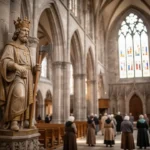
When churches, statues, or paintings show a royal woman with roses, the image may refer to Elizabeth of Portugal, though it could also refer to another saint associated with roses. The surrounding symbols, location, and inscription usually provide the clearest identification.
Practical tips for learning about Elizabeth of Portugal
Elizabeth’s story includes documented political history, religious tradition, and legends that developed over time. Reading each type of material in the same way can create confusion. A careful approach allows you to appreciate her spiritual significance without treating every devotional detail as a verified event.
Separate history from legend. Her marriage, queenship, widowhood, death, and canonization belong to the broad historical record. The roses story belongs to devotional tradition and should be identified as such.
Compare her with the right saint. If a source mentions a royal woman named Elizabeth, check whether it means Elizabeth of Portugal or Elizabeth of Hungary.
Look for her Portuguese name. Searches for Santa Isabel de Portugal can lead to churches, shrines, artworks, and local traditions that an English-only search may miss.
Use the feast day carefully. July 4 is associated with Saint Elizabeth of Portugal, while other saints named Elizabeth have different feast days.
Visit historical sites with context. Santa Clara-a-Velha and Santa Clara-a-Nova are connected with her patronage, but the buildings and communities reflect centuries of later history as well.
Read modern biographies alongside devotional accounts. A historical biography can clarify chronology, while a devotional account may explain how Catholics understand her virtues and intercession.
Common mistakes usually come from compressing several traditions into one simple story. Elizabeth was not merely a woman who performed a miracle with roses. She was also a queen involved in dynastic politics, a benefactor who supported institutions, a widow who adopted Franciscan spirituality, and a mediator who accepted serious personal risk.
Elizabeth is often invoked by people praying for peace within families, reconciliation after conflict, and wisdom in difficult negotiations. Her example is particularly relevant to situations where people have competing claims, old resentments, or relationships damaged by pride and fear.
Her charity also has a practical dimension. She did not treat compassion as an abstract feeling. She used resources, authority, and time to provide real assistance. Remembering her can encourage a form of service that asks what a person actually needs: food, shelter, protection, medical care, education, legal support, or a safe place to belong.
At the same time, Elizabeth’s story should not be used to pressure people into remaining in unsafe or abusive relationships. Her reputation for patience does not require anyone to tolerate violence or injustice. Peace built on fear is not the reconciliation represented by her life; authentic peace involves truth, safety, accountability, and a meaningful end to harm.
For Catholics, Elizabeth’s feast day may be observed through prayer, Mass, charitable service, or reflection on the needs of families and communities divided by conflict. A person who is not Catholic can still approach her life historically, as an example of how a medieval woman used royal authority to support charity and diplomacy.
Prayers and devotions connected with Elizabeth
There is no single required prayer that defines devotion to Elizabeth of Portugal. People may ask for her intercession in their own words, pray a novena, attend Mass on her feast day, or read about her acts of mercy and peacemaking. A prayer can focus on a particular need, such as reconciliation between relatives or help for people living in poverty.
A simple devotional practice might include three parts:
Remember: Reflect on Elizabeth’s decision to use her influence for mercy and peace.
Request: Ask God for wisdom, courage, and healing in a conflict or charitable concern.
Respond: Take one practical action, such as listening carefully, apologizing, making amends, or helping someone in material need.
Those who pray through Elizabeth’s intercession generally understand that the saint is not the source of divine power. Rather, she is honored as a person who lived faithfully and is asked to pray with and for those who seek help.
Elizabeth of Portugal remains memorable because her royal position did not keep her at a distance from suffering. She used access to power for charity, treated reconciliation as serious work, and continued serving others after leaving the throne. Her life joins mercy, diplomacy, and religious devotion in a way that explains why her name has endured for centuries.
Frequently asked questions
Was Elizabeth of Portugal a queen?
Yes. Elizabeth married King Denis of Portugal in 1282 and became queen consort. She was not a reigning queen in her own right, but she exercised influence through charitable foundations, religious patronage, family diplomacy, and mediation in disputes involving her husband, son, and neighboring rulers.
What is Elizabeth of Portugal the patron saint of?
She is especially associated with peace, reconciliation, charitable work, and people seeking harmony in families or communities. Her most famous role was mediating conflicts between members of the Portuguese and Castilian royal families, and her charitable reputation is reflected in the traditional story of the roses.
Where is Elizabeth of Portugal buried?
Elizabeth was first buried at the Monastery of Santa Clara in Coimbra, which she supported during her lifetime. Her remains are associated with the later Monastery of Santa Clara-a-Nova, built after flooding affected the original convent. Both sites are connected with her enduring devotion in Coimbra.
When is the feast day of Elizabeth of Portugal?
The Catholic Church celebrates Saint Elizabeth of Portugal on July 4, the date associated with her death in 1336. Her feast day is distinct from those of other saints named Elizabeth, including Saint Elizabeth of Hungary, whose life and feast belong to a different period.

















Leave a Reply