Margaret of Scotland was an English princess who became queen of Scotland and one of the country’s most influential medieval saints.
Remembered as Saint Margaret of Scotland, she lived during a period of political upheaval after the Norman Conquest of England. Her marriage to King Malcolm III connected an exiled royal family with the Scottish crown, while her religious devotion and charitable work gave her a reputation that lasted long after her death.
Margaret was born around 1045, probably in Hungary, into the royal house of Wessex. Her father, Edward the Exile, was the son of Edmund Ironside, the English king who briefly opposed the Danish ruler Cnut. Her mother was Agatha, whose exact family background remains uncertain.
Margaret’s family had a strong claim to the English throne, but her early life unfolded far from England. Edward the Exile had spent years in exile before returning with his family after the accession of Edward the Confessor. When Edward the Confessor died in 1066, Margaret’s brother Edgar Ætheling was recognized by some English nobles as king, although William of Normandy soon seized the crown.
The Norman Conquest changed the family’s prospects. Margaret, her sister Christina, her brother Edgar, and their mother eventually left England. Tradition says that their ship was driven toward Scotland, where they found protection at the court of Malcolm III. Whether the voyage happened exactly as later accounts describe, Margaret was living in Scotland by the late 1060s.
The central point: Margaret’s importance came from both her royal position and her personal influence. She helped connect Scotland to wider European culture while using the authority of queenship to support worship, education, and the poor.
How Margaret became queen of Scotland
Margaret married Malcolm III Canmore around 1070. Malcolm had become king after years of conflict and was consolidating his rule over Scotland. The marriage strengthened his relationship with the old English royal house and brought Margaret into a court that was politically ambitious but still shaped by regional traditions.
As queen, Margaret did more than provide a royal heir. Medieval queens commonly exercised influence through household management, religious patronage, diplomacy, and care for dependents. Margaret used each of these forms of authority. Accounts of her life describe a court in which prayer, liturgical observance, hospitality, and charitable distribution had an unusually visible place.
Her marriage also created a lasting royal dynasty. Margaret and Malcolm had several children who became important figures in Scottish and English history:
Edward, who died with his father in 1093.
Edmund, who later became involved in the succession crisis.
Edgar, king of Scotland from 1097 to 1107.
Alexander I, king from 1107 to 1124.
David I, king from 1124 to 1153 and a major patron of religious foundations.
Edith, also called Matilda, who became queen of England through her marriage to Henry I.
Margaret’s children linked the Scottish royal family with the ruling house of England. Her daughter Edith, known at the English court as Matilda, helped preserve her mother’s memory and promoted the writing of a biography after Margaret’s death.
Margaret’s main achievements as queen
Margaret’s influence is best understood through several connected areas rather than one single reform. Later accounts praise her religious observance, but they also show a queen managing a court, strengthening royal connections, encouraging church practices, and caring for vulnerable people.
She promoted religious observance at court
Margaret was known for regular prayer, fasting, confession, and participation in worship. Her biographer, Turgot, described these practices in detail, presenting her as a model Christian queen. Medieval saints’ biographies often emphasized virtue in idealized language, so these accounts should be read as both historical evidence and devotional writing.
Margaret reportedly encouraged Malcolm to respect religious services and to support books used in worship. Turgot also says that Malcolm could not read but valued books associated with Margaret and sometimes had them decorated with precious materials. The story may be shaped by admiration, yet it conveys a broader point: the queen’s religious interests were visible at court and affected the king’s patronage.
She supported church reform
Margaret is associated with efforts to bring Scottish religious practice closer to customs followed elsewhere in Latin Christianity. The surviving accounts mention questions involving the timing of Lent, the observance of Easter, the celebration of Mass, and the rules surrounding marriage and communion.
These matters were not simply technical disputes. They concerned how local Scottish churches related to wider ecclesiastical structures. Margaret had grown up among Christian traditions connected with England and continental Europe, and she favored practices that she considered orderly and consistent with Roman usage.
Historians debate how much change can be directly attributed to Margaret. Medieval sources sometimes credit a powerful ruler with reforms that took place over a longer period or involved several clergy members. It is safest to say that Margaret encouraged and sponsored religious standardization, while bishops, priests, monasteries, and later kings also shaped the process.
She gave practical help to the poor
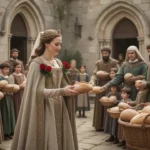
Margaret’s reputation for charity was central to her image as a saint. Accounts describe her distributing food, clothing, and money, as well as arranging meals for poor people. She is also said to have washed the feet of people in need during Advent and Lent, following a Christian tradition of humility and service.
Royal charity had a public and political dimension in the Middle Ages. A queen was expected to care for widows, orphans, pilgrims, prisoners, and other vulnerable people connected to the royal household. Margaret’s charitable work was personal as well as institutional, and later generations remembered her as someone who treated the poor with dignity rather than as an abstract obligation.
She welcomed people seeking assistance at the royal court.
She arranged food and alms for those who lacked basic necessities.
She supported religious communities that prayed for the royal family.
She used royal resources to care for travelers and the sick.
She treated service to the poor as part of her religious life, not merely as public display.
She helped develop Dunfermline as a religious center
Margaret and Malcolm supported the church at Dunfermline, where a community of monks was established or strengthened. The site later became closely associated with the Scottish monarchy and with Margaret’s burial. Dunfermline Abbey developed over time, especially under later rulers, but Margaret’s patronage helped establish its royal and spiritual importance.
The queen also supported the restoration or construction of churches. The most famous example is St Margaret’s Chapel at Edinburgh Castle, traditionally associated with her memory. The surviving chapel is much smaller and later in appearance than the royal buildings around it, and scholars debate aspects of its dating. It remains an important place connected with Margaret’s name and devotion.
A step-by-step way to understand Margaret’s life
Margaret’s story becomes clearer when followed through its major stages. Each stage shows a different part of her identity: exiled princess, queen, mother, reformer, and saint.
She was born into a displaced English royal family. Her ancestry connected her to the old Anglo-Saxon monarchy, but political events kept her family away from the throne.
She experienced the consequences of the Norman Conquest. The change of dynasty in England turned her family’s royal claim into a source of danger and uncertainty.
She arrived at the Scottish court. Scotland offered protection and a new political setting in which her family could regain influence.
She married Malcolm III. The marriage joined the Scottish king to the old English royal line and gave Margaret a formal position from which to act.
She shaped court religion and charity. Her daily practices, patronage, and care for the poor made her a prominent religious figure during her lifetime.
She raised a powerful royal family. Her children later ruled Scotland or married into the English royal house.
She died shortly after Malcolm. The deaths of Margaret and Malcolm in 1093 created a succession crisis but also strengthened the queen’s later reputation for holiness.
She was remembered and canonized. Her daughter’s support for a written life and later ecclesiastical recognition helped establish Margaret as Scotland’s patron saint.
Margaret and Malcolm III’s marriage
Modern readers sometimes ask whether Margaret and Malcolm’s marriage was mainly political or genuinely affectionate. Medieval royal marriages almost always carried political purposes, and this one clearly connected Malcolm to the former English royal dynasty. However, the sources also portray the couple as devoted to each other.
Turgot’s biography presents Malcolm as deeply respectful of Margaret’s character and religious life. It may exaggerate the harmony between them, as saintly biographies often portray a holy person’s household as unusually virtuous. Still, the couple’s long marriage, their children, and their shared patronage indicate a significant partnership.
Margaret could not simply rule independently in the same way as a reigning monarch, but queenship gave her access to resources and decision-making. She could influence appointments, patronage, household policy, and relations with religious institutions. Her authority operated through personal relationships and royal custom rather than through a modern administrative office.
What happened to Margaret in 1093
Malcolm III died in November 1093 during a campaign against William II of England. Their eldest son, Edward, died in the same conflict. Margaret was at Edinburgh Castle, seriously ill, when news of their deaths reached her.
She died on November 16, 1093. Later accounts describe her as accepting the news with profound faith, but these scenes belong partly to the devotional style of her biography. The historical facts are clearer: her death followed closely after Malcolm’s, and the royal family immediately faced a struggle over the succession.
Margaret and Malcolm were buried at Dunfermline. Their tomb became a focus of devotion, and the church associated with them developed into one of the most important royal religious sites in Scotland. Political conflict later affected access to the burial place, and the history of their remains became complicated.
Margaret’s reputation for sanctity grew from several elements that medieval Christians valued: disciplined prayer, generosity, support for churches, concern for the poor, and a death interpreted through faith. Her royal status made her memory especially significant because she represented an ideal of Christian queenship.
Her daughter Matilda, queen of England, asked Turgot, a cleric who had known Margaret, to write an account of her life. That work, often called Vita sanctae Margaritae, is the principal narrative source for Margaret’s character and activities. It was written for a devotional purpose, so it should not be treated like a modern biography, but it preserves valuable details about the queen and her court.
Margaret was canonized in 1250 by Pope Innocent IV. The canonization came more than a century and a half after her death, during a period when her cult had already become established. She is now honored as a patron saint of Scotland and is particularly associated with queens, widows, large families, charitable work, and Christian education.
Historical caution: Most detailed stories about Margaret come from a saint’s life written after her death. The account is valuable, but its praise of Margaret and its presentation of miracles or private conversations should be distinguished from facts independently confirmed by other records.
Margaret’s relationship with the Scottish church
Margaret is sometimes described as the person who “Romanized” the Scottish Church. That wording is too simple. Christianity in Scotland had developed through several regional traditions, and religious change involved local clergy, monasteries, bishops, rulers, and connections with England and Europe.
Margaret’s role was significant because she brought prestige and royal support to certain practices. She encouraged clergy to discuss matters of worship and discipline, and she favored customs that aligned the Scottish court with the broader Latin Christian world. Her position allowed debates that might otherwise have remained local to receive royal attention.
Her influence should not be confused with the creation of a fully centralized Scottish church. That institutional development took place over generations. Margaret helped create conditions for change, while later rulers—especially her sons Edgar, Alexander I, and David I—continued to support monasteries, bishoprics, and religious foundations.
Margaret’s children and her long-term political influence
Margaret’s descendants shaped Scotland and England for centuries. Her daughter Matilda married Henry I of England and became an admired queen. Through Matilda, Margaret became an ancestor of later English rulers. Her sons also carried her family line into the Scottish succession.
David I is especially associated with the transformation of medieval Scotland. During his reign, monasteries were founded or refounded, towns developed, royal administration expanded, and stronger links formed with Anglo-Norman institutions. David’s policies had many causes, but his mother’s religious and cultural influence formed part of the family background from which he ruled.
Margaret’s legacy therefore includes more than personal devotion. She helped create a royal family that connected Scotland with England and continental Europe. Her children’s marriages and reigns made her memory relevant to political history as well as religious history.
Places connected with Margaret of Scotland
Several places preserve the memory of Margaret, although not every building associated with her survives from her lifetime.
Edinburgh Castle: St Margaret’s Chapel is traditionally dedicated to her and is widely regarded as the oldest surviving building within the castle complex, though its exact date and construction history are subjects of scholarly discussion.
Dunfermline: The abbey and royal burial site are closely connected with Margaret and Malcolm. Dunfermline later became an important center of Scottish royal memory.
North Queensferry and South Queensferry: These place names are traditionally linked with Margaret’s charitable provision for pilgrims crossing the Forth. The historical details behind the tradition developed over time.
Queen Margaret’s Chapel at Edinburgh: Local devotion has preserved her name in religious buildings and institutions beyond the places directly connected with her court.
Visitors should distinguish between a site’s direct medieval history and later traditions. A chapel may preserve a dedication or cult even when its present structure was rebuilt centuries afterward. That does not make the connection meaningless; it shows how Margaret’s memory continued to shape Scottish religious and cultural life.
Margaret of Scotland’s feast days and symbols
Margaret’s feast is commonly observed on June 10 in the Roman Catholic calendar, while Scotland also traditionally honors her on November 16, the anniversary of her death. Calendar practices can vary among churches and regions.
Art often depicts Margaret as a crowned queen holding a book, a cross, or a model of a church. These symbols reflect the main themes of her reputation: royal authority, Christian learning, prayer, and church patronage. She may also appear with a dove or other religious imagery, depending on the artistic tradition.
Her association with books is especially meaningful. Margaret’s literacy and interest in religious texts helped connect the Scottish court with a wider culture of manuscript learning. The surviving stories about her books also portray learning as a form of devotion and responsible leadership.
How historians assess Margaret’s legacy
Margaret is remembered through two overlapping lenses. The first is historical: she was a royal refugee, queen, mother, patron, and participant in changes affecting Scotland’s church and monarchy. The second is devotional: she was a holy woman whose prayer and charity were presented as models for Christian life.
Neither lens needs to erase the other. A critical reading of her sources can recognize literary shaping while still taking seriously the evidence for her influence. Royal women in the Middle Ages often left fewer administrative records than kings, so household accounts, religious biographies, dedications, and later traditions become important clues.
Her legacy also raises questions about cultural change. Margaret’s support for practices associated with England and Rome contributed to closer integration with wider European Christianity, but it could also be viewed as part of a process that reduced the prominence of older local traditions. The period should not be described as a simple replacement of one church by another.
Margaret’s enduring reputation rests on the combination of political importance, religious commitment, and practical charity. She was not merely a saint added to Scottish history after the fact. During her lifetime, she occupied a powerful position at a crucial moment, and later generations used her memory to define ideals of queenship, family, and national identity.
What Margaret of Scotland means today
For many people, Margaret represents a form of leadership grounded in service. Her story joins public responsibility with private discipline: she managed a royal household, influenced church policy, raised children who changed dynastic history, and maintained a reputation for personal care of the poor.
Her example also shows why medieval figures need careful interpretation. The Margaret described by Turgot is a saintly model shaped by the expectations of his audience. The Margaret reconstructed by historians is a queen whose decisions took place within systems of dynastic politics, religious authority, gendered power, and international conflict.
Both perspectives help explain why she remains important. Margaret of Scotland is remembered not only because she was Malcolm III’s queen, but because her actions and reputation influenced the monarchy, the church, charitable traditions, and the historical identity of Scotland.
Frequently asked questions
Was Margaret of Scotland born in Scotland?
No. Margaret was probably born around 1045 in Hungary while her family was living in exile. She came from the old English royal house and reached Scotland after the Norman Conquest disrupted her family’s position in England. She later married Malcolm III and became queen of Scotland around 1070.
How many children did Margaret of Scotland have?
Margaret and Malcolm III had at least eight children, according to the usual historical accounts. Their sons included Edgar, Alexander I, and David I, who all became Scottish kings. Their daughter Edith, also known as Matilda, became queen of England through her marriage to Henry I.
Where is Saint Margaret of Scotland buried?
Margaret was buried at Dunfermline with Malcolm III. Their burial site became an important focus of royal and religious devotion. The later history of their remains is complicated, and claims about their relocation or preservation are not equally certain, so Dunfermline remains the principal place associated with their tombs.
What is Saint Margaret of Scotland the patron saint of?
Margaret is recognized as a patron saint of Scotland. She is also associated with queens, widows, large families, charitable work, and Christian education. These connections reflect the main features of her reputation: royal leadership, devotion, care for the poor, support for religious institutions, and her role as a mother of influential rulers.












Leave a Reply