Saint Casimir: Life, feast day, patronage, and prayers
Saint Casimir: Life, feast day, patronage, and prayers
Are you looking for the meaning behind a Saint Casimir medal, parish, school, or feast-day celebration? Saint Casimir was a fifteenth-century prince of Poland and Lithuania who chose prayer, service, and moral discipline over luxury and political ambition. He died at a young age, but his reputation for compassion and holiness made him one of the best-known saints connected with Lithuania.
His feast day is March 4. Catholics especially remember him as the patron saint of Lithuania, as well as a patron of young people and students. His story is not mainly about royal status. It is about how he used privilege responsibly, resisted pressure to abandon his conscience, and treated poor and vulnerable people with unusual care.
Saint Casimir was born in 1458 into the Jagiellonian royal family. His father, Casimir IV, was king of Poland and grand duke of Lithuania. His mother, Elizabeth of Austria, belonged to the Habsburg family. Casimir grew up at the royal court alongside several brothers, receiving the education expected of a European prince.
His teachers included the Polish historian and churchman Jan Długosz, who helped shape the young prince’s religious and intellectual formation. Casimir studied languages, history, Christian teaching, and the responsibilities of government. Although court life offered comfort and influence, accounts of his life describe him as increasingly serious about prayer, self-control, and service to others.
Casimir was not the reigning king of Poland. He was a royal son who was drawn into public affairs because of his family’s position. His father expected him to help with political and military matters, and Casimir sometimes served as a representative of the monarchy. These responsibilities gave him a practical understanding of power, diplomacy, and the suffering that political conflict could cause.
He became known for a temperament that contrasted with the excesses often associated with court life. Prayer, chastity, simplicity, and charity were central to the way people remembered him. His holiness was expressed through ordinary duties as well as private devotion: listening carefully, acting fairly, and refusing to treat status as permission to ignore moral limits.
Saint Casimir’s life in five important points
He was born into royalty. His family placed him near the center of political power in Central and Eastern Europe.
He received a demanding education. His teachers prepared him for leadership while also encouraging religious discipline and learning.
He served in public affairs. His father sent him on political assignments, including responsibilities connected with the Polish crown.
He resisted pressure that conflicted with his conscience. He did not treat political advantage as more important than moral responsibility.
He died young but left a lasting reputation. His devotion, charity, and connection with Lithuania shaped the way later generations honored him.
This pattern helps explain why Saint Casimir remains meaningful. He was not removed from the complicated responsibilities of public life. Instead, he tried to live faithfully while surrounded by wealth, family expectations, political competition, and the possibility of personal advancement.
Central idea: Saint Casimir’s example is often summarized as faithful service without surrendering conscience. His royal position gave him influence, but his character determined how he used it.
How Saint Casimir served as a prince
During his father’s reign, Casimir took part in the work of government. In the 1470s, he was sent to Hungary in connection with a political effort involving the Hungarian crown. The campaign did not succeed, and Casimir returned to Poland. The experience appears to have strengthened his reluctance to pursue power simply for its own sake.
Later, he served as his father’s representative in Poland while the king was occupied with affairs in Lithuania. This was a significant responsibility for someone so young. Casimir dealt with administrative matters and gained a reputation for justice and moderation. Stories about this period emphasize his concern for people who had little influence at court.
His public service also reveals an important part of his spirituality. He did not separate religious devotion from responsibility toward society. For Casimir, prayer was not an escape from duties. It shaped the way he approached authority, money, conflict, and the needs of ordinary people.
Some traditional accounts describe him as defending the poor and opposing unfair treatment. The details in devotional biographies may vary, but the lasting picture is consistent: he was remembered as a ruler’s son who did not become absorbed in privilege. His position made it possible for him to help others, and he regarded that opportunity as an obligation rather than a personal entitlement.
Why Casimir refused a political marriage
One of the best-known stories about Saint Casimir concerns a proposed marriage to a daughter of Matthias Corvinus, the king of Hungary. Casimir is traditionally said to have rejected the arrangement because he had chosen a celibate life dedicated to God. The story is often presented as an example of his commitment to chastity and independence from dynastic expectations.
Royal marriages in medieval Europe commonly served political purposes. They could form alliances, settle disputes, or strengthen claims to territory. A prince who refused such a match was not making a private decision alone; he was resisting a plan that could affect his family and his country.
Casimir’s decision does not mean that marriage or political responsibility is unimportant in Christian teaching. Its significance lies in the particular vocation he believed he had received. He understood his life as a call to celibacy, prayer, and service, and he did not allow family pressure or political opportunity to erase that conviction.
For modern readers, this part of his story can be considered through the broader question of integrity. A person may face expectations from relatives, employers, social groups, or institutions. Saint Casimir’s example asks whether success is worth accepting when it requires you to abandon a deeply held moral commitment.
Saint Casimir’s prayer and devotion
Accounts of Casimir describe a young man with a strong devotion to the Eucharist, the Virgin Mary, and regular prayer. He was also associated with acts of penance and a disciplined lifestyle. Because medieval sources and later devotional traditions do not always provide the same level of detail, it is best to treat individual stories with care rather than assuming every popular detail has equal historical certainty.
His Marian devotion is especially connected with the Latin hymn Omni die dic Mariae, commonly translated as “Every day, my soul, praise Mary.” The hymn is associated with Saint Casimir in Catholic tradition, although its authorship predates him. It expresses a desire to praise Mary continually and to seek her help in following Christ.
Casimir’s prayer life was not presented as a performance for public admiration. It supported the qualities people noticed in his daily conduct: patience, self-restraint, mercy, and concern for those who were overlooked. His example suggests that private prayer becomes credible when it changes the way a person uses time, authority, and resources.
Prayer: He was remembered for a regular and serious relationship with God.
Devotion to Mary: Marian prayer was a visible part of his spiritual identity.
Self-discipline: He practiced restraint rather than allowing comfort to control him.
Charity: He showed concern for people who lacked wealth or political influence.
Integrity: He tried to keep his public choices consistent with his beliefs.
What happened to Saint Casimir
Casimir’s health declined during his early twenties. He had a prolonged illness and died in 1484 at Hrodna, also called Grodno, in present-day Belarus. He was approximately 25 years old. His body was taken to Vilnius, where he was buried in the cathedral.
His early death contributed to the growth of devotion to him, but it was not the only reason people honored him. Those who knew of his life remembered a combination of royal responsibility and personal simplicity. He had not lived long enough to become a major political ruler, yet his reputation as a holy prince continued to grow after his death.
The city of Vilnius became particularly important to his devotion. His tomb there attracted pilgrims, and the cathedral became a major center for honoring him. Saint Casimir eventually became deeply associated with the religious and cultural identity of Lithuania.
He was formally recognized as a saint in the early sixteenth century. The exact details of the early canonization process are described differently in some sources, but his public veneration was firmly established, and later Church approval strengthened his place in the calendar of saints.
Why Saint Casimir is the patron saint of Lithuania
Saint Casimir is widely regarded as the principal patron of Lithuania and is also associated with Poland. His connection with Lithuania comes from his family’s rule, his burial in Vilnius, and the strong devotion that developed there. Over time, he became a symbol of Christian faith linked with the country’s history and national identity.
His patronage does not mean that he was a Lithuanian by modern national definitions. He belonged to a medieval royal dynasty whose political world included Poland, Lithuania, and other parts of Central and Eastern Europe. The modern borders and national categories familiar today did not exist in the same form during his lifetime.
What endured was the way Lithuanian Catholics claimed him as a spiritual protector. He represented a form of leadership that valued faith, justice, and service. In periods when Lithuania faced political and religious challenges, devotion to Saint Casimir offered people a connection to a respected local patron.
He is also honored in Poland, and churches, schools, organizations, and communities bearing his name can be found in many countries. Lithuanian immigrants helped spread his devotion abroad, particularly in communities where a parish or chapel served as a center of cultural and religious life.
When is Saint Casimir’s feast day?
Saint Casimir’s feast day is March 4. The date marks the anniversary of his death and is observed with Masses, prayers, processions, cultural events, and community gatherings. The celebration is especially significant in Lithuania and among Lithuanian Catholic communities in other countries.
Feast-day customs vary by parish and region. A church may display an image or relic associated with Casimir, organize a special liturgy, or invite young people to participate in readings and service projects. Some celebrations combine worship with Lithuanian music, food, art, and traditional crafts.
If you want to observe the feast day privately, you can keep the practice simple:
Read a reliable account of Saint Casimir’s life.
Attend Mass or spend a few quiet minutes in prayer.
Ask for his intercession for young people, students, families, and public servants.
Make a concrete act of charity for someone who needs practical help.
Consider where social pressure is making it difficult for you to act according to your values.
The purpose of a feast day is not only to remember a historical figure. It is also to ask how that person’s virtues can become visible in your own circumstances. Saint Casimir’s feast can therefore be observed through worship, education, and a deliberate act of service.
What Saint Casimir represents for young people
Saint Casimir is often presented as a patron of young people and students because he pursued holiness while still young and while facing expectations normally placed on an adult leader. His life can encourage students who are trying to form convictions, make responsible choices, and manage pressure from family, peers, or institutions.
He is not a symbol of perfection achieved without struggle. He belonged to a powerful family and had access to opportunities that most people did not. That difference should be acknowledged. His example is useful not because every young person shares his social position, but because the question of how to use opportunity responsibly applies across circumstances.
For students, his example can be connected with several practical habits:
Set aside regular time for prayer or reflection before important decisions.
Ask who may be affected by a choice, especially people with less power.
Resist the idea that popularity equals truth or that achievement justifies dishonesty.
Seek wise guidance from parents, teachers, clergy, or trusted mentors.
Use education in service of others rather than treating knowledge only as a path to status.
Parents and educators may invoke Saint Casimir when discussing leadership, peer pressure, vocation, and ethical decision-making. His story makes clear that youth is not a waiting room before meaningful responsibility begins. Young people can practice courage, generosity, and honesty now.
Saint Casimir’s symbols and images
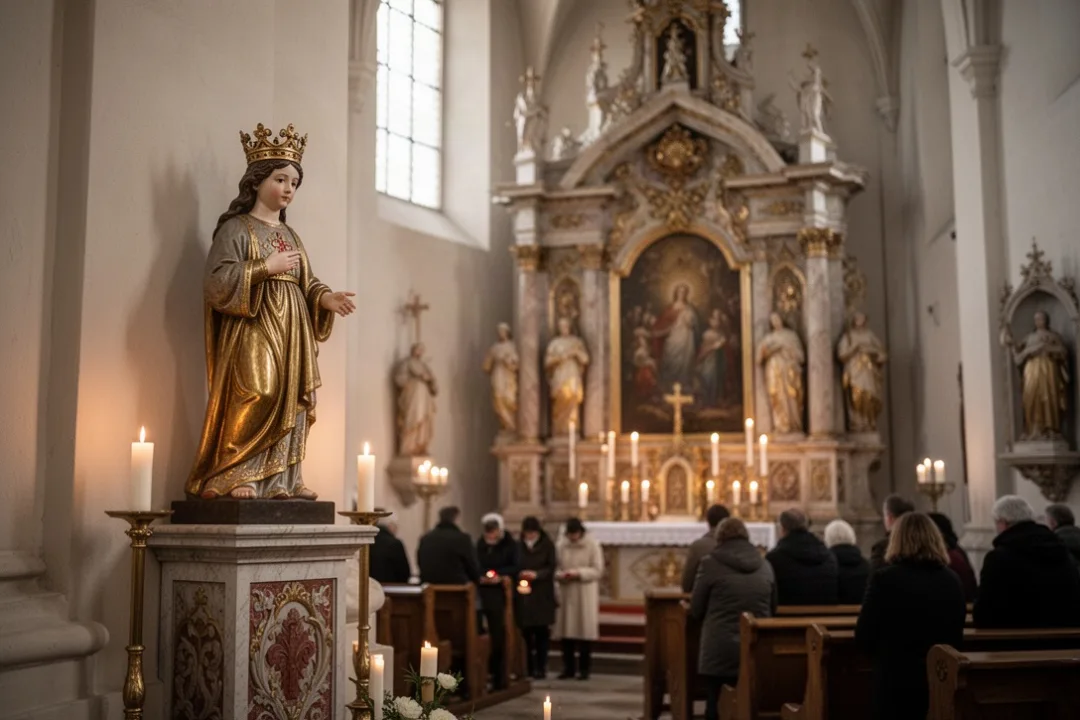
In religious art, Saint Casimir is commonly shown as a young man in royal clothing, sometimes wearing a crown or holding a lily. The crown recalls his birth and rank, while the lily traditionally represents purity and chastity. He may also be shown holding a cross, a rosary, or a devotional image connected with his Marian devotion.
Artists may portray him with the hymn associated with his prayer life or with symbols connected to Lithuania. The exact design varies by church and historical period. Some images emphasize his royal identity; others focus on his youthful appearance and religious dedication.
When you see a statue or holy card of Saint Casimir, the symbols are meant to communicate more than biography. They point to the relationship between privilege and responsibility. The crown says that he belonged to a royal family, while the lily and cross suggest that he sought to place his life under a higher moral and spiritual purpose.
How to pray with Saint Casimir’s example
Catholics may ask Saint Casimir to pray for them, especially when they need help remaining faithful under pressure. A prayer does not need to use elaborate language. You can name the situation directly and ask for the grace to act with wisdom, courage, purity of intention, and compassion.
A simple prayer might follow this pattern:
Saint Casimir, faithful servant of God, pray for young people, families, and all who carry public responsibilities. Help us choose integrity over approval, service over selfish ambition, and compassion over indifference.
You can adapt the prayer for a specific need. A student might ask for honesty and perseverance during exams. A parent might ask for patience and wisdom. A public official might ask for the courage to protect vulnerable people rather than seeking personal advantage.
Practical prayer prompt: Ask, “Where am I being pressured to value status more than character?” Then name one action that would bring your choices closer to your conscience and your faith.
Prayer through a saint’s intercession is not a substitute for responsible action. If you are facing injustice, illness, financial hardship, or a serious moral decision, prayer can accompany practical steps such as seeking qualified advice, contacting appropriate support, or making amends where necessary.
What Saint Casimir can teach about leadership
Casimir’s story offers a distinctive picture of leadership. He had rank without treating rank as proof of personal worth. He had access to power but was remembered for restraint. He also understood that public decisions affect real people, including those who cannot easily defend themselves.
His example can be applied to leadership in a family, classroom, workplace, church, nonprofit organization, or government. A leader does not need to hold a formal title to shape the conditions around other people. The same basic questions remain relevant: Is authority being used for service? Are the vulnerable being heard? Are difficult decisions being made honestly?
Saint Casimir also challenges the assumption that ambition is always virtuous. Ambition can help a person work hard and pursue worthwhile goals, but it becomes dangerous when success requires betrayal of conscience. His life encourages a more careful standard: seek excellence, but do not make status the measure of a good life.
Ways to honor Saint Casimir today
You can honor Saint Casimir through religious observance, cultural participation, or a quiet act of service. A Lithuanian or Polish parish may have a special March 4 celebration, while a school or youth group may choose to study his life and discuss ethical leadership.
Attend a feast-day Mass or visit a church dedicated to Saint Casimir.
Learn about Lithuanian Catholic traditions connected with his feast.
Pray for students, young people, and those responsible for public decisions.
Support a food pantry, shelter, scholarship fund, or local service organization.
Display an image of Saint Casimir as a reminder to use opportunities responsibly.
Talk with children or students about choosing integrity when others apply pressure.
A meaningful observance does not depend on owning a medal or visiting a particular shrine. The strongest way to honor him is to practice the virtues associated with his memory: faithfulness, compassion, self-control, and responsible service. Those virtues can be lived in ordinary choices, including how you speak to others, spend money, use authority, and respond to someone in need.
Why Saint Casimir remains relevant
Saint Casimir lived in a royal world very different from modern life, yet the pressures he faced are recognizable. People still struggle with expectations from family, the desire for approval, the temptation to value status above character, and the responsibility that comes with education or influence.
His life also speaks to anyone who feels young, inexperienced, or overlooked. He was not remembered because he held a long career or accumulated wealth. He became a lasting example through the consistency between his beliefs and his conduct.
That consistency is the heart of his legacy. Saint Casimir shows how a person can receive privilege without becoming entitled, accept responsibility without worshiping power, and practice devotion without separating it from concern for other people. His feast day on March 4 invites believers to make those ideals concrete in the choices of ordinary life.
Frequently asked questions
Was Saint Casimir a king?
No. Saint Casimir was a prince and the son of Casimir IV, king of Poland and grand duke of Lithuania. He took part in government and represented his father in public affairs, but he never became the reigning king. His reputation rests more on his religious devotion, charity, and integrity than on holding the crown himself.
Where is Saint Casimir buried?
Saint Casimir is buried in Vilnius Cathedral in Lithuania. His connection with Vilnius became central to his devotion, and the cathedral has long been an important place for people honoring him. His tomb helped establish Vilnius as a significant pilgrimage destination associated with the saint.
What do people pray to Saint Casimir for?
People commonly ask Saint Casimir’s intercession for young people, students, families, public servants, and anyone facing pressure to compromise personal convictions. He may also be remembered when praying for Lithuania, Polish and Lithuanian Catholic communities, and those trying to use education or authority in service of others.
Why is Saint Casimir shown with a lily?
The lily traditionally symbolizes purity and chastity, virtues associated with Saint Casimir’s decision to live a celibate life dedicated to God. Other common symbols include royal clothing, a crown, a cross, or a rosary. These images connect his royal background with his spiritual discipline and devotion.














Leave a Reply